Why Do Wet Clothes Look Darker Than Dry Clothes?
Wet clothes look darker because water changes how light moves through the fabric. Color, weave, fiber type and water-repellent finishes can all affect how noticeable a wet patch becomes.

A splash of water can turn a light gray T-shirt charcoal, deepen blue denim, or create a dark patch on fabric within seconds. Yet the water itself is clear, and once the clothing dries, the original color returns.
The fabric has not actually changed color. Wet clothes usually look darker because water changes the way light travels through and reflects from the fabric, allowing less light to return to your eyes.
The effect is a small everyday demonstration of optics happening between thousands of fibers, tiny pockets of air and a thin layer of water.
Dry Fabric Is Full of Tiny Air Pockets
A piece of clothing may look like a continuous surface from a distance, but at microscopic scale it is a complicated network of fibers.
Between those fibers are countless tiny spaces filled with air.
When light reaches dry fabric, it encounters repeated boundaries between air and the material of the fibers. At each boundary, some light is reflected, refracted or scattered in a new direction.
Because the surface is rough and full of these microscopic interfaces, a significant amount of light eventually scatters back toward the observer.
That reflected light contributes to how bright the fabric appears.
This is especially easy to understand with white fabric. Individual fibers do not have to behave like tiny pieces of white paint. Multiple reflections and scattering among the fibers help a collection of them appear bright and opaque.
A similar principle explains why snow looks white even though ordinary ice is comparatively transparent: microscopic structure gives light many opportunities to scatter.
Water Replaces the Air Between the Fibers
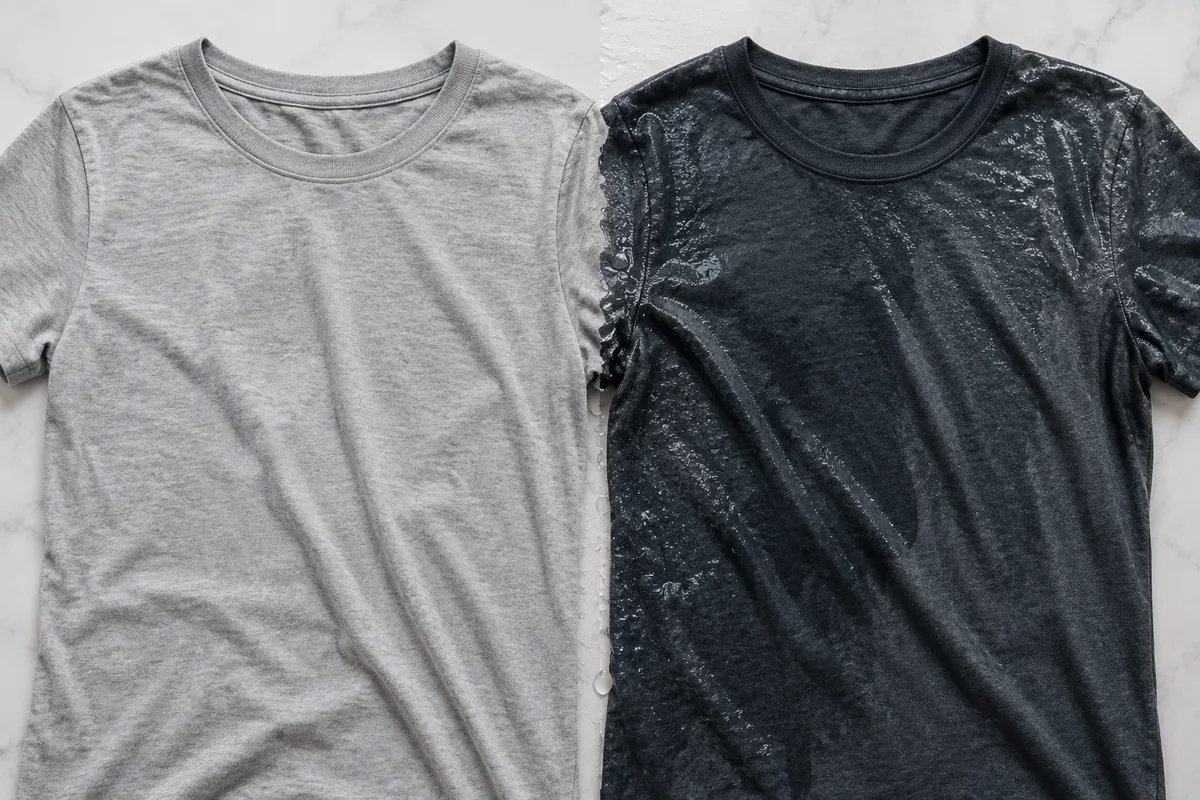
Getting the fabric wet changes that microscopic environment.
Water penetrates the weave and fills many spaces that previously contained air.
Water can also change how textile fibers behave physically, not just how they interact with light. Our guide to why clothes can shrink even in cold water explains how moisture, fiber swelling and fabric tension can change a garment’s dimensions.
That matters because light behaves differently when passing from water into a textile fiber than when passing from air into the same fiber. Water’s optical properties are closer to those of many solid materials than air’s are.
The contrast at all those microscopic boundaries is therefore reduced.
Instead of being scattered back outward as efficiently, more light can travel deeper into the wet material.
Once it goes deeper, it has more opportunities to be absorbed by the fibers and dyes rather than escaping back toward your eyes.
Less returning light means the wet area looks darker.
Optical research into wet surfaces has shown that reduced diffuse reflection, changes in refractive-index contrast and internal reflection within the water-covered material can all contribute to this darkening effect.
The Color Hasn’t Actually Become Darker
This distinction is easy to miss.
Water usually does not chemically transform a blue shirt into a darker shade of blue. Instead, it temporarily changes the optical path taken by light.
Imagine two identical blue sections of fabric.
The dry section scatters a mixture of light back toward you from numerous microscopic surfaces. Some of that scattered light makes the color appear lighter.
In the wet section, less of this diffusely reflected light escapes. More light reaches the dye and can be absorbed before returning.
Your eyes therefore receive less light from the wet area, so your brain interprets it as a deeper, darker blue.
Once the water evaporates, air returns to the spaces between the fibers. The original scattering pattern is restored, and the garment appears to regain its normal color.
Nothing needed to be “recolored.”
Wet Fabric Can Also Look More Saturated
Darkness is only part of the effect.
A wet colored fabric can sometimes appear richer or more saturated, almost as though someone turned up the color intensity.
Consider a dry blue shirt. Some of the light reflected from the many fiber surfaces is relatively neutral scattered light. That can visually dilute the blue produced by the dye.
When water reduces this scattering, the contribution from the dyed material becomes more visually dominant.
The result can be a blue that looks deeper and more intense.
This is why wet clothing often looks both darker and more colorful rather than simply appearing as the same color with the brightness turned down.
A Thin Water Layer Changes the Way Light Escapes
There is another piece of the puzzle.
Light that enters wet fabric must eventually travel back through water and into air if it is going to reach your eyes.
Not all of it succeeds.
At certain angles, light traveling inside a higher-refractive-index material can be reflected back rather than passing through the boundary. This phenomenon is known as total internal reflection.
A classic study by physicists John Lekner and Michael Dorf examined why rough absorbing materials become darker when wet. Their analysis found that the water layer can increase the chances that light is redirected back toward the surface, where it has another opportunity to be absorbed.
So wet fabric does not simply absorb water.
The water alters the journey taken by light.
Why Can Wet Clothes Sometimes Look Shiny?
If water makes clothing darker, why can a wet surface also produce bright reflections?
Because darkness and shininess are not opposites in optics.
Dry fabric has a rough surface that scatters light in many directions. This is called diffuse reflection.
Water can partially smooth the optical surface. Instead of spreading reflected light evenly in many directions, some light becomes concentrated into particular angles, producing a glossy or shiny highlight.
If you happen to view that reflection from the right angle, part of the wet material can look extremely bright.
Move away from that angle and the same surface may look noticeably darker because less diffuse light is reaching you.
That is why a wet black jacket can appear darker overall while simultaneously showing brilliant reflections from a lamp or the Sun.
The same broader idea—different materials changing the way light reaches your eyes—also explains why metal can feel colder than wood even when both are at the same temperature, although that effect involves heat transfer rather than optics.
Why Do Wet Patches Show More on Some Colors and Fabrics?
The amount of visible darkening depends on the material.
Wet patches are often easiest to notice on mid-tone and moderately light fabrics because the contrast between the wet and dry areas is stronger. Very dark fabrics can still become darker when wet, but the difference may be less visually dramatic because they already reflect relatively little light.
A pale cotton shirt may show a dramatic wet patch because its fibrous structure produces substantial scattering when dry. Wetting it strongly changes those air-filled spaces.
Dense, smooth or already-dark materials may show a smaller difference.
Color matters as well.
A medium-gray or colored fabric often makes the contrast particularly obvious because the eye can easily compare wet and dry sections next to each other.
Very dark fabric already reflects relatively little light, so there may be less apparent brightness available to lose.
The weave, thickness, fiber type, dye and amount of water can all affect what you see.
So do darker coats show water marks more clearly than mid-tone ones? Not necessarily. A very dark fabric already reflects little light, so further darkening may actually create less visual contrast. Mid-tone fabrics can sometimes make the boundary between wet and dry areas easier to see. In practice, fabric structure and water repellency can matter just as much as color.
Does Fabric Type Change How Noticeable a Wet Patch Looks?
Yes—but there is no simple rule that one fiber always looks darker than another.
What matters is how the fabric interacts with water and light. Fiber chemistry affects how easily moisture enters the material, while yarn structure, weave, surface texture and finishing treatments influence how far the water spreads and how the wet area reflects light.
Cotton is highly absorbent, so water can move into both the spaces between yarns and the fibers themselves. This can create a broad, clearly defined wet area on some cotton garments.
Polyester behaves differently because the fiber itself absorbs much less water than cotton. However, water can still spread between yarns and remain on the surface, so polyester can still develop visible dark patches.
A tightly woven fabric may also respond differently from a loose knit even when both are made from the same fiber. Textile research shows that liquid spreading and stain appearance can vary with fiber content, fabric structure and previous finishing or laundering.
That is why two jackets in exactly the same color may show rain very differently.
The difference is not simply “dark fabric versus light fabric.”
It is the result of several factors acting together:
- fiber type,
- weave or knit structure,
- surface roughness,
- thickness,
- dye and color,
- finishing treatments,
- and how easily water wets and spreads through the material.
In other words, the label that says “100% cotton” or “100% polyester” tells only part of the story.
White Clothes Reveal an Extra Effect
White fabric produces an interesting variation.
When water fills the air spaces between fibers, the material can become more transparent or translucent because there is less scattering inside it.
That means whatever lies underneath can influence the apparent color.
If a wet white shirt is against skin, the darker skin-and-shadow background may become more visible through the fabric. The wet patch then appears considerably darker.
But put the same wet white fabric in front of a bright light and something different can happen: more light may pass through the wet section, making it look brighter from the opposite side.
This is a useful reminder that wet fabric is not simply acquiring a “darkening filter.”
Its entire interaction with light has changed.
Why Does Rain Bead Up on Some Jackets but Soak Into Others?
Not every fabric allows water to enter in the same way.
Some jackets and outdoor fabrics are treated with water-repellent finishes designed to make droplets bead on the surface instead of spreading into the textile.
When a fabric resists wetting, less of its internal air-filled structure is replaced by water. The familiar dark wet patch may therefore be smaller, slower to appear or look different from the patch on an untreated absorbent fabric.
Textile laboratories actually measure this property. The American Association of Textile Chemists and Colorists uses standardized spray testing to evaluate how strongly a fabric resists surface wetting.
That also explains why water marks can change as a garment ages.
Repeated washing, abrasion and wear can alter the performance of some surface finishes. A jacket that once shed rain in neat droplets may eventually begin developing broader wet areas.
So when two coats of similar color react very differently in the rain, color may not be the main reason.
One may simply allow water to wet the textile much more easily than the other.
Why Doesn’t Water Make Everything Look Darker?
The effect is most noticeable on rough, porous or fibrous materials.
A glass window, polished metal surface or glossy plastic object does not contain the same network of air-filled microscopic spaces as a T-shirt.
Adding water therefore does not alter its internal light scattering in the same dramatic way.
Water on a smooth object may mostly produce reflections, droplets or glare instead.
This is why rain can make asphalt, concrete, wood and fabric look strikingly darker while having a much less dramatic effect on a shiny metal sign.
The structure of the material matters as much as the water.
The Same Physics Appears Beyond Clothing
Wet pavement turning dark after rain is closely related to the effect seen on a shirt.
So is darkened beach sand near the shoreline.
Concrete, stone, soil, paper and many other porous materials can show similar changes because water modifies how light scatters and escapes from their surfaces.
The exact optical behavior varies between materials, but the central idea remains remarkably consistent:
A wet surface often sends less diffusely reflected light back toward your eyes.
That is why a clear liquid can make something underneath it appear dramatically darker.
What Happens as the Clothes Dry?
Evaporation gradually reverses the process.
As water leaves the fabric, tiny spaces between the fibers refill with air. The stronger optical contrast between air and the fibers returns, increasing the amount of light scattered through the material.
More light escapes toward your eyes.
The dark wet patch slowly brightens until it becomes indistinguishable from the surrounding dry fabric.
Watch a damp shirt dry and you are effectively watching the microscopic optical structure of the material change in real time.
No dye is moving back into place.
No hidden pigment is disappearing.
The changing appearance comes mostly from light finding a different route through the fibers.
Drying changes more than the way fabric looks. It can also change the way some fibers feel, which helps explain why towels can go hard after washing.
Clear Water, Darker Clothes
The paradox disappears once you stop thinking of color as something produced only by pigment.
What we see depends on light reaching our eyes.
Dry fabric contains many fiber-air boundaries that scatter light back outward. Water fills those gaps, changes the refractive environment and allows more light to travel deeper into the material, where more of it can be absorbed or prevented from escaping toward us.
The wet spot therefore sends less light back to our eyes and usually looks darker.
Once the water evaporates, the microscopic air spaces return—and so does the familiar color of the dry fabric.
A spilled glass of water has not changed the shirt’s dye.
It has temporarily changed the physics of how you see it.








Join the discussion