Why Does Ice Float Instead of Sink?
Ice floats because frozen water is less dense than liquid water. The reason lies in the unusual crystal structure created when water molecules freeze.
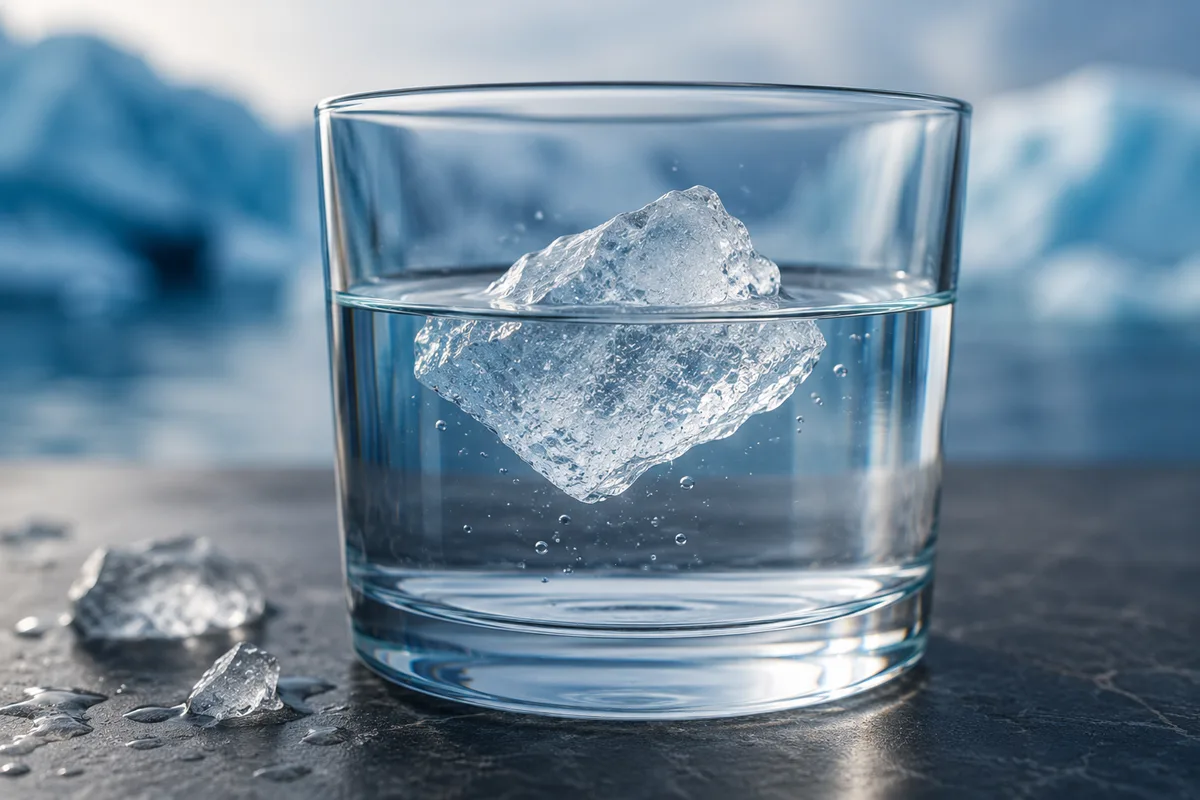
Drop an ice cube into a glass of water and it rises to the surface.
That seems completely normal because we see it all the time.
But scientifically, it is actually unusual.
For most substances, the solid form is denser than the liquid form. A solid should therefore tend to sink in its own liquid.
Water does the opposite.
Ice floats because frozen water is less dense than liquid water.
When water freezes, its molecules arrange themselves into a more open crystal structure. The same amount of water therefore occupies more space, lowering its density.
That unusual property is the reason ice cubes float, lakes freeze from the top down, and aquatic life can survive beneath winter ice.
Density Is the Key
Density describes how much mass is packed into a certain volume.
Two objects can be the same size but have different densities.
If an object is less dense than the liquid surrounding it, it tends to float.
If it is more dense, it tends to sink.
The U.S. Geological Survey notes that ordinary liquid water has a density close to 1 gram per milliliter, while ice is less dense. Water expands by roughly 9% when it freezes, which lowers the density of the solid form.
That is the basic reason an ice cube rises.
But Why Does Water Expand When It Freezes?
The answer comes from the structure of water molecules.
A water molecule contains:
- two hydrogen atoms,
- one oxygen atom.
Its chemical formula is H₂O.
Water molecules attract one another through interactions known as hydrogen bonds.
In liquid water, molecules are constantly moving. Hydrogen bonds continually form and break, allowing molecules to remain relatively close together.
As water cools enough to freeze, that changes.
The molecules become organized into a more regular crystalline structure.
This structure holds neighboring water molecules farther apart than they are, on average, in liquid water.
So when water becomes ice:
the mass stays essentially the same, but the volume increases.
More volume for the same mass means lower density.
NOAA describes this process as water molecules becoming locked into a crystalline structure during freezing, producing roughly a 9% expansion.
Water Behaves Differently From Most Substances
Most materials contract as they cool.
Their particles move less and pack more closely together.
When they freeze, the solid therefore tends to become denser than the liquid.
Water follows this pattern only up to a point.
Liquid water becomes denser as it cools down toward approximately 4°C (39°F).
Below that temperature, water begins behaving unusually.
Its molecular structure becomes increasingly open.
As freezing approaches, density decreases.
NOAA notes that water reaches maximum density around 4°C and then expands as it cools further toward freezing.
That reversal is one of water’s most important physical properties.
Why Doesn’t the Whole Ice Cube Sit Above the Water?
An ice cube floats, but most of it remains underwater.
Why?
Because ice is only slightly less dense than liquid water.
The cube sinks until it has displaced enough water for the upward buoyant force to balance its weight.
At that point it stops sinking.
The USGS explains that ice has roughly 90% of the density of liquid water.
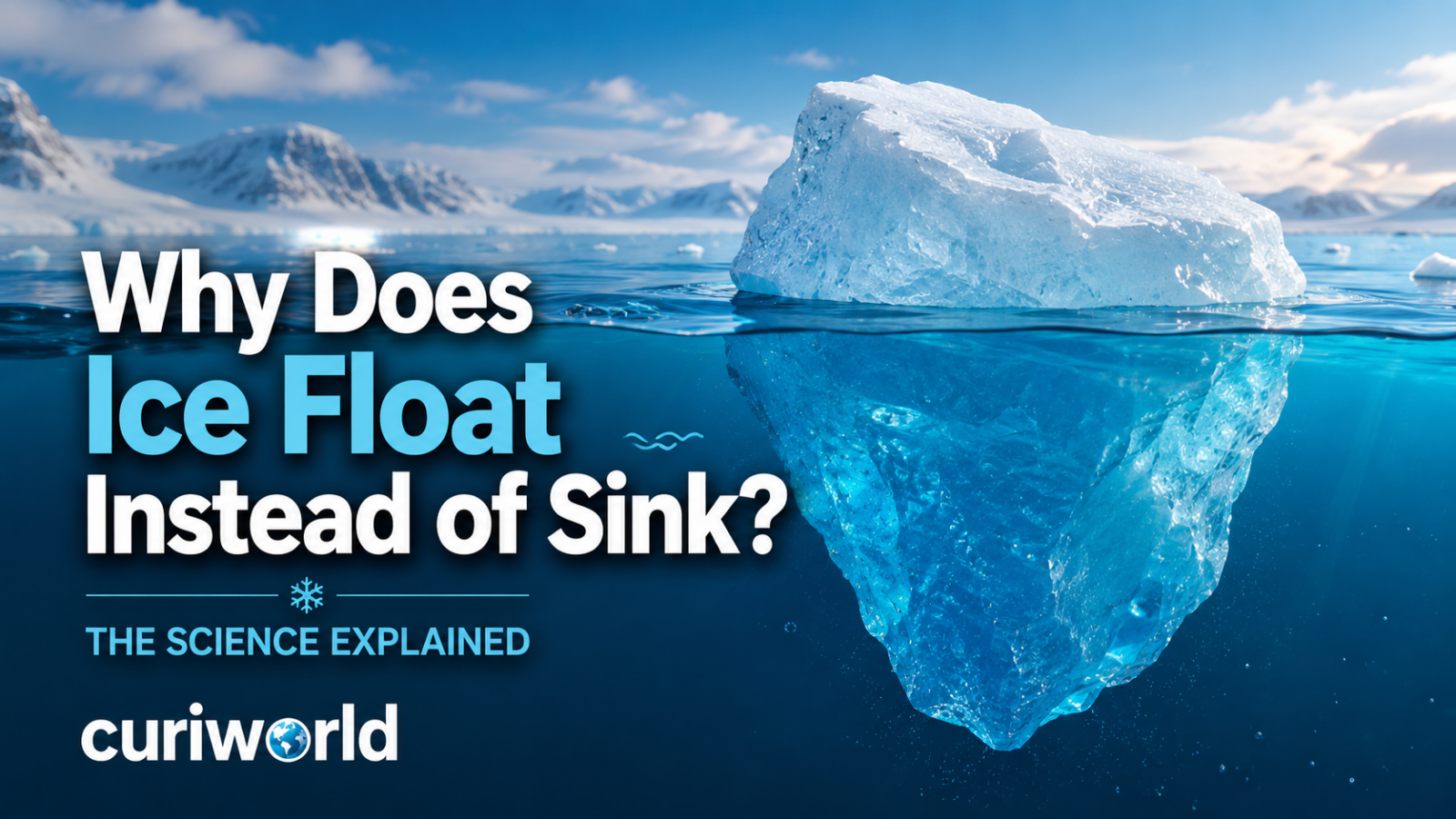
That is why only a relatively small part of an iceberg appears above the surface.
The majority remains hidden underwater.
The Same Physics Explains Icebergs
A giant iceberg and an ice cube follow the same rule.
Both float because their average density is lower than the density of the surrounding water.
Ocean water is actually denser than freshwater because it contains dissolved salts.
That makes floating even easier.
NOAA educational material gives typical values of about:
- 0.92 g/mL for ice
- 1.00 g/mL for freshwater
- approximately 1.03 g/mL for seawater
although real density varies with temperature and salinity.
This is why enormous icebergs can float despite weighing millions of tons.
Floating has nothing to do with being lightweight.
It is about density relative to the surrounding fluid.
Why Is This So Important for Lakes?
Imagine the opposite situation.
Suppose frozen water were denser than liquid water.
Ice would form at the surface.
Then it would sink.
More water would freeze.
That ice would sink too.
Over time, lakes in cold climates could freeze progressively from the bottom upward.
Instead, real ice floats.
When the surface of a lake freezes, the ice remains on top and forms an insulating layer.
Water below the ice can remain liquid.
NOAA highlights this unusual property of water as an important reason organisms can survive beneath frozen lakes and ponds.
So ice floating is not just an interesting kitchen experiment.
It profoundly affects ecosystems.
Why Does Water Expand Inside a Freezer?
You may have seen the same physics in less convenient situations.
Fill a rigid container completely with water and freeze it.
The container may deform or even crack.
Water pipes can burst in freezing weather for the same general reason.
As liquid water turns into ice, its volume increases.
The container has to make room for that expansion.
A floating ice cube and a burst frozen pipe are therefore different consequences of the same molecular structure.
Why Is Water Densest at About 4°C?
Water does not wait until it freezes to become unusual.
At relatively warm temperatures, cooling causes the molecules to move more slowly and pack closer together.
Density rises.
But once water cools below about 4°C, hydrogen-bond-driven structure becomes increasingly important.
The molecules begin arranging themselves in ways that require more space.
Density starts falling.
That means a lake during winter behaves in a fascinating way.
Water near 4°C tends to sink because it is relatively dense.
Colder water remains closer to the surface.
Eventually the upper layer reaches freezing temperature and turns to ice.
The ice then floats.
This creates a stable winter structure:
ice on top, cold liquid water underneath.
Does Salt Change Whether Ice Floats?
Salt changes the density and freezing behavior of water.
Seawater is denser than freshwater because dissolved salts add mass.
Salt also lowers water’s freezing point.
That is why seawater generally freezes below 0°C.
When sea ice forms, much of the salt is excluded from the developing ice crystals, although some concentrated brine can initially become trapped.
NOAA explains that sea ice contains much less salt than the seawater from which it forms.
The result is still the same basic outcome:
sea ice floats.
Does Floating Ice Raise the Water Level When It Melts?
Here is another interesting consequence of buoyancy.
A floating ice cube already displaces an amount of water equal in weight to itself.
When the ice melts, it turns into essentially that same mass of liquid water.
So, ignoring small complications, a floating ice cube does not significantly raise the water level when it melts.
This is why melting floating sea ice is physically different from melting ice sitting on land.
Land-based glaciers and ice sheets can add additional water to the ocean when they melt.
The distinction becomes very important when discussing sea-level rise.
Are There Types of Ice That Can Sink?
Ordinary H₂O ice floats in ordinary water.
But there are interesting exceptions.
The USGS describes heavy ice, made from heavy water containing deuterium instead of ordinary hydrogen.
Heavy-water ice can actually be denser than normal liquid water and sink in it.
So the statement:
“ice always floats”
is slightly too broad.
Ordinary ice under everyday conditions floats because of its molecular structure and resulting density.
Why Does This Matter Beyond Ice Cubes?
Water’s density anomaly affects much more than drinks.
It influences:
- lake circulation,
- aquatic ecosystems,
- sea ice,
- climate,
- weathering of rocks,
- frozen soil,
- plumbing,
- and polar environments.
A property that seems trivial in a glass of water helps shape entire ecosystems.
That is one reason water is such an unusual substance.
Frequently Asked Questions
Why does ice float on water?
Ice floats because it is less dense than liquid water. When water freezes, its molecules form an open crystal structure that takes up more space.
Does water expand when it freezes?
Yes. Ordinary water expands by roughly 9% as it freezes under normal conditions.
Why is ice less dense than water?
Hydrogen bonding organizes water molecules into a relatively open lattice in solid ice, keeping the molecules farther apart than they are on average in liquid water.
Why are most icebergs underwater?
Ice is only slightly less dense than water, so an iceberg must displace a large amount of water before buoyancy balances its weight.
Would lakes freeze completely if ice sank?
They would be much more likely to freeze progressively because newly formed surface ice could sink instead of creating an insulating layer on top.
Final Thoughts
Ice floats because water breaks one of the rules we expect most substances to follow.
As water freezes, its molecules do not pack more tightly.
They organize themselves into an open crystalline structure.
The water expands.
Its density falls.
And the solid rises above the liquid.
That single molecular quirk explains:
ice cubes floating in drinks, icebergs rising above oceans, lakes freezing from the surface, and aquatic ecosystems surviving through winter.
Sometimes one of the most important properties of water is also one of the easiest to overlook.







Join the discussion