Can It Really Rain Fish? The Science Behind Animal Rain
Fish falling from the sky sounds impossible, but rare animal-rain events have a plausible scientific explanation involving powerful storms, updrafts, and waterspouts.
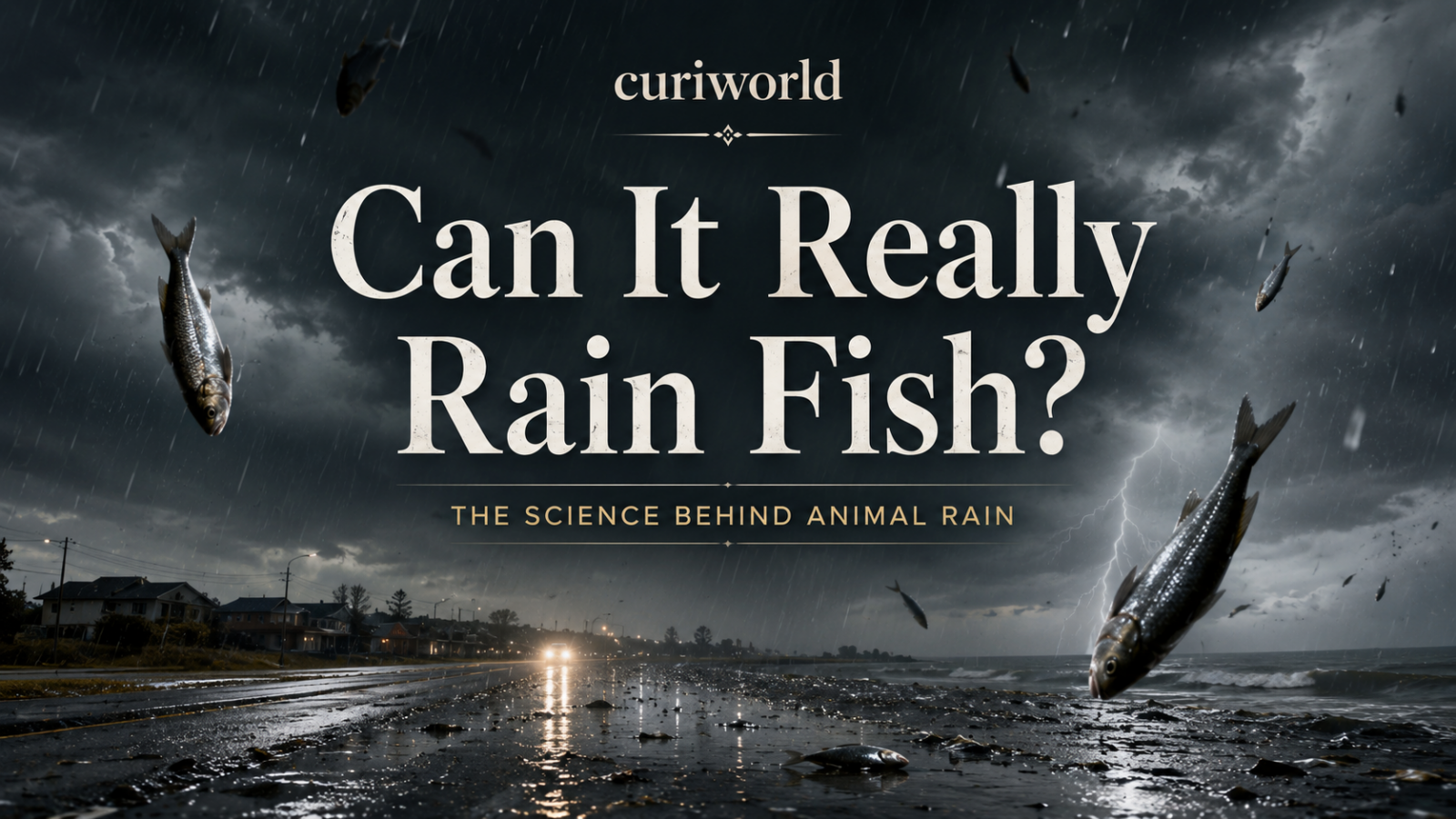
A fish landing on a road during a thunderstorm sounds like a prank, a myth, or a scene from a disaster movie. Yet reports of fish and frogs falling during storms go back centuries, and some modern cases include eyewitnesses who found the animals immediately afterward.
So, can it really rain fish?
In a sense, yes. Fish can fall from the sky under unusual weather conditions. But they do not form inside clouds, and they are not part of the normal rain-making process. The leading scientific explanation involves powerful storm updrafts, rotating winds, and sometimes waterspouts that may lift small animals or other lightweight material from the ground or water and carry them elsewhere.
Fish Do Not Actually Form in Rain Clouds
Ordinary rain begins when water vapor in the atmosphere cools and condenses into tiny droplets or ice crystals. Those particles eventually become heavy enough to fall toward the ground.
Fish obviously cannot be created through this process.
When people describe an event as “raining fish,” they usually mean that fish appeared to fall from the sky during or immediately after a storm.
That turns the mystery into a different scientific question: what kind of weather could lift small animals into the air and carry them far enough for them to fall somewhere unexpected?
Powerful updrafts and rotating storm systems provide a plausible explanation.
How Could a Storm Lift Fish Into the Air?
One weather phenomenon frequently associated with stories of animal rain is the waterspout.
A waterspout is a rotating column of air that develops over a body of water. According to the National Oceanic and Atmospheric Administration (NOAA), there are two main types: fair-weather waterspouts and tornadic waterspouts.
Fair-weather waterspouts usually form over relatively warm water under developing clouds and tend to be less violent. Tornadic waterspouts are associated with severe thunderstorms and behave much more like tornadoes.
Under sufficiently powerful conditions, upward-moving air can lift spray, debris, and lightweight objects from near the surface.
Small aquatic animals could potentially be caught in this circulation as well.
A possible sequence would look something like this:
- Strong atmospheric circulation develops over or near a body of water.
- Powerful upward-moving air lifts spray, debris, and possibly small aquatic animals.
- The storm transports some of that material away from its original location.
- As the circulation weakens, gravity brings the transported material back toward the ground.
This does not mean every waterspout is capable of lifting fish. Most waterspouts do not produce reports of animal rain at all.
A Waterspout Is Not Simply a Giant Straw
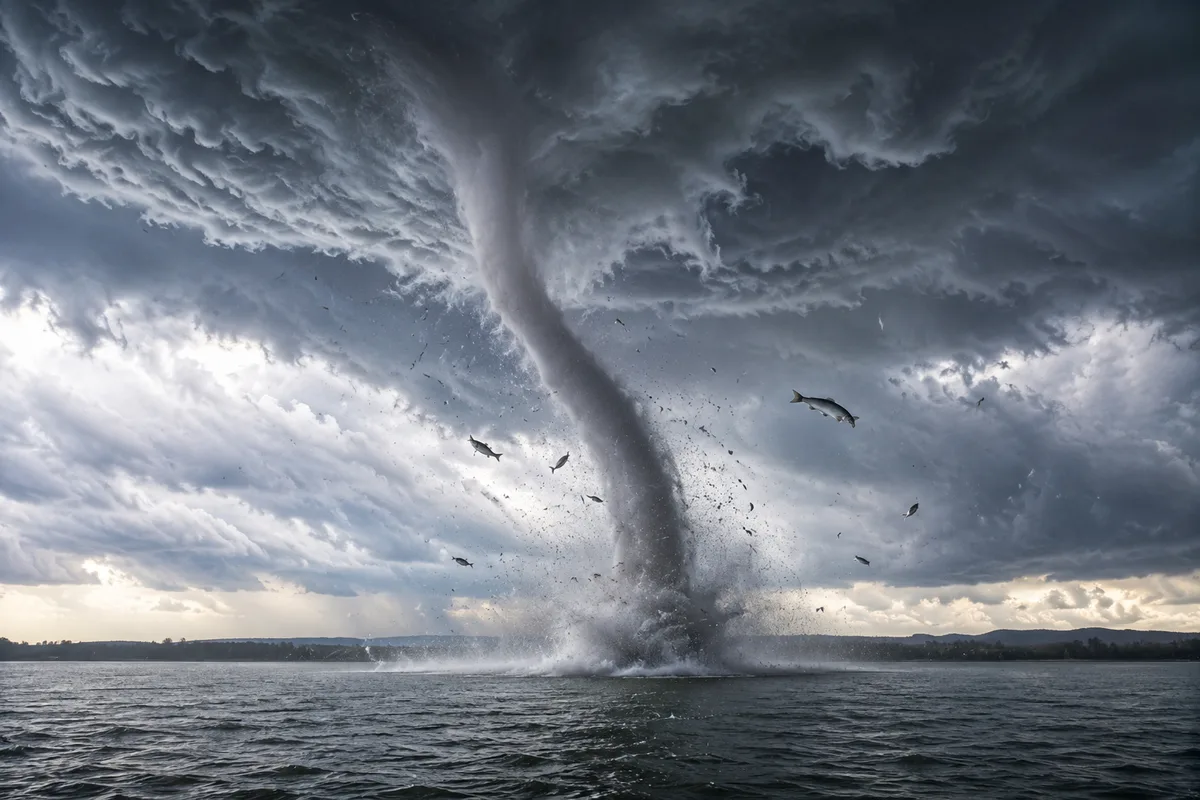
Images of waterspouts can create another misconception.
The visible funnel often looks like an enormous tube of water stretching from the ocean or lake into the clouds. That can make it seem as though a storm is sucking an entire column of water directly into the sky.
That is not quite what is happening.
Much of the visible funnel consists of condensed water droplets, while spray may also be produced near the water’s surface. The phenomenon is primarily a rotating column of air rather than a solid pipe of water being pulled upward.
Condensation is also responsible for much more familiar effects. For example, it explains why a bathroom mirror fogs after a hot shower, although the atmospheric conditions involved in a waterspout are obviously very different.
Why Would Only Fish Fall From the Sky?
Some of the strangest animal-rain accounts describe only one type of creature.
A location might suddenly be covered with small fish but no frogs, plants, or other obvious debris.
At first, that seems unlikely. If a storm were powerful enough to lift animals, shouldn’t it pick up everything around them?
Not necessarily.
Animals of the same species often occupy the same part of a habitat. A group of similarly sized fish near the surface could therefore be exposed to the same powerful circulation.
Size and weight could also affect where transported objects eventually fall.
The Library of Congress notes that objects of similar size and weight may be deposited together as wind loses strength, while heavier material may fall sooner than lighter material.
That means an apparently selective “fish rain” does not necessarily require a storm to collect every type of animal in a lake.
How Far Could Fish Travel Through the Air?
There is no scientifically established distance that applies to every reported case of animal rain.
The distance would depend on several factors, including:
- the strength of the storm,
- the size and weight of the animals,
- how high they were lifted,
- how long they remained airborne,
- and the direction and speed of the winds.
Powerful thunderstorms are capable of transporting lightweight debris considerable distances.
The difficulty is that animal-rain events are rarely observed from beginning to end.
Researchers usually do not see a particular fish leave a pond, travel through a storm, and land several miles away. Instead, they encounter the result afterward and attempt to determine the most plausible explanation.
For that reason, claims stating that fish traveled an exact number of miles should be treated carefully unless the specific event provides strong evidence.
Can Fish Survive Falling From the Sky?
Some reports describe fish that were still alive or appeared very fresh after falling.
Survival is possible under certain circumstances, but it should not be assumed.
A small fish would face several hazards during atmospheric transport, including time outside water, changes in temperature, physical stress, and impact with the ground.
Its chances of survival would also depend heavily on where it landed.
A fish falling into wet grass, shallow water, or soft mud may fare very differently from one that hits pavement or a roof.
The important scientific point is not that fish routinely survive trips through storms. It is that small organisms can sometimes be light enough to be moved by unusually strong atmospheric forces.
Not Every Case of “Animal Rain” Actually Comes From the Sky
This is one of the most important distinctions when examining reports of raining fish or frogs.
A storm can suddenly leave animals scattered across an unusual location without ever carrying them high into the atmosphere.
Heavy rainfall may flood ponds, drainage systems, streams, and other habitats. Fish can be washed onto roads or into fields. Frogs and worms may emerge from hiding places when the ground becomes saturated.
Floodwater can also move animals considerable distances.
Someone arriving after the storm may therefore see dozens of fish lying on a road and reasonably assume they fell from the sky.
But their actual route may have been horizontal rather than vertical.
Historical reports are especially difficult to verify because many are based on eyewitness descriptions rather than direct scientific observation.
The Library of Congress notes that some apparent animal-rain events may have alternative explanations involving flooding, animals emerging after heavy rain, or other storm-related movement.
So finding fish scattered across the ground after a thunderstorm is evidence that something unusual happened.
It is not automatically proof that the fish fell from a cloud.
Are There Documented Cases of Fish Rain?
Reports of animals apparently falling from the sky have been recorded in many places.
One frequently cited example occurred in Marksville, Louisiana, in 1947.
Biologist A. D. Bajkov documented an event in which fish were reportedly found across streets and yards following unusual weather. Bajkov collected specimens and recorded eyewitness accounts of fish apparently falling during the event.
The Library of Congress also discusses reports involving frogs in Serbia and fish appearing in Lajamanu, Australia.
Cases like these are fascinating because they provide more than folklore alone.
However, even well-documented aftermath does not necessarily reveal the entire atmospheric journey.
Researchers may know that fish appeared in an unexpected location during a storm without knowing precisely where the animals originated or exactly which part of the storm carried them.
That distinction is important.
A physically plausible explanation is not the same thing as having a complete video record of an animal traveling from a lake to the sky and back to the ground.
Why Are Waterspouts So Often Blamed?
Waterspouts are natural suspects because they bring rotating air into direct contact with the surface of a lake, sea, or ocean.
But not every waterspout is equally powerful.
NOAA explains that fair-weather waterspouts generally develop under relatively light-wind conditions and often remain nearly stationary.
Tornadic waterspouts, on the other hand, are associated with severe thunderstorms and can produce dangerous winds, large waves, hail, and lightning.
For that reason, saying that “a waterspout sucked up the fish” may oversimplify what actually happened.
A more accurate explanation is that powerful atmospheric circulation associated with storms can sometimes lift small objects or organisms and transport them before releasing them elsewhere.
Scientists must still evaluate individual events separately.
Can It Really Rain Frogs?
Fish are not the only animals associated with strange falls from the sky.
Frogs are probably the second most famous example.
The same broad mechanism has been proposed: powerful upward-moving air could potentially lift small frogs from shallow water, wetlands, or other exposed habitats and carry them elsewhere.
But frogs create another identification problem.
Many frogs become highly active during or after heavy rainfall. Animals that were previously hidden in vegetation, soil, or shallow pools may suddenly appear in large numbers.
To someone who did not see where they came from, it may look as though the frogs arrived with the rain.
This is why scientists cannot assume that every story of raining animals has the same explanation.
Some may involve atmospheric transport.
Others may involve flooding, animal behavior, or unusual local conditions.
Does It Ever Rain Other Animals?
Stories of unusual objects and animals falling from the sky extend beyond fish and frogs.
Historical reports have described small aquatic animals, insects, seeds, and other organic material appearing during storms.
Meteorology provides a mechanism for at least some unusual falls because strong winds and updrafts are capable of carrying surprisingly large amounts of material.
Tornadoes demonstrate this very clearly.
Powerful tornadoes can lift debris high into the atmosphere and deposit it far from where it originated.
Animal rain would represent a much rarer and more unusual version of the same basic physical principle: moving air can transport objects that normally have no business being in the sky.
Why Animal Rain Is So Difficult to Prove
The biggest scientific problem is timing.
Animal rain is rare and unpredictable.
Scientists cannot easily place instruments around a pond and wait for a storm to pick up fish.
Most events become scientifically interesting only after somebody notices animals scattered across the ground.
By then, investigators must reconstruct what happened from weather conditions, eyewitness reports, the species involved, nearby bodies of water, and the condition of the animals.
This makes absolute certainty difficult.
Reports also vary enormously in reliability.
Some have physical specimens and multiple witnesses. Others come from old newspaper stories, folklore, or secondhand accounts.
Separating those categories matters.
A strange story should not automatically be dismissed simply because it sounds unbelievable—but it should not automatically be accepted either.
So, Can Fish Really Fall From the Sky?
Yes, fish can apparently fall from the sky under unusual circumstances.
The most plausible scientific explanation involves powerful winds, storm updrafts, or rotating atmospheric systems capable of lifting small animals and carrying them away from their original habitat.
Waterspouts are frequently suggested because they occur directly over water, although they should not be imagined as giant vacuum cleaners sucking lakes into the clouds.
At the same time, not every reported fish rain necessarily involves animals traveling through the atmosphere. Flooding, overflowing waterways, and storm-driven displacement can create surprisingly similar scenes.
The science is therefore more interesting than simply saying, “Yes, it rains fish.”
Some cases have reasonable meteorological explanations. Others remain difficult to reconstruct because nobody observed the entire event.
Nature regularly produces sights that look almost fictional until the mechanism becomes clearer. Another example is why the ocean can glow blue at night, where a seemingly unnatural blue glow can actually be created by living organisms.
Animal rain belongs to a similar category.
The sky does not manufacture fish.
But under the right conditions, the atmosphere may be powerful enough to put them there.
Sources
Library of Congress — Can It Rain Frogs, Fish, and Other Objects?








Join the discussion