Why Do Towels Go Hard After Washing?
Towels can turn stiff even when they are perfectly clean. The reason involves cotton fibers, drying, water chemistry, and a few common laundry habits.
A towel can go into the washing machine soft and fluffy, come out perfectly clean—and somehow dry into something that feels closer to cardboard.
The obvious suspect is usually detergent buildup. Sometimes that is part of the problem, especially in hard-water areas. But clean cotton towels can become stiff even when there is no detergent residue at all.
The real explanation begins with what happens to cotton fibers as water disappears.
Clean Cotton Can Become Stiff Just From Drying
Cotton towels are made from countless cellulose fibers twisted into yarn and formed into loops. Those loops create the thick, absorbent surface that makes terry towels so effective at holding water.
Once the towel is wet, water gets between those fibers.
As it dries, surface tension pulls neighboring fibers closer together. A small amount of water also remains closely associated with the surface of the cotton. Research on naturally dried cotton suggests that this “bound water” helps create hydrogen-bonding networks between adjacent fibers.
The fibers effectively become temporarily linked together.
That makes the yarn harder to bend and the towel feel stiffer.
Researchers studying cotton yarn and towels found that naturally dried cotton became noticeably harder even after treatments designed to remove substances that might otherwise explain the stiffness. Repeated bending reduced that hardness, supporting the idea that physical links between fibers were being disrupted.
So a rough towel is not necessarily a dirty towel.
Sometimes it is simply dried cotton behaving like cotton.
Water can change the behavior of textile fibers in other ways too. Moisture, fiber structure and tension are also part of why clothes can shrink even in cold water.
Why Air-Dried Towels Often Feel Crunchier
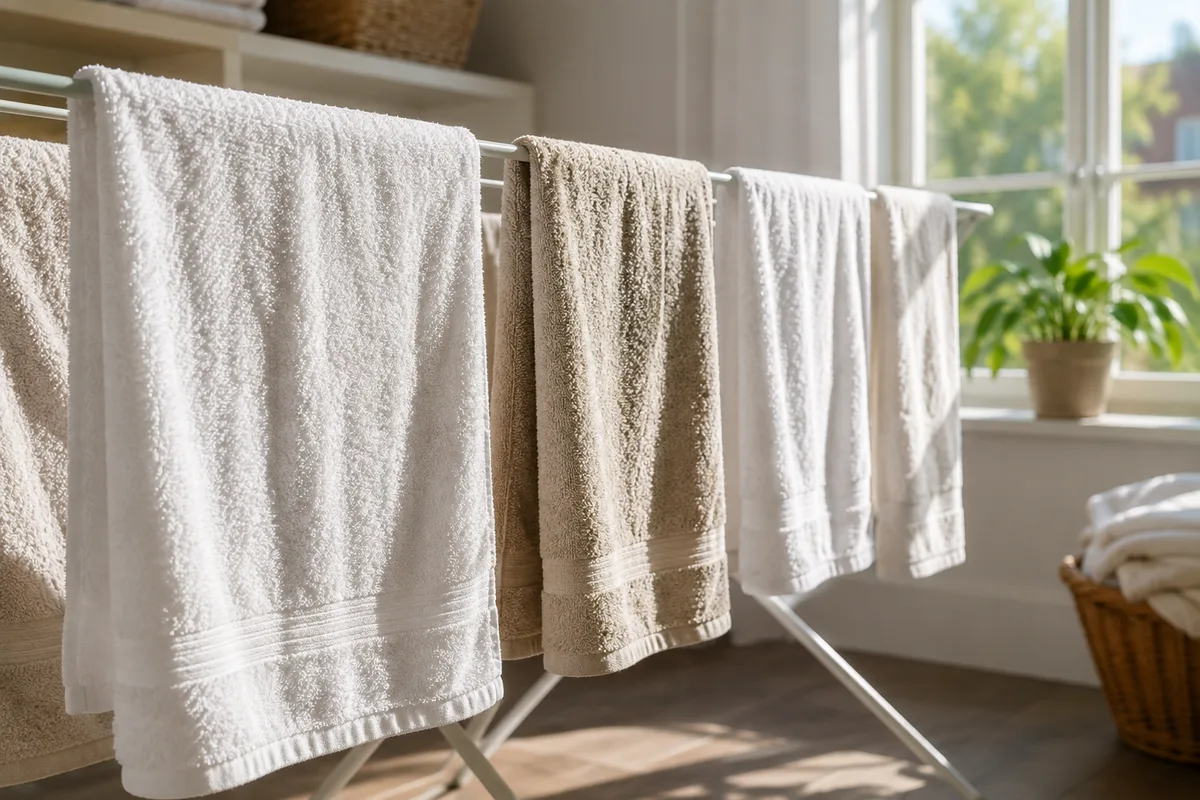
This also explains one of laundry’s most familiar mysteries: towels dried on a rack or clothesline often feel noticeably harder than towels from a tumble dryer.
The difference is movement.
A towel hanging motionless while it dries gives its wet fibers plenty of opportunity to settle closely together. The loops can become compressed, and the fiber-to-fiber connections formed during drying remain largely undisturbed.
A tumble dryer continuously bends, lifts, drops, and flexes the towel.
That mechanical movement helps separate the fibers and fluff the pile as moisture disappears.
In laboratory work on cotton towels, researchers found that an additional dehydration and “fluttering” step produced towels with more volume and greater softness than cotton simply left to dry naturally.
This is why an air-dried towel may initially feel stiff but soften after you shake it vigorously, rub it, fold it several times, or use it.
You are physically breaking up some of the connections that made the dry fibers feel rigid.
Hard Water Can Make the Problem Worse
Drying is not the only reason towels lose their softness.
Water chemistry matters too.
Hard water contains relatively high levels of dissolved minerals, particularly calcium and magnesium. These minerals can interfere with laundry chemistry and contribute to deposits on fabrics.
The American Cleaning Institute notes that hard water can create laundering problems and that mineral-related residues may leave fabrics feeling stiff rather than fluffy.
If your towels gradually become rougher over many washes rather than turning stiff only after air drying, water hardness becomes a more likely part of the explanation.
Signs elsewhere in the home can provide clues. Mineral deposits around faucets, showerheads, kettles, or glass surfaces often accompany harder water.
If the same mineral residue also appears as a milky film on drinking glasses, see our guide to why glasses become cloudy after the dishwasher.
Your local water utility may also publish the hardness level of the water supply.
Hard water does not affect every towel in exactly the same way.
Calcium and magnesium ions can interfere with detergents and contribute to deposits on textile fibers. Laboratory studies show that water hardness can change detergent performance, residue deposition and several physical properties of cotton fabrics.
That makes hard water a plausible contributor to rough-feeling towels, especially when combined with detergent buildup, but it is not the only reason a towel can feel stiff.
Detergent Is a “More Is Better” Trap
When towels begin feeling less fresh, adding more detergent seems logical.
That can backfire.
Laundry detergent is designed to work within a particular concentration range. The American Cleaning Institute advises following the product’s dosing instructions because both too much and too little detergent can produce poorer washing results.
Towels make overdosing especially tempting because they are thick, absorbent, and often washed after repeated use.
But pouring in extra detergent does not automatically mean extra-clean towels.
If washing conditions do not allow products and loosened soils to rinse away effectively, substances can remain within the dense pile. Over time, the towel may lose some of the airy, flexible feel it had when new.
The solution is not to stop using detergent. It is to use the correct amount for the load, detergent concentration, washer type, soil level, and water hardness.
More foam is not a reliable measure of cleanliness.
An Overloaded Washer Can Work Against Softness
Towels become heavy when saturated.
Packing too many of them into one load leaves less room for individual towels to move through the wash and rinse water.
That matters because laundering is not only chemical. Mechanical action and adequate rinsing are part of the process too.
If towels are tightly packed together, detergent and suspended soil may be harder to remove completely. The pile also receives less movement.
Giving towels enough room to circulate is therefore a simple place to start if they routinely emerge feeling coated or unusually harsh.
A giant load may save one wash cycle, but it does not necessarily produce the best rinse.
What About Fabric Softener?
Fabric softener has an obvious name, so using more of it seems like the easiest fix for hard towels.
The chemistry is more interesting.
Research on cotton suggests that softening agents can interfere with the formation of the water-mediated hydrogen-bonding network that contributes to stiffness. In the experiments, softener-treated cotton became noticeably softer than untreated naturally dried cotton.
That does not mean pouring unlimited softener into every towel wash is useful.
The same research found that concentration matters. The goal is to alter how fibers interact, not saturate the fabric with product.
Always follow the towel’s care label and the softener manufacturer’s dosing instructions if you use one.
If a towel develops an unusual coating, poor rinsing or excessive laundry additives should be considered before simply adding another product.
If the towel also develops a sour or musty odor rather than simply feeling stiff, the cause may be different. See why clothes can still smell bad after washing for the most common laundry-odor problems.
Overdrying Is Not the Same Problem as Air-Drying
It may sound contradictory that air-drying can produce stiff towels while excessive dryer use can also leave towels feeling less pleasant over time.
These are different issues.
Air-drying stiffness is strongly associated with the way wet cotton fibers come together and remain relatively undisturbed as they dry.
Repeated exposure to unnecessarily aggressive heat, on the other hand, can contribute to wear over the life of a textile.
The goal is not to cook a towel until every trace of moisture has been blasted away.
If you use a dryer, choose a setting appropriate for the towel’s care label and remove the load when it is dry rather than repeatedly extending the cycle simply because the towels are thick.
A towel needs to be thoroughly dry before storage, but “dry” and “heated for as long as possible” are not the same thing.
How to Keep Towels Softer After Washing
If your towels have become noticeably harder, the best approach is to identify what kind of stiffness you are dealing with.
If they feel crunchy mainly after line drying but become softer once flexed or used, the drying process itself is probably a major factor.
Shake each towel firmly after washing and again as it dries. This helps separate and lift the pile rather than allowing the loops to remain compressed.
If you own a dryer but prefer line drying, even a short period of appropriate tumble drying can provide mechanical movement that a stationary drying rack cannot.
If the towels feel increasingly coated or stiff after repeated washes, review your detergent dose and water hardness.
Use the amount of detergent appropriate for the actual load rather than automatically filling the measuring cup. Avoid cramming the washer so tightly that towels cannot move or rinse properly.
And if hard water is an issue, follow detergent and appliance guidance designed for your local water conditions rather than treating every rough towel as a drying problem.
Why New Towels Can Change After the First Few Washes
A new towel’s shop-floor softness can also create unrealistic expectations.
Manufacturing processes, finishing treatments, pile construction, yarn twist, and the towel’s original condition all affect how it feels before its first real cycle through your washing machine.
Once regularly washed, the towel settles into the behavior of its actual fibers and construction.
Two towels made from cotton can therefore react differently even if you wash them together.
A thick towel with long, loosely structured loops may feel very different from a lighter towel with compact yarns. Age matters as well: repeated laundering gradually changes pile structure and fabric surface.
Not every change in softness signals that you are washing something incorrectly.
The Simplest Test: Look at When the Towel Becomes Hard
The timing of the problem can tell you a lot.
A towel that feels soft while damp but becomes rigid after hanging still is behaving differently from one that gradually becomes rougher after dozens of washes.
The first pattern points strongly toward what happens during drying.
The second makes accumulated residue, hard-water conditions, washing habits, and ordinary textile wear more relevant suspects.
That distinction can save you from endlessly changing detergents when the real culprit is simply how wet cotton dries.
A clean cotton towel can genuinely become stiff without anything being “wrong” with your washing machine. Water draws the fibers together, interactions between those fibers can lock the structure into a harder state, and stationary drying preserves it.
That is why one of the simplest solutions is also one of the least glamorous:
Give the fibers room to move.
Sometimes the difference between a crunchy towel and a fluffy one is not another laundry product at all.
It is a good shake.
Sources
Journal of Oleo Science — Effects of Water Hardness on Textile Detergency
International Journal of Consumer Studies — Water Hardness and Laundry Results








Join the discussion