Why Do Mirrors Reverse Left and Right but Not Up and Down?
Mirrors seem to reverse left and right while leaving up and down untouched. The real explanation involves depth, reflection, and the way our brains compare orientations.
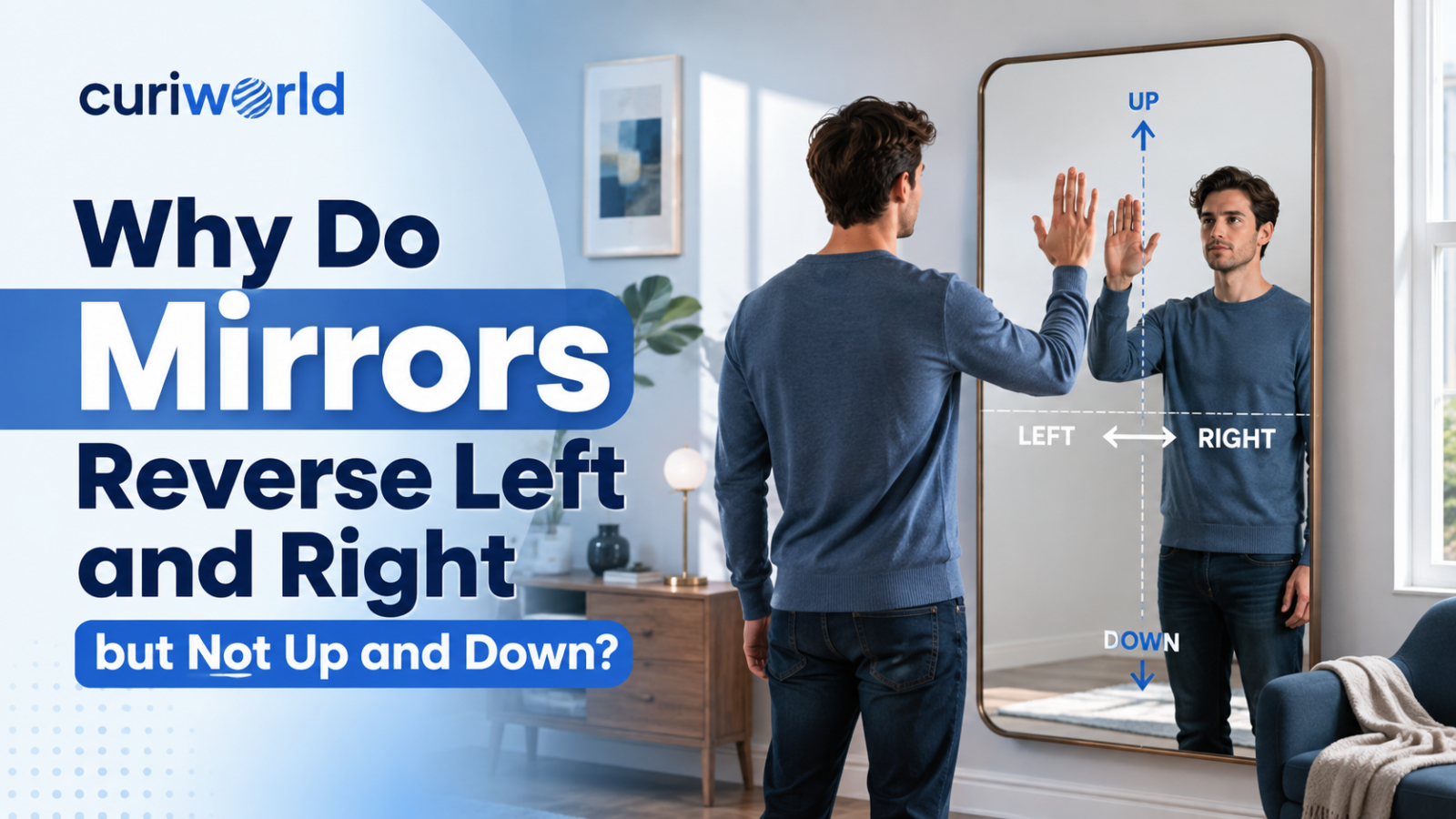
Stand in front of a mirror and raise your right hand.
The person in the mirror seems to raise their left hand.
Look at writing and the letters appear backward.
Yet your head is still at the top and your feet are still at the bottom.
So why does a mirror seem to reverse left and right, but not up and down?
The surprising answer is:
A normal flat mirror does not actually choose left and right to reverse.
Optically, a mirror reverses the direction perpendicular to its surface — what we usually think of as front and back. The familiar left-right reversal appears because of the way we mentally compare ourselves with a person who seems to be facing us.
That sounds abstract, but one simple experiment makes it much easier to see.
First, a Mirror Does Not Literally Swap Your Left and Right
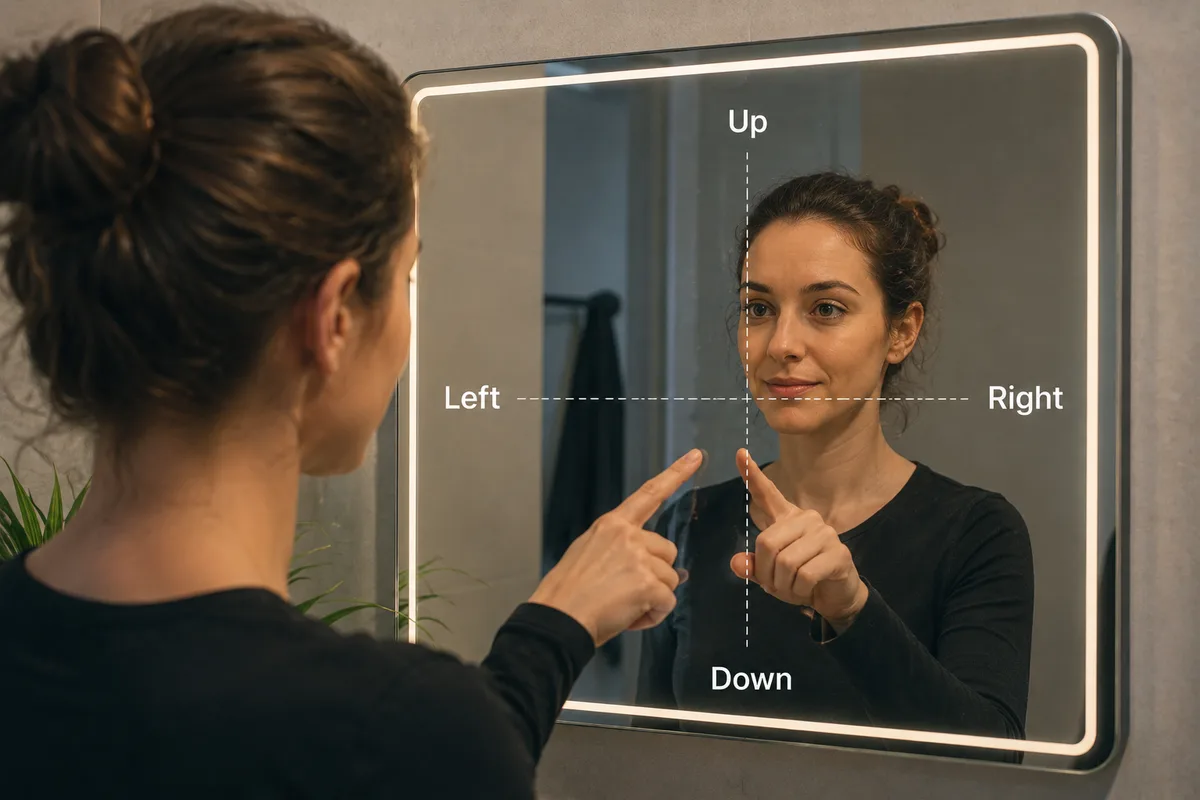
Hold up your right hand.
Your reflected hand appears on the right side of the mirror from your own point of view.
The mirror has not physically moved your hand to the other side of space.
Similarly, if you put a sticker on the left side of your shirt, its reflection remains directly opposite that same sticker.
What changes is depth.
You are standing in front of the mirror.
Your reflection appears to exist behind the mirror.
That front-to-back transformation is the key optical operation.
Research into the long-running “mirror reversal problem” distinguishes the actual optical transformation of a mirror from the way observers mentally interpret the reflected person.
The Easiest Way to See It: Point at the Mirror
Imagine three directions:
- up and down,
- left and right,
- forward and backward.
Now point one finger directly toward the mirror.
Your reflected finger appears to point back toward you.
That is the direction the mirror has reversed.
If we label the direction toward the mirror as forward, then the reflected version points in what looks like the opposite depth direction.
But:
- up remains up,
- down remains down,
- left remains left,
- right remains right.
The axis perpendicular to the mirror has changed.
This is why physicists often describe a plane mirror as performing a front-back or depth reversal, rather than a special left-right reversal.
Then Why Does My Right Hand Look Like the Mirror Person’s Left Hand?
Because you are mentally treating your reflection as though it were another person standing opposite you.
Imagine a friend is standing in front of you.
Your right side faces their left side.
Your left side faces their right side.
That is completely normal whenever two people face each other.
Now look into a mirror.
Your brain interprets the reflected body in a similar way:
“That person is facing me.”
Once you assign the reflected figure its own body-centered left and right, your right hand corresponds to what would be their left hand.
The mirror itself did not selectively swap the two sides.
Your comparison did.
This is part of why mirror reversal has interested psychologists as well as physicists: perception depends partly on the frame of reference we use to describe what we see.
Imagine Turning Around to Become Your Reflection
There is another useful way to understand the confusion.
Suppose you want to physically stand where your mirror image appears to stand.
How would you get there?
Most people imagine turning around horizontally.
You rotate approximately 180 degrees around a vertical axis.
During that turn:
- your head stays up,
- your feet stay down,
- but your left and right sides exchange positions relative to the room.
That imagined rotation is one reason we naturally describe the reflection as left-right reversed.
But there is nothing inevitable about rotating that way.
Imagine instead performing a forward somersault into the mirror position.
Now your left and right could remain aligned while your head and feet would swap.
Suddenly you might describe the mirror as having reversed up and down instead.
The mirror did not change.
Your imagined transformation changed.
This is one reason the seemingly simple mirror-reversal question has produced surprisingly complicated discussions in psychology and perception research.
Why Does Writing Look Backward in a Mirror?
Text makes the illusion especially convincing.
Write the word:
HELLO
on a transparent sheet and hold it facing a mirror.
The reflected word looks horizontally reversed.
But again, the mirror is not applying a special “reverse letters” command.
The important detail is the direction in which the writing faces.
The front surface of the text faces the mirror.
Its reflection appears to face outward from behind the mirror.
That depth reversal changes the orientation from which you view the pattern.
Because written language has a strong directional structure, we perceive the result very strongly as left-right reversal.
Most ordinary objects do not make the effect as obvious.
A coffee cup still looks like a coffee cup.
A human face remains recognizable.
But letters depend on precise orientation, so even a small transformation becomes immediately noticeable.
Why Does a Mirror Not Turn You Upside Down?
Because nothing in ordinary mirror reflection singles out the vertical direction.
Light from your head reaches the upper part of the mirror and reflects toward your eyes.
Light from your feet reaches lower portions of the mirror and reflects toward your eyes.
There is no optical process exchanging those rays vertically.
The same is true horizontally.
Light from objects on your left does not have to travel over to the opposite side of the mirror.
Each light ray reflects according to the ordinary law of reflection.
The apparent image forms behind the mirror because reflected rays reaching your eyes appear to originate from that location.
So the mirror preserves the spatial relationships parallel to its surface while reversing the depth relationship perpendicular to it.
A Mirror Does Not “Know” Which Way Is Left
This is perhaps the best way to remember the concept.
A mirror has no information about:
- your left hand,
- your right hand,
- where the ceiling is,
- where the floor is,
- which direction humans normally stand.
It simply reflects light.
If you rotate the mirror 90 degrees, the basic optical rule stays the same.
If you lie down in front of it, it does not suddenly decide that a different axis deserves reversal.
The mirror only responds to geometry.
The human labels come afterward.
Try the Text-on-Glass Experiment
Here is a simple demonstration.
Write a word on a transparent sheet.
Then stand behind the sheet and look through it.
The writing will already appear reversed from that side — without using a mirror at all.
Why?
Because you have moved to the opposite side of the writing.
You are seeing its back.
That is closely related to what happens when a mirror creates an image that appears to face you from behind the reflective plane.
The “backward” appearance is therefore not evidence that the mirror has a built-in left-right flipping mechanism.
It is a consequence of orientation.
What About a Photograph?
Photos create another useful comparison.
Take a normal photograph of someone facing you.
The person’s left hand appears on the right side of the photograph from your viewing perspective.
That does not mean the camera reversed them.
They were simply facing you.
Now compare that photo with the person’s mirror image.
The two can look surprisingly different because most people are accustomed to seeing their own face in a mirror rather than in the orientation other people normally see.
Faces are not perfectly symmetrical.
A slightly higher eyebrow, uneven smile, different hair direction, or small facial asymmetry can make the non-mirrored version of your own face seem unfamiliar.
This is why a photograph can sometimes make people think:
“Why do I look so different from the mirror?”
The mirror did not distort your facial features.
It showed a different orientation from the one captured in a conventional photograph.
Why Are Ambulance Words Sometimes Written Backward?
Some emergency vehicles display words such as AMBULANCE in reversed lettering on the front.
Why?
Because drivers ahead may see the vehicle through their rear-view mirrors.
The reversed lettering on the vehicle can then appear in a more readable orientation in the mirror.
This is not proof that mirrors specifically reverse letters.
It is designers deliberately compensating for the orientation created by reflection.
The same principle explains why mirror writing has long been such a useful demonstration of reflection.
Could a Mirror Ever Look Like It Reverses Up and Down?
Yes — depending on the arrangement and how the reflected image is interpreted.
Multiple mirrors, angled mirrors, curved reflective surfaces, or unusual viewing orientations can produce images that do not match the simple everyday “left-right reversal” description.
Psychological research on mirror reversal has emphasized that people can perceive different kinds of reversals depending on the object, orientation, and reference frame involved.
That is another clue that “mirrors reverse left and right” is not a complete physical law.
It is a convenient description of the most familiar situation:
a vertically standing person looking straight into a vertical mirror.
Why Do We Notice Left-Right Reversal More Than Front-Back Reversal?
Human bodies are especially important here.
We have clearly defined:
- left and right hands,
- left and right eyes,
- left and right feet.
We constantly think in these terms.
Front and back are also meaningful, but when we look into a mirror we usually focus on the reflected person’s body rather than on the coordinate system of the room.
Our brains therefore make a person-to-person comparison:
my right ↔ their left
rather than a geometry-first comparison:
my forward direction ↔ reflected backward direction.
The first description feels intuitive.
The second is optically cleaner.
Mirrors and Light Reflection
The reason a mirror produces an image at all is simpler than the reversal puzzle.
Light travels from objects toward the mirror.
At the reflective surface, it changes direction according to the law of reflection: the angle at which light arrives equals the angle at which it leaves, measured relative to the surface normal.
Your eyes receive those reflected rays.
Your visual system interprets light as though it traveled in straight lines.
So the reflected rays appear to continue backward through the mirror.
The result is a virtual image that seems to exist behind the glass.
Nothing is physically located there.
The geometry of the reflected light simply makes it appear that way.
Curiworld already explores another everyday property of mirrors in Why Does a Bathroom Mirror Fog Up After a Shower?. That article focuses on condensation and how microscopic water droplets scatter the reflected light that would otherwise form a clear image.
A Simple Rule That Solves Most of the Puzzle
When this question becomes confusing, forget left and right for a moment.
Ask:
Which direction points directly through the mirror?
That is the direction being reversed.
For a vertical wall mirror:
- vertical stays vertical,
- horizontal stays horizontal,
- depth changes sign.
That one idea explains much of what we see.
The remaining sense of left-right reversal comes from how we mentally orient ourselves relative to the reflected figure.
Frequently Asked Questions
Do mirrors actually reverse left and right?
Not in the simple physical sense. A flat mirror reverses the direction perpendicular to its surface — effectively front versus back. Left-right reversal arises largely from how we compare ourselves with the reflected figure.
Why is text backward in a mirror?
The reflected image has the opposite front-back orientation. Because letters have a specific direction, that change makes writing appear horizontally reversed to us.
Why doesn’t a mirror reverse up and down?
Up and down lie parallel to an ordinary vertical mirror. The mirror does not exchange those positions. The optical transformation occurs along the depth axis perpendicular to the surface.
Does a mirror flip your face?
A mirror changes the orientation in which you see your face, but it does not randomly rearrange facial features. Because human faces are slightly asymmetrical, a non-mirrored photograph can look unfamiliar if you are accustomed to your reflection.
What direction does a mirror really reverse?
For a flat mirror, the most useful description is front to back, or the axis perpendicular to the mirror.
Final Thoughts
The classic question:
“Why do mirrors reverse left and right but not up and down?”
contains a hidden assumption.
Mirrors do not actually have a preference for left and right.
A flat mirror reflects light according to simple geometric rules and produces a virtual image behind its surface.
What changes optically is depth:
front becomes back.
The familiar left-right reversal appears when our brains compare the reflected body with a person who seems to be standing opposite us.
That is why your head remains above your feet while your right hand seems to belong to the reflection’s left side.
The physics is simple.
The confusing part is the way humans describe what they see.
Sources
Takano — Why Does a Mirror Image Look Left-Right Reversed?
Symmetry — On the Legibility of Mirror-Reflected and Rotated Text







Join the discussion