Why Do Authors Use Pen Names? The Real Stories Behind Pseudonyms
Why do writers hide—or reinvent—their names? From George Eliot and the Brontë sisters to Lewis Carroll and Robert Galbraith, discover the fascinating reasons authors use pen names.
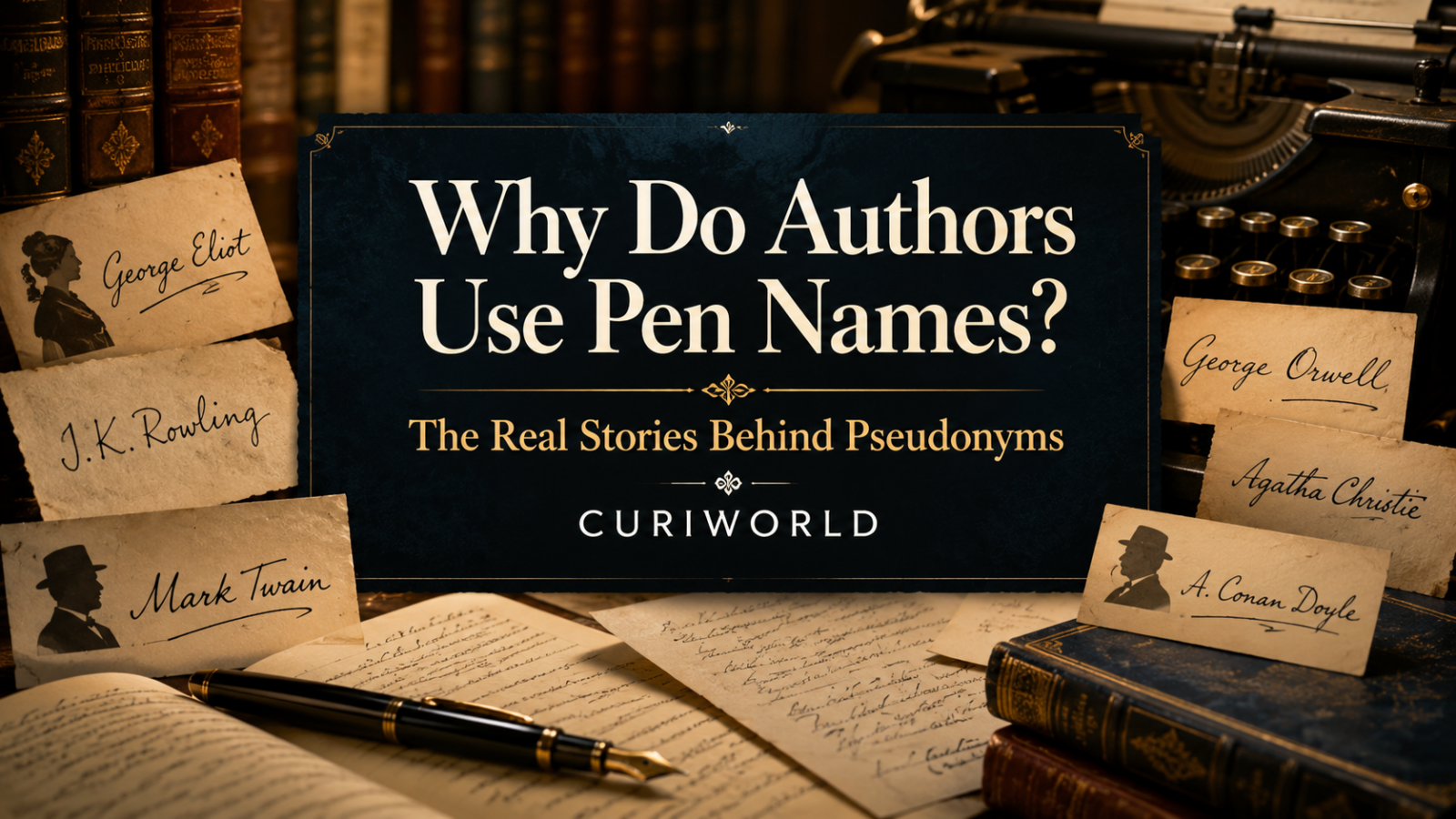
George Eliot was not George Eliot.
Lewis Carroll was not Lewis Carroll.
And Robert Galbraith—the crime novelist behind the Cormoran Strike series—turned out to be one of the most famous authors in the world.
Literary history is full of writers who published books under names that were not the ones they were born with. Some wanted privacy. Others wanted freedom. Some were trying to escape prejudice, separate one kind of writing from another, or discover whether readers liked a book without being influenced by the author’s reputation.
A pen name can look like a simple change on a book cover.
In reality, it can reveal a great deal about publishing, identity, reputation, and the way readers judge the person behind a story.
What Is a Pen Name?
A pen name, also called a pseudonym or sometimes a nom de plume, is a name an author uses when publishing instead of—or alongside—their real name.
The practice is much older than modern publishing.
Writers have published anonymously or under assumed identities for centuries, and the reasons have varied dramatically depending on the period, culture, and circumstances.
Some pen names conceal the writer’s identity almost completely. Others are open secrets. In many cases, the author’s real identity eventually becomes widely known, but the pseudonym remains on the books.
That tells us something important:
A pen name is not always about permanently hiding who wrote the work.
Sometimes it is about creating a different identity for the work itself.
Why Do Authors Use Pen Names?

There is no single reason.
Two writers may both choose fictional names while trying to solve completely different problems.
The most common reasons include privacy, prejudice, genre changes, marketing, professional separation, and the desire to let a new book stand on its own.
To Avoid Prejudice
One of the most important historical reasons involves gender.
For women writing in periods when literature was dominated by male publishers, critics, and assumptions about what women were expected to write, a male-sounding name could affect how seriously a work was received.
Mary Ann Evans provides one of the clearest examples.
She became famous as George Eliot, the author of novels including Middlemarch, Silas Marner, and Adam Bede.
The choice was not simply a theatrical disguise.
The British Library notes that serious fiction written by women could be dismissed by some reviewers before it had even been properly considered. Publishing as George Eliot allowed Evans’s fiction to encounter readers and critics without immediately being filtered through assumptions about the author’s sex.
It also gave her a degree of distance from intense public interest in her private life.
The name eventually became so famous that today “George Eliot” feels less like a disguise than one of literature’s most recognizable identities.
The Brontë Sisters Became the Bell Brothers
Charlotte, Emily, and Anne Brontë faced a similar publishing world.
Before their novels made them famous, the sisters published using the names Currer Bell, Ellis Bell, and Acton Bell.
Charlotte became Currer.
Emily became Ellis.
Anne became Acton.
The surnames remained the same, while their initials were preserved.
The names were deliberately ambiguous enough to avoid announcing that the authors were women.
It is difficult to imagine Jane Eyre without the name Charlotte Brontë today, or Wuthering Heights without Emily Brontë. Yet the first readers encountered those books through very different author identities.
Their story shows why a pen name can be more than a disguise.
It can act as a doorway into a literary world that might otherwise have judged the writer before judging the writing.
To Separate Different Parts of a Career
Not every pseudonym is created to escape prejudice.
Sometimes a writer simply wants two careers to feel separate.
Charles Lutwidge Dodgson, for example, was a mathematician and academic. The world of imaginative literature knew him by another name:
Lewis Carroll.
Under that identity came Alice’s Adventures in Wonderland and Through the Looking-Glass.
The distinction illustrates one of the most useful things about a pen name: it allows a writer to create boundaries.
A serious academic identity and a fantasy-author identity do not necessarily need to occupy the same space.
Modern writers can face a similar problem when they work in dramatically different genres.
Imagine an author who has spent fifteen years publishing gentle children’s stories and suddenly wants to write violent crime fiction.
Readers approaching the new novel may carry expectations created by the old books.
A different name creates a cleaner break.
J.K. Rowling Wanted to Become an Unknown Writer Again
One of the most fascinating modern examples came after an author had already achieved extraordinary fame.
Following the success of Harry Potter, J.K. Rowling began publishing crime fiction as Robert Galbraith.
Her identity was initially kept secret.
Why would an author whose real name could practically guarantee attention choose to remove it from the cover?
According to Rowling’s official explanation, that was exactly the point.
She wanted to experience the beginning of a writing career again, away from the hype and expectations surrounding Harry Potter, and to receive feedback that was not influenced by her existing fame.
The first Cormoran Strike novel, The Cuckoo’s Calling, therefore arrived as the debut of Robert Galbraith rather than the newest book from the creator of Harry Potter.
Her identity was later revealed, but she continued publishing the series under the Galbraith name.
By then, the pseudonym had acquired another purpose: it clearly separated her crime novels from her other work.
That is a good example of how the meaning of a pen name can change.
At first, it protected anonymity.
Later, it became a recognizable literary brand.
To Escape the Weight of a Famous Name
Fame sounds like an advantage for every writer.
It can also become a problem.
Once an author becomes closely associated with a particular series, genre, or style, readers develop expectations before opening the next book.
A famous name on the cover can influence reviews, publicity, sales, and even the way readers interpret the story.
A pseudonym offers something unusual:
the possibility of being judged with less baggage.
Of course, this only works while the connection remains unknown.
But even after a pseudonym is revealed, maintaining a second author name can still tell readers what kind of book they are about to encounter.
One name may mean thrillers.
Another may mean romance.
Another may mean children’s fiction.
In that sense, a pen name can function almost like a label on a bookshelf.
To Protect Privacy
Some writers simply do not want their publishing identity attached to every other part of their lives.
That can be especially relevant when a book discusses controversial subjects, exposes sensitive information, draws heavily on personal experience, or belongs to a genre the author prefers to keep separate from their professional life.
A teacher, lawyer, academic, journalist, physician, or government employee might not necessarily want readers searching a book title to immediately find their workplace.
For other writers, the motivation may be more personal.
They may dislike publicity.
They may want their family life protected.
They may prefer the work to receive attention rather than the person who created it.
A pen name can help create that distance, although it should never be confused with guaranteed anonymity. Publishing contracts, financial arrangements, copyright records, interviews, leaks, or investigative reporting can all make a writer’s identity discoverable.
A pseudonym creates separation.
It does not create invisibility.
Sometimes the Pen Name Simply Sounds Better
There is also a far less dramatic reason:
branding.
A writer’s legal name may be difficult to remember, very common, easily confused with another author, or simply feel wrong for the type of books being published.
A pseudonym can be shorter, more distinctive, easier to pronounce, or easier to fit onto a book cover.
This may sound superficial, but books have always existed as both creative works and physical products.
Even seemingly small details—from a title to a cover design—can influence how readers encounter a book.
The physical object has its own history too. Even something as simple as why old books develop their distinctive smell reveals that books are more than words on pages; their materials, presentation, and identities all develop stories of their own.
An author’s name is part of that presentation.
A Pen Name Can Become More Famous Than the Real Name
There is a strange point at which a pseudonym stops feeling fictional.
Most readers know George Eliot as George Eliot.
Lewis Carroll feels like a real historical person even when we know his legal name was Charles Dodgson.
The invented identity becomes attached to interviews, biographies, libraries, literary criticism, and generations of readers.
Eventually the pseudonym may become more culturally recognizable than the name it replaced.
That creates an interesting paradox.
A writer chooses a false name.
The false name becomes famous.
Then the real name begins to sound like the unfamiliar one.
Pen Name vs. Anonymous: They Are Not Quite the Same
Publishing anonymously and publishing under a pen name are related, but they are not identical.
An anonymous work presents no named author to the reader.
A pseudonymous work presents an author identity—it simply may not be the writer’s legal identity.
That difference matters because a pseudonym can accumulate a reputation.
Readers can recognize Robert Galbraith.
They can search for other Robert Galbraith novels.
A publisher can build a series around the name.
Reviews can compare one Galbraith book with another.
An anonymous writer cannot build that kind of visible author identity in quite the same way.
A pseudonym therefore provides something anonymity does not:
continuity.
Do Authors Still Use Pen Names Today?
Absolutely.
The publishing environment has changed dramatically, but many of the reasons for using pseudonyms have survived.
Writers still use alternate names to:
- separate genres
- protect privacy
- avoid confusion with another author
- create a memorable publishing identity
- write for different audiences
- experiment without existing expectations
- keep professional and creative lives separate
Digital publishing has even created new possibilities.
An author can release novels independently, build separate websites and reader communities, or publish different genres under entirely different identities.
At the same time, the internet makes permanent secrecy harder.
Social media, public records, publishing databases, interviews, digital trails, and simple curiosity can connect identities that previous generations might have kept separate much more easily.
Modern pen names therefore often function less as perfect disguises and more as deliberately constructed creative identities.
Is Using a Pen Name Dishonest?
Usually, no.
Readers understand that the name printed on a novel does not necessarily have to be the author’s legal name.
Actors use stage names.
Musicians perform under artist names.
Writers use pen names.
What matters is the context.
Using a pseudonym to establish a publishing identity is very different from impersonating a real person, falsifying professional qualifications, or using another identity to commit fraud.
In ordinary publishing, the pen name is simply part of how the work is presented.
And in many cases, publishers and agents know exactly who the author is even when readers do not.
The Name on the Cover Is Part of the Story
Pen names have survived because authors have never written in a vacuum.
They write inside publishing industries, social expectations, careers, reputations, markets, and private lives.
For the Brontë sisters, assumed names helped their work enter a literary culture that could judge women differently.
For George Eliot, a male pseudonym helped place the writing ahead of assumptions about the writer.
For Lewis Carroll, another name helped distinguish imaginative literature from Charles Dodgson’s academic identity.
For J.K. Rowling, Robert Galbraith created the rare opportunity for one of the world’s most famous authors to temporarily experience what it felt like to publish without her famous name attached.
Different centuries.
Different writers.
Different reasons.
Yet the basic idea remains surprisingly consistent.
Sometimes an author changes the name on the cover not because they want to disappear, but because they want the reader to see the book differently.
And occasionally, the invented name becomes so successful that it never disappears at all.
Sources
British Library — Women Writers, Anonymity and Pseudonyms
J.K. Rowling Official Website — FAQs: Robert Galbraith and Writing Under a Pseudonym







Join the discussion