Why Do Airplanes Leave White Trails in the Sky? Contrails Explained

Look up on a clear day and you may see a jet crossing the sky with a long white line behind it. Sometimes the line disappears almost immediately. Other times it hangs around, spreads sideways, and gradually begins to look like a thin cloud.
Those white trails are called contrails, short for condensation trails.
They form when hot, moist aircraft exhaust mixes with the extremely cold air found at cruising altitude. Water vapor condenses and freezes into tiny ice crystals, producing a visible white trail.
So while a contrail may look like smoke from the ground, what you are mostly seeing is something much closer to a narrow, human-made ice cloud.
How Does a Contrail Actually Form?
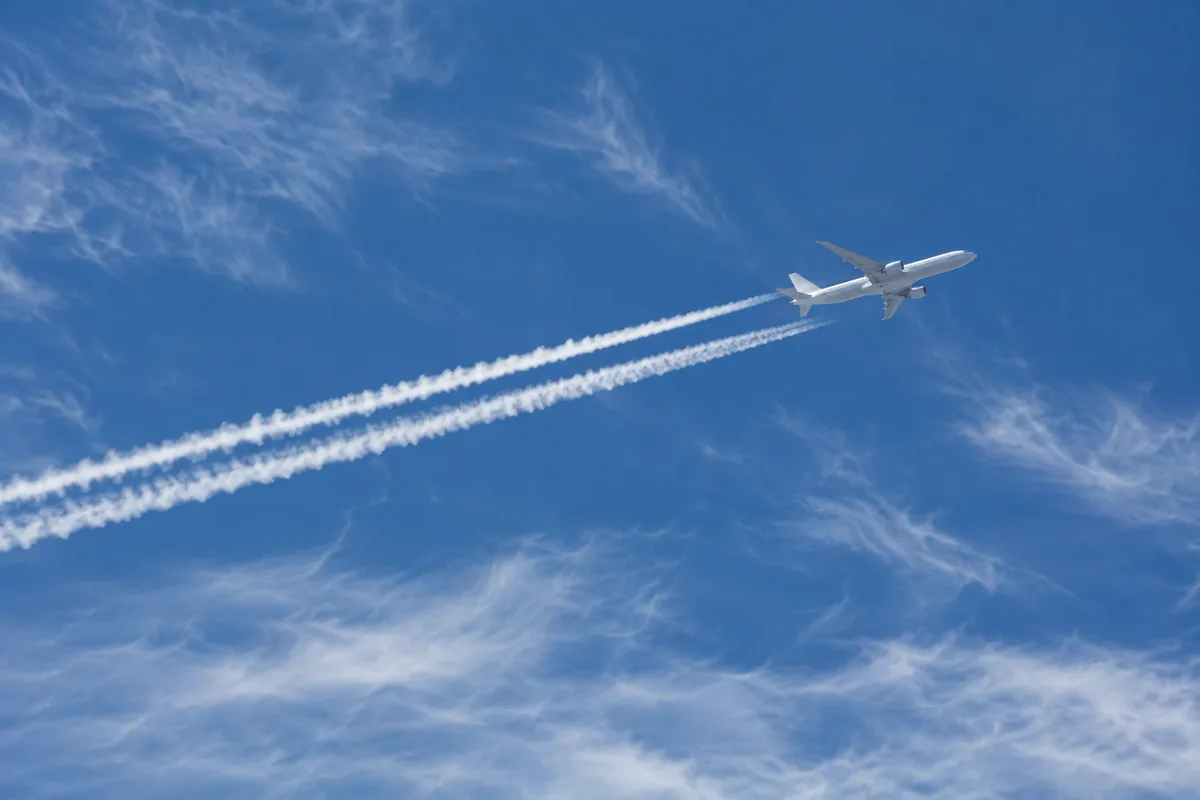
Jet fuel contains hydrogen. When fuel burns inside an aircraft engine, one of the products of combustion is water vapor.
That water vapor leaves the engine in a hot exhaust plume.
At the altitudes where commercial aircraft commonly cruise, however, the surrounding atmosphere can be intensely cold. When the warm exhaust mixes rapidly with that cold air, conditions may allow the water vapor to condense and freeze around tiny particles.
A cloud of microscopic ice crystals forms behind the aircraft.
From miles below, those crystals collectively appear as a bright white streak.
NASA and NOAA describe contrails as ice-crystal clouds created under the cold atmospheric conditions encountered by high-flying aircraft.
The process has something in common with seeing your breath on a cold day. Warm, moist air suddenly enters a much colder environment and becomes visible. The physics of a jet contrail is more complex—and happens under far colder conditions—but the basic idea of cooling moist air is familiar.
Why Are Contrails White?
Contrails look white for essentially the same reason many ordinary clouds do.
The tiny ice crystals scatter incoming sunlight in many directions. When large numbers of them are concentrated together, the result appears bright or white against the blue sky.
Lighting can change their appearance.
Near sunrise or sunset, a contrail may turn:
- orange,
- pink,
- yellow,
- or reddish.
That does not mean the material in the trail has changed. You are seeing sunlight pass through the atmosphere at a different angle and illuminate the ice crystals.
Why Do Some Contrails Disappear in Seconds?
This is one of the most useful clues to what is happening high above you.
A newly formed contrail may vanish quickly if the surrounding upper atmosphere is relatively dry. The ice crystals cannot survive for long and return to water vapor.
You might see a short white streak following closely behind the aircraft, while the older part of the trail seems to disappear almost as quickly as it forms.
But change the atmospheric conditions and the result can look completely different.
Why Do Other Contrails Stay in the Sky for So Long?
If the air surrounding the aircraft is sufficiently cold and moist, a contrail can persist instead of disappearing.
The ice crystals remain stable and the trail may survive long after the airplane itself has disappeared from view.
Wind then begins to reshape it.
A narrow line can:
- widen,
- become uneven,
- drift away from the original flight path,
- develop wispy edges,
- and eventually resemble natural cirrus cloud.
Persistent contrails can last much longer than the brief trails people often expect.
This is why the length of time a trail remains visible is not simply a measure of what the aircraft emitted. It tells you a great deal about the atmospheric conditions the plane happened to fly through.
Why Can One Airplane Leave a Trail While Another Doesn’t?
You might occasionally see one aircraft producing a clear white contrail while another nearby appears to leave nothing behind.
That can seem strange until you remember that the atmosphere is three-dimensional.
Temperature and humidity can change significantly with altitude.
Two aircraft that appear close together from the ground may actually be:
- flying thousands of feet apart,
- traveling through different layers of air,
- using different engine power settings,
- or encountering slightly different atmospheric conditions.
A relatively small difference in altitude can be enough to move an aircraft into or out of conditions favorable for contrail formation.
That is also why a single contrail can sometimes appear broken.
The aircraft may pass through alternating regions where the atmosphere is favorable and unfavorable for a persistent trail.
The engine did not necessarily switch on and off. The air changed.
Are Contrails Just Water Vapor?
Not quite.
Water vapor itself is invisible.
The white feature you see from the ground consists primarily of tiny ice crystals that formed after water vapor in the exhaust mixed with cold surrounding air.
Saying contrails are simply “water vapor” therefore misses an important step.
A better description is:
Jet engines release water vapor as part of their exhaust. Under the right atmospheric conditions, that moisture helps form a visible cloud of ice crystals behind the aircraft.
Are Contrails the Same as Smoke?
No.
Aircraft engines do produce combustion emissions, just as other fuel-burning engines do. But the large white streak visible across the sky is not simply a long plume of ordinary white smoke.
Its visible cloud-like appearance comes primarily from ice crystals.
This also explains why the same aircraft can produce an obvious trail during one part of a flight and no visible trail during another.
If the white line were simply ordinary engine smoke, changes in upper-atmosphere humidity would not have such a dramatic effect on whether it persists.
Are Contrails Caused by Airplanes Dumping Fuel?
Ordinary contrails are not fuel dumping.
Fuel jettison is a separate procedure available on some aircraft and may be used in unusual operational circumstances when an aircraft needs to reduce its weight before landing.
It is not what normally creates the familiar white lines seen behind jets at cruising altitude.
Contrails are a routine atmospheric consequence of aircraft exhaust under suitable conditions.
Why Do Contrails Sometimes Turn Into Cloudy Skies?
A persistent contrail does not have to remain a neat line.
High-altitude winds can stretch and spread the ice crystals over a much larger area. Over time, the original trail may become difficult to distinguish from naturally occurring cirrus clouds.
Several persistent trails can also overlap.
That is why a sky that initially contains a few obvious straight white lines can later appear covered by thin, wispy cloud.
NOAA notes that persistent contrails can increase high-level cloudiness.
This is more than an interesting visual effect because high clouds interact with incoming sunlight and outgoing heat.
Do Contrails Affect the Climate?
Yes. Persistent contrails and the cirrus-like clouds that can develop from them are part of aviation’s climate impact.
Clouds influence Earth’s energy balance in competing ways.
They can reflect some incoming solar radiation back toward space, which has a cooling influence. But they can also reduce the amount of infrared heat escaping from Earth, creating a warming influence.
For aviation-induced contrail cirrus, research indicates that the overall global effect is net warming, although estimating its exact magnitude involves substantial uncertainty.
A major peer-reviewed assessment published in Atmospheric Environment found that aviation’s climate effects extend beyond carbon dioxide emissions and include important non-CO₂ effects such as contrail cirrus.
That is why researchers are investigating whether certain persistent contrails could be reduced by adjusting flight routes or altitudes when atmospheric conditions make their formation especially likely.
It does not mean every white line you see is individually causing a major climate effect. The scientific interest is in the accumulated effect of persistent contrails across large volumes of air traffic.
Are Contrails the Same as “Chemtrails”?
No scientific evidence supports treating the ordinary persistent white trails behind high-altitude passenger aircraft as a separate phenomenon called “chemtrails.”
The observed behavior of contrails—including why some disappear quickly, why others persist, why they spread, and why seemingly nearby aircraft can produce different trails—is explained by known atmospheric physics.
Government atmospheric and aviation agencies, including NASA, NOAA and the U.S. Environmental Protection Agency, identify the familiar trails as condensation trails formed primarily from ice crystals.
Aircraft can release substances for specific, documented purposes in entirely different situations—for example agricultural aviation, firefighting or some forms of weather modification—but those operations should not be confused with ordinary high-altitude contrails behind commercial jets.
Contrails Can Actually Tell You Something About the Atmosphere
You cannot produce a full weather forecast simply by looking at airplane trails, but contrails can provide a visible clue about moisture high in the atmosphere.
A trail that disappears rapidly suggests conditions are unfavorable for persistent ice crystals around that altitude.
A trail that remains, widens and spreads indicates a layer where ice crystals can survive much longer.
This makes contrails unusually visible markers of conditions occurring several miles above your head.
The same aircraft cabin and atmosphere also produce other effects passengers notice firsthand. Changing air pressure, for example, explains why your ears pop on an airplane, while the unusual cabin environment can even help explain why tomato juice tastes better on an airplane.
Why Do Contrails Sometimes Cross the Entire Sky?
A long trail does not mean the aircraft released an unusual amount of material.
If atmospheric conditions remain favorable along a large section of the flight path, the contrail can continue forming for many miles.
At typical jet speeds, an aircraft covers a huge distance in only a few minutes.
Meanwhile, the older parts of a persistent trail remain behind.
Viewed from the ground, the result can look like one continuous white line extending from one horizon toward the other.
Multiple aircraft traveling along established routes can create intersecting trails, which is why some days produce striking grids or crisscross patterns in the sky.
Again, the atmosphere determines whether those flight paths become visible.
On another day, similar aircraft traffic could pass overhead with barely a trail in sight.
The White Line Is Really a Cloud
The simplest way to understand a contrail is to stop thinking of it as something painted across the sky.
It is a cloud created by a moving aircraft.
Jet engines produce water vapor during combustion. At cruising altitude, that moisture mixes with very cold air and can freeze into microscopic ice crystals. If the surrounding atmosphere is dry, those crystals disappear quickly. If it is cold and humid enough, they can persist, spread and sometimes merge into cirrus-like cloud.
That is why airplane trails can behave so differently from one day—or even one altitude—to another.
The aircraft provides the ingredients.
The atmosphere decides what happens next.
Sources
NASA — Contrail Web over the Central Rhône Valley, Eastern France
NOAA NESDIS — Do Contrails Affect Conditions on the Surface?
NOAA NESDIS — Types of Clouds







Join the discussion