Why Is Static Electricity Worse in Winter?
Static shocks are far more common in winter, but cold itself is not the main cause. Dry air lets electrical charge build up until it suddenly escapes as a spark.
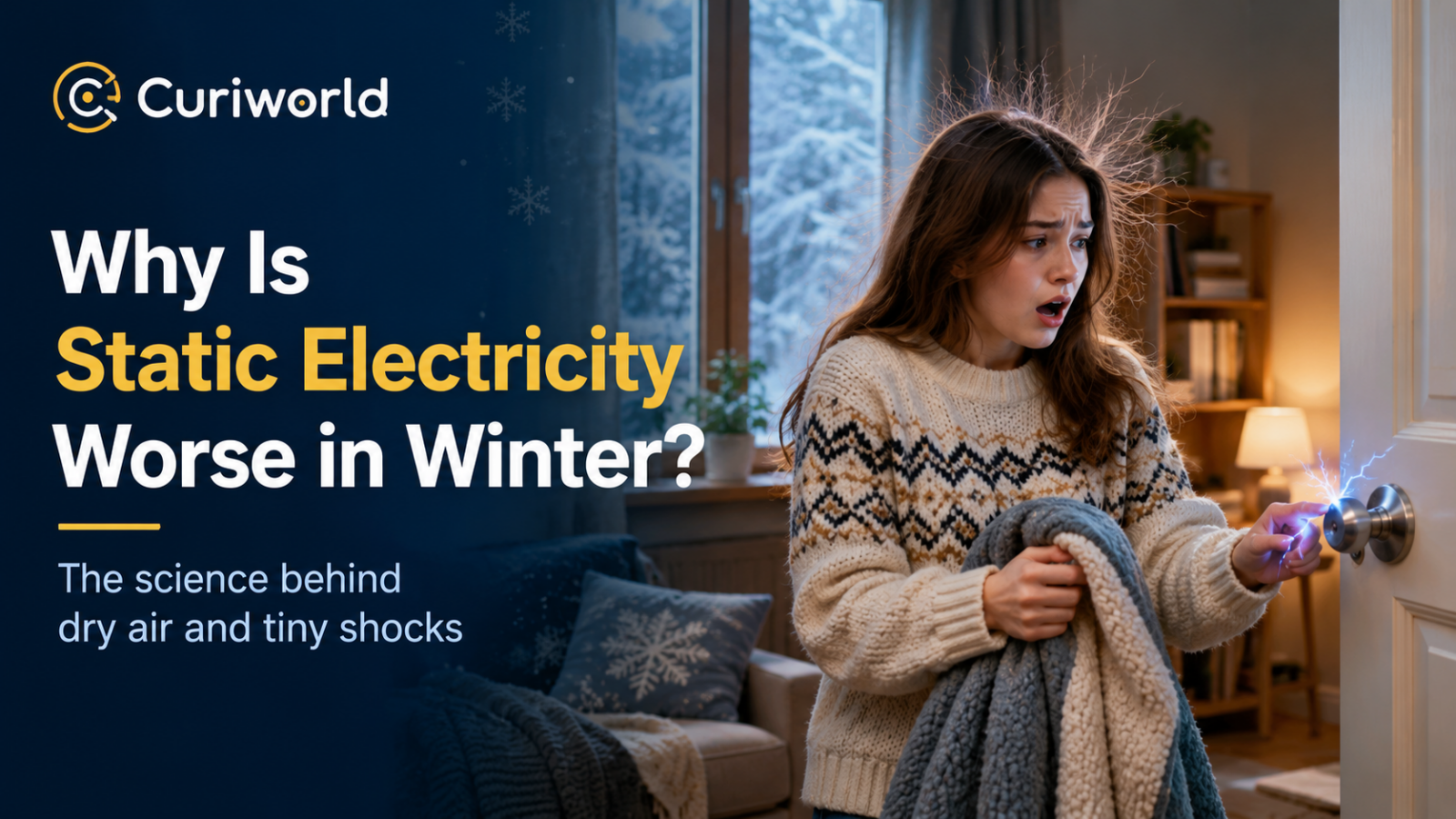
You walk across a carpet, reach for a metal doorknob and—
zap.
A tiny spark jumps between your finger and the metal.
Your sweater crackles when you take it off. Your hair stands up after removing a hat. A blanket seems to produce miniature lightning in the dark.
And somehow all of this happens far more often in winter.
The obvious suspect is cold weather, but cold itself is not the main reason.
Static electricity becomes more noticeable in winter largely because the air—especially heated indoor air—is much drier. With less moisture available to help electrical charge leak away, charge can build up on your body and objects until it suddenly discharges as a spark. The U.S. National Weather Service notes that static electricity is particularly noticeable during dry winter conditions because humid air allows charge to dissipate more readily.
What Is Static Electricity?

Everything around you is made of atoms.
Atoms contain:
- positively charged protons,
- negatively charged electrons,
- and electrically neutral neutrons.
Normally an object contains roughly balanced positive and negative charge.
But electrons can sometimes transfer between materials when those materials come into contact and then separate.
One surface may gain electrons and become more negatively charged.
The other may lose electrons and become more positively charged.
That imbalance is what we call static electric charge.
Unlike the electricity continuously flowing through a wire, this charge can remain temporarily accumulated on a surface.
Then you touch something conductive.
The accumulated charge suddenly moves.
And you feel:
zap.
Walking Across Carpet Can Charge Your Body
Carpet is one of the classic examples.
As your shoes repeatedly contact and separate from carpet fibers, electrons can transfer between the materials.
Which material gains or loses electrons depends partly on what they are made from.
After several steps, your body may have accumulated an electrical imbalance.
Then your finger approaches a metal doorknob.
Metal is a good electrical conductor.
If the voltage difference is large enough, electrons can cross the tiny air gap between your finger and the metal before you even make full contact.
The air briefly becomes conductive.
A tiny electrical discharge occurs.
That is the spark you see and the shock you feel.
Friction Is Not Actually the Whole Story
You may have learned:
“Rubbing creates static electricity.”
That description is useful, but incomplete.
The charge transfer happens because different materials make contact and separate.
Rubbing often makes the effect stronger because it creates repeated contact across a larger area.
But friction itself is not the fundamental source of charge.
Science World specifically notes that static charge can develop through contact between different materials even without the simplistic idea that friction somehow “creates electricity.”
This process is commonly associated with the triboelectric effect.
It explains familiar experiments such as rubbing a balloon against hair and watching the hair rise toward it.
So Why Is Winter So Much Worse?
The key is water vapor in the air.
Humidity affects how long electrical charge can remain accumulated on many surfaces.
When the surrounding environment is relatively humid, thin layers of moisture can form on surfaces.
That moisture makes it easier for electrical charge to move away gradually.
Instead of remaining concentrated until a dramatic spark occurs, the excess charge can leak away.
Dry air makes that process less effective.
As a result:
charge builds → stays longer → voltage increases → sudden discharge becomes more likely.
The National Weather Service gives essentially this explanation: winter’s dry air allows larger static charges to accumulate, while moisture in humid air helps electrons move away more quickly.
Why Does Heating Your Home Make the Air Feel So Dry?
This part can be confusing because winter outdoor air may sometimes have a high relative humidity.
You can even have snow or rain outside while your heated home feels extremely dry.
The reason is that relative humidity depends on temperature.
Cold air can contain much less water vapor than warm air before becoming saturated.
Bring cold outdoor air indoors and heat it without adding additional moisture.
The absolute amount of water vapor may remain similar.
But because the warmer air could hold much more moisture, its relative humidity falls dramatically.
The National Weather Service explains this relationship: warmer air can accommodate substantially more water vapor, so warming air without adding moisture lowers relative humidity.
That creates classic winter indoor conditions:
warm room + low relative humidity + carpets + synthetic clothing = excellent conditions for static buildup.
Why Are Carpets So Bad for Static?
Carpets repeatedly bring different materials into contact.
Your shoe sole touches the carpet.
You lift your foot.
It touches again.
This happens hundreds of times as you walk across a room.
Depending on the materials involved, charge may transfer with each contact.
Synthetic carpeting can make the effect especially noticeable.
Then your body acts as a temporary reservoir for that accumulated charge.
Nothing dramatic happens while you are walking.
The surprise comes when you touch:
- a metal door handle,
- a radiator,
- a filing cabinet,
- a car door,
- another person,
- or another conductive object.
That is when the stored charge finds a rapid path to equalize.
Why Do Sweaters Crackle in Winter?
Clothing creates the same basic phenomenon.
When layers of fabric rub against each other and then separate, charge can transfer.
Synthetic materials are particularly good at retaining charge because they are generally poor electrical conductors.
Pull a sweater over your head in dry winter air and you may hear:
crack… crack… crack.
In a dark room, you can sometimes even see tiny flashes.
Those are miniature electrical discharges.
Your clothing has essentially created a very small-scale version of the same basic electrical phenomenon behind much larger sparks.
Why Does Your Hair Stand Up?
Rub a balloon against your hair and electrons transfer between the two materials.
Individual hairs can end up with similar electrical charges.
Like charges repel each other.
So instead of lying together, the hairs push apart.
Since each hair is trying to move away from the others, they spread outward and appear to stand up.
The National Weather Service uses this exact balloon-and-hair demonstration to explain static electricity.
Winter hats can create a similar effect.
Remove a wool or synthetic hat in a dry room and suddenly your hairstyle appears to be negotiating with gravity.
Why Does Touching Metal Hurt More?
Metal does not necessarily create the charge.
It provides an efficient path for discharging it.
Suppose you have accumulated charge while walking across a carpet.
Your body and the metal object now have different electrical potentials.
As your fingertip gets extremely close to the metal, the electric field across the small gap may become strong enough for the air to break down electrically.
A spark jumps across.
The charge equalizes very quickly.
Your nervous system notices the sudden discharge as a sharp sting.
The total energy is normally very small, but because the discharge occurs so rapidly and in a tiny area of skin, it can feel surprisingly intense.
Why Can You Sometimes See the Spark?
Air normally behaves as an electrical insulator.
But sufficiently strong electric fields can ionize molecules in the air and create a temporary conductive path.
Electrons rush through that path.
Some of the energy excites molecules in the air.
When those molecules return to lower-energy states, they can emit light.
That brief flash is the visible spark.
In a bright room it may be impossible to notice.
Turn off the lights and the same discharge can look like a tiny blue-white lightning bolt.
Is Static Electricity Basically Tiny Lightning?
The scale is enormously different, but there is a useful conceptual similarity.
Both involve:
- electrical charge separation,
- growing differences in electrical potential,
- and a sudden discharge through air once conditions allow it.
A thunderstorm can separate enormous amounts of electrical charge across kilometers of atmosphere.
Your winter carpet generates a vastly smaller charge across a tiny distance.
So calling a static spark “miniature lightning” is not completely unreasonable as an analogy.
It is simply happening with dramatically less energy.
Why Don’t We Get Shocked Every Time?
Because charge buildup depends on many variables.
Change any of them and the result may change.
Important factors include:
- humidity,
- shoe material,
- flooring,
- clothing,
- how much you move,
- what surfaces you touch,
- and how easily charge can leak away.
Walk across the same carpet wearing different shoes and you may get a different result.
Repeat the experiment on a humid summer day and the charge may disappear before reaching a high enough voltage to produce an obvious spark.
That is why static electricity can seem strangely unpredictable.
Why Is Static Worse in Cars During Winter?
Cars combine several ingredients that can produce static charge.
You slide across the fabric seat while getting out.
Your clothing and the seat separate.
Your body can become charged.
Then you reach for the metal door frame.
Zap.
It can feel as though the car itself shocked you, but charge transfer between your clothing and the seat may have occurred while you were moving.
Dry winter conditions allow that charge to remain longer.
One useful habit is to keep a hand in contact with a metal part of the vehicle while getting out, allowing charge to equalize more gradually rather than waiting until your fingertip approaches the door afterward.
Does Humidity Really Make That Much Difference?
Yes.
A classic static electricity experiment that works perfectly on a dry day can behave poorly on a humid one.
Science World specifically warns that humidity can make it difficult for static charges to accumulate. In another demonstration, adding moisture causes charge on balloons to dissipate.
That is why classroom electrostatic demonstrations often work best under dry conditions.
It is also why your house can feel like a static-electricity laboratory in January and perfectly ordinary in July.
Can a Humidifier Reduce Static Electricity?
Increasing indoor humidity can reduce static buildup because surfaces become less electrically insulating.
That does not mean the goal should be to make your house extremely humid.
Excess indoor moisture can create entirely different problems, including condensation and mold.
For broader indoor-air considerations, many guidelines put normal indoor relative humidity somewhere around the 30–50% range, depending on conditions.
Curiworld’s existing guide on why bathroom mirrors fog after showers explores the opposite side of the humidity problem: when enough moisture is present for water to condense on cooler surfaces.
The useful lesson is not:
“More humidity is always better.”
It is that extremely dry air makes static charge easier to retain, while excessive humidity creates its own indoor-moisture problems.
Why Does a Dryer Create So Much Static?
A clothes dryer is almost a perfect static-generating environment.
Different fabrics:
- tumble together,
- touch repeatedly,
- rub,
- separate,
- and become very dry.
As water leaves the fabric, there is less moisture available to help accumulated electrical charge escape.
Synthetic materials can be especially noticeable.
The result is familiar:
- socks sticking to shirts,
- clothes clinging together,
- hair attracting fabric,
- and tiny crackling discharges.
It is the same physics you experience with carpet, compressed into a rotating drum.
Can Static Electricity Damage Electronics?
Ordinary household static shocks are usually more annoying than dangerous to people.
Sensitive electronics are another matter.
An electrostatic discharge (ESD) that you barely notice can potentially damage vulnerable electronic components.
This is why people assembling computers or handling exposed circuit boards often use anti-static procedures such as:
- grounding themselves,
- using ESD-safe work surfaces,
- handling components by their edges,
- and avoiding unnecessary contact with electrical contacts.
Touching the outside of your everyday phone or laptop after walking across carpet is not the same as handling an exposed circuit board.
But when working directly with sensitive components, static control matters.
Is Static Electricity Dangerous to People?
The tiny shock from touching a household doorknob is normally harmless.
The electrical energy involved is extremely small.
However, static discharge matters more around certain environments because a spark can potentially ignite flammable vapors or gases.
That is one reason grounding and bonding procedures are important in industries handling fuels, solvents, powders, and other potentially combustible materials.
So:
annoying carpet spark at home: generally trivial.
electrostatic discharge around flammable material: potentially important.
Context matters.
How Can You Reduce Static Shocks in Winter?
You do not need to eliminate electricity from your house.
A few changes can reduce how easily charge accumulates:
- Avoid letting indoor air become excessively dry.
- Use a humidifier appropriately if your home is extremely dry.
- Choose less static-prone clothing combinations when practical.
- Moisturize very dry skin.
- Avoid dragging your feet across carpet.
- Touch grounded metal more gradually instead of approaching it with one fingertip.
- Use anti-static precautions when working with exposed electronics.
If you use a humidifier, monitor humidity rather than simply running it continuously.
Curiworld’s guide to why a room gets dusty so quickly also discusses indoor humidity and humidifier use from a different household perspective.
Frequently Asked Questions
Why do I get shocked more in winter?
Winter indoor air is often much drier. Low humidity allows electrical charge to remain accumulated on your body and other surfaces instead of leaking away gradually, making noticeable sparks more likely.
Does cold weather create static electricity?
Not directly. The stronger effect is associated with the dry conditions common during cold weather and especially with indoor air that has been heated without adding moisture.
Why do blankets spark at night?
Different fabric surfaces repeatedly contact and separate, transferring charge. In dry air, that charge can accumulate and discharge as tiny visible sparks.
Why do I get shocked when touching a doorknob?
Your body may accumulate electrical charge while walking across carpet or moving against clothing. When you approach conductive metal, the charge can suddenly discharge across the small air gap.
Why is there less static electricity in summer?
Summer air is often more humid. Moisture helps accumulated electrical charge dissipate from surfaces, making large static buildups less common.
Can static electricity damage my phone?
Ordinary use usually does not create a problem, but electrostatic discharge can damage sensitive exposed electronic components. Extra ESD precautions are important when handling internal computer or electronic hardware.
Final Thoughts
Static electricity is not stronger in winter because electrons somehow prefer cold weather.
The real story is mostly about dryness.
Materials touch and separate.
Electrons transfer.
Your body accumulates charge.
In humid air, much of that charge can gradually leak away.
But in dry winter air—especially inside heated buildings—it can remain trapped long enough for the electrical potential to grow.
Then your finger approaches a metal doorknob.
The air gap breaks down.
Zap.
A tiny spark equalizes the charge in an instant.
So that annoying winter shock is actually a small demonstration of several fundamental ideas in physics:
electrons, charge transfer, conductivity, humidity, electric fields, and electrical discharge—all happening at your fingertips.
Sources
National Weather Service — Lightning Experiments and Static Electricity








Join the discussion