Why Does Metal Feel Colder Than Wood at the Same Temperature?
Metal and wood can be exactly the same temperature yet feel completely different. The reason is not temperature itself, but how quickly each material moves heat.
Put a metal spoon and a wooden spoon on the same table for a few hours. A thermometer may show that both are at exactly the same temperature, yet the metal will usually feel noticeably colder when you touch it.
Nothing is wrong with the thermometer.
Your hand is not measuring the temperature of the object itself. What you experience as “cold” or “warm” depends largely on how quickly heat moves between the object and your skin.
Metal is extremely good at carrying heat away from your hand. Wood is not. That difference in heat transfer is enough to make two objects at the same temperature feel completely different.
Your Sense of Touch Is Not a Thermometer
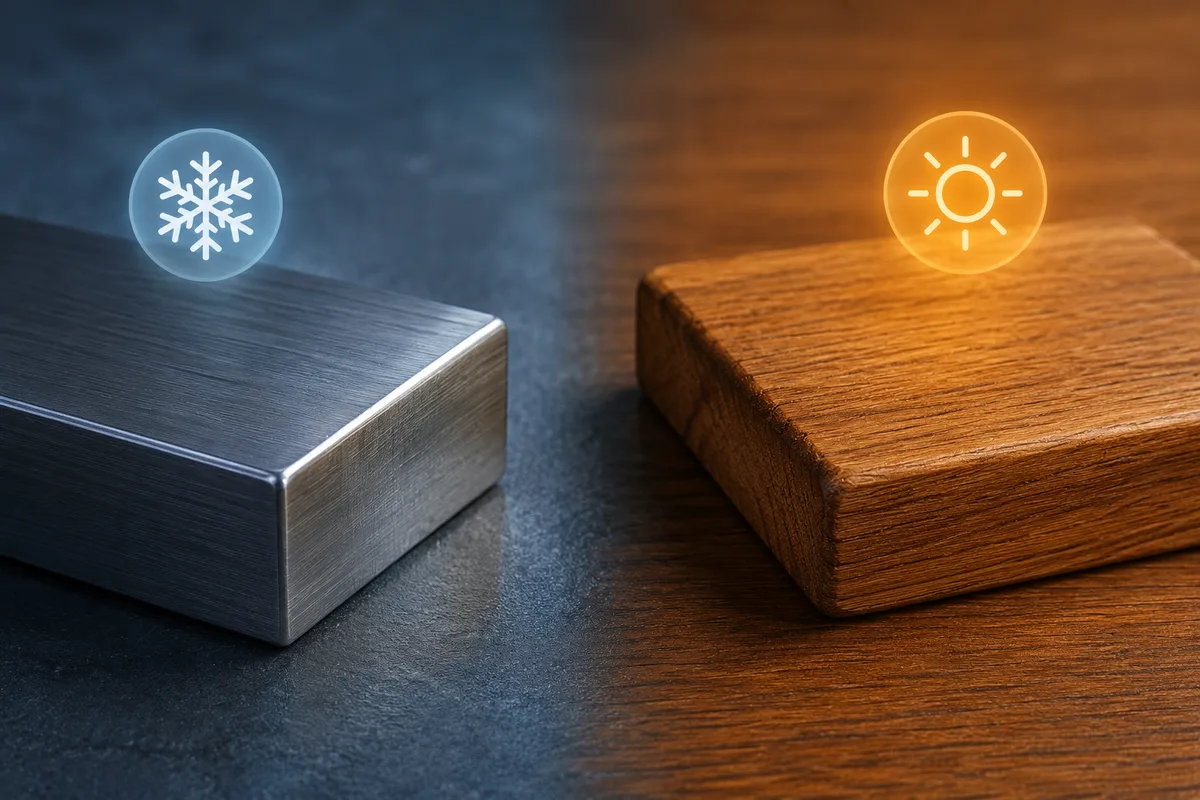
Suppose a metal chair leg and a wooden tabletop have been sitting in a room long enough to reach thermal equilibrium with their surroundings.
If the room is about 72°F (22°C), both objects may also be close to 72°F.
Your skin, however, is warmer.
The surface temperature of your fingers is typically higher than ordinary room temperature. The moment you touch either material, thermal energy begins moving from your warmer hand into the cooler object.
What your nervous system notices is the resulting change in the temperature of your skin.
The American Physical Society explains the effect using this same comparison: metal transfers energy away from your fingers faster than wood does, so your skin cools more rapidly and the metal feels colder.
The important point is subtle:
Your brain is interpreting the rate of heat transfer, not simply reading the object’s temperature.
That is why touch can be surprisingly misleading.
Metal Moves Heat Much Faster Than Wood
The familiar explanation involves thermal conductivity.
Thermal conductivity describes how readily heat moves through a material.
Most metals are good thermal conductors. Once heat from your finger enters the surface of a piece of metal, that energy can quickly spread deeper into the object. The surface touching your hand therefore continues to accept more heat.
Your finger keeps losing energy.
Wood behaves differently.
Wood is a relatively poor thermal conductor. Heat entering the point where your finger touches the wood does not spread through the material nearly as efficiently. The small area directly beneath your finger warms, reducing the temperature difference between your skin and the wood.
Heat transfer then slows.
Your skin stays warmer, so the wood feels warmer.
This difference is also why metal is commonly used when engineers want heat to move efficiently, while materials with lower thermal conductivity are useful for insulation.
Surface temperature and heat transfer can make everyday objects behave in surprisingly different ways. Another familiar example is why a bathroom mirror fogs up after a shower.
Thermal Effusivity Tells the Story Even Better
Thermal conductivity is the easiest way to explain the effect, but there is a more precise concept for what happens during those first moments of contact: thermal effusivity.
Thermal effusivity describes how strongly a material exchanges heat with another material touching it.
It depends not only on thermal conductivity but also on the material’s density and heat capacity. In simplified terms, it describes how readily a material can absorb thermal energy from your skin without its own surface temperature changing very quickly.
Materials with high thermal effusivity tend to feel colder when they are below skin temperature.
Metals generally have high thermal effusivity. Wood has much lower thermal effusivity.
Research on tactile temperature perception has found that materials maintained at similar temperatures can produce different sensations of warmth because of these thermophysical properties. Studies comparing building materials have also shown that people can perceive one material as colder even when it is actually slightly warmer than another.
That is a useful reminder that temperature and perceived temperature are not the same thing.
A Simple Experiment Makes the Effect Obvious
You can test the idea without special equipment.
Find two objects that have been sitting in the same room for several hours:
- a metal object, such as a spoon or furniture leg,
- and a wooden object, such as a table, shelf, or spoon.
Neither should have recently been near sunlight, a heater, electronics, or another heat source.
Touch each one.
The metal will probably feel colder.
Now measure both with an appropriate thermometer if you have one.
Their temperatures may be almost identical.
The difference you felt came primarily from what happened after your finger made contact.
Your skin began warming both materials, but the metal accepted and distributed that heat much more efficiently.
Why Metal Can Also Feel Hotter Than Wood
The same physics works in reverse.
Imagine a piece of metal and a piece of wood that are both warmer than your skin.
Now heat flows from the objects into your hand.
Because metal transfers thermal energy efficiently, it delivers heat to your skin much faster than wood does.
This time, the metal feels hotter.
So saying “metal feels cold” is incomplete.
A better rule is:
Metal tends to make temperature differences feel more intense because it exchanges heat with your skin quickly.
Below skin temperature, it feels colder.
Above skin temperature, it feels hotter.
This is one reason touching metal that has been sitting in strong sunlight can be dramatically different from touching nearby wood, even before considering that the two surfaces may actually have reached different temperatures in the sun.
Why Wood Feels Relatively Warm
Wood is often described casually as a “warm” material.
Part of that impression is visual and psychological, but there is also a physical reason.
Its relatively low thermal conductivity and effusivity mean that it does not pull heat away from your skin as aggressively as metal.
The area of wood under your hand warms relatively quickly while the heat spreads slowly through the rest of the object.
That thin warmed region acts almost like a buffer between your skin and the cooler material beneath it.
This is why wooden furniture, handles, and floors can feel comfortable at temperatures where metal objects seem distinctly chilly.
The wood is not secretly warmer.
It simply changes your skin temperature more slowly.
This Is Also Why Carpet Feels Warmer Than Tile
The same basic principle explains another everyday experience.
Walk barefoot across a room where a rug and a tile floor have been sitting at the same indoor temperature.
The tile usually feels colder.
The rug feels warmer.
Again, the temperatures do not necessarily need to be different.
Tile accepts heat from your foot more readily. Carpet contains fibers and trapped air that greatly reduce heat transfer.
Your foot therefore cools more rapidly on tile.
The difference can be so convincing that people naturally assume the tile itself must be several degrees colder.
Sometimes it is. But even at the same temperature, the materials can still feel different.
Why a Metal Bench Is Brutal on a Cold Day
The effect becomes stronger when the temperature difference between your skin and the object increases.
Touch a metal railing indoors and it may feel mildly cool.
Touch a metal railing on a freezing winter morning and it can feel painfully cold.
Your hand is now much warmer than the metal, creating a large temperature difference that drives rapid heat transfer.
Wood exposed to the same cold conditions will also be cold, but because it transfers heat more slowly, it usually does not draw energy from your skin as aggressively during the first moments of contact.
This is one reason material choice matters for things people regularly touch, from tool handles and outdoor furniture to flooring and building interiors.
Surface Texture Can Change What You Feel
Material type is not the only factor.
How completely your skin contacts a surface also matters.
A smooth object can make broad contact with the skin, while a rough surface may touch only at many small points with tiny pockets of air in between.
Since air is a poor conductor of heat, reduced contact can make heat transfer slower.
Thickness and construction matter too.
A paper-thin metal coating over an insulating material may not feel exactly like a thick solid block of metal. A piece of engineered wood may behave differently from dense hardwood. Moisture can also change thermal behavior.
So “metal versus wood” is an excellent demonstration of heat transfer, but real objects involve more than a single material property.
Why Your Hand Cannot Tell You the True Temperature
Human temperature perception is designed to protect the body, not to replace laboratory instruments.
From a biological perspective, detecting rapid changes in skin temperature is extremely useful.
Something pulling heat from your hand quickly may present a cold hazard. Something transferring heat into your skin quickly may cause a burn.
Your nervous system therefore cares greatly about what is happening to your skin.
It does not need to determine whether a stainless-steel surface is exactly 68°F or 70°F.
A thermometer has a different job. Given enough time and appropriate measurement conditions, it can measure the actual temperature of each surface independently of how that surface feels to you.
That is why the thermometer wins the argument when your hand insists that two room-temperature objects cannot possibly be the same temperature.
The Cold Feeling Is Really Heat Leaving Your Hand
The strange part of touching cold metal is that “cold” is not entering your fingers.
Energy is leaving them.
Your warm skin transfers heat into both the metal and the wood. Metal carries that energy away from the contact point much more effectively, allowing the process to continue rapidly. Wood slows the transfer, so your skin remains warmer.
The result is one of those everyday illusions that becomes more interesting once you know the physics behind it.
The metal does not have to be colder.
It only has to be better at making you colder.
Sources
American Physical Society — “Getting Warmer/Getting Colder.”
American Physical Society source
Aalto University — “Quantifying the Sensation of Temperature: A New Method for Evaluating the Thermal Behaviour of Building Materials.”
Aalto University research source








Join the discussion