Countries Inside Other Countries: How Do They Exist?
Lesotho sits inside South Africa, while San Marino and Vatican City sit inside Italy. So how can a country exist entirely inside another one?
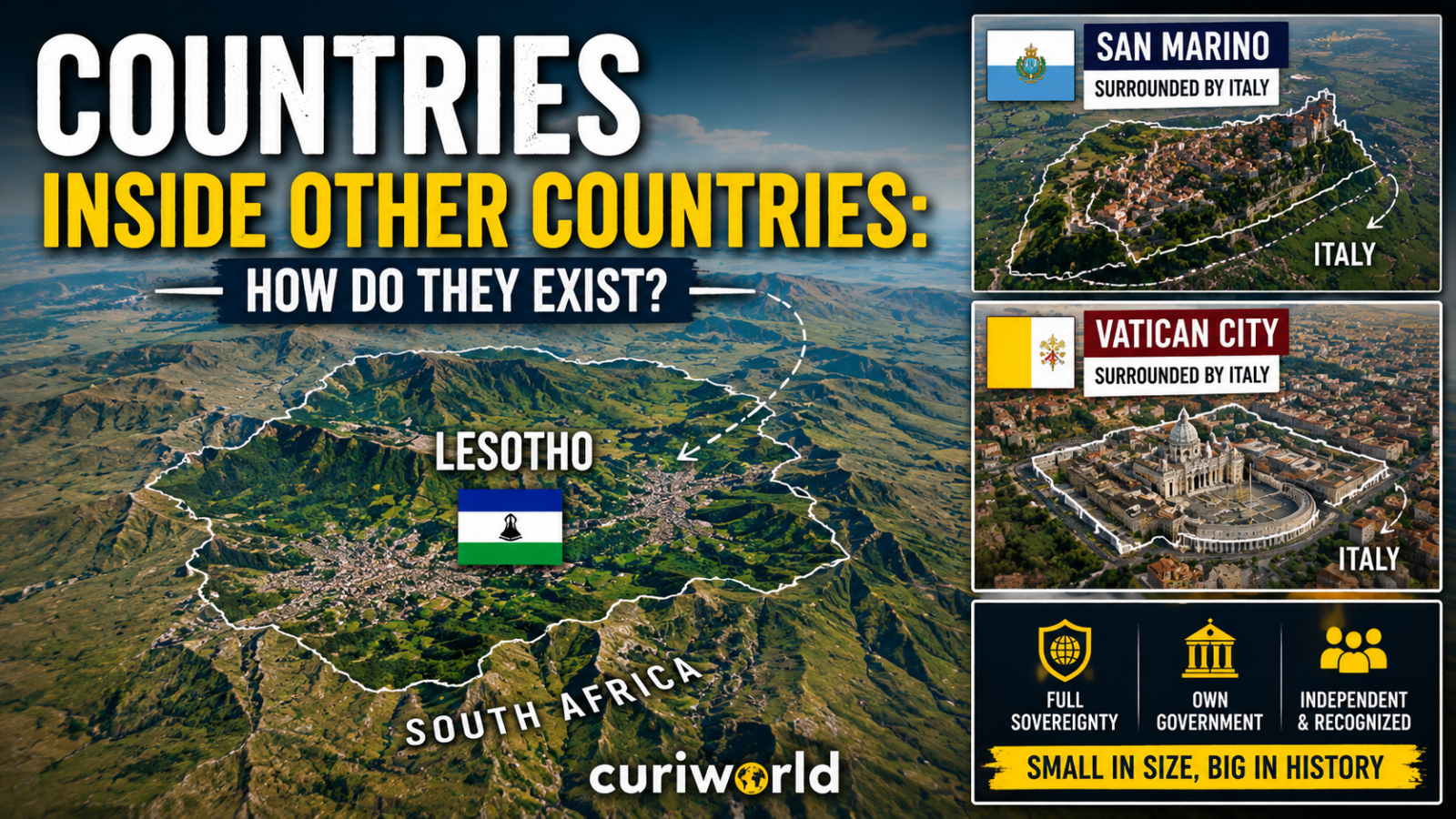
A country is supposed to have borders with other countries—or at least a coastline.
Yet three countries break that expectation completely.
Lesotho is surrounded by South Africa. San Marino is surrounded by Italy. Vatican City is surrounded by Rome, inside Italy.
They have no second neighboring country and no independent route to the sea. Cross any land border and you enter the same country that surrounds them.
Still, none of them belongs to its larger neighbor.
They have their own sovereignty, governments, laws, and international identities.
The reason is simple but easy to overlook: geography can surround a country, but geography does not decide who owns it. History and political sovereignty do.
How Many Countries Are Completely Surrounded by Another Country?
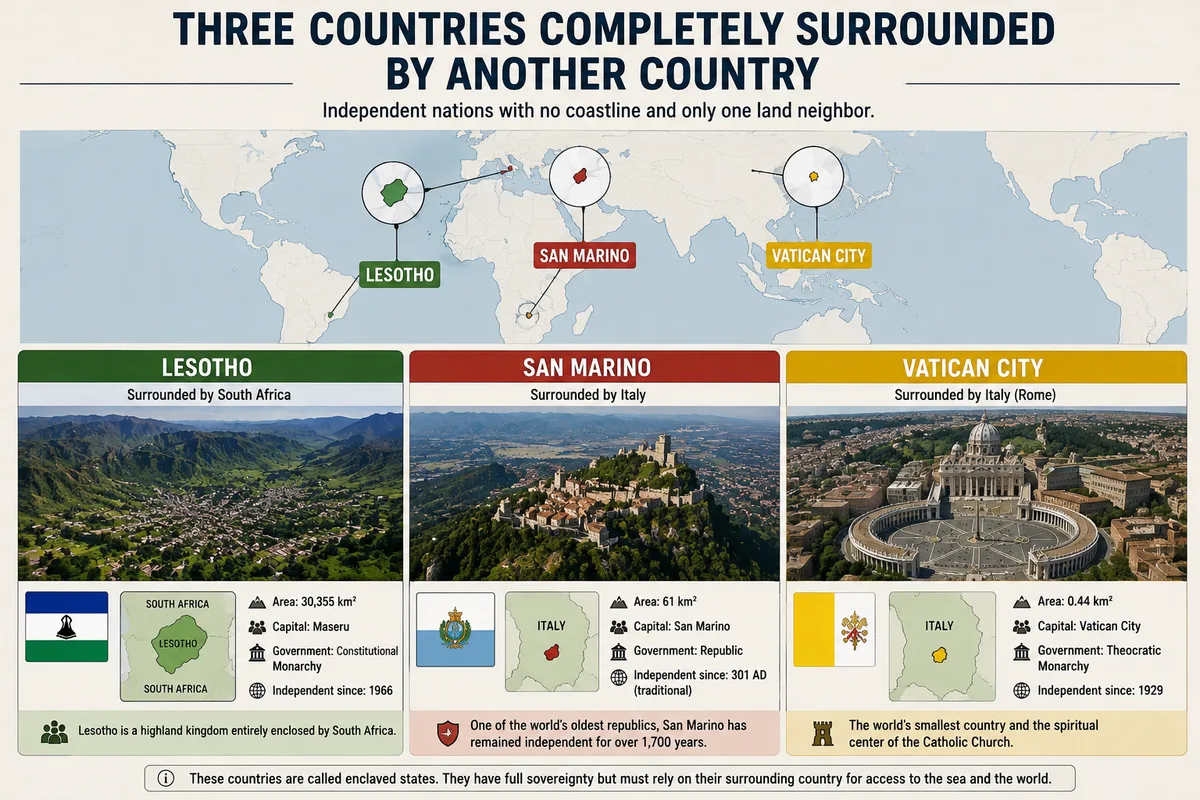
A country completely enclosed by the territory of one other country is usually described as an enclaved state.
Only three sovereign states fit the strict definition:
- Lesotho, surrounded by South Africa
- San Marino, surrounded by Italy
- Vatican City, surrounded by Italy
That is different from simply being landlocked.
Switzerland has no coastline, for example, but it borders several countries. Mongolia is landlocked between Russia and China.
Lesotho has only South Africa.
San Marino has only Italy.
Vatican City does not even reach the outer edge of Italy—it sits inside the city of Rome.
Being enclosed does not make these countries subdivisions of their neighbors. Their borders mark changes in sovereign jurisdiction just as surely as the border between France and Germany does.
Geography even has specific terms for these arrangements; our guide explains what enclaves and exclaves are, with some of the world’s strangest examples.
What Is an Enclaved Country?
An enclaved country is a sovereign state whose entire land territory is surrounded by one other sovereign state.
That is different from:
- a landlocked country, which has no coastline but may border several countries;
- an exclave, which is a detached part of a country;
- or a territory with special legal status that is not an independent state.
Lesotho, San Marino and Vatican City are unusual because the entire sovereign country is enclosed by one neighboring country.
Lesotho: South Africa Completely Surrounds a Kingdom
Lesotho is by far the largest of the three.
Its unusual geography makes more sense once you stop looking at the modern map and look at the order in which the political entities developed.
The Basotho nation took shape under King Moshoeshoe I during the nineteenth century. The Government of Lesotho traces the country’s emergence as a single polity to this period.
As conflict and territorial pressure increased in southern Africa, Moshoeshoe sought British protection. The territory that became Basutoland eventually came under direct British control.
Meanwhile, the political map around it continued changing.
The Union of South Africa was created in 1910, bringing several surrounding British colonies together—but Basutoland was not incorporated into it.
When Basutoland became independent on October 4, 1966, it became the Kingdom of Lesotho.
The result is today’s remarkable map:
A sovereign country completely encircled by South Africa.
This is an important distinction. Lesotho was not recently carved out of the middle of an already existing South Africa for the sake of creating a strange border.
Its separate political history survived while the territories around it were consolidated into a much larger state.
Does Lesotho Depend on South Africa?
Geographically, there is no way around South Africa.
Any ordinary overland journey from Lesotho to another country must first enter South African territory. Goods moving by road toward an international seaport face the same reality.
That gives geography real economic consequences.
But dependence and sovereignty are not opposites.
Countries around the world depend on neighbors for transport routes, trade, electricity, water, employment, or access to ports without surrendering their independence.
Lesotho remains an internationally recognized sovereign state.
Its surrounding geography creates constraints.
It does not erase the border.
San Marino: A Small State That Survived a Changing Italy
San Marino creates a very different puzzle.
It covers only about 61 square kilometers, yet it sits independently inside Italy.
Its separate identity stretches back far earlier than the modern Italian state.
San Marino developed around Mount Titano and survived centuries during which the Italian Peninsula was divided among republics, kingdoms, duchies, papal territories, and other political entities.
During the nineteenth-century movement toward Italian unification, most of the peninsula became part of the Kingdom of Italy.
San Marino did not.
Instead, its separate political existence was preserved.
Modern San Marino therefore is not a tiny Italian region pretending to be a country. It is a sovereign republic whose existence predates the unified country surrounding it.
Today it maintains close relations with Italy and is geographically dependent on crossing Italian territory to travel elsewhere by land.
Yet the international border remains real.
Sometimes the strangest thing about a country is not how it was created.
It is how it managed not to disappear while everything around it changed.
Vatican City: A Country Inside a Capital City
Vatican City takes the idea even further.
San Marino is surrounded by Italy.
Vatican City is surrounded specifically by Rome.
At roughly 0.44 square kilometers, Vatican City is the world’s smallest independent state by territory.
Its modern sovereignty dates from 1929, when an agreement between Italy and the Holy See settled the long-running dispute over the political status of the papacy following Italian unification.
Vatican City State provided a territorial basis for the Holy See’s independence from Italy.
This distinction is useful:
Vatican City is the territorial state.
The Holy See is the central governing authority of the Catholic Church and the entity through which diplomatic relations are conducted.
The two are closely connected but are not simply interchangeable terms.
Walk across the boundary around St. Peter’s Square and you can therefore move from Italy into another sovereign state without traveling between distant cities, crossing a river, or passing through a dramatic mountain frontier.
Why Doesn’t Italy Simply Absorb San Marino or Vatican City?
Because surrounding a country does not create a legal right to own it.
International borders exist through political authority, treaties, recognition, historical continuity, and international law.
Italy cannot simply declare San Marino Italian because the country happens to be inside Italian territory.
The same principle applies to Vatican City.
A larger country surrounding a smaller one may have enormous geographic advantages, but size is not sovereignty.
Consider the reverse idea.
If Country A completely surrounded Country B and geographic enclosure automatically transferred ownership, then international borders would depend on shape rather than political status.
They do not.
A tiny state can be just as sovereign as a huge one.
Why Didn’t These Countries Eventually Merge With Their Neighbors?
History rarely reorganizes itself simply because a cleaner map would look nicer.
Once a political community maintains separate institutions, agreements, identity, and international recognition, removing that sovereignty becomes a major political act.
There also needs to be a reason for both sides to want it.
San Marino has little incentive to disappear into Italy merely to simplify an atlas.
Lesotho does not become unnecessary because South Africa surrounds it.
Vatican City exists specifically because territorial independence serves a political and institutional purpose.
What looks inconvenient from a mapmaker’s perspective may work perfectly well from the perspective of the people and institutions involved.
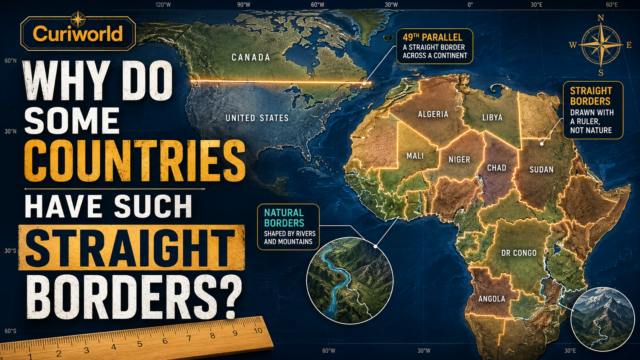
This is the same reason so many unusual borders survive elsewhere. As Curiworld explains in why some countries have such straight borders, political boundaries are often inherited from treaties, historical claims, surveying decisions, conflicts and compromises rather than designed from scratch to produce tidy shapes.
Being geographically surrounded does not create any automatic legal claim for the surrounding country.
Sovereignty depends on political history, treaties, institutions, recognition and the continued existence of the state—not on whether its borders look convenient on a map.
Being Surrounded Creates Practical Problems
Independence does not make geography disappear.
An enclaved country has an unusual vulnerability: almost every physical connection with the wider world involves its surrounding neighbor.
Road access matters.
Customs arrangements matter.
Trade agreements matter.
Transport infrastructure matters.
Diplomatic relations with the surrounding country matter enormously.
For Lesotho, this issue operates on the scale of an entire national economy.
For tiny San Marino and Vatican City, the relationship is physically much more compact, but cooperation with Italy remains unavoidable.
An ordinary country can potentially choose among several land neighbors.
An enclaved country cannot choose a different surrounding state.
Geography therefore does not determine sovereignty—but it can strongly influence how sovereignty operates in everyday life.
What Is the Difference Between an Enclave and an Exclave?
The terms are related but not identical.
An enclave is territory completely surrounded by other territory.
An exclave is a part of a country that is physically separated from the country’s main territory.
A place can sometimes be both.
For example, a detached territory may be an exclave from the perspective of the country it belongs to and an enclave from the perspective of the territory surrounding it.
Lesotho, San Marino and Vatican City are different because they are not detached pieces of larger countries. They are sovereign states in their own right.
Are Embassies Tiny Countries Inside Other Countries?
No.
This is one of the most persistent geographical myths.
An embassy can enjoy special legal protections under international law, but the land does not literally become sovereign territory of the country using the embassy.
The U.S. Embassy in London is not a piece of the United States.
The Italian Embassy in Washington is not a piece of Italy.
The same caution applies to military bases and many properties with special diplomatic or extraterritorial arrangements.
They may have unusual legal status.
That is different from being an independent sovereign country physically enclosed by another country.
Lesotho, San Marino, and Vatican City are the real thing.
Why Aren’t Monaco or The Gambia Included?
Monaco is almost surrounded by France, but it has a Mediterranean coastline.
The Gambia is largely wrapped by Senegal, yet it reaches the Atlantic Ocean.
Neither is completely enclosed on all sides by the land territory of one country.
That coastline changes the classification.
A true enclaved state has no independent coastline and no second neighbor.
Every overland exit leads into the same surrounding country.
That is why the list contains only three.
The Map Makes Them Look Impossible—History Makes Them Logical
Seen without context, these countries can look like geographical mistakes.
They are not.
Lesotho exists because the Basotho polity survived a complicated history of regional conflict, British protection, colonial rule, and the creation of South Africa around it.
San Marino survived centuries of political transformation on the Italian Peninsula and remained independent through Italian unification.
Vatican City emerged from a specific settlement designed to guarantee the territorial independence associated with the Holy See.
Three countries.
Three completely different historical paths.
The common feature is the shape left on today’s map.
And that is one of the most useful lessons political geography can teach:
A country does not stop being a country because another country happens to surround it.
Borders tell us where sovereignty changes.
History tells us why.
Sources
South African Government — Lesotho Is Completely Enclosed by South Africa




Join the discussion