Can Hot Water Really Freeze Faster Than Cold Water? The Mpemba Effect
Hot water does not always freeze faster than cold water, but under certain conditions an initially hotter system can cool unusually quickly. This counterintuitive behavior is known as the Mpemba effect.
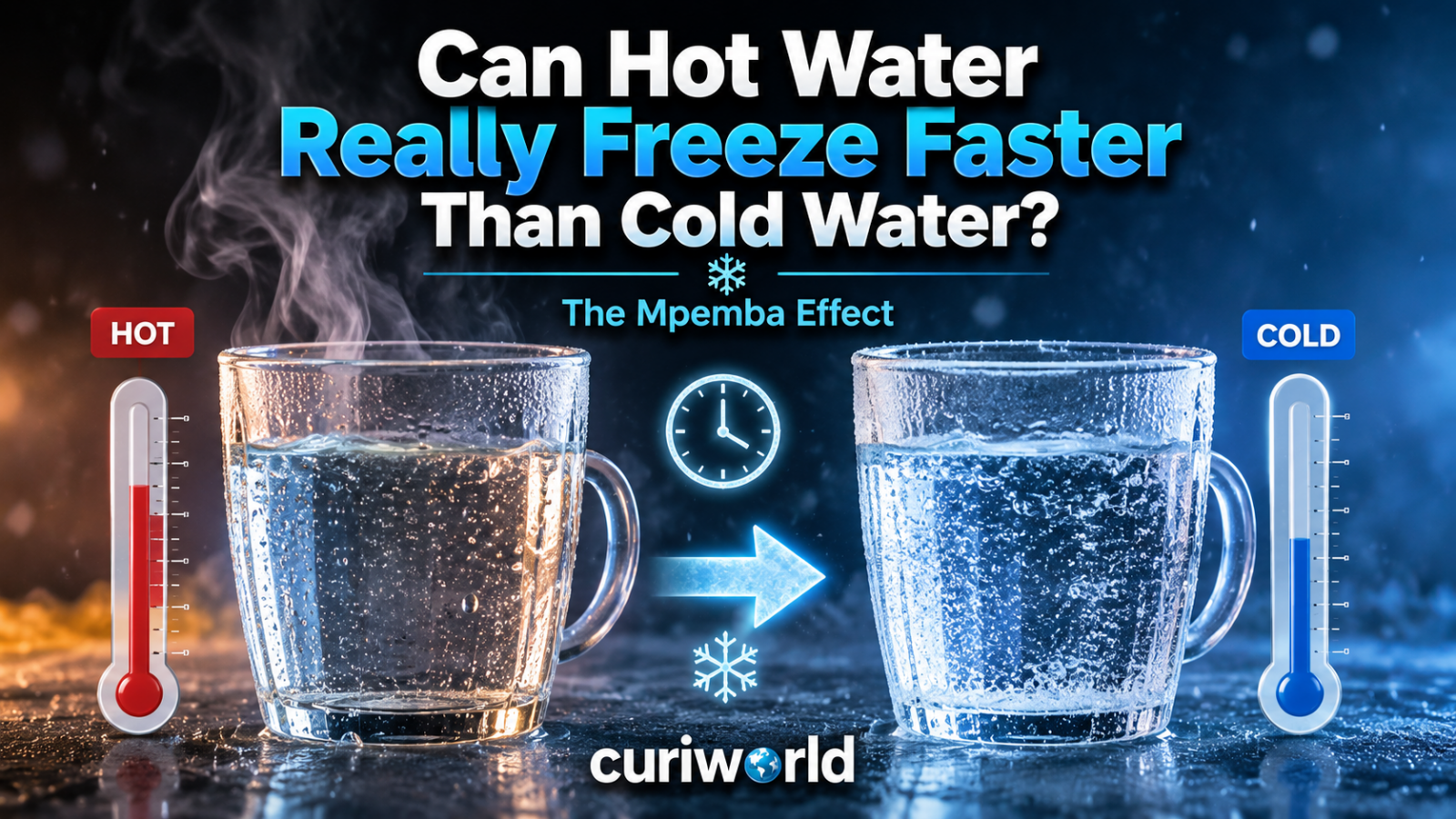
It sounds impossible.
Put one container of hot water and another container of cooler water into the same freezer.
Common sense says the cooler water should freeze first.
After all, the hot water has farther to go before reaching the freezing point.
Yet under some experimental conditions, researchers have reported the opposite:
water that starts hotter can sometimes reach a frozen state sooner.
This strange phenomenon is known as the Mpemba effect.
But there is an important catch.
The popular claim that “hot water always freezes faster than cold water” is false.
The Mpemba effect is highly sensitive to experimental conditions, definitions and the thermal history of the water. Scientists have debated for decades when it genuinely occurs and what mechanisms are responsible. Some controlled experiments have even failed to find a meaningful water-freezing Mpemba effect at all.
So the interesting question is not:
Does hot water freeze faster?
It is:
Under what conditions could hotter water cool or freeze faster than cooler water?
What Is the Mpemba Effect?
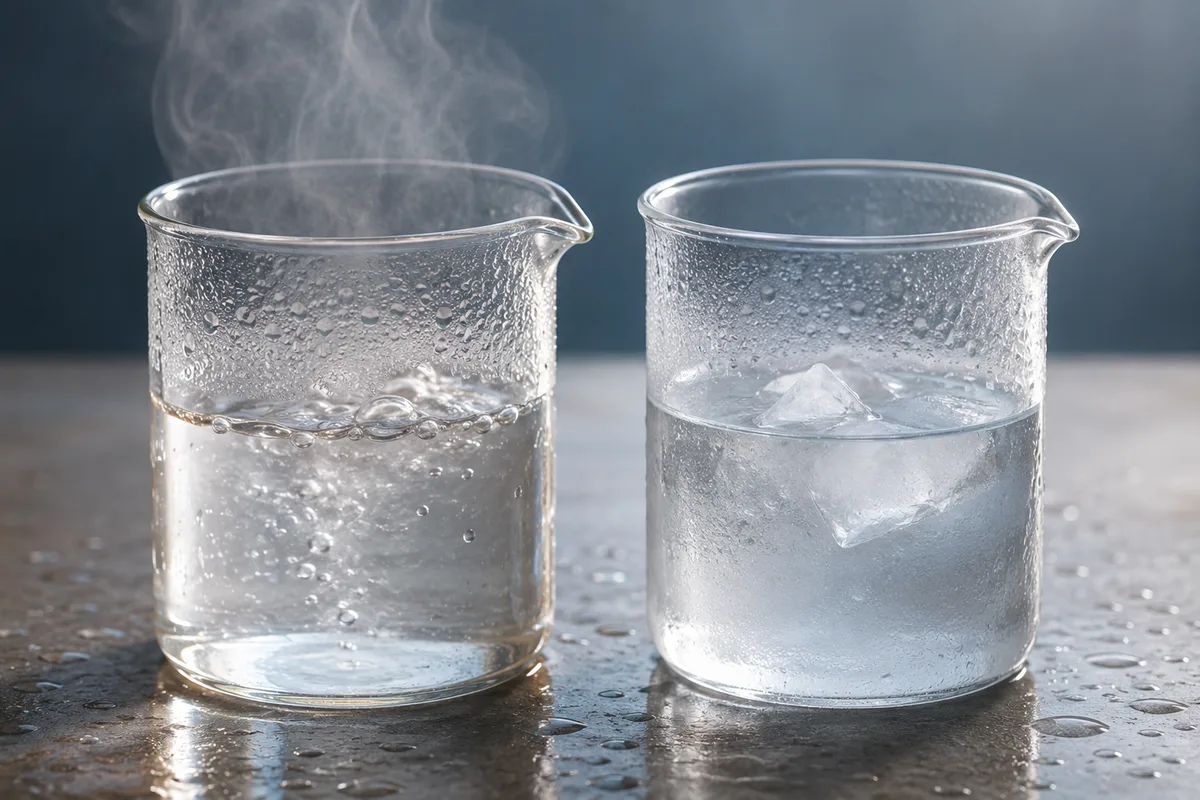
The Mpemba effect describes situations in which a system starting farther from thermal equilibrium reaches a colder state faster than one starting closer to it.
The famous everyday version involves water:
hot water apparently freezing sooner than cooler water under otherwise similar conditions.
Modern physics uses the term more broadly. Researchers now study Mpemba-like relaxation in statistical, colloidal and even quantum systems.
That broader scientific interest is important.
It suggests that the underlying puzzle is not simply a strange property unique to ice cubes.
It is connected with a deeper question:
Does being closer to equilibrium always mean reaching equilibrium sooner?
Surprisingly, the answer can sometimes be no.
Where Did the Name Come From?
The phenomenon is named after Erasto Mpemba, a Tanzanian student.
In the 1960s, Mpemba noticed something unexpected while making ice cream: a hotter mixture appeared to freeze sooner than a cooler one.
He continued asking about the observation despite initial skepticism.
Eventually he worked with physicist Denis Osborne, and their account brought renewed scientific attention to the phenomenon.
But the observation itself is much older.
Reports that heated water may sometimes freeze unusually quickly have appeared in scientific and philosophical writing for centuries.
What Mpemba did was transform an old curiosity into a modern experimental question.
Why Does the Idea Seem Impossible?
Imagine two identical cups.
Cup A begins at:
80°C
Cup B begins at:
30°C
Both are placed in the same freezer.
Before Cup A can even reach 30°C, it must lose a large amount of heat.
Cup B is already there.
So if everything else remained identical throughout the cooling process, we would naturally expect Cup B to stay ahead.
That reasoning is sound.
This is exactly why researchers are careful with the Mpemba effect.
A hotter sample can freeze first only if starting hotter changes something else about the system or the cooling process.
In real water experiments, many things can change.
Hot Water Can Evaporate More
One frequently suggested explanation is evaporation.
Hot water evaporates faster than cooler water.
If enough water escapes, the hot sample eventually contains less mass.
Now there is less water left to cool and freeze.
So the competition is no longer:
same amount of hot water vs same amount of cold water.
It becomes:
smaller amount of formerly hot water vs larger amount of cooler water.
That can potentially change freezing times.
However, evaporation cannot explain every reported Mpemba-like result.
Experiments can be designed to reduce evaporation, and anomalous cooling behavior has also been studied in systems where evaporation is not the central mechanism.
So evaporation is a possible contributor—not a universal answer.
Convection Can Change the Cooling Rate
Hot water does not necessarily cool uniformly.
Temperature differences inside the container create convection currents.
Warmer, less-dense water rises while cooler water moves downward.
These circulating flows can change how efficiently heat reaches the container walls and escapes into the environment.
A hotter sample may initially produce stronger internal circulation than a cooler sample.
That can increase its heat-loss rate during part of the cooling process.
Again, this does not mean convection guarantees a Mpemba effect.
It means two samples that differ only in their starting temperature may quickly stop behaving as though temperature were their only meaningful difference.
The Container and Freezer Matter
Even something as simple as how a container touches the freezer surface can influence the experiment.
Imagine placing a very hot container on frost.
The heat may melt some of the ice beneath it.
The container could then make better thermal contact with the cold freezer shelf.
A cooler container might remain sitting on an insulating layer of frost.
Now the hot sample has accidentally gained a better pathway for transferring heat.
What looks like a mysterious property of water may partly involve:
- the freezer,
- frost,
- container material,
- shape,
- surface contact,
- airflow,
- and heat transfer.
This is one reason household freezer experiments are difficult to interpret.
Supercooling Makes Freezing Complicated
Reaching 0°C is not always the same as freezing.
Very pure or undisturbed water can sometimes cool below its normal freezing point while remaining liquid.
This is called supercooling.
Freezing begins only after ice crystals successfully nucleate.
One sample might cool to:
−2°C and remain liquid
while another begins forming ice near:
0°C.
Which one “froze first”?
The answer depends on how the experiment defines freezing.
This is one of the biggest problems in Mpemba-effect discussions.
Researchers may measure:
- time to reach 0°C,
- time until the first ice crystal appears,
- time until a certain percentage freezes,
- or time until the entire sample becomes solid.
Those are not equivalent measurements.
A major controlled study published in Scientific Reports emphasized exactly this difficulty and argued that convincing, repeatable evidence for ordinary water consistently freezing faster simply because it started hotter has been elusive.
The Water’s History Can Matter
An especially interesting possibility is that temperature history matters, not just the temperature shown by a thermometer when the experiment begins.
Heating water can change:
- dissolved gas levels,
- convection patterns,
- evaporation,
- microscopic impurities,
- nucleation behavior,
- and interactions with the container.
That means two samples both reading 30°C might not actually be physically identical if:
- one was heated to boiling and cooled back down,
- while the other was never heated.
An American Physical Society experiment reported freezing differences associated with the previous thermal history of water, illustrating how difficult it is to define “identical except for temperature.”
Does Dissolved Gas Matter?
Water naturally contains dissolved gases.
Heating drives some of those gases out.
That changes the composition of the water before freezing.
Scientists have investigated whether changes in dissolved gases could influence:
- convection,
- nucleation,
- thermal properties,
- or freezing behavior.
Results have not produced a single accepted explanation for every Mpemba-effect experiment.
But dissolved gases are another reminder that heating water can alter more than its temperature.
The hot sample arriving at 30°C may not be identical to water that started at 30°C.
Why Scientists Disagree About the Effect
You might expect a question this simple to have been settled immediately.
But experimentally, it is surprisingly difficult.
To compare two samples properly, researchers must control variables such as:
- water volume,
- container shape,
- freezer temperature,
- airflow,
- evaporation,
- dissolved substances,
- initial temperature,
- water purity,
- nucleation sites,
- thermometer placement,
- and the definition of “frozen.”
Small differences can change the result.
One influential 2016 investigation concluded that when water samples were carefully compared under controlled conditions, there was no meaningful evidence that hotter water consistently cooled to the freezing point faster than cooler water.
Other work has nevertheless observed Mpemba-like behavior under specific circumstances, while modern statistical physics has demonstrated that anomalous faster relaxation from a “hotter” or farther-from-equilibrium state can occur in more general systems.
So the scientifically accurate conclusion is nuanced.
Is the Mpemba Effect Real or a Myth?
The safest answer is:
The broad physical phenomenon is real, but the popular water claim is oversimplified.
Physics research now recognizes Mpemba-like relaxation effects in multiple systems, and modern theoretical work describes conditions under which a system farther from equilibrium can relax faster than one closer to equilibrium.
But ordinary water in a household freezer does not reliably obey a rule that hotter water freezes first.
That distinction matters.
The internet version:
Hot water freezes faster than cold water.
is too strong.
A better statement is:
Under particular conditions, an initially hotter system may sometimes reach a colder or frozen state sooner than a cooler one.
That is far more interesting scientifically.
What Does Modern Physics Mean by a Mpemba Effect?
Researchers now study the Mpemba effect as a form of anomalous relaxation.
Imagine two systems moving toward the same equilibrium state.
System A begins closer.
System B begins farther away.
You might assume System A must arrive first.
But depending on how each initial state projects onto the system’s slow relaxation processes, System B can sometimes approach equilibrium faster.
This idea has been developed mathematically in statistical physics and has also inspired experiments involving microscopic and quantum systems.
In that sense, the famous freezing-water puzzle opened the door to a much broader field of research.
What Is the Quantum Mpemba Effect?
Recent research has pushed the idea into quantum physics.
Scientists have explored situations in which quantum systems that begin farther from an equilibrium-like state relax faster than systems that initially appear closer.
APS highlighted several such studies in 2024, describing quantum versions of the same counterintuitive relaxation principle.
These experiments do not mean scientists are freezing cups of quantum water.
The similarity is conceptual:
initially farther away does not always mean arriving later.
That principle turns out to be much more general than the original kitchen-freezer story.
Can You Test the Mpemba Effect at Home?
You can experiment with freezing water, but it is surprisingly difficult to draw scientific conclusions from it.
Two trays in a household freezer may experience different:
- airflow,
- shelf contact,
- frost,
- container positions,
- temperature fluctuations,
- and nucleation behavior.
Opening the freezer door changes conditions again.
If one tray freezes first, that does not automatically demonstrate a fundamental Mpemba effect.
A proper experiment would need:
- identical containers,
- carefully measured equal water masses,
- calibrated temperature probes,
- controlled positions,
- repeated trials,
- and a clearly defined freezing endpoint.
Most importantly, the experiment should be repeatable.
One surprising trial is interesting.
Repeated controlled results are science.
Hot Water Does Not Break Thermodynamics
The Mpemba effect is sometimes presented as though it violates the laws of thermodynamics.
It does not.
A hotter sample contains more thermal energy.
Nothing about the phenomenon requires that energy to disappear magically.
Instead, starting hotter can alter the path the system takes while losing energy.
Different:
- convection patterns,
- evaporation rates,
- phase-transition behavior,
- boundary conditions,
- or relaxation modes
can make the cooling histories cross.
The surprising part is not that thermodynamics fails.
It is that real systems are more complicated than a simple thermometer reading suggests.
Why the Mpemba Effect Is Such a Good Science Question
This phenomenon is valuable precisely because the obvious question sounds so simple.
Two cups of water.
One hot.
One cold.
Which freezes first?
Yet answering it forces us to think about:
- heat transfer,
- phase transitions,
- evaporation,
- convection,
- nucleation,
- experimental design,
- definitions,
- and nonequilibrium physics.
It demonstrates one of the most important lessons in science:
A simple observation does not always have a simple cause.
Frequently Asked Questions
Does hot water always freeze faster than cold water?
No. There is no general rule saying hotter water always freezes first. The outcome depends strongly on experimental conditions, and carefully controlled water experiments have produced conflicting results.
What is the Mpemba effect?
It is the counterintuitive situation in which a system starting farther from equilibrium can sometimes approach a colder equilibrium state faster than one starting closer to it. The classic example involves hot and cooler water.
Why might hot water freeze faster?
Possible contributors include evaporation, convection, differences in supercooling, dissolved gases, thermal history and differences in heat transfer to the surroundings. No single mechanism explains every reported experiment.
Is the Mpemba effect proven?
Mpemba-like anomalous relaxation is well established as a broader phenomenon in modern physics. The narrower claim that initially hotter ordinary water reliably freezes faster than cooler water under otherwise identical conditions remains much more complicated and experimentally disputed.
Does hot water cool faster?
Hot water can initially lose heat at a greater rate because the temperature difference with its surroundings is larger. But losing heat faster at one stage is not the same as necessarily reaching the final temperature first.
Final Thoughts
The Mpemba effect does not mean:
“Always use hot water if you want ice faster.”
Reality is more interesting.
Under ordinary controlled conditions, cooler water usually has the obvious advantage: it begins closer to freezing.
But heating water can also change the system itself.
Evaporation changes mass.
Convection changes heat transfer.
Heating changes dissolved gases.
Freezing depends on nucleation and supercooling.
The container and environment matter.
Under particular circumstances, those effects can produce counterintuitive cooling behavior.
And modern physics has shown that the deeper idea behind the Mpemba effect extends far beyond water:
sometimes the system that begins farther away can find a faster path home.
Sources
Scientific Reports — “Questioning the Mpemba Effect: Hot Water Does Not Cool More Quickly Than Cold”




Join the discussion