Why Do White Clothes Turn Yellow in Storage?
White clothes can turn yellow in storage even when they were clean. Invisible body oils, oxidation, fabric finishes, humidity and packaging materials can all contribute to discoloration over time.

A white shirt can look perfectly clean when you put it away in spring and come out of the closet months later with a cream-colored cast, yellow patches around the collar, or mysterious marks along the folds.
The clothes did not become “dirty” while sitting untouched. In many cases, the discoloration is the result of slow chemical changes that continue after the garment has been stored.
Invisible traces of skin oil can oxidize, some fabric finishes can change with age, and certain packaging materials can contribute to a type of discoloration known as phenolic yellowing. Heat, humidity, and long storage periods can make these changes more noticeable.
Where the yellowing appears often provides the best clue to what caused it.
Clothes Can Look Clean and Still Contain Body Oils
A shirt does not need a visible stain to contain residue.
Laundry residues can create other texture problems as well; see why towels sometimes go hard after washing.
Areas that repeatedly touch the skin — especially collars, cuffs, waistbands, and underarms — can retain tiny amounts of sebum, skincare products, and other oily substances even after washing.
Those residues may be practically invisible when the garment goes into storage.
Then time changes them.
Research on sebum-soiled cotton has shown that components of human skin oil can undergo autoxidation as they age. Compounds including squalene and oleic acid can chemically change and produce yellowing, with higher temperatures and humidity capable of increasing the effect.
This is why an apparently spotless white T-shirt may develop yellow areas months later exactly where it once touched the neck or skin.
The stain was not necessarily created in the closet. The closet simply gave an invisible residue enough time to become visible.
Why White Fabric Makes the Change So Obvious
Colored clothing can undergo aging and chemical changes too, but white fabric gives discoloration nowhere to hide.
Even a slight shift toward cream or pale yellow can be obvious against a bright white background.
Many white textiles are also bleached or treated with whitening finishes during manufacturing. As fabrics age and finishes change, the garment may gradually lose some of the cool, bright appearance it had when new.
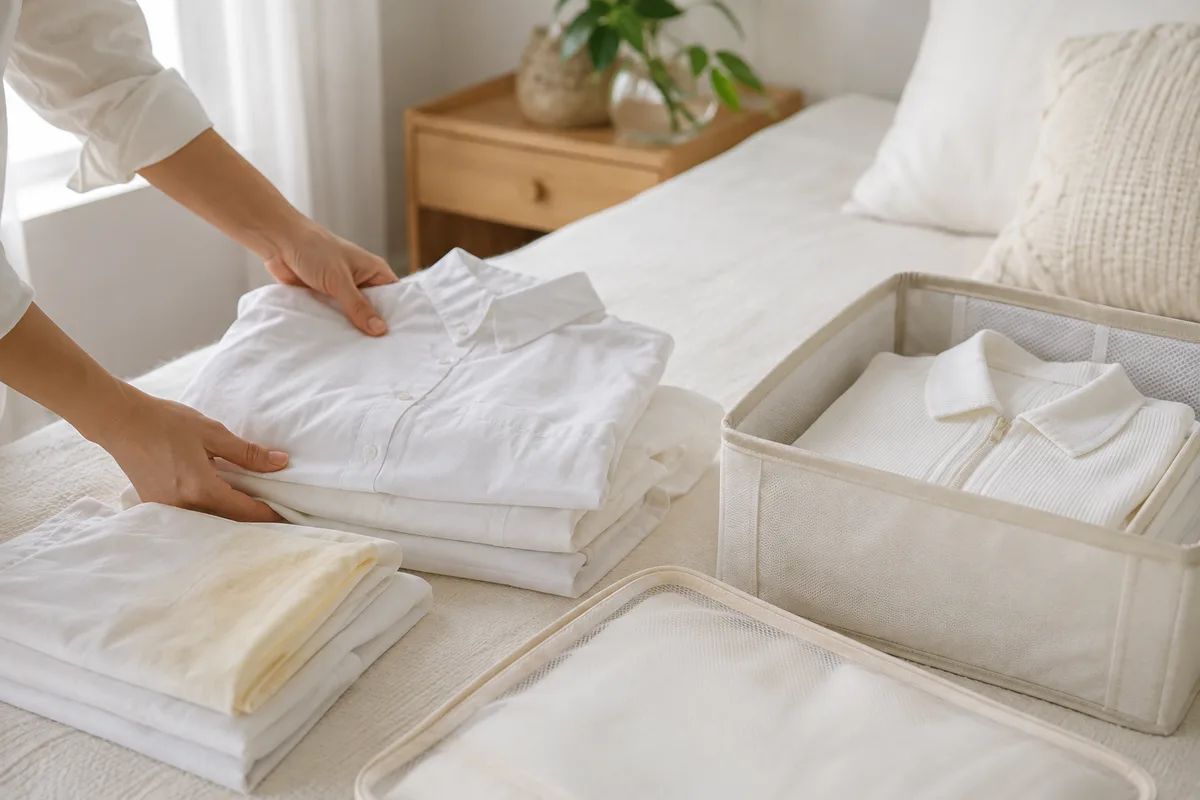
This can produce a more even off-white or ivory cast rather than a distinct stain.
That distinction matters.
Yellow concentrated around a collar or underarm suggests something different from an entire bedsheet slowly becoming cream-colored.
A similar yellowing problem can happen in bedding for a different reason. If the discoloration is concentrated on pillows rather than stored garments, see why pillows turn yellow even when you use pillowcases.
Plastic Packaging Can Cause a Different Kind of Yellowing
Sometimes the garment itself is not the main source of the problem.
Certain storage and packaging plastics can contribute to phenolic yellowing, a chemical reaction that has been documented in the textile industry.
Research published in Textile Chemist and Colorist described yellowing associated with butylated hydroxytoluene, or BHT, an antioxidant used in some polyethylene packaging. BHT can migrate from packaging and react with nitrogen dioxide in the surrounding air, producing yellow compounds on white textiles.
This does not mean every plastic container will automatically turn clothing yellow.
Different plastics contain different additives, and modern storage products vary considerably. But it does explain why prolonged contact with certain plastic wrapping or garment packaging can sometimes create discoloration even when the fabric was clean before storage.
If the yellowing follows folds, contact areas, or places where fabric pressed directly against packaging, the storage material deserves suspicion.
The Location of the Yellowing Can Reveal the Cause
Before trying to whiten the garment, look at the pattern.
Yellow around the collar, cuffs, or underarms
Residual body oils, perspiration-related soils, deodorant, lotions, or other products are likely contributors.
These areas usually receive the most direct contact with skin.
Yellow marks concentrated along folds
Consider what the garment was touching during storage.
Packaging materials, trapped residues, and pressure points can create patterns that follow the way the item was folded.
The entire garment looks slightly cream-colored
General aging, oxidation, residue buildup, or changes in whitening finishes may be involved.
Yellow-brown spots accompanied by a musty smell
Moisture may have been present during storage.
At that point, the problem may involve mildew or another form of deterioration rather than ordinary storage yellowing.
The pattern is often more useful than simply asking, “Why did my white shirt turn yellow?”
Does Storing Clothes in the Dark Prevent Yellowing?
Not necessarily.
Darkness protects fabric from some forms of light-related fading and degradation, but several causes of storage yellowing do not require sunlight.
Residual skin oils can continue oxidizing while a garment sits inside a closed drawer. Chemical interactions involving packaging materials can also occur without visible light.
A dark closet is therefore not enough by itself.
For long-term storage, cleanliness, dryness, stable temperature, and suitable storage materials matter just as much as keeping clothes away from sunlight.
Heat and Humidity Can Make the Problem Worse
A hot attic may seem like convenient storage space, but it is not ideal for white clothing.
Chemical reactions generally occur faster under warmer conditions, and research on sebum-soiled textiles has found greater yellowing under higher-temperature and higher-humidity aging conditions.
Humidity creates another problem: fabric can retain moisture.
That can encourage musty odors and, under sufficiently damp conditions, microbial growth.
Seasonal clothes are better stored in a clean, dry part of the home with relatively stable conditions rather than somewhere exposed to dramatic heat and moisture changes.
Why Washing Clothes Before Storage Matters So Much
The most effective time to prevent a yellow stain may be months before you ever see it.
Wash clothing before putting it away, even if it looks clean.
A shirt worn for only a few hours can still contain invisible skin oils. A tablecloth may have tiny food residues that are impossible to notice under normal lighting. Pillowcases and bedding naturally collect oils from skin and hair.
Leaving those substances in the fabric gives them months to age.
For washable garments, pay particular attention to:
- collars
- cuffs
- underarms
- necklines
- waistbands
- areas exposed to food
- clothing that has absorbed lotion, sunscreen, or cosmetics
The goal is not simply to make the garment look clean before storage. It is to remove as much invisible residue as reasonably possible.
Make Sure Clothes Are Completely Dry
Putting slightly damp clothing into storage creates unnecessary risk.
Moisture can become trapped between layers of folded fabric, especially when clothing is packed tightly or placed inside poorly ventilated containers.
After washing, allow garments to dry completely before folding or covering them.
That includes thick areas such as waistbands, cuffs, pockets, and layered seams, which may remain damp longer than the rest of the garment.
A shirt that feels almost dry is not necessarily ready for months of storage.
Should You Store White Clothes in Plastic?
For short-term organization, many people use plastic storage containers without obvious problems.
Long-term storage requires more thought.
Because certain packaging additives have historically been associated with phenolic yellowing, keeping valuable white textiles pressed against unknown plastic materials for months or years is not ideal.
For seasonal clothing, a clean breathable fabric garment bag can be a practical alternative.
For heirloom garments, vintage textiles, wedding dresses, or items intended to remain stored for years, archival storage materials are a better choice than improvised household packaging.
Also remove disposable dry-cleaning covers before long-term storage. They are intended primarily to protect garments during transport, not to serve as permanent preservation materials.
What Should You Do With Clothes That Have Already Turned Yellow?
Start gently.
First, check the garment’s care label and identify the fabric if possible. Cotton, polyester, silk, wool, and blended fabrics do not necessarily tolerate the same treatments.
For ordinary machine-washable whites, washing again with a suitable detergent may remove residues that have aged during storage. Treat obvious oily areas before washing rather than relying only on the normal wash cycle.
If the care label allows it, an oxygen-based laundry whitener can be useful for some washable white fabrics. Follow the product instructions rather than increasing the concentration in the hope of getting faster results.
Do not automatically reach for chlorine bleach simply because the garment is white. Some fibers, dyes, trims, and fabric finishes are not compatible with it.
And avoid improvised combinations of household cleaning chemicals. More chemicals do not necessarily mean whiter fabric, and some combinations can be dangerous.
For silk, wool, vintage garments, heavily embellished pieces, or valuable textiles, professional cleaning is the safer route.
Can Storage Yellowing Be Completely Removed?
Sometimes.
If the yellow color comes mainly from removable surface residues, aged body oils, or certain storage-related compounds, careful cleaning may noticeably improve the fabric.
But not every color change is a stain sitting on top of an otherwise unchanged fiber.
Long-term oxidation, chemical degradation, repeated bleaching, or aging of the textile itself can alter the material more permanently.
That is why increasingly aggressive treatment is not always the answer. A valuable garment can be damaged in an attempt to make it perfectly white again.
The older or more delicate the textile, the more conservative the treatment should be.
The Best Prevention Happens Before the Closet Door Closes
White clothes usually do not turn yellow in storage because a closed closet somehow makes fabric dirty.
What changes is chemistry.
A trace of skin oil that was invisible in September can oxidize by March. A storage material can interact with a textile over time. Heat and humidity can accelerate reactions that would otherwise happen much more slowly.
The simplest prevention strategy is also the most effective: store whites clean, completely dry, away from excessive heat and moisture, and without prolonged contact with questionable packaging materials.
That may sound less dramatic than finding a miracle whitening treatment months later.
But preventing the reaction is much easier on the fabric than trying to reverse it after the yellow has appeared.
Sources
Yu, Y., Cai, M., Zhou, L. & Shao, J. — Study on the Aging and Yellowing Properties of Sebum-Soiled Cotton Fabrics — Fibers and Polymers
Springer Nature study
Smeltz, K. C. — Why Do White Fabrics and Garments Turn Yellow During Storage in Polyethylene Bags and Wrappings? — Textile Chemist and Colorist / U.S. EPA HERO
U.S. EPA HERO record








Join the discussion