Why Is My Room So Dusty Even After Cleaning?
Does your room look dusty again a day after cleaning? Windows, bedding, carpets, HVAC filters, pets and even your cleaning method can all make dust return faster than expected.
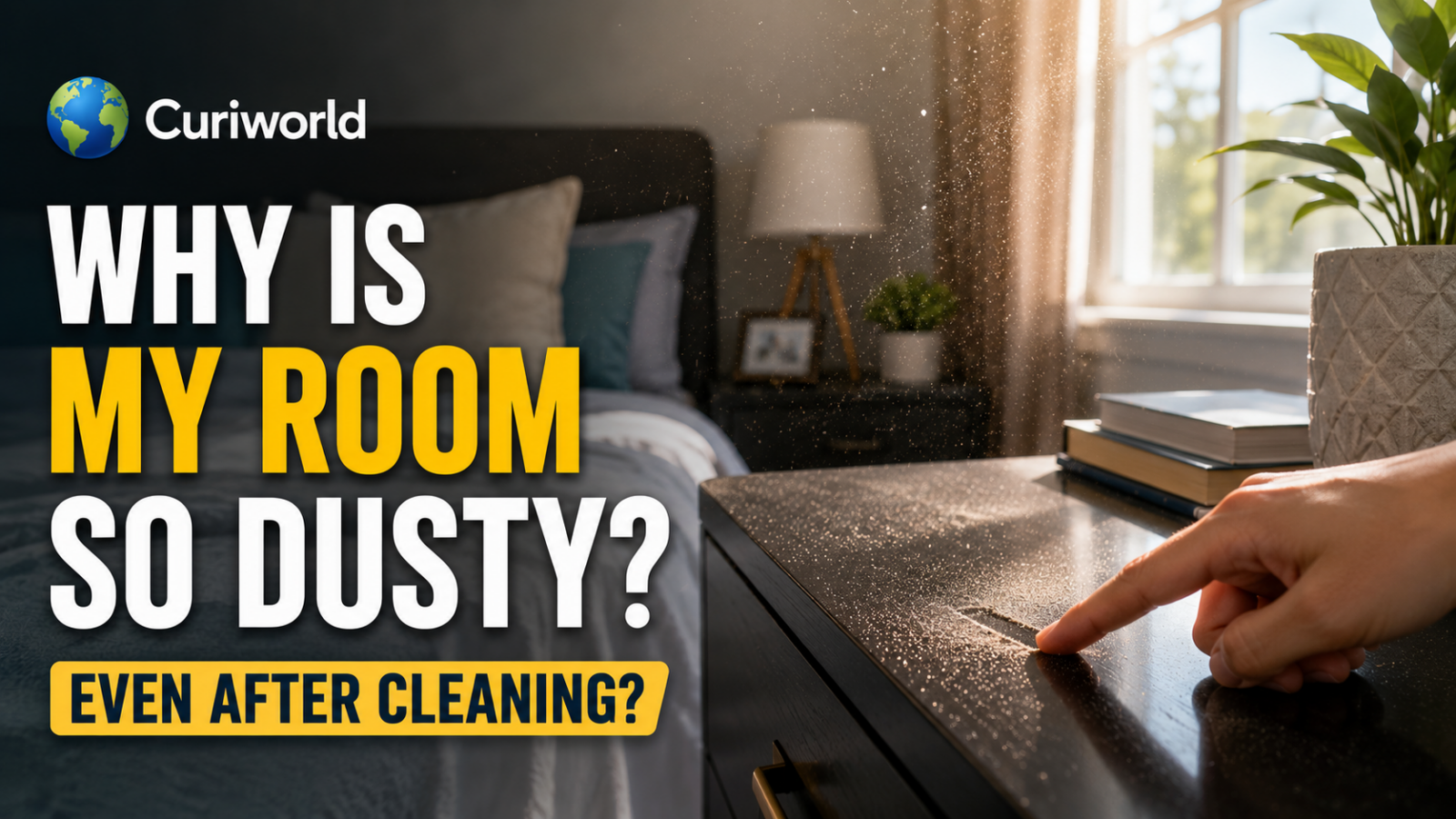
You dust the shelves.
Vacuum the floor.
Wipe the desk.
For a few hours, the room looks spotless.
Then sunlight comes through the window and suddenly you can see tiny particles floating through the air. By the next day, there is already another fine layer across the furniture.
It can feel as though the room is somehow producing dust faster than you can remove it.
In a way, it is.
A dusty room is not always a sign that you are cleaning badly. Dust is continuously entering the room, being generated inside it and being moved back into the air.
The real solution is therefore not necessarily cleaning more often.
It is figuring out where all that dust is coming from.
Dust Does Not Come From Just One Place
Household dust is a mixture of many different particles.
It can contain:
- soil and outdoor dust;
- pollen;
- pet dander;
- human skin flakes and hair;
- dust mite material;
- fibers from fabrics;
- particles from cooking;
- particles produced by candles and other combustion;
- mold spores;
- and material tracked indoors on shoes, clothing and pets.
Some dust originates inside your home.
Some arrives from outside.
And some was already in the room but becomes airborne again whenever people walk around, make the bed, vacuum or clean.
That explains the frustrating cycle:
You remove the dust you can see while more particles are already settling behind you.
1. Your Cleaning Method May Be Moving Dust Around
Start with the simplest possibility.
How are you dusting?
A dry feather duster or cloth can remove visible dust from one surface while sending finer particles back into the air.
Those particles eventually settle somewhere else.
That can create the impression that dust “came back” almost immediately.
A slightly damp microfiber cloth is usually more effective because it traps settled particles instead of simply pushing them around.
EPA guidance similarly recommends dusting with a damp cloth to help prevent settled dust from becoming airborne again.
There is also a useful order to cleaning.
Work from high surfaces downward.
Clean:
- ceiling fans and high shelves;
- blinds and window areas;
- furniture;
- lower surfaces and baseboards;
- the floor last.
If you vacuum first and then dust everything above it, some of what you remove simply ends up back on your freshly cleaned floor.
There is also a psychological reason finishing a visible cleaning task can feel unusually satisfying. Curiworld explains why cleaning can make you feel more productive.
2. Your Vacuum Could Be Returning Fine Dust to the Room
A vacuum cleaner removes visible debris remarkably well.
But filtration matters.
Air enters the machine along with dirt and dust. That air eventually has to leave again.
If the filtration system does not capture finer particles effectively—or the filter, seals or bag are poorly maintained—some material can escape back into the room.
That is one reason a room can sometimes look strangely dusty shortly after vacuuming.
Consider a vacuum equipped with effective filtration, such as a HEPA filter, particularly if fine dust is a recurring problem.
But having “HEPA” written somewhere on the machine is not the end of maintenance.
Check:
- whether the filter needs cleaning or replacement;
- whether the dust bin is overfilled;
- whether disposable bags are overdue for replacement;
- and whether the vacuum is operating as intended.
A good vacuum with a neglected filter can still perform poorly.
3. Your Bedding Creates and Collects Dust
The bed is one of the biggest fabric surfaces in most bedrooms.
Every night it interacts with:
- skin;
- hair;
- clothing fibers;
- blankets;
- pillows;
- and the movement of your body.
Bedding also provides an environment where dust mite allergens can accumulate.
Then every morning you move the duvet, shake the blanket and rearrange the pillows.
Some settled particles become airborne again.
Wash bedding regularly and dry it completely.
EPA guidance recommends washing bedding weekly as part of reducing indoor dust and biological contaminants.
Do not forget decorative blankets and pillow covers that may stay on the bed for months without being washed.
If they collect dust, moving them can redistribute it around the room.
4. Carpet Can Act Like a Dust Reservoir
Carpet does not necessarily create all the dust you see.
But it can hold a lot of it.
Particles settle between carpet fibers and can be disturbed again by walking, vacuuming and normal movement.
The same applies to:
- rugs;
- upholstered chairs;
- fabric headboards;
- curtains;
- and other soft furnishings.
A room containing several large textile surfaces may therefore hold more settled material than a minimally furnished room with hard flooring.
Vacuum carpets and upholstered furniture regularly, including edges and areas underneath furniture where practical.
Those forgotten areas matter because dust does not stop accumulating just because you cannot see it.
5. Check the HVAC Filter
If your room becomes dusty quickly, look beyond the room itself.
Your heating and cooling system moves large quantities of air through the home.
Its filter is designed to capture particles from that airflow.
But filters do not last forever.
A filter that is overdue for replacement can become heavily loaded, and the overall filtration performance of the system depends on the filter being suitable and properly maintained.
Check the manufacturer’s replacement schedule rather than relying on memory.
Homes with:
- pets;
- construction nearby;
- heavy system use;
- smoke;
- or unusually dusty conditions
may need closer attention to filter condition.
EPA recommends routinely changing HVAC and portable air-cleaner filters according to manufacturer instructions.
6. Look Around Air Vents and Returns
Dust concentrated around vents can provide a useful clue.
Inspect supply registers and return-air grilles.
Are they visibly coated?
Is dust noticeably heavier on furniture close to one particular vent?
Does a burst of particles seem to appear when the HVAC system starts?
Do not immediately assume your entire duct system needs an expensive cleaning.
Instead, begin with the accessible basics:
- clean dirty vent covers;
- check the HVAC filter;
- make sure filters fit correctly;
- and look for obvious gaps or maintenance problems.
If there appears to be significant contamination or a mechanical problem inside equipment you cannot safely inspect, an HVAC professional can investigate further.
7. Open Windows Can Bring Dust and Pollen Inside
Opening the window may make a room feel fresher.
It also creates a direct route between the outdoor environment and your bedroom.
Outdoor particulate matter, pollen and dust can enter with outside air.
How much depends on where you live.
A room facing:
- a busy road;
- construction;
- exposed soil;
- a parking area;
- or a high-pollen landscape
may collect outdoor particles faster than a room in a different location.
This does not mean you should never open a window.
It means you should notice patterns.
Does the desk become noticeably dustier on days when the window stays open?
Does the problem get worse during construction nearby?
Is it seasonal?
Patterns can tell you more than simply cleaning again.
8. Shoes and Clothing Carry Outdoor Dust In
Not all outdoor dust floats through a window.
Some of it walks through the door.
Soil, pollen and other particles can travel indoors on shoes, clothing, bags and pets.
If you wear outdoor shoes in the bedroom, some of what is attached to the soles can eventually become part of the room’s settled dust.
A simple habit can reduce this source:
Leave outdoor shoes near the entrance rather than wearing them throughout the home.
You can also use an effective entrance mat and clean it regularly.
Think about clothing too.
A jacket worn outdoors can carry pollen and particles into the room when it is thrown across the bed.
The source of dust is not always something built into the house.
Sometimes it came home with you.
9. Pets Add More Particles Than Just Fur
If you have a dog or cat, the visible hair is only part of the picture.
Pets can contribute:
- dander;
- hair;
- outdoor soil;
- pollen;
- and other particles carried on paws and fur.
Pet allergens can also become part of household dust.
Regular grooming and cleaning areas where pets sleep can help reduce accumulation.
Wash pet bedding when appropriate and vacuum upholstered surfaces where animals spend time.
If a pet regularly sleeps in your bedroom, that room will naturally receive more pet-related material than one the animal rarely enters.
That does not mean the pet is “dirty.”
It simply means another source of particles is present.
10. Your Curtains, Blinds and Ceiling Fan May Be Forgotten Dust Traps
Some surfaces are easy to forget because you do not look directly at them very often.
Run a finger across the top of a door frame.
Look at the upper edge of your blinds.
Inspect the ceiling-fan blades.
You may find the dust you thought was mysteriously appearing on your desk.
When a dusty ceiling fan starts spinning, accumulated material can be disturbed.
Opening and closing dusty blinds and curtains can do something similar.
Add these overlooked surfaces to your cleaning rotation:
- fan blades;
- blinds;
- curtain rods;
- curtains;
- door frames;
- baseboards;
- picture frames;
- high shelves;
- and the tops of wardrobes.
The goal is not to clean every hidden surface every day.
It is to prevent months of accumulation from becoming a recurring source.
11. Too Much Clutter Gives Dust More Places to Settle
Compare two shelves.
One holds three books.
The other contains books, cables, boxes, souvenirs, papers, figurines and several objects you have not touched in a year.
Which one is easier to clean properly?
Dust settles on both.
But clutter creates more surfaces, corners and spaces that are difficult to wipe or vacuum.
That can leave reservoirs of settled dust even after the room looks clean.
You do not need an empty minimalist bedroom.
Simply make frequently cleaned surfaces reasonably accessible.
Closed storage can also be useful for small objects that otherwise turn a shelf into an obstacle course.
The easier a surface is to clean, the more likely it is to actually get cleaned.
12. High Humidity Can Make Another Dust Problem Worse
Humidity does not simply create visible dust out of thin air.
But it can affect biological contaminants associated with household dust.
Dust mites, for example, thrive in warm, humid environments and commonly live in bedding, mattresses, upholstered furniture, carpets and curtains.
The American Lung Association identifies humidity as an important factor affecting dust-mite levels.
EPA generally recommends keeping indoor relative humidity below 60%, ideally around 30% to 50%, for broader indoor air-quality and moisture control.
If high humidity is accompanied by a persistent damp or musty odor, the issue may extend beyond ordinary household dust. See why a house can develop a musty smell and which moisture sources are worth checking.
A basic hygrometer can tell you what the room is actually doing.
Do not assume it is dry simply because the air feels normal.
If the room also has a persistent damp or earthy odor, investigate the moisture issue rather than treating it only as a dust problem. Our guide to why your house smells musty explains where hidden moisture can come from and what to check first.
13. Candles Can Add Particles to Indoor Air
That cozy candle on your desk is easy to overlook.
Combustion creates particles.
EPA identifies activities such as burning candles and using fireplaces among potential indoor sources of particulate matter.
That does not mean one candle automatically explains every dusty bedroom.
But if you frequently burn candles, incense or other combustion products indoors, they become another possible contributor to indoor particles.
Watch for patterns.
If you notice dark residue around candles, nearby surfaces or walls, that is particularly worth paying attention to.
Reducing unnecessary indoor combustion is a more useful approach than continuously cleaning the residue it creates.
14. Construction or Renovation Can Keep Producing Dust
If anyone has recently:
- drilled into drywall;
- sanded a wall;
- replaced flooring;
- remodeled a nearby room;
- repaired plaster;
- or carried out construction work,
fine dust may continue appearing long after the obvious mess has been cleaned.
Fine construction particles can travel farther than expected and settle on surfaces throughout nearby rooms.
Renovation dust can also move through doors and other openings if the work area was not adequately contained.
In this situation, repeated cleaning may genuinely be necessary for a while.
Clean from top to bottom, vacuum soft surfaces carefully and pay attention to filters that may have collected unusually large amounts of material during the work.
15. Your Humidifier Could Be Creating “White Dust”
This one can be surprisingly easy to miss.
Some cool-mist and ultrasonic humidifiers can disperse minerals from tap water into indoor air.
When the water evaporates, those minerals can settle as a fine pale or white residue on nearby furniture.
You clean it.
Run the humidifier again.
The “dust” comes back.
If the residue is especially noticeable around a humidifier, inspect the device and review the manufacturer’s instructions.
EPA recommends cleaning humidifiers according to manufacturer directions and notes that using distilled water can reduce the potential for minerals to be dispersed into the air.
In other words, what looks like mysterious household dust may sometimes be mineral residue.
Why Does Dust Come Back So Quickly After Cleaning?
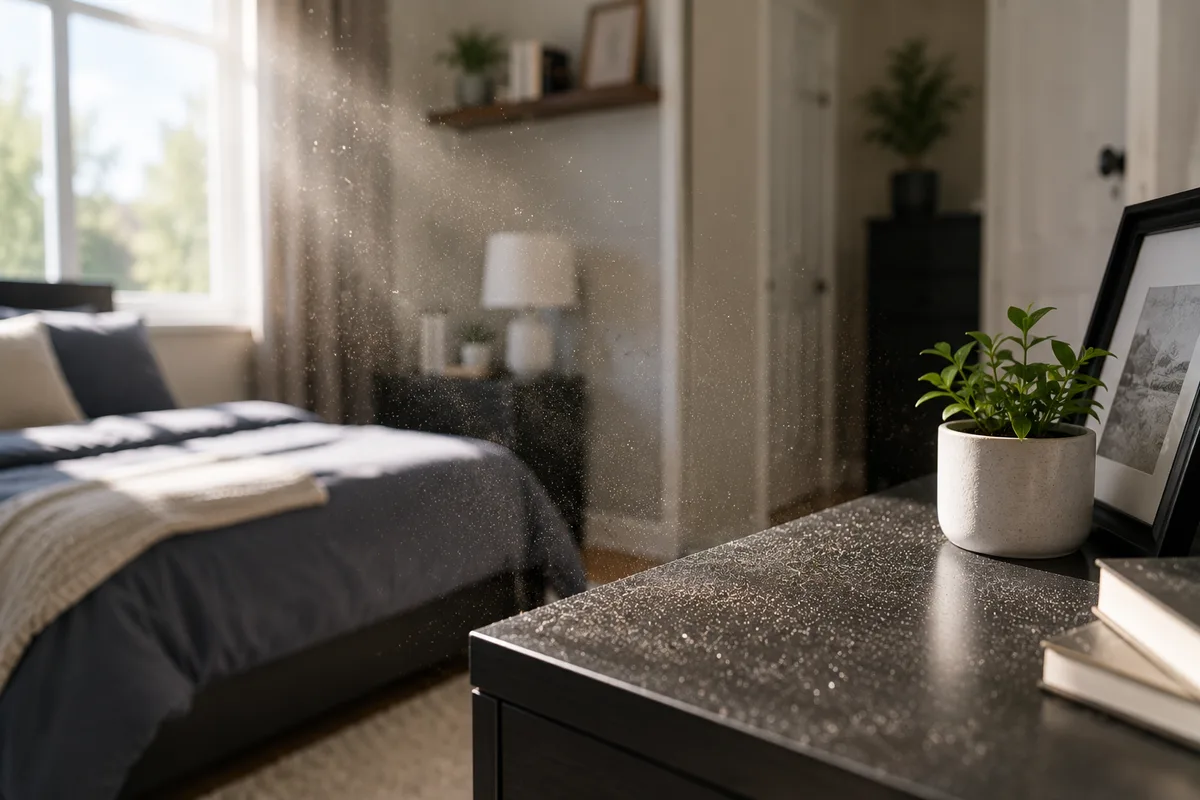
Because cleaning does not stop the dust cycle.
Imagine thousands of tiny particles suspended in the room.
Some are floating.
Some are trapped in carpet.
Some are sitting on curtains.
Some are on your bedding.
Some are entering from outside.
You wipe the desk clean.
Meanwhile, the particles still suspended in the air slowly settle.
A few hours later, the desk has another thin layer.
That does not mean your cleaning accomplished nothing.
It means you cleaned one destination for dust without necessarily controlling its sources.
That distinction is the key to making the room stay cleaner for longer.
Does an Air Purifier Help With Dust?
A properly sized air cleaner with effective particle filtration can capture some airborne particles.
But it should be viewed as one part of the solution rather than a replacement for cleaning.
An air cleaner cannot vacuum your carpet.
It cannot wash your bedding.
It cannot stop soil coming in on shoes.
And it cannot clean the top of a ceiling fan.
Think in layers:
Source control reduces what enters or is generated in the room.
Cleaning removes what has already settled.
Filtration can help capture some particles while they are airborne.
Using all three strategically is more useful than expecting one device to make dust disappear.
A Better Cleaning Routine for a Dusty Room
If your room becomes dusty unusually quickly, try this sequence:
1. Find the biggest sources first.
Check windows, bedding, carpets, pets, HVAC filters and any recent renovation.
2. Clean high to low.
Start with fans, shelves and blinds. Finish with the floor.
3. Use a damp microfiber cloth.
Capture dust rather than throwing it back into the air.
4. Vacuum fabric surfaces, not only the floor.
Carpets, upholstered furniture and other textiles can hold settled particles.
5. Maintain the vacuum.
Check its bag, bin and filters.
6. Wash bedding regularly.
Do not forget decorative blankets and washable covers.
7. Check the HVAC filter.
Replace it according to the manufacturer’s instructions.
8. Watch the window.
If outdoor dust or pollen is a major source, notice when opening the window makes the problem worse.
9. Measure humidity.
Especially if the room also feels damp or smells musty.
10. Look for a humidifier connection.
Fine white residue near an ultrasonic humidifier may not be ordinary dust at all.
Then give the room a little time.
You are trying to reduce the rate at which dust returns—not achieve a scientifically dust-free space.
The Bottom Line
If your room gets dusty again almost immediately after cleaning, you probably do not need to start dusting twice as hard.
You need to find the source.
Dust can enter through windows, arrive on shoes and clothing, collect in carpets and bedding, come from people and pets, settle on forgotten surfaces and circulate through normal household activity.
Even cleaning itself can temporarily send fine particles back into the air.
Start with the easy fixes:
Dust with a damp cloth. Clean from high to low. Vacuum fabrics. Wash bedding. Check the HVAC filter. Inspect windows, fans and blinds. Measure humidity.
Then look at what is unique about the room.
A constantly open window, a pet that sleeps on the bed, old carpet, nearby construction or an ultrasonic humidifier can completely change where the dust is coming from.
The goal is not to stop dust from ever existing.
That is unrealistic in a lived-in home.
The goal is to reduce how much enters, how much accumulates and how often it gets thrown back into the air.
Do that, and your clean room should start looking clean for considerably longer.






Join the discussion