Why Does a Bathroom Mirror Fog Up After a Shower?
A foggy bathroom mirror is a miniature lesson in atmospheric physics. Warm, humid shower air meets cooler glass, turning invisible water vapor into tiny droplets.

Step out of a hot shower and a perfectly clear bathroom mirror can turn into a cloudy sheet of glass within seconds. What looks like “steam” covering the mirror is actually thousands of tiny liquid water droplets.
The reason is condensation. A hot shower fills the bathroom with warm, humid air. When that moisture-rich air reaches the cooler mirror, it cools at the glass surface. If the surface is cold enough, some of the invisible water vapor in the air changes back into liquid water, forming the droplets that make the mirror look foggy.
There is a little more going on, though—and it explains why mirrors can fog so quickly, why some bathrooms are worse than others, and why certain anti-fog tricks actually work.
The “Fog” Is Water, Not Steam Stuck to the Glass
A hot shower adds a large amount of moisture to the bathroom air.
Some liquid water evaporates and becomes water vapor, which is a gas. Contrary to the way we casually use the word “steam,” water vapor itself is invisible.
The cloudy material you can see in a steamy bathroom consists largely of tiny suspended water droplets. The coating on the mirror is also liquid water created when vapor condenses on the glass.
The U.S. Geological Survey defines condensation as the change from gaseous water vapor into liquid water and gives fogged glasses and condensation on cool windows as familiar everyday examples.
So your mirror is not absorbing steam. Water is changing state directly on its surface.
Why the Mirror Becomes the Perfect Place for Condensation
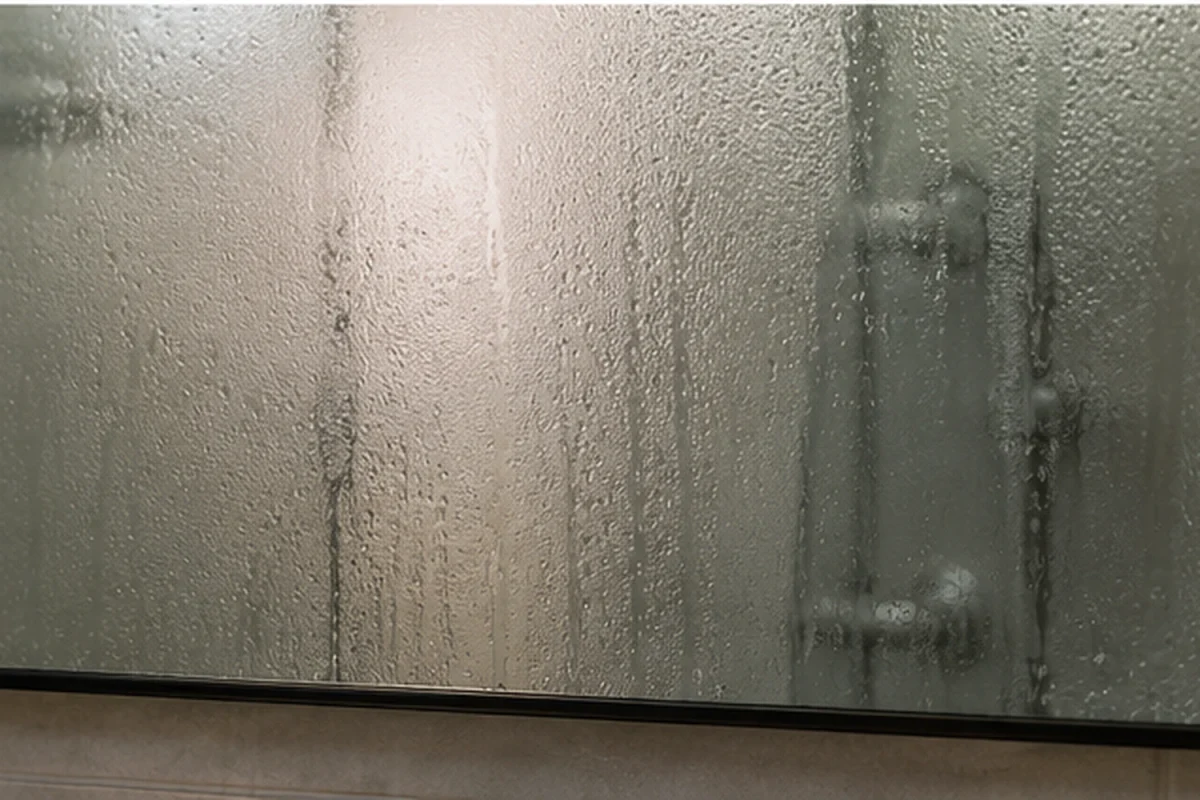
Before you start showering, the mirror is usually close to the bathroom’s normal room temperature.
Then the shower rapidly changes the surrounding air.
If the bathroom stays humid for hours or a damp odor persists beyond the shower, see why a house can develop a musty smell and which moisture sources are worth checking.
Hot water warms the bathroom and raises its humidity, but the large sheet of glass does not instantly warm to the same temperature. For a while, the mirror remains relatively cool while increasingly warm, moisture-rich air moves across it.
That temperature difference is crucial.
Air can contain water vapor, but the amount that can remain in vapor form depends strongly on temperature. When moist air next to the glass cools sufficiently, it can reach its dew point—the temperature at which condensation begins.
The surface of the mirror then becomes a convenient place for liquid droplets to form.
The same basic process explains why a cold drink becomes wet on the outside on a humid day and why a window may collect moisture when warm indoor air meets cold glass.
Dew Point Is the Key to Whether the Mirror Fogs
You do not need to calculate the bathroom’s dew point before taking a shower, but the concept explains almost everything you see.
Imagine the bathroom air becomes warm and extremely humid during a long shower. Its dew point rises because the air contains so much moisture.
If the mirror’s surface temperature falls below that dew point, water begins condensing on it.
This also explains why the same mirror does not always fog to the same degree.
A hotter or longer shower usually adds more heat and moisture to the room. A cold bathroom may begin with a colder mirror. Weak ventilation allows humidity to build more quickly.
Put those conditions together and the mirror can become almost completely opaque.
On another day, a shorter, cooler shower with good ventilation may leave only a light haze—or no noticeable fog at all.
Why Do Tiny Droplets Ruin Your Reflection?
A mirror works best when light can travel through the front glass, reflect predictably from the reflective layer behind it, and return toward your eyes.
Condensation changes the surface.
Instead of encountering relatively smooth glass, incoming light encounters countless microscopic water droplets. Their curved surfaces bend and scatter the light in many directions.
Your reflection has not disappeared. The organized light carrying the image is simply being scattered before it reaches your eyes clearly.
That is why a heavily fogged mirror looks white or gray rather than simply darker.
It also explains why wiping a small section immediately restores your reflection. Removing the droplets creates a smooth optical path again.
Why Does the Mirror Fog More Than Some Other Surfaces?
It may look as though the mirror is uniquely attracting moisture, but it is not.
Condensation can also form on windows, tiles, metal fixtures, walls, and other sufficiently cool surfaces.
The mirror simply makes the effect especially obvious.
A thin layer of droplets dramatically changes the way a reflective surface handles light, while the same amount of moisture on a textured wall may be almost invisible.
Surface temperature matters as well. A mirror mounted against a cooler wall may remain colder than nearby objects for longer, making condensation easier under the same humid conditions.
So the mirror is not necessarily receiving dramatically more water than everything else. It is often just the surface where you notice it first.
Why Doesn’t a Cold Shower Fog the Mirror as Much?
A cooler shower generally produces less dramatic mirror fog because it creates less of the temperature-and-humidity combination that drives rapid condensation.
Hot water increases evaporation and fills the bathroom with warm, moist air. At the same time, the mirror may remain considerably cooler than that air.
A cold or lukewarm shower creates a smaller temperature contrast and often introduces less water vapor into the room.
That makes it less likely that the air immediately next to the mirror will cool past its dew point.
This is also why the problem can seem much worse during colder seasons. If the bathroom and its surfaces begin the morning cold, the temperature difference between a hot, humid shower and the mirror can become particularly large.
Why Does an Exhaust Fan Help?
A bathroom exhaust fan attacks the problem from the other side: instead of warming the mirror, it removes moisture-rich air.
As humid air is exhausted and replaced by drier air, the amount of water vapor available to condense decreases.
The U.S. Environmental Protection Agency recommends running a bathroom exhaust fan or opening a window when showering as part of controlling indoor humidity and condensation. The EPA also notes that condensation can be a sign of elevated humidity and recommends increasing ventilation or air movement to reduce it.
If the bathroom stays humid for hours or a damp odor persists beyond the shower, see why a house can develop a musty smell and which moisture sources are worth checking.
A fan may not keep a cold mirror perfectly clear during a very hot shower, especially in a small bathroom, but good ventilation can reduce how heavily it fogs and how long the moisture remains afterward.
Why Heated Mirrors Stay Clear
A heated anti-fog mirror uses the opposite strategy.
Instead of trying to remove all the humid air, it keeps the mirror surface warm enough that water vapor is less likely to condense on it.
The principle follows directly from the dew-point explanation.
If the glass stays above the temperature at which the surrounding moist air would begin condensing, droplets do not readily form.
It is similar in principle to keeping a car window warm enough to resist interior fogging.
This is why a mirror heater does not need to make the glass feel genuinely hot. It only needs to change the surface temperature enough to prevent the conditions required for condensation.
Do Anti-Fog Sprays and Shaving Cream Actually Work?
Some anti-fog products use a different approach.
Rather than stopping water from reaching the mirror, they alter how that water behaves on the surface.
Tiny individual droplets scatter light very effectively. A surfactant can encourage moisture to spread into a thinner, more uniform film instead of forming countless distinct beads.
The mirror may still have moisture on it, but the water interferes less with your reflection.
This is also the basic reason various household anti-fog tricks can appear to work temporarily.
Their limitations are equally straightforward: the coating wears away, gets cleaned off, or becomes uneven, so it has to be reapplied.
For a long-term solution, controlling bathroom humidity or warming the mirror addresses the physical conditions behind the problem more directly.
Is a Foggy Mirror a Sign Your Bathroom Is Too Humid?
Some mirror fog after a hot shower is completely ordinary.
What matters more is how long the moisture remains.
If the mirror clears reasonably soon after the shower and the bathroom dries normally, the temporary condensation is simply the expected result of warm humid air meeting cooler surfaces.
A bathroom that remains damp for a long time is different.
Persistent condensation on mirrors, windows, walls, or other surfaces can indicate that moisture is not leaving the room efficiently. The EPA recommends controlling indoor moisture because prolonged dampness can encourage mold growth, and specifically advises using bathroom ventilation during showering.
So a fogged mirror is not automatically evidence of a ventilation problem. A bathroom that stays wet long after every shower deserves more attention.
How to Keep the Mirror Clearer
The physics suggests several practical solutions without requiring any unusual tricks.
Run the exhaust fan during the shower.
Removing humid air lowers the amount of moisture available to condense.
Leave the fan running afterward.
This helps the bathroom return to normal humidity more quickly.
Open a window when appropriate.
If outdoor conditions allow it, additional ventilation can help humid indoor air escape.
Take a slightly cooler or shorter shower.
Less heat and moisture generally mean less condensation.
Keep the bathroom reasonably warm.
A very cold mirror reaches the condensation point more easily when hot shower air arrives.
Use a heated mirror or demister pad if persistent fog is a major annoyance.
Keeping the glass warmer directly addresses the surface-temperature part of the problem.
The best option depends on whether your goal is simply to see yourself immediately after showering or to control excessive bathroom moisture more generally.
Your Mirror Is Showing You a Tiny Weather System
A bathroom mirror fogging after a shower may seem like a minor household annoyance, but the process is surprisingly close to what happens on a much larger scale in the atmosphere.
Water evaporates. Moist air encounters cooler conditions. Water vapor condenses into tiny liquid droplets.
In the sky, that process contributes to clouds and fog. In your bathroom, the cooler surface happens to be a mirror.
The difference is scale.
So the next time your reflection disappears after a hot shower, the mirror is not malfunctioning. It is providing a remarkably clear demonstration of condensation—by making itself temporarily impossible to see through.
Sources
U.S. Geological Survey — Condensation and the Water Cycle
USGS source
U.S. Environmental Protection Agency — A Brief Guide to Mold, Moisture and Your Home
EPA source







Join the discussion