Why Does Rain Smell So Good? The Science of Petrichor
That unmistakable earthy smell after rain is called petrichor. Here is how soil bacteria, geosmin and even tiny bubbles inside raindrops help create it.
You step outside just after the first rain in days.
The pavement is dark. Dust has disappeared from the air. The ground is damp.
And suddenly there is that unmistakable smell: earthy, fresh, slightly mineral, and somehow deeply familiar.
Many people casually call it “the smell of rain.”
But rain itself has very little smell.
What you are actually detecting is a mixture of chemicals released from soil, plants, microorganisms, and the surfaces that raindrops strike.
Scientists have a name for the characteristic earthy aroma associated with rain falling on dry ground:
petrichor.
And the way that smell gets from the soil into your nose involves an unexpectedly beautiful combination of microbiology, chemistry, and fluid physics.
What Is Petrichor?
Petrichor is the distinctive earthy smell that often appears when rain falls after a dry period.
The word became established in scientific literature after Australian researchers Isabel Joy Bear and Richard Thomas investigated the characteristic odor of dry soil and rocks in the 1960s. Their work appeared in Nature in 1964.
The name combines Greek roots associated with stone and the mythological fluid said to flow through the veins of the gods.
But petrichor is not one single chemical.
The smell we associate with fresh rain can involve several sources, including:
- compounds produced by soil microorganisms,
- oils and other substances associated with plants,
- chemicals accumulated on dry surfaces,
- and tiny airborne droplets created when rain strikes the ground.
One molecule, however, plays a particularly famous role.
Geosmin Is Responsible for Much of the Earthy Smell
If petrichor is the overall experience, geosmin is one of its star ingredients.
Geosmin is an organic compound with a powerful earthy odor.
Certain microorganisms produce it, particularly members of the bacterial genus Streptomyces found in soil. Research has identified the biochemical machinery these bacteria use to synthesize geosmin.
That matters because humans are remarkably good at detecting earthy odors.
You do not need a visible cloud of geosmin floating above the ground.
A tiny amount reaching your nose can be enough to produce that familiar impression of damp earth.
Interestingly, geosmin is not unique to the smell of rain. It can also contribute earthy or musty odors in water and food, where the same chemical people may enjoy in the air can become undesirable.
So the molecule has not suddenly changed.
Context has.
Smelling earthy soil after a summer storm can be pleasant.
Tasting “earth” in a glass of drinking water usually is not.
Where Does Geosmin Come From?
Soil is full of life.
Even apparently dry dirt contains complex communities of bacteria, fungi, microscopic organisms, plant material, and organic compounds.
Some Streptomyces bacteria produce geosmin during their life cycle.
A 2020 study in Nature Microbiology found that geosmin and another earthy-smelling compound can even play an ecological role by attracting tiny soil arthropods called springtails. Those animals can help disperse bacterial spores.
That means the smell humans associate with peaceful rain may originate partly from a chemical communication system that existed long before anyone described it as relaxing.
The forest floor is not making perfume for us.
We simply happen to be exceptionally sensitive observers.
Why Does the Smell Become Stronger When It Rains?
This is where the physics becomes especially interesting.
It is not enough for geosmin and other aromatic compounds to exist in soil.
To smell them, those molecules have to reach the air and eventually enter your nose.
Raindrops help make that happen.
Researchers at MIT used high-speed cameras to study individual droplets striking porous materials and soil.
They observed something surprisingly complex.
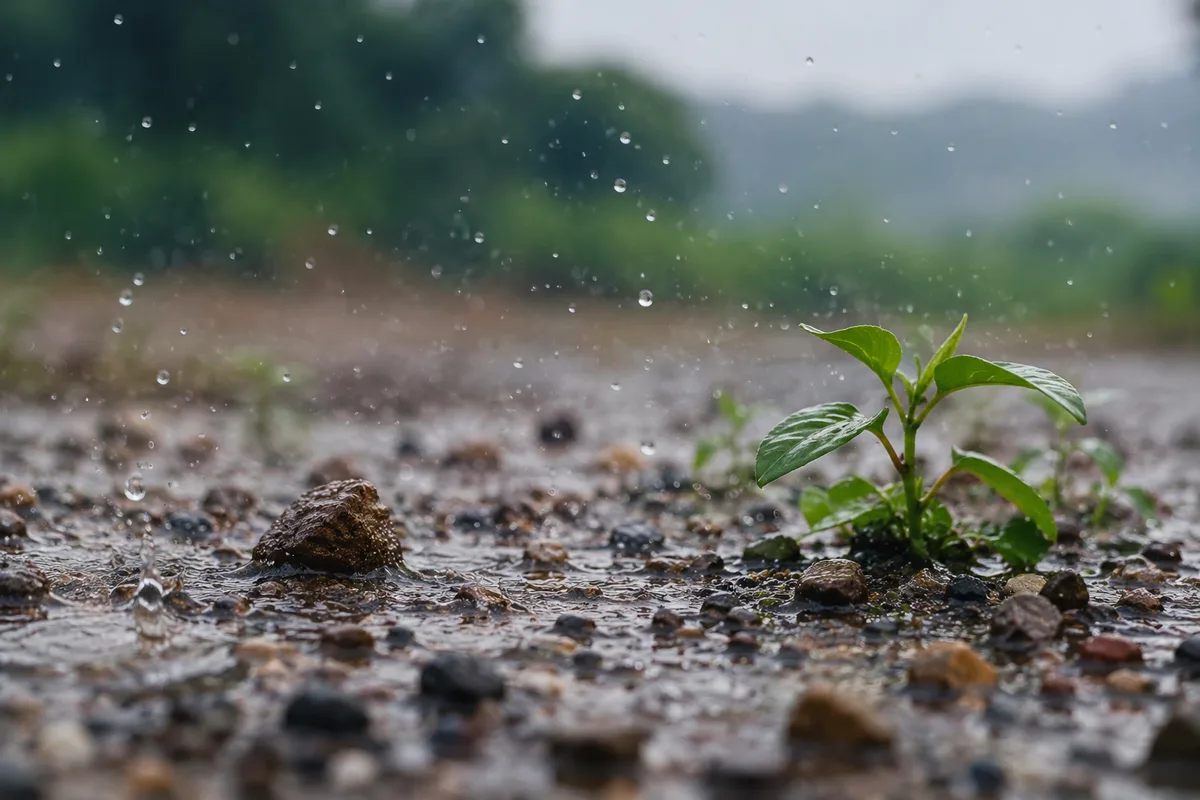
When a raindrop hits a porous surface, tiny air bubbles can become trapped beneath the spreading droplet.
Those bubbles then rise through the water.
When they reach the surface, they burst.
The bursting process can launch extremely small droplets called aerosols into the surrounding air.
Those aerosols can carry material originating from the surface.
In natural soil, that may include aromatic compounds associated with the characteristic smell after rain.
In other words:
The raindrop does more than make the ground wet.
It can help send microscopic pieces of the ground-air interface upward into the atmosphere.
Think of a Raindrop Like a Tiny Aerosol Machine
Imagine one raindrop hitting dry soil.
For a fraction of a second:
- the droplet spreads across the surface,
- microscopic pockets of air become trapped,
- bubbles rise through the droplet,
- those bubbles burst,
- tiny aerosol droplets are released into the air.
Now multiply that by thousands or millions of raindrops.
Suddenly the air above the ground contains newly released microscopic material.
Wind can then carry those aerosols toward you.
That is one reason a smell that seemed completely absent minutes earlier can suddenly become obvious when rainfall begins.
Light Rain Can Sometimes Produce More of the Effect Than Heavy Rain
You might assume that the harder it rains, the stronger this aerosol effect should become.
Not necessarily.
MIT researchers found that the conditions for aerosol production can actually be especially favorable during light or moderate rainfall on certain porous surfaces.
Very fast raindrops can hit too aggressively for the same bubble-forming process to occur as efficiently.
That helps explain a familiar experience:
A gentle shower after several dry days can sometimes produce an incredibly vivid earthy smell.
A violent downpour does not necessarily smell proportionally stronger.
The physics of the impact matters, not just the quantity of water.
Why Is the First Rain After a Dry Spell So Noticeable?
Petrichor is often most obvious when rain arrives after a period of dry weather.
During dry conditions, substances associated with soil, rocks, microorganisms, and vegetation can accumulate on surfaces.
Then the first rain arrives.
Raindrops disturb those surfaces and help transfer volatile compounds and aerosols into the air.
The contrast matters too.
If the ground has remained wet for several days, many of the easily released substances have already been washed away or the environmental conditions have changed.
The first rainfall after a dry period therefore creates a particularly noticeable transition:
dry landscape → fresh rainfall → rapid release of earthy aromas.
That is the classic petrichor moment.
Does Rain Itself Have a Smell?
Pure water is not responsible for the earthy odor.
When people say:
“I can smell the rain.”
they are often detecting chemicals whose concentration or movement has changed because rain is approaching or has begun.
The specific odor depends on the environment.
Rain falling on:
- dry soil,
- a forest,
- asphalt,
- grass,
- hot pavement,
- agricultural land does not necessarily produce exactly the same chemical mixture.
That is why rain in a city can smell different from rain in a forest.
The water may be similar.
The surface being disturbed is not.
Why Can You Sometimes Smell Rain Before It Arrives?
People occasionally report detecting a rain-like smell before the first drops reach them.
That does not necessarily mean humans possess a mysterious weather-prediction sense.
Storm systems involve changing wind, humidity, atmospheric chemistry, temperature, and air movement.
Wind can transport odors from areas where rainfall has already begun toward places that are still dry.
So you may sometimes smell compounds associated with wet soil even though the rain responsible for releasing them is occurring some distance away.
Certain storms can also produce atmospheric odors associated with ozone and other chemical processes, although that is chemically different from the earthy geosmin-driven component of petrichor.
The phrase “smell of rain” can therefore describe more than one phenomenon.
Petrichor and Ozone Are Not the Same Thing
These two smells are often confused.
Petrichor is primarily associated with rain interacting with dry ground and releasing earthy compounds.
Ozone, by contrast, has a sharper smell sometimes described as clean, metallic, or chlorine-like.
Electrical activity during thunderstorms can participate in atmospheric chemical reactions, while storm winds can also transport ozone-rich air.
So a storm can create a complex smell containing several environmental signals at once.
The earthy smell of wet soil, however, is not simply ozone.
Geosmin and other ground-derived compounds are central to the classic petrichor experience.
Why Do Some People Love the Smell So Much?
This is where chemistry meets psychology.
There is nothing universally written into geosmin that requires humans to interpret it as beautiful.
Smell perception is shaped partly by:
- previous experiences,
- memories,
- context,
- culture,
- familiarity,
- expectations,
- and individual sensitivity.
Rain can also become associated with meaningful experiences.
Someone may connect the smell with:
- childhood summers,
- a grandparent’s garden,
- hiking,
- vacations,
- cooler weather after extreme heat,
- playing outside,
- forests,
- farming,
- or the beginning of a favorite season.
Over time, the odor itself may become a cue for those memories.
Curiworld has explored this mechanism more deeply in Why Do Certain Smells Bring Back Powerful Memories?, where we look at how olfactory signals interact with brain systems involved in emotion and autobiographical memory.
So part of the pleasure may come from the molecules.
Part may come from everything your brain has attached to them.
Our Noses Are Surprisingly Sensitive to Earthy Odors
The biological story becomes even stranger when we consider how many organisms can detect geosmin.
Humans are sensitive to it.
Fruit flies detect it.
Springtails respond to it.
Research on soil bacteria suggests geosmin can participate in ecological interactions rather than simply being a metabolic accident.
Yet humans interpret the signal through an entirely different world of associations.
A molecule involved in microbial ecology becomes, to us:
“That amazing smell after rain.”
It is a perfect example of how the same chemistry can have completely different meanings depending on who—or what—is sensing it.
Is Petrichor Stronger in Some Places?
Absolutely.
The intensity of the smell can vary with:
- soil composition,
- microbial activity,
- vegetation,
- how long the environment has been dry,
- rainfall intensity,
- temperature,
- wind,
- surface porosity,
- and humidity.
A dry trail surrounded by vegetation may produce a much stronger earthy smell than rain landing on a continuously wet concrete surface.
Even two rainstorms in the same place can smell different depending on what happened during the preceding days.
Can Rain Spread More Than Smell?
Yes—and this was one of the interesting consequences of the aerosol research.
If raindrops can launch tiny droplets from soil into the air, those aerosols may carry more than fragrant molecules.
Follow-up MIT research found that raindrop impacts under certain conditions could aerosolize soil bacteria as well.
That does not mean ordinary rainfall should be treated as dangerous.
It means the physical mechanism responsible for carrying some soil-derived smells into the air can also transport biological material.
The pleasant scent of petrichor is therefore connected to a much broader phenomenon:
rain actively moves microscopic material between the ground and the atmosphere.
Why Does Wet Ground Look Darker Too?
Rain changes more than smell.
You may notice that soil, pavement, wood, rocks, and fabric often appear darker when wet.
That effect has a different explanation.
Water changes how light interacts with a surface, often reducing the amount of scattered light that returns toward your eyes.
Curiworld explores the same optical principle in Why Do Wet Clothes Look Darker Than Dry Clothes?.
So during a rainstorm, several pieces of physics and chemistry happen simultaneously:
The ground becomes darker.
Humidity changes.
Droplets create aerosols.
Volatile molecules enter the air.
And your brain combines the smells, visuals, sounds, temperature, and memories into one experience we simply call:
“the smell of rain.”
Frequently Asked Questions
What is the smell after rain called?
The characteristic earthy smell that appears when rain falls on dry ground is commonly called petrichor.
What chemical makes rain smell earthy?
Geosmin is one of the most important compounds responsible for the earthy smell. It is produced by certain microorganisms, including soil-dwelling Streptomyces bacteria.
Is petrichor the same as geosmin?
Not exactly.
Geosmin is a specific chemical compound. Petrichor describes the broader characteristic smell associated with rain on dry ground, which can involve geosmin along with other compounds.
Why does rain smell stronger after hot, dry weather?
Dry conditions allow compounds to accumulate on soil and other surfaces. When rain finally arrives, droplets can help release aromatic compounds and microscopic aerosols into the atmosphere.
Why does light rain sometimes smell stronger than heavy rain?
Experiments examining raindrop impacts found that aerosol production can be particularly efficient under light-to-moderate rainfall conditions on suitable porous surfaces. Heavy impacts do not necessarily create more aerosols.
Can everyone smell petrichor?
People differ in odor sensitivity and in how they interpret particular smells. Many people readily notice the earthy aroma associated with geosmin, but its perceived intensity and pleasantness can vary.
Final Thoughts
The smell of rain is really the smell of a landscape changing state.
Dry soil contains microorganisms and accumulated compounds.
A raindrop hits the surface.
Tiny bubbles form.
Microscopic aerosols burst into the air.
Earthy molecules such as geosmin travel with them.
Wind carries those molecules toward your nose.
Your brain recognizes the signal—and may instantly connect it with years of memories associated with storms, gardens, forests, summer evenings, or childhood.
So the next time someone says:
“I love the smell of rain,”
the scientific answer is wonderfully complicated.
You are smelling chemistry produced partly by microscopic life, launched into the air by the physics of falling water, and interpreted through a brain full of personal memories.
That single breath after a rainstorm contains microbiology, chemistry, physics, and psychology all at once.
Sources
Massachusetts Institute of Technology — Rainfall Can Release Aerosols
MIT News — Rainfall can release aerosols
Jiang, He & Cane — Biosynthesis of the Earthy Odorant Geosmin, Nature Chemical Biology
Nature — Geosmin biosynthesis research







Join the discussion