Why Do Spiders Suddenly Appear Indoors in Fall?

A spider races across the living room floor in September. A few days later, another appears in the bathtub. Then you spot one beside a baseboard and start wondering whether your home has suddenly become much more attractive to spiders.
The obvious explanation is colder weather: spiders must be coming inside to escape the cold.
That can happen with some outdoor species, but it is only part of the story. Many spiders that suddenly become noticeable indoors in late summer and fall were already living in or around the building. Others become much easier to spot because mature males start wandering in search of mates.
So the apparent fall “spider invasion” is often a combination of seasonal behavior, accidental entry, and spiders simply becoming more visible.
Fall Spider Season Is Not Quite an Invasion
House spiders are very good at staying out of sight.
They can spend long periods behind furniture, inside wall voids, beneath storage boxes, in basements, garages, crawl spaces, utility rooms, and other quiet parts of a building.
Then something changes.
For several common species, late summer and early fall coincide with mating activity. Mature males leave their usual hiding places and begin moving around while searching for females.
That can bring them across open floors, along walls, through hallways, and into rooms where people suddenly notice them.
The Burke Museum’s arachnology program points out an important distinction: many true house spiders are adapted to living inside buildings and may spend their entire lives there. When large numbers become visible during a particular season, wandering males looking for mates can be responsible.
In other words, the spider crossing your living room may not have entered the house that afternoon.
It may have been your neighbor for weeks or months.
Are Spiders Coming Indoors Because It Is Cold?
Some are. Many are not.
Outdoor spiders can occasionally enter buildings as temperatures fall. University extension resources note that certain hunting and ground-dwelling spiders may wander indoors in autumn, sometimes through gaps around doors, windows, foundations, garages, or utility openings.
Penn State Extension, for example, notes that grass spiders are frequently encountered indoors during autumn as temperatures fall.
But this does not mean every spider is making a deliberate migration toward your heated living room.
Outdoor spiders have existed through cold seasons long before houses did. Many species survive winter by becoming inactive, overwintering in protected locations, or reaching the cold season at a particular stage of their life cycle.
Meanwhile, species specialized for indoor environments may already be living inside year-round.
That gives us two different groups that can easily be confused:
- Indoor-adapted spiders becoming more visible
- Outdoor spiders accidentally or seasonally wandering inside
Both can happen at roughly the same time.
That is why the simple explanation—“spiders come inside because they are cold”—does not tell the whole story.
Why September and October Can Feel Especially Spider-Heavy
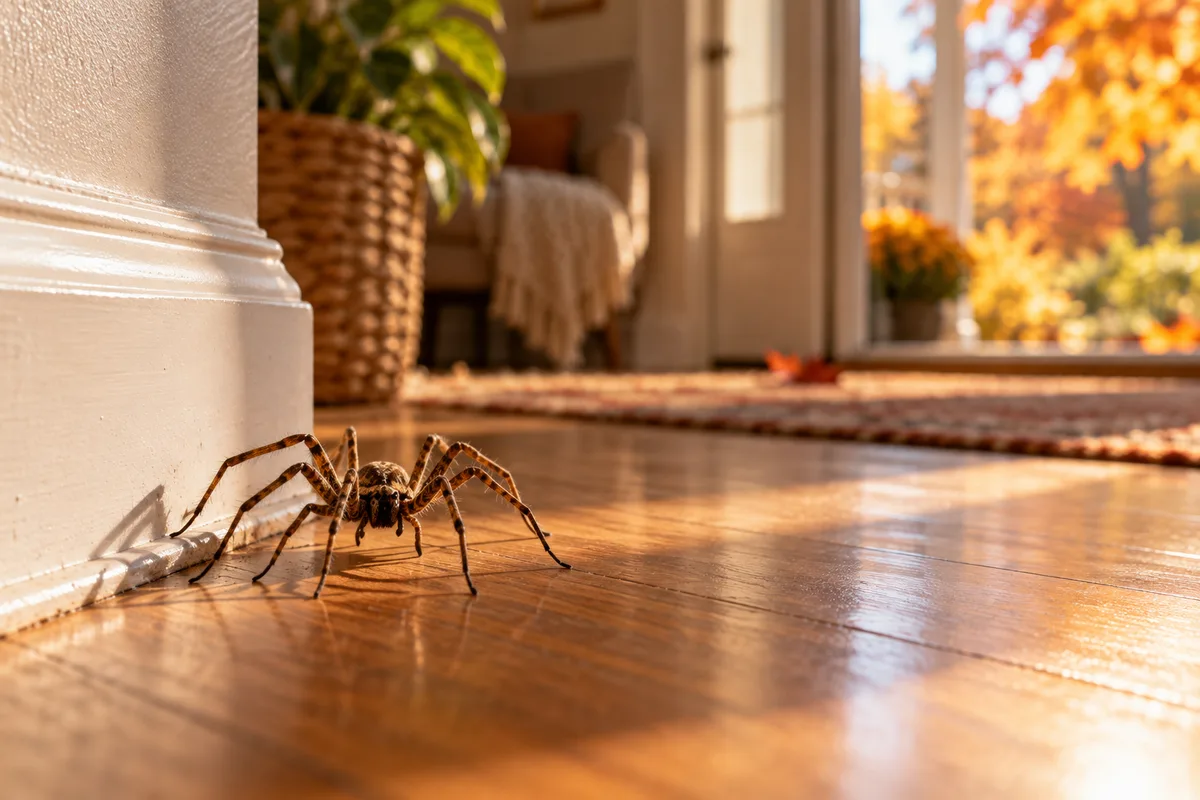
Timing matters.
Many spiders reach maturity during late summer or fall. Adult males of some species then become much more mobile while searching for females.
A spider that previously stayed hidden near a web, behind furniture, or in a dark corner can suddenly travel across an exposed part of the house.
Humans are far more likely to notice a large spider sprinting across a pale carpet than one sitting motionless behind a washing machine.
This also explains why people sometimes report seeing unusually large spiders at this time of year.
The spiders did not suddenly grow because fall arrived. You may simply be encountering mature adults during the stage of their life cycle when they move around most.
Seasonal changes often make animals more noticeable without necessarily making them more numerous. Weather and animal behavior can create some surprisingly convincing illusions about where animals came from—as seen in a very different phenomenon explored in Curiworld’s Can It Really Rain Fish? The Science Behind Animal Rain.
The Spider in Your Bathtub Probably Did Not Come Up the Drain
A spider sitting in an empty bathtub creates an obvious question:
Did it crawl up through the drain?
Usually, that is not the best explanation.
Burke Museum arachnology resources note that house spiders found in sinks and bathtubs typically did not arrive through household plumbing. Modern drain systems include water-filled traps that make that route highly unlikely.
A much simpler scenario is that the spider approached the sink or tub from elsewhere, climbed or fell inside, and then became trapped.
Smooth surfaces such as porcelain, acrylic, fiberglass, or enamel can be difficult for some spiders to climb.
That is why a spider may still be sitting in the bathtub when someone turns on the bathroom light in the morning.
If spiders repeatedly appear in one bathroom, look around the room as well as the drain. Gaps around pipes, windows, baseboards, vents, and wall openings can be more useful clues.
Does Seeing Spiders Mean Your House Is Dirty?
No.
Spider sightings are not a reliable measure of cleanliness.
Spiders care about conditions such as shelter, hiding places, and access to prey—not whether a countertop was wiped yesterday.
Even a well-maintained home can have spiders, particularly in garages, basements, attics, storage areas, and spaces that connect easily to the outdoors.
However, insects do matter.
Spiders are predators, and their food includes flies, moths, beetles, mosquitoes, and many other small arthropods. Areas that consistently support more insect activity may therefore support more spiders too.
Exterior lights provide a simple example. Lighting near windows and doors can attract flying insects after dark. Those insects can, in turn, create useful hunting areas for spiders around the outside of a building.
So if spiders repeatedly appear in the same location, it can be useful to ask a second question:
What might they be eating there?
And if your concern is really that a room never seems clean despite regular housekeeping, that can be a separate issue entirely. Curiworld’s guide to why a room gets dusty again even after cleaning looks at windows, fabrics, HVAC systems, pets, and other common sources of indoor dust.
Spiders Can Actually Be Useful Around a Home
They may not be welcome guests, but spiders play an important ecological role.
They consume insects and other arthropods, including many species people are even less enthusiastic about finding indoors.
Colorado State University Extension describes spiders as beneficial predators that can contribute to controlling insect populations in homes, gardens, fields, and forests.
That does not mean you need to leave every spider exactly where you find it.
It does mean that an occasional spider is not automatically evidence of an infestation or a household problem.
For many homes, reducing unwanted encounters is more realistic—and more useful—than trying to create a completely spider-free environment.
Why Do Spiders Keep Appearing in the Same Room?
Repeated sightings in one location can tell you more than a single spider ever will.
If spiders keep appearing near one window, basement wall, exterior door, garage corner, or utility room, look for patterns.
There may be an easy entry point
Small openings around door frames, windows, siding, foundations, vents, cables, and pipes can allow wandering spiders and insects to enter.
The area may have more prey
A place that attracts moths, flies, or other insects may also become attractive to spiders.
It may provide good shelter
Boxes, stored belongings, undisturbed corners, crawl spaces, and seldom-moved furniture provide places where spiders can remain unnoticed.
You may simply be seeing seasonal wanderers
During mating season, male spiders may travel through rooms that would otherwise contain very little visible spider activity.
A single spider cannot tell you which explanation applies.
A repeated pattern is much more useful.
How to Reduce Spiders Indoors Without Overreacting
If you are seeing more spiders than you would like, physical prevention is a sensible place to start.
Check exterior doors for damaged or missing weatherstripping.
Repair loose or torn window screens.
Seal accessible gaps around utility pipes, cables, vents, and foundations where appropriate.
Reduce piles of unused boxes, papers, and other clutter in quiet storage spaces.
Vacuum abandoned webs and egg sacs when you find them.
Move firewood and similar outdoor materials away from direct contact with the house where practical.
Also look at insect activity. If many flying insects gather around exterior lighting beside a door every evening, reducing that attraction may indirectly make the location less appealing to spiders.
University of Minnesota Extension recommends an integrated approach that includes reducing hiding places, removing individual spiders, removing webs and egg sacs, controlling insect food sources, and limiting entry into the home.
The key point is that prevention is usually more useful than spraying every visible surface simply because one spider appeared.
Should You Put an Indoor Spider Outside?
For an obvious outdoor wanderer, gently moving the spider outside may be reasonable.
A simple container-and-card method avoids touching it directly: place a container over the spider, slide a stiff piece of paper or thin cardboard beneath it, and relocate it.
But there is an interesting complication.
Not every spider found indoors belongs outdoors.
Some true house-spider species are adapted to indoor environments and may have lived inside buildings for generations. Burke Museum notes that moving such spiders outdoors is not necessarily doing them a favor because indoor-adapted species may not survive well outside.
So there is no universal rule that every spider inside your home should be “returned” outdoors.
If you do not know the species and simply want it out of a living area, moving it to a sheltered garage, shed, or similarly low-conflict location may sometimes be an option.
Avoid handling unfamiliar spiders with bare hands.
When Does a Spider Sighting Deserve More Attention?
Seeing one or two spiders during fall is common in many homes.
A different situation is repeated, unusually heavy activity—for example:
- many spiders appearing in one small area;
- numerous spiderlings emerging at the same time;
- persistent activity despite closing obvious entry points;
- or a spider you believe may be a medically significant species in your region.
Identification matters because harmless spiders are frequently mistaken for species people fear.
Color alone is rarely enough.
A brown spider is not automatically a brown recluse, for example, and large size does not automatically mean danger.
Geography is also crucial. Spider species vary significantly by region, so an identification that makes sense in one U.S. state may be highly unlikely somewhere else.
When identification matters, a local university extension office, natural history institution, professional pest specialist, or reputable regional identification service is more useful than comparing the spider with random photographs on social media.
Spiders also rarely bite people. If someone develops significant symptoms following a suspected bite, medical evaluation is more useful than trying to diagnose the cause from the appearance of the skin alone.
So Why Do Spiders Suddenly Appear in Fall?
Because several things can happen at once.
Some outdoor spiders enter buildings as temperatures change.
Some indoor spiders become more active.
And mature males of certain species begin wandering much farther while looking for mates.
Together, those behaviors can make a quiet home suddenly seem full of spiders.
But the most surprising explanation may be the simplest:
You may not suddenly have more spiders. You may simply be seeing more of the spiders that were already there.
That is why the “fall spider invasion” can feel so dramatic—and why it is usually much less mysterious than it first appears.
Sources
Burke Museum — Myth: Spiders Come Up Through the Drains








Join the discussion