That Adorable Head Tilt Isn’t Random — Here’s What Your Dog May Be Doing
That adorable dog head tilt may involve much more than confusion. Discover how hearing, vision, meaningful words and even your own reaction may influence why dogs tilt their heads.

You say your dog’s favorite word.
“Walk?”
The ears perk up.
The eyes lock onto you.
And then it happens.
The head tilt.
You repeat yourself.
“Do you want to go for a walk?”
The head moves even farther to one side, producing an expression so ridiculously adorable that whatever you were doing suddenly seems less important.
Dog owners know the look.
But why do dogs tilt their heads when you talk to them?
Are they confused?
Trying to understand the words?
Listening more carefully?
Or have dogs somehow discovered that tilting their heads is one of the fastest ways to make humans melt?
The answer is fascinating because there probably isn’t just one.
Researchers and behavior experts have proposed several explanations involving hearing, vision, attention, learning, and information processing.
And yes—our enthusiastic human reaction may help keep the behavior going.
Your Dog May Be Listening More Carefully
Start with the most obvious clue.
Head tilting often happens immediately after a dog hears something interesting.
A strange noise.
A squeaky toy.
An unfamiliar sound.
Or your voice suddenly saying:
“Treat?”
Dogs have excellent hearing, but detecting a sound and determining exactly where it came from are different tasks.
The shape and position of a dog’s ears can influence how sound reaches the ear canal. Moving the head and adjusting the ears may help a dog gather additional auditory information.
That makes the classic tilt less like:
“I have absolutely no idea what you’re saying.”
and potentially more like:
“Wait. Let me listen to that.”
Your Tone May Matter as Much as the Word
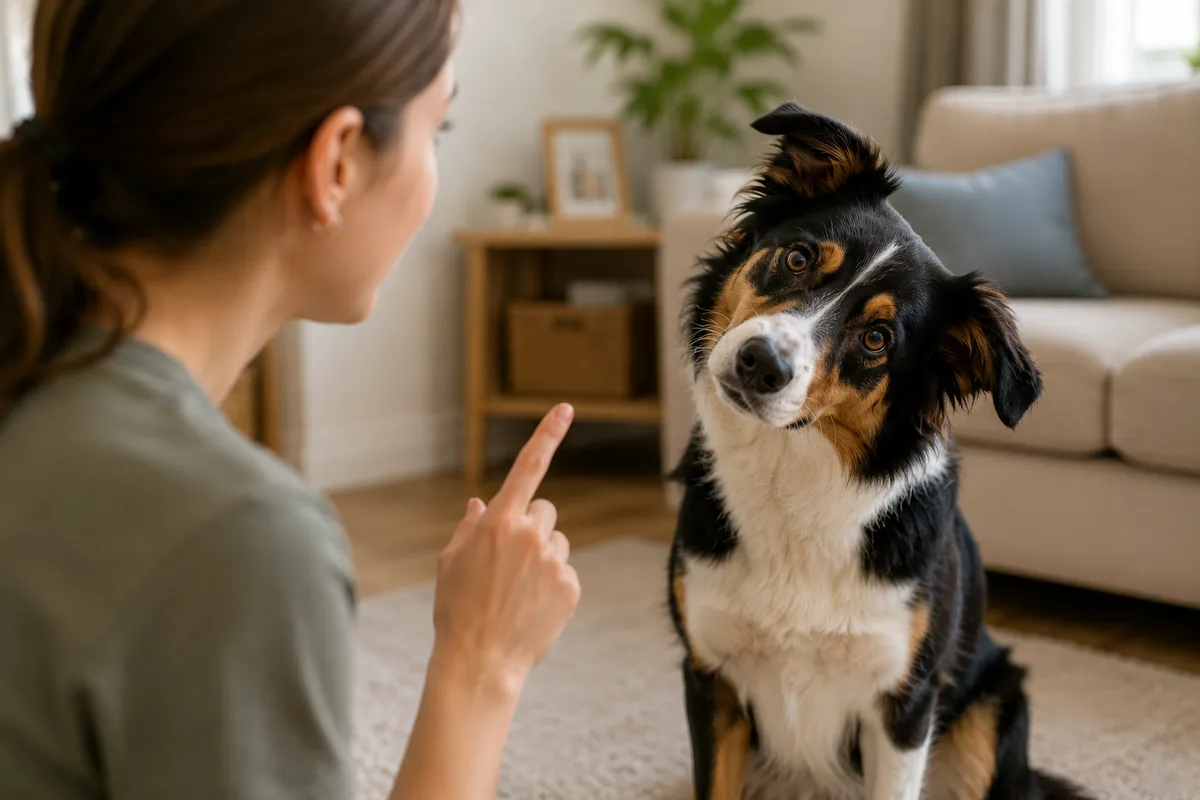
Think about how you actually speak to your dog.
You probably do not say:
“Would you like to go for a walk?”
in exactly the same tone you would use during a business meeting.
Instead, your voice changes.
“Wanna go for a WALK?”
Higher pitch.
More energy.
Exaggerated rhythm.
Dogs are remarkably attentive to vocal cues, and the way something is said can carry information in addition to the words themselves.
Experts cited by the American Kennel Club suggest that when a dog tilts their head while a person is directly in front of them, the behavior may help them focus on frequencies and inflections rather than simply determine where the sound originated.
So your dog may not be puzzled by your question.
They may be concentrating on it.
Certain Words Can Become Extremely Important
Say this sentence to your dog:
“The international economic outlook remains uncertain.”
Probably nothing.
Now say:
“Walk?”
Different dog.
Dogs can learn associations between particular sounds and events.
“Dinner.”
“Outside.”
“Ball.”
“Car.”
“Treat.”
And, of course, their own name.
These sounds become meaningful because something predictable often follows them.
That makes an interesting question:
Does head tilting sometimes occur when dogs are processing words that matter to them?
Research suggests that may happen.
A study involving dogs with an unusual ability to learn the names of toys found that these “gifted word learner” dogs tilted their heads frequently when owners asked for specific toys by name.
The researchers were careful not to claim that every dog head tilt means deep word comprehension.
But the finding supports an intriguing possibility:
Sometimes that little sideways movement may accompany the processing of meaningful information.
Watch What Happens When You Say the Magic Words
You can observe this in your own home without turning your living room into a laboratory.
Notice whether your dog tilts their head equally when you say random sentences and familiar words.
Try an ordinary phrase.
Then naturally use something meaningful in your normal routine:
“Dinner?”
“Outside?”
“Where’s your ball?”
“Want to go for a walk?”
You may notice that certain words immediately produce greater attention.
That does not prove your dog understands the sentence in the same way a human does.
But it can reveal which sounds have become significant through experience.
Dogs are constantly learning patterns.
Human speech is one of them.
Your Dog May Also Be Trying to See You Better
Here is where the explanation becomes even more interesting.
The head tilt may not be entirely about hearing.
It could also involve vision.
Dogs pay attention to human faces and body language.
But many dogs have something humans do not:
A muzzle extending directly in front of their face.
Try making a loose fist and placing it against your nose.
Now look toward the lower half of someone’s face.
Part of your view is obstructed.
One hypothesis suggests that some dogs may tilt their heads to change their viewing angle and see more of a person’s face.
If facial expressions provide useful information, improving that view could be valuable.
Researchers have not established this as the single explanation for head tilting, however.
Hearing and vision may both contribute.
The Shape of Your Dog’s Face Could Matter
Dogs come in an extraordinary range of shapes.
Compare the face of a Greyhound with a Pug.
Or a Collie with a French Bulldog.
The visual obstruction created by the muzzle is clearly not identical.
An exploratory study discussed by the AKC found that dogs with more pronounced muzzles were reported to tilt their heads more frequently than flatter-faced dogs when looking at their owners.
That is interesting evidence for the visual hypothesis.
But it is not enough to declare the mystery solved.
Head shape could be one factor among several.
Your dog may be simultaneously trying to hear more clearly, see your expression, and process something interesting.
Behavior does not always come with one neat explanation.
Your Dog Is Watching More Than Your Mouth
Dogs do not communicate with humans through spoken language alone.
They watch us.
Closely.
Your face changes.
Your posture changes.
Your hands move.
You walk toward particular objects.
You reach for the leash.
You open a cupboard.
All of these actions provide information.
That is why interpreting head tilting without looking at the rest of the interaction misses part of the story.
Your dog may be combining:
your words + your tone + your facial expression + your body language + previous experience
to predict what happens next.
Suddenly, the adorable head tilt looks less silly.
Your dog may be collecting data.
Head Tilting Fits Into a Bigger Communication System
If you have followed our dog-behavior series, you may notice a pattern.
Dogs rarely communicate with one behavior alone.
They watch us.
They follow us.
They lick us.
They adjust their posture.
They respond to our movements.
Our guide to why dogs stare at their owners explains how dogs can watch people for information, attention, cues, and social interaction.
Head tilting may occur during that same information-gathering process.
Instead of treating the tilt as an isolated trick, look at the whole dog.
Where are their eyes?
What are their ears doing?
Is their body relaxed?
What did you just say?
What normally happens after you say it?
Context transforms a cute pose into useful information.
We May Be Encouraging the Head Tilt Without Realizing It
Now we arrive at the explanation humans are partially responsible for.
Dog tilts head.
Human sees dog.
Human immediately loses all emotional composure.
“AWWWW! Who’s a good boy?”
Then comes:
Petting.
Smiling.
Attention.
Maybe even a treat.
From the dog’s perspective, that sequence can be extremely useful.
Head tilt → wonderful things happen.
Dogs repeat behaviors that are rewarded.
The AKC notes that positive reinforcement from people may help explain why some dogs repeat head tilting more frequently.
The behavior may begin spontaneously because the dog is listening or gathering information.
Then humans react enthusiastically.
Now there is another reason to do it again.
We may accidentally help turn an ordinary response into a signature move.
Your Dog Might Know That You Love It
Does this mean dogs deliberately sit around thinking:
“I shall now tilt my head exactly 23 degrees because the human finds this irresistible”?
We cannot responsibly make that claim.
But dogs absolutely learn which behaviors produce attention and rewards.
We already see this principle with other everyday behaviors.
A dog may discover that licking you gets immediate attention.
Another learns that bringing a toy starts a game.
Another paws at your knee because that reliably produces petting.
Head tilting can be reinforced through the same basic learning process.
The dog does something.
You respond positively.
The behavior becomes more likely to happen again.
No canine conspiracy required.
Why Does My Dog Tilt Their Head at Certain Sounds?
Human speech is not the only trigger.
Dogs may tilt their heads when they hear:
a squeaky toy;
an unusual whistle;
another animal;
a sound from a television;
a noise outside;
a strange electronic tone;
or something you cannot immediately hear.
In these situations, auditory information becomes an especially plausible explanation.
Your dog may reposition their head and ears while trying to gather more information about the sound.
Watch what happens immediately afterward.
Do they look toward a particular location?
Walk toward the source?
Move their ears?
Become more alert?
Those additional behaviors can help explain what caught their attention.
Why Do Puppies Tilt Their Heads?
Puppies are encountering an enormous amount of unfamiliar information.
New voices.
New household noises.
New words.
New routines.
New objects.
A puppy tilting their head at your voice may simply be responding to an interesting stimulus and trying to gather information.
And then something else happens.
You see the puppy tilt.
You melt.
The puppy receives attention.
Repeat that cycle often enough and learning may become part of the behavior too.
As with adult dogs, avoid assigning one universal meaning to every puppy head tilt.
Look at the context.
Why Doesn’t My Dog Tilt Their Head?
Your dog is not defective.
And they are not ignoring you.
Some dogs tilt dramatically.
Some do it occasionally.
Others barely seem to do it at all.
Individual differences are normal.
Anatomy, hearing, vision, experience, temperament, reinforcement history, and the situation itself may all influence the behavior.
So there is no reason to repeatedly make strange noises at a perfectly content dog because social media convinced you every dog should perform the classic head tilt.
Your dog has plenty of other ways to pay attention.
Is a Head Tilt Always Cute and Harmless?
No.
This distinction is extremely important.
There is a major difference between:
A brief head tilt triggered by your voice or an interesting sound
and:
A dog persistently holding their head tilted to one side.
The first is common communication-related behavior.
The second can be a medical sign.
According to veterinary guidance, persistent head tilting can occur with conditions involving the ears or vestibular system, among other possible causes.
So do not assume every tilted head means your dog is being adorable.
The circumstances matter.
The Key Question: Does the Head Return to Normal?
Imagine this:
You say, “Want a treat?”
Your dog tilts their head for two seconds.
Then their head returns to its normal position and they run toward the kitchen.
That is the familiar behavior discussed throughout this article.
Now imagine:
Your dog wakes up with their head continuously tilted to one side.
You say nothing.
The tilt remains.
They walk around with it.
Perhaps they also seem unsteady or otherwise unusual.
That is a very different situation.
A persistent unexplained tilt deserves veterinary attention.
Watch for Other Symptoms
Contact your veterinarian if an unexplained persistent head tilt appears, particularly when accompanied by other changes such as:
- loss of balance;
- stumbling or falling;
- walking in circles;
- unusual eye movements;
- vomiting or nausea;
- scratching or pawing at an ear;
- ear discharge or odor;
- apparent pain;
- sudden behavioral changes;
- or difficulty standing or walking normally.
This is not a situation where an internet article should be used to diagnose the cause.
A veterinarian needs to evaluate the dog.
A short video of the behavior may also be useful if the symptoms change before the appointment.
Don’t Confuse a Behavior With a Symptom
This is perhaps the simplest way to remember the distinction.
Behavioral head tilt:
Usually brief.
Often follows a voice, word, or interesting sound.
Dog otherwise appears normal.
Head returns to its usual position.
Potentially concerning head tilt:
Persistent or repeatedly unexplained.
May happen without an obvious sound or interaction.
Dog may show other physical or neurological changes.
Does not simply disappear when the interesting stimulus ends.
They may look similar in a photograph.
In real life, they are very different situations.
Your Dog Probably Isn’t “Confused” in the Human Sense
The classic interpretation is irresistible:
You say something.
Your dog tilts their head.
Therefore the dog must be thinking:
“What on earth are you talking about?”
It makes a great caption.
But scientifically, “confusion” is too simplistic.
The behavior may instead reflect increased attention or information processing.
Your dog heard something relevant.
They are focusing.
Listening.
Watching.
Perhaps connecting a familiar sound with something they have learned.
That is considerably more interesting than assuming their brain temporarily stopped working.
So, Does Your Dog Understand What You’re Saying?
Not the way another human understands a conversation.
But dogs can learn that particular words, sounds, tones, gestures, and routines predict particular outcomes.
Your dog may not understand the grammar of:
“Would you perhaps like to accompany me on an afternoon walk?”
But if one sound inside that sentence resembles a familiar cue—
“walk”
—you may suddenly have their complete attention.
Dogs live alongside humans long enough to become remarkably skilled observers of our patterns.
Sometimes the head tilt may be a visible part of that attention.
The Bottom Line
That adorable sideways head probably does not have one universal explanation.
Your dog may be adjusting how they hear a sound.
They may be concentrating on your voice.
They may be processing a familiar word.
They may be changing their viewing angle to gather more visual information from your face.
And because humans tend to respond enthusiastically to head tilting, your reaction may reinforce the behavior and make it more likely to happen again.
The most interesting answer may therefore be:
Several things are happening at once.
Your dog is listening.
Watching.
Learning.
Predicting.
And perhaps discovering that one tiny movement of the head has extraordinary power over humans.
Just remember the important exception.
A brief tilt while you talk is one thing.
A head that remains persistently tilted without an obvious trigger—particularly alongside balance problems, unusual eye movements, ear symptoms, pain, or other changes—is something to discuss with a veterinarian.
So the next time you say “walk?” and your dog gives you that famous sideways look, enjoy it.
They may be doing much more than simply looking cute.








Join the discussion