Why Do Birds Fly in a V Formation? The Aerodynamics Behind Migration
Why do birds fly in a V formation during migration? The answer lies in wingtip vortices, upwash, synchronized wingbeats and an aerodynamic strategy that can make long-distance flight more efficient.
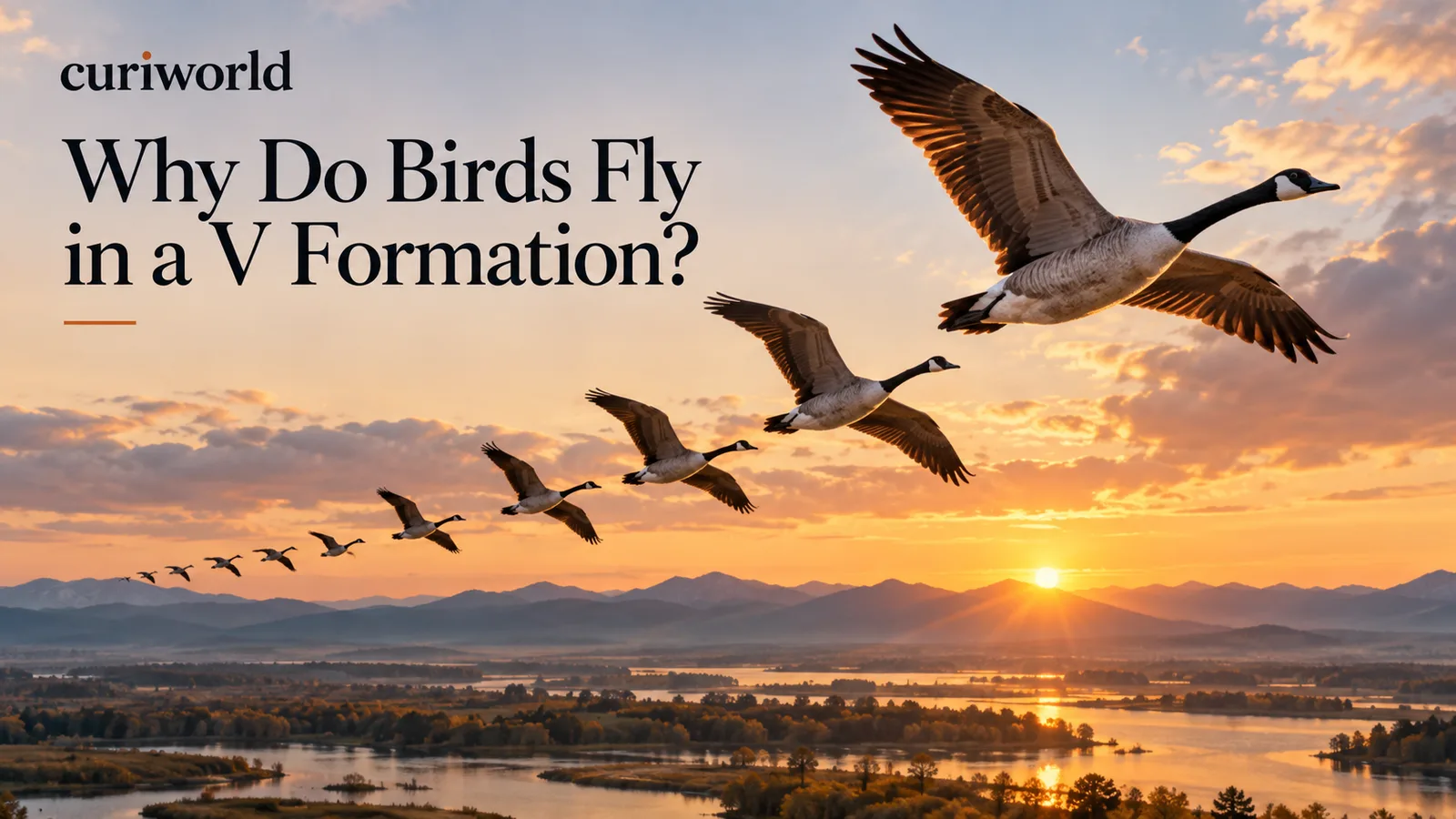
The familiar V made by migrating geese is not simply a convenient way for a flock to stay together.
It is an aerodynamic strategy.
A bird flying behind and slightly to the side of another can use upward-moving air generated by the bird ahead. Positioned correctly, the follower receives extra lift and can reduce some of the mechanical work required to stay airborne.
But this is not the same as a cyclist simply hiding from the wind behind another rider. In fact, flying directly behind another bird can put a follower in less favorable air.
The real physics involves wingtip vortices, precisely chosen positions and even the timing of individual wingbeats.
And new research published in 2026 has added another piece to the puzzle.
The Short Answer: The V Helps Some Birds Fly More Efficiently
A flying bird does more than move forward through still air.
Its wings continuously change the air around them.
As the wings generate lift, swirling regions of air called wingtip vortices form behind them. Those vortices create different zones in the wake.
Some air is pushed downward.
Other parts of the wake move upward.
For a following bird, the goal is to avoid the most disadvantageous downwash while positioning its wings where it can benefit from the upward-moving air, or upwash, created by the bird ahead.
That is why birds in a formation usually do not fly perfectly nose-to-tail.
They spread outward.
The result is the familiar V—or sometimes a less symmetrical line or echelon.
Research on northern bald ibises has shown that birds in formation tend to occupy positions consistent with aerodynamic predictions for exploiting this upwash.
What Is Upwash, and Why Does It Matter?
Think of the air behind a flying bird as a moving wake rather than an empty space.
A bird’s wings create lift by changing the momentum of the surrounding air. Near the wingtips, pressure differences contribute to rotating vortices that trail behind the bird.
Immediately behind the bird, parts of this airflow produce downwash—air moving downward.
Farther to the sides of that wake are regions where the vortex motion carries air upward.
That upward component matters.
A second bird flying through the right part of the wake can gain aerodynamic assistance instead of generating all of its lift independently.
This is the crucial distinction that the simple phrase “birds draft each other” often misses.
The useful position is generally behind and offset to one side, not directly behind the bird in front.
That geometry naturally produces the arms of a V.
Birds Do More Than Choose the Right Position
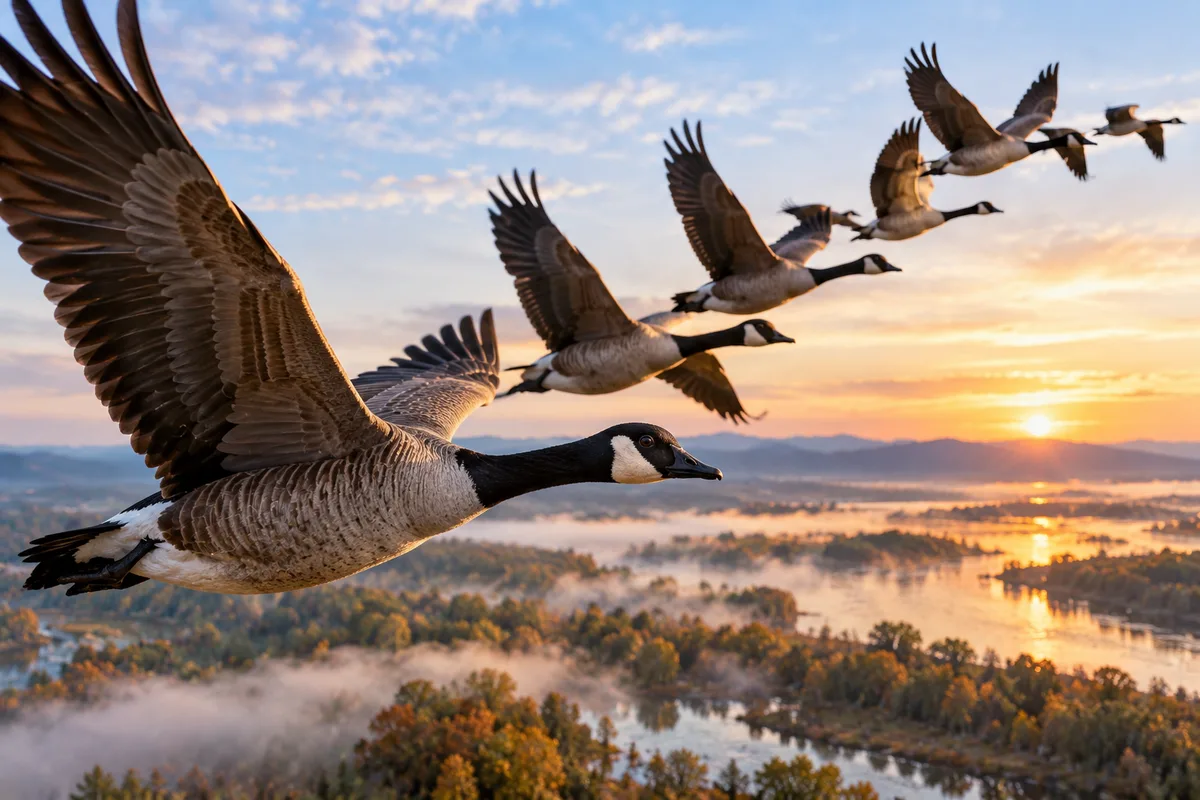
Position is only part of the trick.
The wake behind a bird is constantly changing because its wings are flapping. A follower therefore has to deal with a moving aerodynamic pattern rather than a fixed stream of rising air.
A landmark 2014 Nature study tracked northern bald ibises during flight using lightweight instruments capable of recording their positions and wing movements.
The researchers found something remarkable.
When an ibis was in a favorable V position, it coordinated its wingbeats with the bird ahead. Its wingtip movements were timed in a way that helped it remain aligned with the beneficial parts of the preceding bird’s wake.
When a bird moved into a less favorable position directly behind another, its flapping pattern changed.
In other words, the birds were not simply holding a geometric formation.
They were responding dynamically to the air created by their flockmates.
A 2026 Study Found Another Way the V May Save Power
The basic aerodynamic explanation has been studied for decades, but researchers are still working out exactly where the savings come from.
A 2026 study by researchers at Brown University developed a wake-vortex model of two flapping birds, using the northern bald ibis as its reference.
The model predicted that a follower flying in the optimal formation position could require about 11% less total mechanical power than it would otherwise.
One of the most interesting findings was how that reduction occurred.
The model suggested that the follower could reduce the vertical amplitude of its wingbeats and, to a lesser extent, change the flexion of the wings during the upstroke. In simpler terms, favorable airflow from the bird ahead may allow the following bird to accomplish the same flight with somewhat less demanding wing motion.
That does not mean every goose in every V saves exactly 11%.
The figure comes from a model for a particular bird configuration, not a universal measurement for every species, flock, speed and weather condition.
But the predicted optimum closely matched observations from live birds, giving researchers a more detailed mechanical explanation for why formation flight works.
Do We Know That Birds Actually Save Energy?
There is evidence beyond aerodynamic theory.
In an earlier experiment published in Nature, researchers studied great white pelicans trained to fly together. Heart rate was used as a proxy for energy expenditure.
Pelicans flying in formation showed reduced heart rates and lower wingbeat frequencies compared with birds flying alone, supporting the idea that formation flight can reduce the cost of flying for birds occupying favorable positions.
That evidence is important because energy savings during migration are not a trivial advantage.
Long-distance flight is expensive.
A migratory bird may travel hundreds or thousands of miles while repeatedly balancing energy use, food availability, weather and the need to reach seasonal habitat.
Even a modest reduction in the power needed during sustained flight can therefore matter.
Why Does the Bird at the Front Lead if It Gets Less Help?
There is an obvious problem with the V.
Someone has to be first.
The lead bird cannot take advantage of upwash from another bird immediately ahead, so why would any individual remain in that position?
The answer appears to involve switching.
A 2015 study of northern bald ibises found that birds frequently exchanged leading and following positions. At the pairwise level, the amount of time an ibis spent leading another bird was closely related to the amount of time it later benefited from following that bird.
The researchers interpreted the pattern as evidence of reciprocal cooperation.
Rather than one permanent leader doing all the difficult work, birds can trade access to the more favorable trailing positions.
This also means the common image of a single dominant or especially wise bird leading an entire migration should be treated cautiously.
At least in the ibises studied, leadership was much more fluid.
Is the Front Bird Always the Strongest or Oldest?
Not necessarily.
Popular explanations sometimes describe the leader as the flock’s strongest bird, oldest bird or navigator.
Real formation dynamics are more complicated.
Individuals can change position frequently, and the leader can be replaced during flight.
For northern bald ibises, researchers documented repeated exchanges between leading and trailing roles rather than a permanently assigned leader.
Navigation and social knowledge may still matter in bird migration, and different species do not necessarily organize themselves identically.
But the existence of a V does not by itself prove that the bird at the point is the oldest, strongest or highest-ranking member of the flock.
Why Don’t All Migrating Birds Fly in a V?
Because formation flight is not equally useful—or practical—for every bird.
The classic V is especially associated with relatively large birds such as geese, cranes, pelicans and ibises.
Many small migratory birds travel in very different flock structures, and some migrate largely on their own.
Size matters because larger wings create substantial aerodynamic wakes that neighboring birds may be able to exploit. Formation flight also requires birds to maintain useful spacing and coordinate their movement while traveling relatively steadily.
A study of pigeons illustrates why “flocking” and “energy saving” should not automatically be treated as the same thing.
Researchers found that pigeons flying in tight cluster flocks increased their wingbeat frequency when flying near other birds, particularly behind them. In that context, flocking could impose additional aerodynamic and control costs rather than providing the advantages seen in classic V formations.
So the rule is not:
birds save energy whenever they fly together.
It is closer to:
certain birds, flying in certain formations and positions, can exploit the airflow produced by their neighbors.
Does the V Help Birds See Each Other Too?
Possibly.
Aerodynamics provides strong evidence for the formation’s energetic value, but the geometry can have other advantages.
An offset position gives birds a relatively unobstructed view of flockmates ahead rather than placing one bird directly behind another.
That may help with maintaining spacing and coordinating movement.
Researchers have long discussed communication and visual organization alongside aerodynamic explanations for formation flight.
These ideas are not mutually exclusive.
A behavior can persist because it solves several problems at once.
Still, the strongest experimental evidence for the distinctive V geometry centers on aerodynamic interaction and energy use.
Is a Perfect V Necessary?
No.
Real migrating flocks rarely look like diagrams for long.
One side may be longer than the other.
The formation may bend.
Birds change places.
Gaps expand and contract.
The shape may temporarily resemble a J, diagonal line or echelon rather than a perfectly symmetrical V.
The aerodynamic principle does not require every bird to maintain an aesthetically perfect angle.
What matters more is the relative position of a bird to the wake created by the individual ahead.
That is why a messy-looking formation can still make aerodynamic sense.
Why Is This Especially Useful During Migration?
Flying is expensive, and migration magnifies that cost.
For a short trip between a feeding area and a nearby lake, a small aerodynamic improvement may not change much.
During sustained travel over long distances, repeated savings can become much more valuable.
That is also why the V should not be confused with the signal that tells birds when to migrate.
Formation flight helps with the journey once the birds are traveling. Seasonal timing involves a separate set of biological and environmental cues.
Those migrations often become especially visible during the same autumn transition that changes the landscape below them. Curiworld explores another part of that seasonal transformation in why leaves change color in fall.
The V Is Really a Moving Aerodynamic System
The most impressive part of formation flight may not be the V shape itself.
It is how much adjustment is required to maintain it.
Each bird is moving.
Its wings are moving.
The wake behind it is moving.
The flock is traveling through air that may itself be turbulent or changing direction.
Yet birds can continually adjust position and wingbeat timing well enough to exploit these temporary regions of useful airflow.
That turns the flock into something more interesting than several animals following one another.
It becomes an interacting aerodynamic system.
Energy efficiency appears elsewhere in bird biology too. A very different example can be seen in Curiworld’s look at why flamingos stand on one leg, where anatomy and posture can reduce unnecessary muscular effort while the bird is standing rather than flying.
So Why Do Birds Fly in a V?
For the large birds that use it, the V formation can make sustained flight more efficient.
Birds behind the leader position themselves to exploit favorable upwash from the wings ahead while avoiding disadvantageous parts of the wake. Some can synchronize their wingbeats with those moving vortices, and individuals may exchange leading and following positions so that the energetic burden is shared.
The classic V is therefore not simply about following a leader.
It is a constantly changing arrangement of wings, vortices, spacing and cooperation.
And although scientists have been studying the phenomenon for decades, research published as recently as 2026 shows that there is still more to learn about exactly how birds turn another bird’s wake into useful lift.
Sources
Weimerskirch et al. — Energy Saving in Flight Formation, Nature (2001)








Join the discussion