Why Do Cats Chatter at Birds Through the Window?
Cats often chatter when birds or other prey appear just out of reach. The behavior is tied to predatory arousal, but the exact reason behind those rapid jaw movements is still not fully understood.
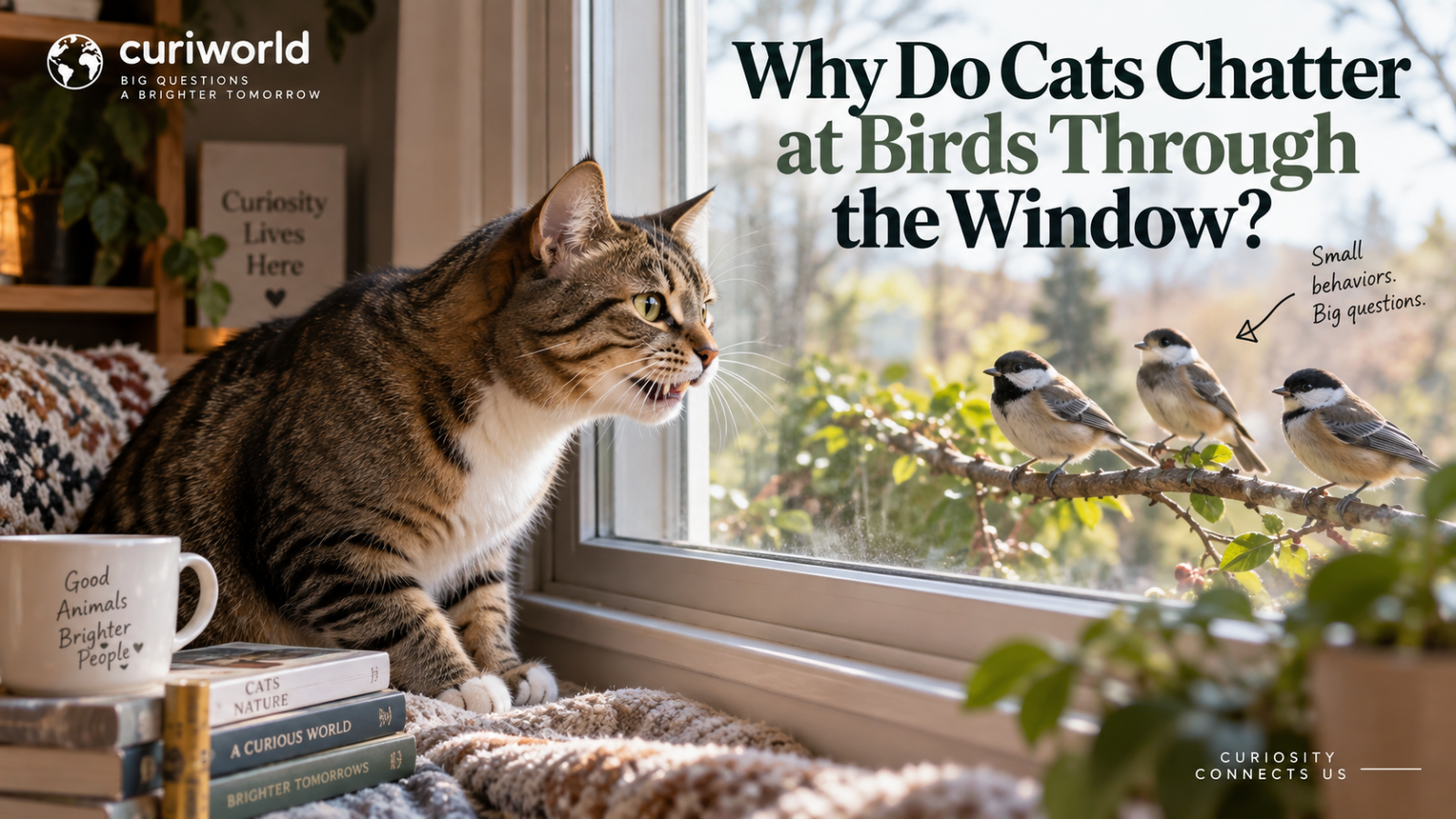
Your cat freezes at the window.
Eyes wide. Body low. Tail twitching.
A bird lands outside.
Then the cat’s jaw starts moving rapidly:
ek-ek-ek-ek-ek.
It can sound like teeth clicking, a tiny machine gun, or an extremely unsuccessful attempt to speak bird.
This behavior is usually called chattering, although people also describe it as chittering, twittering or chirping.
It is strongly associated with seeing potential prey—especially birds, squirrels, rodents and insects.
But the important part is this:
Scientists and veterinary behavior experts do not have one proven explanation for why cats chatter.
The strongest possibilities involve the cat’s predatory system becoming highly activated: excitement at seeing prey, frustration because the prey cannot be reached, or both.
The window may be what makes the behavior especially obvious.
What Does Cat Chattering Actually Look and Sound Like?
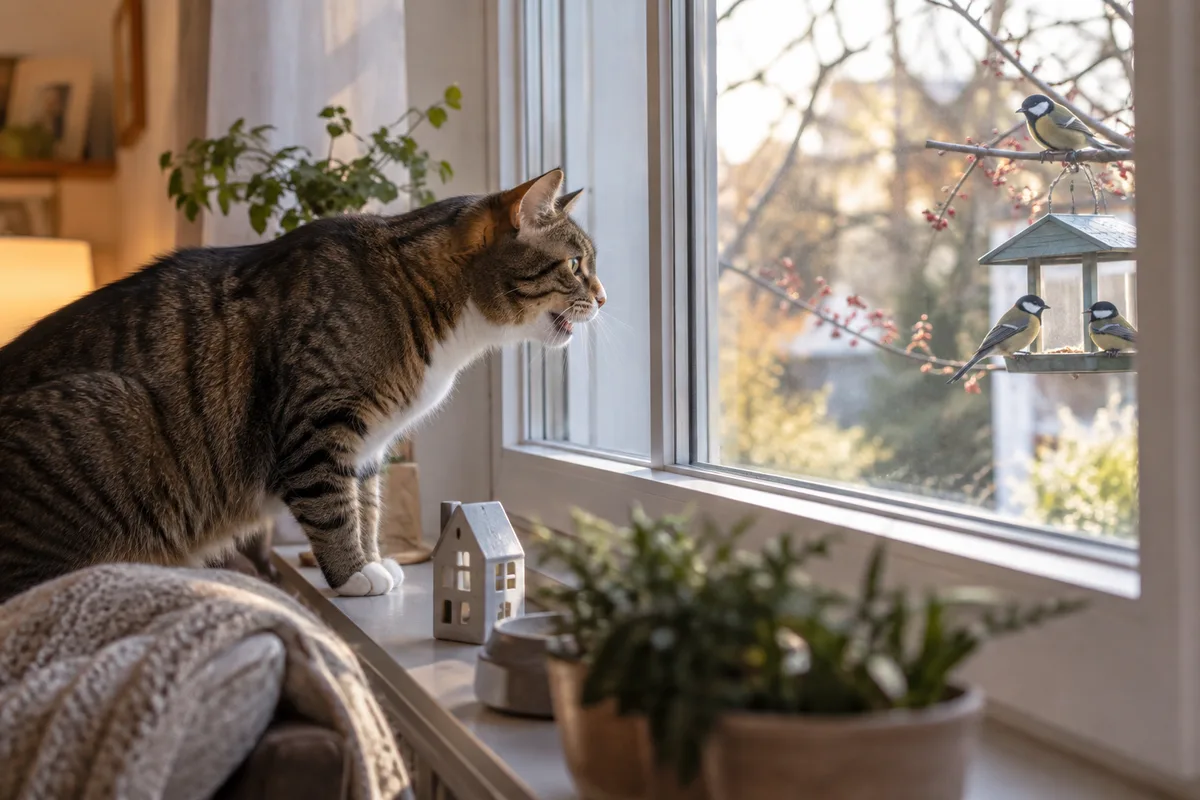
Chattering is usually easy to recognize once you have seen it.
The cat rapidly opens and closes its jaw, sometimes producing a sequence of clicking or smacking sounds.
You may also hear high-pitched chirps mixed in.
At the same time, the cat often looks intensely focused.
Common body-language clues include:
- eyes fixed on the animal outside,
- ears directed forward,
- a crouched or ready posture,
- whiskers oriented toward the target,
- small tail movements,
- and very little attention to anything else in the room.
Cats Protection notes that this behavior is particularly common when a cat is indoors watching birds or other potential prey through a window.
The visual target matters.
Your cat is not randomly making a strange noise.
Something has activated the hunting system.
Chattering and Chirping Are Similar, but Not Exactly the Same
These terms are often used interchangeably.
In practice, there can be a difference.
Chattering usually refers to the rapid movement of the jaw and the clicking or smacking sound that comes with it.
Chirping tends to describe a shorter, higher-pitched vocal sound.
A cat may do either. Or both at the same time.
PetMD’s veterinary behavior guidance describes chattering as a rhythmic jaw movement often associated with prey the cat wants to hunt but cannot reach.
So when a cat sits at the window going: “ek-ek-ek… chirp… ek-ek” you may be hearing two related behaviors layered together.
The Bird Has Activated a Hunting System That Never Disappeared
A bowl full of food does not erase predatory behavior.
Domestic cats still retain many of the behavioral patterns that help felines hunt.
Those include: locate → watch → stalk → chase → pounce → capture A bird moving unpredictably outside a window is excellent at activating that sequence.
It is small. Fast. It changes direction suddenly. It may flutter, hop and disappear behind objects.
Those are exactly the kinds of movements that attract feline attention.
That is why even a cat that has just eaten dinner may stare at a sparrow as though nothing else in the world exists.
Hunting behavior is not controlled only by hunger.
Is Your Cat Frustrated Because the Bird Is Behind Glass?
Possibly.
This is one of the leading explanations.
The cat can: see the prey, track the prey, hear the prey, and become physically ready to pursue it.
But then comes the problem.
There is a window in the way.
VCA Animal Hospitals describes chattering as a response to the excitement—and possibly frustration—of seeing animals outside that the cat cannot reach.
Cats Protection makes the same point.
This idea fits an important observation:
cats often chatter when prey is visible but inaccessible.
The window gives the cat almost every part of the hunting experience except the chase and capture.
That incomplete sequence may help explain the unusual reaction.
Excitement May Be Just as Important as Frustration
It would be too simple to say every chattering cat is unhappy.
Some cats appear intensely excited rather than distressed.
The bird has created a highly stimulating event.
The cat’s body becomes alert.
Attention narrows.
Predatory motivation rises.
The rapid jaw movement and sounds may be part of that state of high arousal.
Cats Protection therefore lists both excitement and frustration among the likely explanations.
We cannot ask the cat which one dominates.
And it may not be the same every time.
A particular chattering episode could involve both: “There it is!” and “Why can’t I get to it?”
Why Would a Cat Make Noise if It Were Really Hunting?
This is a useful question.
If a cat were actually stalking a bird outdoors, making an obvious clicking sound could reveal its location.
And cats hunting real prey usually benefit from being quiet.
That is one reason researchers and behavior specialists are cautious about saying chattering itself is a necessary hunting technique.
Cats Protection specifically notes that cats with a genuine opportunity to hunt are generally more likely to remain quiet rather than announce themselves.
This supports the idea that chattering may be especially associated with watching inaccessible prey, rather than being an essential part of the final hunting sequence.
Is the Cat Trying to Imitate the Bird?
You will see this explanation everywhere online.
The theory is appealing:
the cat produces bird-like chirps in an attempt to fool the bird and get closer.
There are observations of some wild felids producing sounds that resemble those of prey species, so vocal mimicry in cats is not an absurd idea.
But for ordinary domestic-cat window chattering, there is not strong evidence proving that cats are deliberately imitating birds as a hunting strategy.
VCA describes the mimicry explanation as anecdotal rather than research-backed.
Cats Protection presents it as one of several theories, not an established fact.
So the careful answer is:
perhaps—but we do not know.
It should not be presented as the main proven explanation.
What About the “Kill Bite Practice” Theory?
Another popular claim says the rapid jaw movement mimics the bite a cat would use on captured prey.
According to this explanation, the cat is almost rehearsing the killing movement before it reaches the bird.
Again, it sounds plausible.
But evidence is weak.
Cats Protection describes the kill-bite explanation as an unlikely theory rather than a demonstrated mechanism.
That distinction matters.
A good explanation of animal behavior should separate: what we observe from what we think might explain it.
We observe that cats often chatter while intensely watching prey.
We do not have evidence proving that every jaw movement is a rehearsal for biting a bird’s neck.
Why Do Cats Chatter at Squirrels and Bugs Too?
Because the behavior is not really about birds.
Birds are simply one of the most common triggers because they are so visible through windows.
Cats can also chatter at:
- squirrels,
- mice,
- flies,
- moths,
- insects,
- and other small moving animals.
PetMD notes the same behavior in cats watching insects that are difficult to reach.
The common factor is more likely: potential prey + intense visual attention rather than a special relationship between cats and birds.
Why Doesn’t Every Cat Chatter?
Because cat behavior varies enormously between individuals.
Some cats chatter frequently.
Others chirp occasionally.
Some silently stare at birds for twenty minutes.
Others lose interest after a few seconds.
Cats Protection specifically notes that not all cats display the behavior.
So the absence of chattering does not mean a cat lacks hunting instincts.
It may simply express predatory arousal differently.
One cat crouches.
Another flicks its tail.
Another paws at the glass.
Another makes the famous clicking sound.
Does Chattering Mean Your Cat Wants to Go Outside?
Not necessarily.
A cat staring intensely through a window may certainly want access to what it sees.
But chattering itself is not proof that an indoor cat needs to be released outdoors.
In fact, window viewing can provide valuable environmental stimulation.
Current feline welfare guidance emphasizes giving indoor cats opportunities for:
- observation,
- play,
- stalking,
- chasing,
- pouncing,
- foraging,
- and other simulated predatory behaviors.
The Feline Veterinary Medical Association’s environmental guidance specifically recommends play that allows cats to express parts of the predatory sequence.
A safe window perch can be one part of a stimulating indoor environment.
The important question is how the individual cat responds.
Is Watching Birds Through the Window Good for Cats?
For many cats, yes.
A secure window can provide an ever-changing source of:
- movement,
- sound,
- novelty,
- sunlight,
- visual stimulation,
- and opportunities to monitor the environment.
That can be particularly valuable for indoor cats.
However, enrichment works best when it is not the cat’s only outlet.
Watching a bird is not the same as stalking, chasing and catching something.
Interactive play can provide the parts that glass prevents.
The AAFP/ISFM environmental guidelines recommend toys and play routines that simulate prey and allow the cat to successfully “capture” the toy at least some of the time.
That final capture matters.
A hunting sequence with no possible completion may be less satisfying for some cats.
A Window View Can Sometimes Produce Too Much Arousal
Most chattering is harmless.
But occasionally a cat becomes extremely agitated by something outside.
This is particularly important when the trigger is another cat rather than a bird.
Cornell’s Feline Health Center notes that when a cat becomes highly aroused by something it cannot reach—such as an animal outside a window—the cat may sometimes redirect aggression toward another cat or a person nearby.
That is called redirected aggression.
Ordinary bird chattering is not the same thing.
But watch the whole body.
A cat that is:
- casually chirping,
- focused,
- interested,
- and able to walk away afterward
looks very different from a cat that is:
- growling,
- hissing,
- violently striking the window,
- lashing its tail,
- attacking another household cat,
- or remaining highly agitated long after the trigger disappears.
Context matters more than the sound alone.
Should You Stop Your Cat From Chattering?
Usually, no.
Chattering at a bird is generally considered normal feline behavior.
There is no reason to interrupt a relaxed cat simply because the noise sounds strange.
If the cat enjoys the window and remains calm afterward, let it watch.
The better response is to make sure the cat also has healthy outlets for the predatory behaviors the bird activates.
Try:
- wand toys,
- toys that move unpredictably,
- food puzzles,
- hidden treats,
- climbing opportunities,
- short chase-and-capture games,
- and rotating toys to keep them interesting.
Allow the cat to catch the toy sometimes.
The goal is not to eliminate hunting behavior.
It is to give it a safe outlet.
Should You Put a Bird Feeder Outside the Window?
This requires some thought.
From the cat’s perspective, a bird feeder can create fascinating visual stimulation.
From the wildlife’s perspective, however, attracting birds close to a place where outdoor cats can reach them is obviously not ideal.
If your cat is strictly indoors and the window is secure, visual observation can be enriching.
If the cat has outdoor access, avoid creating a situation that deliberately concentrates prey within hunting range.
Cat welfare and wildlife welfare both matter.
Can a Cat Hurt Its Teeth by Chattering?
Normal brief chattering should not damage healthy teeth.
The jaw movement is usually small and rapid rather than forceful chewing.
But something that merely resembles chattering can occasionally be a different problem.
Repeated jaw movements when no prey is present, pawing at the mouth, drooling, difficulty eating, bad breath, visible oral pain or suddenly refusing food can point toward a dental or oral issue instead.
The clue is context.
Chattering only while staring intensely at birds: very likely behavioral.
Repeated jaw movement during meals or at random times with signs of discomfort: worth discussing with a veterinarian.
Why Did My Cat Suddenly Start Chattering When It Never Did Before?
Sometimes there is a simple explanation.
The cat may have discovered a better window.
Bird activity outside may have changed.
A feeder may have appeared nearby.
The cat may simply have matured into a stronger predatory response.
A newly adopted indoor cat may also become more comfortable and begin displaying behaviors that were suppressed when it was stressed.
But sudden changes in vocalization deserve context.
If chattering occurs only around obvious prey and the cat otherwise behaves normally, it is usually not concerning.
If a cat develops unusual jaw movements or completely new vocal behavior without an obvious trigger—especially with changes in eating, weight, energy, breathing or behavior—a veterinary evaluation is more appropriate.
Why Does the Tail Twitch at the Same Time?
Because the sound is only one piece of the reaction.
A cat watching prey often becomes intensely focused.
Small tail flicks or twitches can accompany that elevated arousal.
The ears may rotate toward the bird.
The pupils may widen.
The body may lower.
The whiskers may shift forward.
Taken together, these signals tell a more complete story than the chatter alone:
the cat’s attention is locked onto something important.
This is another reason it is better to read feline behavior as a pattern rather than translating each isolated movement into a single emotion.
Chattering Fits Into a Much Larger Predatory Pattern
Curiworld already explores another feline behavior connected partly to predatory movement in why cats suddenly get the zoomies.
The behaviors look completely different.
One cat is motionless at a window.
The other is racing down a hallway.
Yet both make more sense once we remember something fundamental:
domestication changed where cats live and how they obtain food.
It did not remove the behavioral systems of a small predator.
The Bottom Line
Cats usually chatter at birds because seeing potential prey activates their predatory system.
The rapid jaw movements and clicking sounds are strongly associated with intense prey-focused attention.
What we do not know is exactly what the sound means.
The best-supported explanations involve:
excitement, high arousal and possibly frustration when prey is visible but unreachable.
The popular ideas that cats are imitating birds or rehearsing a killing bite remain theories rather than established explanations.
So when your cat sits behind the glass making that strange little: ek-ek-ek-ek it probably is not trying to have a conversation with the bird.
It is showing you what happens when thousands of years of feline hunting behavior encounter one very modern obstacle: a closed window.
Sources
Cats Protection — Why Do Cats Chatter and Chirp at Birds?
VCA Animal Hospitals — Cat Chattering and Other Pet Sounds
AAFP and ISFM — Feline Environmental Needs Guidelines








Join the discussion