Why Do Flamingos Stand on One Leg? The Science Behind the Pose
Flamingos may stand on one leg to conserve body heat and because their unusual anatomy allows them to remain remarkably stable with little muscular effort. The pose is more efficient than it looks.
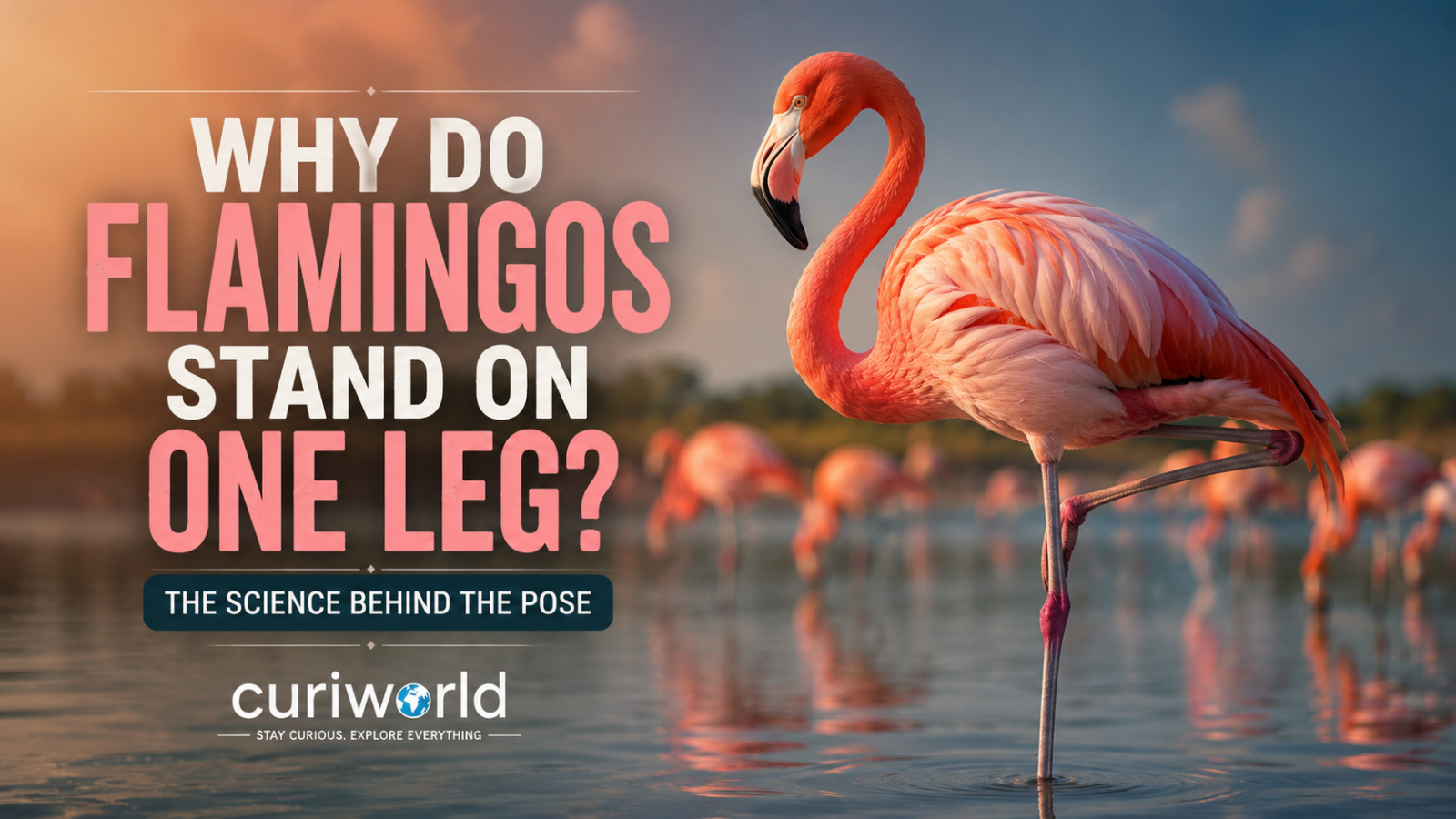
A flamingo standing on one leg looks as though it is performing a balancing trick.
It probably does not feel like one.
Flamingos can remain in this position for long periods and may even rest or sleep that way. Scientific research suggests that the famous pose may offer more than one advantage: lifting one leg can help reduce heat loss, while the bird’s unusual anatomy appears to allow its body to remain stable with remarkably little active muscular effort.
So what looks like an uncomfortable feat of balance may actually be one of the most efficient ways for a flamingo to rest.
The Short Answer: Flamingos May Be Saving Heat and Energy
There is no single experiment proving that every flamingo stands on one leg for one universal reason.
Instead, two explanations have particularly strong scientific support.
The first is thermoregulation.
Flamingos spend a great deal of time standing in water. Their long, largely unfeathered legs can transfer body heat to the surrounding environment. By tucking one leg against the body and exposing only the other, a bird may reduce the amount of heat escaping through its limbs.
The second explanation comes from biomechanics.
Researchers have found evidence that a flamingo can settle into a mechanically stable one-legged position that requires surprisingly little active muscular force.
Put those findings together and the pose begins to make much more sense: standing on one leg may help a flamingo conserve heat while also providing an efficient resting position.
Why Would a Flamingo Need to Conserve Heat?
The feathers covering a flamingo’s body provide insulation.
Its long legs are different.
They have far less insulating plumage and contain blood vessels capable of exchanging heat with the surrounding environment. When those legs are standing in cool water, heat can leave the body.
That makes the legs useful for regulating temperature, but it can also make them a significant source of heat loss.
Researchers Matthew Anderson and Sarah Williams studied one-legged resting behavior in captive Caribbean flamingos and found an interesting pattern: the birds were more likely to stand on one leg when temperatures were lower.
As temperatures increased, one-legged resting became less common.
The researchers also found that flamingos standing in water were more likely to adopt the posture than birds standing on land.
Those observations support the idea that thermoregulation plays an important role.
Think of the flamingo’s legs as exposed radiators. Two long legs in cool water provide more surface area for heat exchange than one. Pulling one leg up into the feathers reduces the amount of exposed limb and may help preserve body heat.
But Heat Conservation Does Not Explain Everything
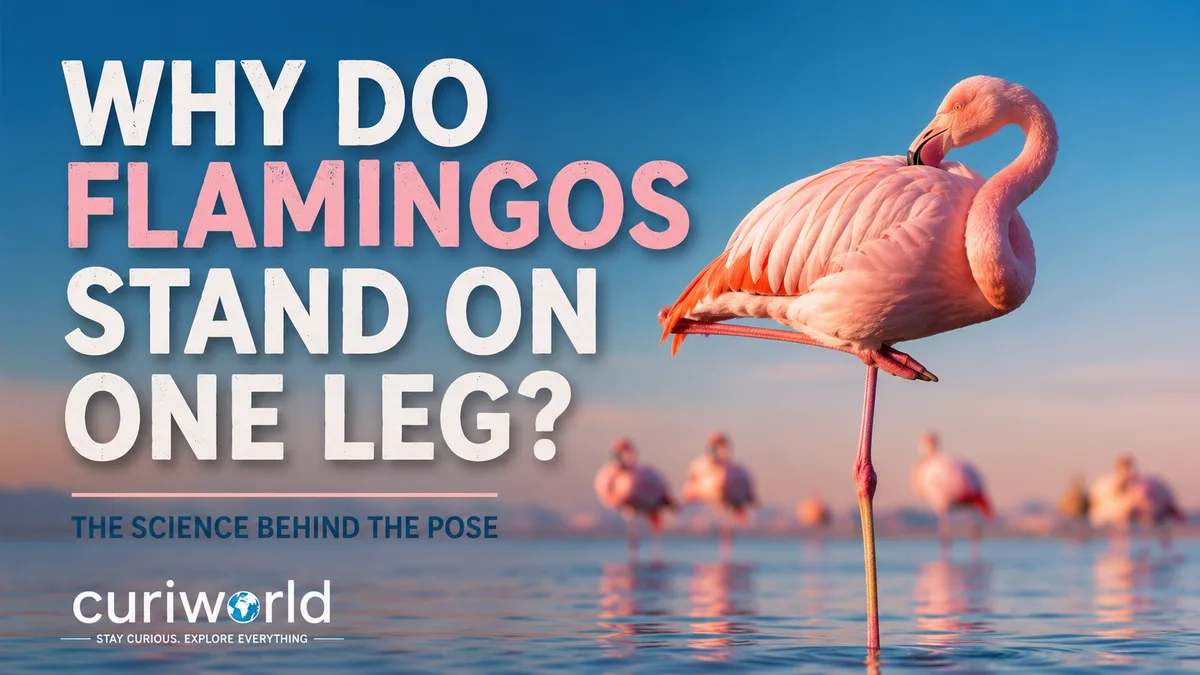
For years, the temperature explanation seemed like the obvious answer.
Then researchers asked another question:
How difficult is it for a flamingo to stand on one leg in the first place?
Humans naturally assume that balancing on one foot requires more muscular effort than standing on two.
Try standing on one foot for several minutes and that assumption seems perfectly reasonable.
Flamingos, however, are built very differently.
A 2017 biomechanics study by Young-Hui Chang and Lena Ting investigated the flamingo stance using both live birds and flamingo cadavers.
Their experiments revealed something remarkable.
A flamingo’s body can adopt a stable one-legged configuration in which gravity and the structure of its joints help support the bird without requiring large amounts of active muscular force.
The researchers described this mechanism as a passively engaged gravitational stay apparatus.
In simpler terms, the flamingo can let its anatomy do much of the work.
A Flamingo Does Not Balance Like a Human
This is the detail that makes the behavior especially fascinating.
A human standing on one leg constantly makes tiny muscular corrections.
Your ankle moves. Your hips adjust. Muscles contract. Your nervous system continually works to stop you from falling.
A resting flamingo appears capable of entering a much more mechanically stable position.
In the 2017 study, researchers found that even flamingo cadavers could be positioned so that they supported body weight on one leg without active muscle contraction.
The same specimens could not maintain an equivalent stable two-legged posture.
Observations of living flamingos offered another clue. When the birds were quiet and resting on one leg, their postural movement became extremely small.
They actually became more stable as they relaxed.
That is almost the opposite of what happens when a person attempts the same pose.
For a flamingo, standing on one leg may therefore be less like balancing on a tightrope and more like allowing a structure to settle naturally into a stable position.
Does Standing on One Leg Prevent Muscle Fatigue?
You may come across another popular explanation: flamingos alternate legs because the supporting leg becomes tired.
The scientific evidence is not that simple.
Researchers have examined whether flamingos might switch legs primarily to reduce muscle fatigue, but observations did not provide strong support for fatigue as the main explanation.
The later biomechanics research made the idea even less convincing by showing that the one-legged position may require very little active muscular force when a flamingo is resting.
Flamingos certainly switch between their legs, but this does not necessarily mean one leg has become exhausted.
Their behavior appears to be more sophisticated than simply shifting weight because a leg is tired.
Do Flamingos Prefer Their Right or Left Leg?
Apparently not.
Researchers observing Caribbean flamingos looked for a consistent preference for one side and did not find a strong population-level bias.
Individual flamingos divided their resting time between the right and left legs.
That makes sense if the main benefit comes from having one leg tucked away, rather than from using one particular dominant leg.
Unlike humans being right-handed or left-handed, flamingos do not appear to have a universal favorite leg for this famous resting position.
Can Flamingos Sleep Standing on One Leg?
Yes.
Flamingos commonly rest in the one-legged position and can remain remarkably stable even while becoming very quiet.
Biomechanics researchers observed flamingos as they transitioned from alert behavior into quieter resting states. When a bird relaxed with its eyes closed, its movements became even smaller.
Once again, this seems counterintuitive from a human perspective.
Close your eyes while balancing on one foot and the task usually becomes more difficult.
A flamingo’s anatomy changes the equation.
Its characteristic posture allows the body to remain mechanically stable without constantly fighting gravity.
Why Do Flamingos Tuck the Other Leg Into Their Feathers?
Once a flamingo lifts its unused leg, it typically bends the limb and draws it close to its body.
This behavior fits well with the heat-conservation explanation.
Holding the leg close to the warm, insulated body reduces how much of the limb remains exposed to cooler air or water.
Birds use similar strategies with other exposed body parts.
Many species tuck their bills into their feathers while resting, fluff their plumage to trap insulating air, or change posture according to environmental temperature.
The flamingo’s one-legged stance can therefore be viewed as part of a broader biological challenge: maintaining a stable body temperature without wasting unnecessary energy.
Why Don’t Flamingos Fall Over?
Because the posture is far more stable than it looks.
A flamingo can position its center of mass over the supporting foot while the geometry of the hip, leg and joints helps maintain the body in an efficient configuration.
The biomechanics experiments found that this passive support worked only when the body and leg were positioned appropriately.
In other words, flamingos are not simply wobbling around on whichever foot happens to be available.
Their characteristic stance aligns the body in a way that allows gravity to become part of the support system.
This helps explain why photographs of resting flamingos often show such a recognizable posture.
The pose is not random.
It is mechanically useful.
Do Other Birds Stand on One Leg Too?
Yes.
One-legged resting is not unique to flamingos.
Various bird species occasionally tuck one leg into their feathers while resting, especially when conserving body heat may be useful.
That is another reason scientists are cautious about explaining flamingo behavior with one simple rule.
Heat conservation may be particularly valuable for birds that spend significant time standing in water, while anatomical and energetic advantages may also contribute.
Animal behavior often looks strange mainly because we compare it with the way human bodies work.
A dog turning several circles before finally lying down is another good example. What looks unnecessary in a living room may have understandable biological roots. Curiworld’s explanation of why dogs circle before lying down explores another seemingly odd resting behavior in the animal world.
Does Every Flamingo Always Stand on One Leg?
No.
Flamingos can stand and move perfectly normally on both legs.
They walk, feed, interact with other birds and change their posture depending on what they are doing.
The one-legged stance is particularly associated with quiet resting rather than being a flamingo’s permanent default position.
Temperature, environment and activity can all influence how often the posture appears.
This distinction matters because viral animal facts sometimes turn flexible behavior into rigid biological rules.
Real animal behavior is rarely that simple.
A flamingo does not have to lift one leg every time it stops moving.
Why Does the Behavior Look So Strange to Humans?
Mostly because our own anatomy gives us the wrong intuition.
For humans:
Two legs = stable.
One leg = work.
For a quietly resting flamingo, that relationship may be very different.
Its anatomy can transform what looks like a difficult pose into an efficient resting configuration.
This is a recurring theme in animal behavior. A cat suddenly racing through the house can also appear completely random until normal feline activity patterns are considered. Curiworld’s guide to why cats suddenly run around the house explores another behavior that makes far more sense from the animal’s perspective than from ours.
The flamingo’s stance is particularly striking because it challenges something that feels physically obvious.
What seems difficult to us may be effortless for a body built differently.
So Why Do Flamingos Really Stand on One Leg?
The best scientific answer is not a single sentence claiming that researchers have discovered one universal reason.
Evidence suggests that several advantages may overlap.
Standing on one leg can reduce the amount of unfeathered limb exposed to the environment, supporting heat conservation—particularly in cooler conditions and while standing in water.
At the same time, flamingo anatomy allows the one-legged position to become mechanically stable with surprisingly little active muscular effort.
Those two explanations are not competitors.
The posture can be thermally useful and mechanically efficient.
What looks to us like an impressive balancing performance may therefore feel very different to the flamingo itself.
It may simply be a remarkably efficient way to stand still.
Sources
Anderson, Matthew J. & Williams, Sarah A. — “Why Do Flamingos Stand on One Leg?” — Zoo Biology
https://pubmed.ncbi.nlm.nih.gov/19637281/
Chang, Young-Hui & Ting, Lena H. — “Mechanical Evidence That Flamingos Can Support Their Body on One Leg With Little Active Muscular Force” — Biology Letters
https://pmc.ncbi.nlm.nih.gov/articles/PMC5454233/








Join the discussion