Your Dog Suddenly Goes Full Speed — Here’s What the Zoomies Really Mean
Those sudden high-speed laps around the house have a name: zoomies, or FRAPs. Discover why dogs get these wild bursts of energy, what commonly triggers them and when frantic running deserves a closer look.

Everything is calm.
Your dog is standing in the living room doing absolutely nothing remarkable.
Then something changes.
Their eyes widen.
Their body drops.
Their back legs seem to engage some hidden launch system.
And suddenly—
they are gone.
Across the room.
Around the couch.
Down the hallway.
Back around the couch.
Possibly onto the bed.
Then another lap at a speed that makes you question whether you actually adopted a dog or a small racing vehicle.
And just as suddenly as it started, it ends.
Your dog stops.
Looks completely satisfied.
Maybe grabs some water.
Then lies down as though nothing happened.
Welcome to the zoomies.
These sudden explosions of energy are familiar to countless dog owners, but they are not just an internet nickname for dogs acting ridiculous.
They actually have a name:
Frenetic Random Activity Periods—or FRAPs.
And in most cases, they are a completely normal part of dog behavior.
But why do dogs get the zoomies?
Why do they often happen after baths, in the evening, during play, or seemingly for no reason at all?
The answer is more interesting than simply:
“My dog has too much energy.”
First, What Exactly Are Dog Zoomies?
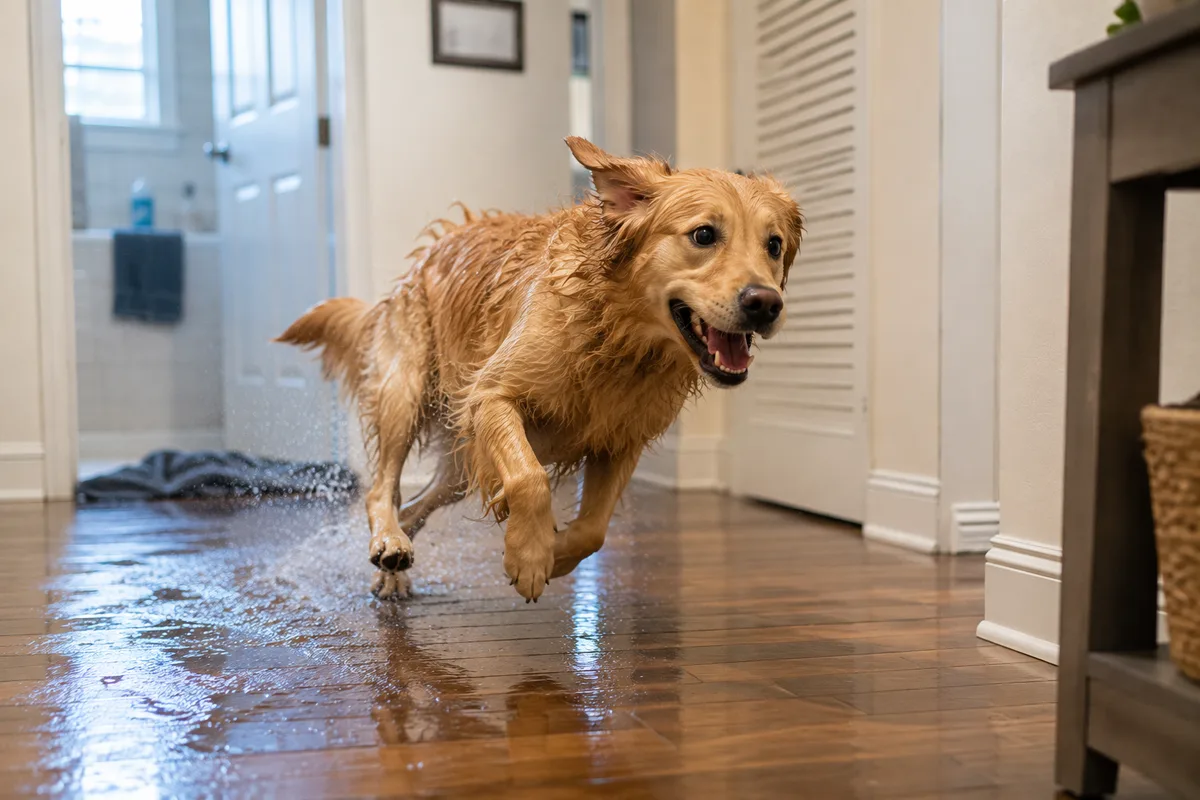
Zoomies are short, intense bursts of activity in which a dog suddenly begins running, spinning, bouncing, or racing around.
Cornell University College of Veterinary Medicine describes the scientific term for this behavior as frenetic random activity periods (FRAPs).
A classic FRAP is hard to miss.
Your dog may:
run in large circles;
sprint between rooms;
tuck their rear end while running;
make sudden turns;
bounce toward you;
perform play bows;
or encourage another dog to join the chaos.
Then, usually within a relatively short period, the episode ends.
The dog settles.
Life returns to normal.
For most dogs, this is exactly what it looks like:
a burst of energy being released all at once.
There Isn’t One Proven Cause of the Zoomies
Here is an important detail that often gets lost online.
Scientists do not have one definitive explanation for why every FRAP occurs.
Cornell notes that there is no known specific cause of FRAPs in dogs.
Instead, several factors appear capable of triggering them.
A dog may be releasing:
pent-up energy;
excitement;
playful arousal;
or even stress.
That means two dogs can perform almost identical crazy laps for very different reasons.
One may be thrilled that you came home.
Another may have spent hours without enough stimulation.
Another may be releasing tension after an experience they did not particularly enjoy.
The running looks similar.
The context tells you more.
Sometimes Your Dog Simply Has Energy to Burn
Imagine spending several hours doing almost nothing.
Then suddenly you are given space to move.
For an energetic dog—particularly a puppy or young dog—that stored-up activity can come out dramatically.
Cornell explains that a dog that has spent much of the day at home without enough to do may zoom around the house or yard as a way to expend pent-up energy.
This is one reason zoomies can appear when you arrive home.
The door opens.
You walk inside.
Your dog sees you.
Suddenly several things happen at once:
activity becomes possible;
social interaction returns;
excitement rises;
and the dog’s environment becomes interesting again.
The result?
Turbo mode.
Puppies Are Famous for Zoomies
If you have a puppy, the zoomies may feel less like an occasional event and more like a scheduled natural disaster.
That is not unusual.
Cornell notes that FRAPs are particularly common in puppies and young dogs.
Young dogs often have plenty of energy and are still developing their ability to regulate arousal.
Play can quickly become extremely exciting.
A training session can become stimulating.
An evening can produce one final burst of activity before sleep.
Then suddenly your puppy is running laps around the coffee table.
PetMD also notes that puppies tend to experience zoomies frequently, although the behavior is certainly not limited to young dogs.
So if your puppy suddenly transforms into a furry missile every evening, you are not alone.
Adult Dogs Get Zoomies Too
Zoomies are not something every dog automatically leaves behind after puppyhood.
Adult dogs can continue experiencing FRAPs.
Even senior dogs may occasionally have a joyful burst of running if their physical condition allows it.
The frequency often varies dramatically between individuals.
One adult dog may zoom almost every evening.
Another may do it once every few weeks.
Another may rarely do it at all.
There is no required number of zoomies a healthy dog must perform.
Individual behavior matters.
Why Do Dogs Get the Zoomies at Night?
This is one of the most common versions.
The day is winding down.
You are ready to relax.
Your dog has made a different decision.
Suddenly:
lap one.
lap two.
lap three.
PetMD notes that many dogs have a period of increased activity during the late afternoon or evening, sometimes corresponding with exciting events such as family members returning home, meals, or pre-bedtime activity.
Puppies can be particularly prone to evening craziness.
But there is another possibility that surprises some owners:
Your dog may actually be overtired.
An Overtired Puppy Can Look Like a Hyper Puppy
Human children sometimes become chaotic when they desperately need sleep.
Puppies can do something surprisingly similar.
An overtired puppy may become:
mouthy;
wild;
unable to settle;
extremely playful;
vocal;
or suddenly start racing around.
PetMD includes overtiredness among situations that can contribute to zoomies.
So the solution to every evening FRAP is not necessarily:
“This puppy needs even more exercise.”
Sometimes the puppy needs help winding down and getting adequate rest.
More stimulation is not always the answer to overstimulation.
Why Do Dogs Get Zoomies After a Bath?
This may be the funniest version of all.
You finally finish bathing your dog.
They stand quietly for one second.
Then—
launch.
Across the bathroom.
Into the hallway.
Onto a rug.
Back into the bedroom.
Possibly followed by aggressive rubbing against every piece of furniture you own.
Post-bath zoomies are extremely common.
PetMD explains that bathing can involve unusual sensations, handling, water, shampoo, and the unfamiliar feeling of wet fur. When the experience ends, a burst of activity may help release excitement or tension.
There may also be another practical element.
Your dog is wet.
Running, shaking, and rubbing against surfaces may contribute to drying off.
Unfortunately, your freshly cleaned couch may become part of that strategy.
Your Dog May Be Celebrating Freedom
There is something wonderfully obvious about many post-bath zoomies.
The bath is over.
Your dog is free.
If bathing is not their favorite activity, that alone can create a dramatic release.
Think about other situations where your dog has been relatively restrained.
After grooming.
After training.
After being released from a confined area.
After waiting patiently.
When the restriction ends, energy can spill out.
In those moments, the zoomies may look almost like a celebration.
Why Does My Dog Get Zoomies After Pooping?
Yes.
This is a real thing.
Some dogs finish their business and immediately take off.
Cornell specifically lists after defecating among times when dogs may experience FRAPs. PetMD also discusses post-poop zoomies as potentially related to the feeling of relief afterward.
There is not one definitive explanation that applies to every dog.
Relief may contribute.
Excitement may contribute.
For some dogs, it may simply become part of their routine.
So if your dog finishes pooping and immediately begins running around the yard like they just won a championship—
they are not the only one.
Excitement Is a Powerful Zoomie Trigger
Sometimes the explanation is much easier.
Your dog is incredibly excited.
Maybe you just came home.
Maybe their favorite person arrived.
Maybe you picked up the leash.
Maybe another dog wants to play.
Maybe you opened the gate to a large safe field.
Cornell notes that FRAPs can occur when something exciting happens, including an owner returning after being away.
Dogs do not always express excitement by calmly wagging their tails.
Sometimes joy requires speed.
A lot of speed.
Play Can Turn Into a FRAP
A normal game can suddenly cross into zoomie territory.
You throw the toy.
Your dog retrieves it.
Again.
Again.
Then instead of returning the toy, your dog races past you.
Around the yard.
Back toward you.
Away again.
PetMD identifies playfulness as another common context for zoomies.
The dog’s arousal level has climbed.
The game is exciting.
And the excitement spills into a burst of frenetic movement.
You may also see a classic play bow:
front legs down;
rear end up;
loose, playful body.
That body language is an important clue.
Your dog is probably having a very good time.
Zoomies Aren’t Always About Happiness
This is where understanding context becomes important.
People often assume:
Zoomies = happy dog.
Frequently, that is correct.
But not always.
Cornell notes that FRAPs may sometimes help alleviate stress, while PetMD also identifies stress, tension, frustration, and nervous energy as possible contributors.
A dog may experience a burst of frantic movement after an uncomfortable or highly stimulating event.
That is why you should not interpret the running by itself.
Look at the dog.
Happy Zoomies Usually Look Loose
A dog enjoying a classic playful FRAP often looks ridiculous in the best possible way.
Cornell describes typical happy zoomie body language as loose and wiggly.
You may see:
a relaxed body;
bouncy movements;
play bows;
a loosely moving tail;
an open mouth;
a tongue flapping while running;
and repeated attempts to involve you or another dog.
The movement looks energetic rather than fearful.
When the episode ends, the dog generally returns to normal.
That is very different from frantic movement caused by distress.
Stress Zoomies Can Look Different
A frightened or highly stressed dog may also run rapidly.
But the body language can tell a different story.
Cornell notes that a frightened dog may appear tense, hold the tail tightly tucked, lower the head, pull the ears back, and show other signs of distress.
So ask:
What happened immediately before the running?
A fun game?
You coming home?
A bath?
Or something frightening?
Body language plus context is far more useful than simply labeling every burst of running “zoomies.”
This is the same principle we have seen throughout our dog-behavior series: one movement rarely tells the entire story.
Your Dog Isn’t Necessarily “Going Crazy”
The phrase practically writes itself:
“Why does my dog run around like crazy?”
But normal FRAPs are not evidence that something is psychologically wrong with your dog.
The behavior is common enough to have a recognized scientific term.
If your dog suddenly races around for a short period, appears playful and comfortable, then settles normally afterward, you are probably watching ordinary canine behavior.
The more useful questions are:
How often does it happen?
What triggers it?
What does the dog’s body language look like?
Can they settle afterward?
Those details matter.
Should You Try to Stop the Zoomies?
Usually, you do not need to stop a happy FRAP.
But you do need to make sure the environment is safe.
A dog at full speed is not carefully calculating braking distance.
Cornell warns that although FRAPs themselves are normal, dogs can still injure themselves while racing around.
Think of zoomie management as traffic control rather than behavior correction.
The goal is not:
“Make the dog stop being a dog.”
The goal is:
“Make sure the dog doesn’t launch themselves down the stairs.”
Slippery Floors and Zoomies Are a Bad Combination
Hard flooring can become particularly hazardous when a dog suddenly accelerates.
A high-speed turn on a slippery surface can result in a fall.
Cornell recommends keeping zooming dogs away from unstable or slippery footing and notes that grass, carpet, and packed dirt can provide better traction than surfaces such as hard floors or ice.
If your dog has predictable indoor zoomies, rugs or other secure traction areas may help.
This is especially worth considering for:
puppies;
large dogs;
senior dogs;
and dogs with orthopedic concerns.
Clear the Zoomie Racetrack
Dogs do not always select sensible routes.
The path may include:
around the couch;
under the table;
past the television;
between two chairs;
and directly toward your knees.
If your dog regularly zooms indoors, remove obvious hazards where practical.
Watch for:
breakable objects;
sharp furniture edges;
unstable tables;
stairs;
open doors;
and people who could easily be knocked over.
You do not need to redesign the entire house.
Just remember that your dog may temporarily stop respecting normal speed limits.
Outdoor Zoomies Need Secure Space
A dog experiencing FRAPs outdoors can cover distance extremely quickly.
Cornell recommends keeping dogs in an enclosed space when they are off-leash.
This is especially important near:
roads;
parking areas;
open gates;
unfenced property;
or other hazards.
Do not assume excitement will disappear because you call the dog’s name.
A secure environment allows the dog to enjoy the burst without turning a funny moment into an emergency.
Don’t Chase Your Dog Unless You Want a Game
Your dog starts zooming.
You chase them.
Congratulations.
You may just have improved the game.
Many dogs find being chased extremely rewarding.
If the dog is already excited, running after them can increase arousal and encourage them to continue.
If the environment is safe, allowing a normal FRAP to run its course may be easier.
If you need your dog to come to you, use trained recall skills rather than turning the situation into an accidental game of keep-away.
Frequent Zoomies Can Be Useful Information
Zoomies are normal.
But frequency and context can still tell you something about your dog’s routine.
Cornell notes that dogs experiencing FRAPs very frequently or at inconvenient times may benefit from additional physical exercise and mental stimulation.
That does not mean:
More zoomies = bad owner.
It means behavior can provide information.
Look at the dog’s overall day.
Do they have opportunities for:
walking;
sniffing;
playing;
training;
exploring;
social interaction;
and appropriate rest?
Physical exercise is only part of the picture.
Dogs need to use their brains too.
Mental Exercise Matters
A dog can have physical energy and mental energy.
A walk where the dog is allowed to safely explore scents can provide a different kind of stimulation from repeatedly walking the exact same route at the exact same pace.
Cornell suggests activities including training, learning tricks, scent games, and exploring new walking locations as ways to provide mental exercise.
You do not need to entertain your dog every waking minute.
Dogs also need downtime.
The goal is a balanced routine.
Activity.
Enrichment.
Social interaction.
And rest.
Zoomies Fit Into a Bigger Pattern of Dog Behavior
One of the most interesting things about dogs is how many apparently strange behaviors become understandable once you look at their context.
A dog may circle before lying down because of a deeply rooted bedtime behavior.
A dog may tilt their head while you talk while focusing on sounds and information.
And a dog may suddenly sprint around the living room because excitement, energy, or tension has reached the point where it needs an outlet.
Cats have their own high-speed version too. See why cats suddenly get the zoomies and how feline activity patterns differ.
These behaviors look quirky through human eyes.
For the dog, they may be completely ordinary.
When Are Zoomies Not Normal?
A typical FRAP is:
brief;
energetic;
recognizable;
often associated with excitement or another trigger;
and followed by a return to normal behavior.
But not every episode of unusual running should automatically be labeled a zoomie.
Pay closer attention if your dog:
appears frightened rather than playful;
seems disoriented;
shows signs of pain;
cannot settle afterward;
repeatedly crashes or falls;
has difficulty coordinating movement;
shows unusual behavior between episodes;
or suddenly develops dramatically different activity patterns.
Cornell specifically advises seeking veterinary help when a dog running frantically appears painful, frightened, or anxious.
If something about the episode does not resemble your dog’s normal playful behavior, it is reasonable to investigate.
Know Your Dog’s Normal
This may be the most useful advice of all.
One dog’s normal zoomie is another dog’s unusual behavior.
Your puppy may race around the living room every evening at 7 p.m.
Your older dog may perform one joyful lap around the yard every few weeks.
Your friend’s dog may never do it.
Instead of comparing dogs, learn the patterns of the individual animal in front of you.
What usually triggers the behavior?
How long does it normally last?
What does their body language look like?
How quickly do they settle?
A sudden departure from those patterns is often more meaningful than the zoomies themselves.
The Bottom Line
Dog zoomies have a wonderfully serious scientific name:
Frenetic Random Activity Periods—or FRAPs.
But the behavior itself is usually exactly as joyful and chaotic as it looks.
Dogs may zoom to release pent-up energy.
They may zoom because they are excited.
They may zoom during play.
They may race around after a bath, after pooping, when you come home, or during their predictable evening burst.
And sometimes FRAPs may be associated with stress, frustration, or overstimulation rather than pure happiness.
There is no single proven cause that explains every episode.
That is why context and body language matter.
A loose, wiggly dog bouncing around a safe yard and inviting you to play is telling a very different story from a tense, frightened dog running frantically after a stressful event.
For normal happy zoomies, your biggest job is usually simple:
Make the environment safe and let the moment pass.
Keep your dog away from roads.
Watch slippery floors.
Protect stairs.
Move breakable objects out of the racetrack.
Then enjoy the show.
Because thirty seconds from now, the same dog that just completed six high-speed laps around your living room may be asleep on the couch.
And apparently, as far as they are concerned, nothing unusual happened.
Sources
Cornell University College of Veterinary Medicine — What Are Zoomies?








Join the discussion