Why Do Mosquitoes Bite Some People More Than Others?
Why do mosquitoes seem to bite some people more than others? Skin odor, carbon dioxide, body heat and even how your skin reacts can all play a role.
Put two people outside on the same summer evening and mosquitoes may seem to make an obvious choice. One person gets a couple of bites. The other wakes up covered in itchy red bumps.
That difference is real—but it probably has nothing to do with having “sweet blood.”
Mosquitoes find people using a combination of signals, including skin odor, carbon dioxide from breath, body heat, humidity and visual cues. Research also suggests that some people produce a chemical signature that makes them consistently more attractive than others.
The Short Answer: Your Skin Smell Matters—a Lot
Before a mosquito can bite you, it first has to find you.
That means the most important differences between people often exist outside the bloodstream.
Human skin releases a constantly changing mixture of chemical compounds. Sweat, sebum and microorganisms living on the skin all contribute to the odor surrounding the body.
We may barely notice those differences. Mosquitoes do.
A major study published in Cell tested the attractiveness of human skin odors to Aedes aegypti mosquitoes. Researchers found huge differences between individuals—and the people who were especially attractive tended to remain mosquito magnets over repeated testing.
The researchers also found that highly attractive participants generally had higher levels of certain carboxylic acids in compounds released from their skin.
The finding does not mean one chemical determines whether mosquitoes love you. Human odor is far more complicated than that. But it provides some of the strongest evidence yet that natural skin chemistry helps explain why one person can attract far more mosquitoes than another.
This is also why the vague phrase “body chemistry” is not entirely wrong—although it is often oversimplified. Curiworld’s look at why the same perfume smells different on everyone explores another way our individual skin environment changes the chemicals released into the air.
Mosquitoes Don’t Follow Just One Signal
Skin odor is important, but a mosquito is not flying around with a detector tuned to one molecule.
It combines several clues.
Your breath releases carbon dioxide. Your body gives off heat and moisture. Your skin produces odor molecules. Your shape and contrast can provide visual information.
Recent research has made that sensory system even more interesting. A 2024 Nature study found that Aedes aegypti can use thermal infrared radiation from a warm target as part of its host-seeking behavior—but importantly, that cue becomes useful alongside other signals associated with a host.
So the process is closer to:
Something is breathing nearby → it smells like a host → there is a warm body in that direction → move closer and investigate.
That helps explain why scientists rarely attribute mosquito attraction to one factor alone.
Does Breathing More Make You More Attractive?
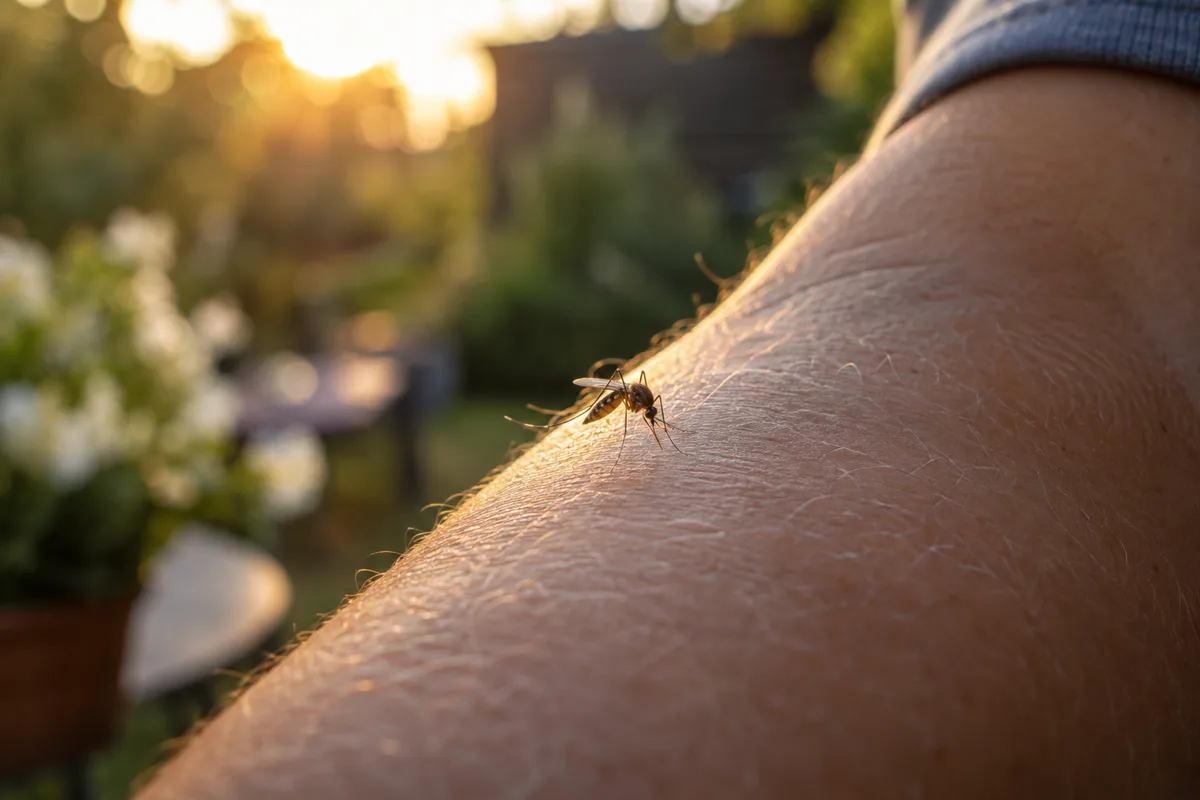
Carbon dioxide is one of the cues mosquitoes use to detect potential hosts.
Every person produces it simply by breathing.
That does not mean a mosquito identifies you solely by the amount of CO₂ you exhale. Carbon dioxide works together with odor, heat and other sensory information.
Temporary changes can also affect the signals around you. After exercise, for example, you may be breathing faster, producing more heat and sweating more heavily.
That can create a different sensory picture than sitting still in a cool room.
It does not mean exercise permanently makes someone a mosquito magnet. It simply shows why attraction can depend on both who you are and what your body is doing at that moment.
What About Sweat?
“Sweat attracts mosquitoes” is only part of the story.
Fresh sweat itself is not a single mosquito-attracting chemical. Instead, substances produced by the skin and sweat interact with microorganisms living there, helping create the complex body odor that surrounds us.
Mosquito host-seeking research has identified a range of human-associated odorants that can influence mosquito behavior.
So two people who are equally sweaty do not necessarily smell the same to a mosquito.
That individual odor profile may be much more important than the simple fact that you are sweating.
Do Mosquitoes Prefer Type O Blood?
This popular claim needs more caution than it usually gets online.
An often-cited laboratory study involving Aedes albopictus found that mosquitoes landed more frequently on people with blood type O than people with type A under the study conditions.
But that does not establish a universal rule that people with type O blood will always be bitten more.
Mosquito species differ. Experimental conditions differ. And decades of host-seeking research show that mosquitoes rely heavily on external signals such as odor, carbon dioxide, heat and humidity before they ever reach your blood.
So blood type may be one factor worth studying, but it is not a good standalone explanation for why mosquitoes repeatedly choose one person over another.
If someone tells you mosquitoes bite you because you have “the wrong blood type,” the science is much less settled than that statement suggests.
Is It Because Your Blood Is Sweeter?
No good evidence supports the idea that mosquitoes choose people because their blood tastes sweeter.
The problem with the theory is simple: the mosquito has to choose where to land before it has tasted your blood.
The cues guiding that decision are coming from your breath, skin and body—not from the flavor of blood hidden beneath your skin.
“Sweet blood” survives as a convenient explanation because the differences between people can be dramatic.
But the biology is far more interesting.
Why Do Some People Look More Bitten Even If They Aren’t?
There is another factor that can make mosquito preference seem stronger than it really is.
People react differently to mosquito saliva.
When a female mosquito feeds, saliva enters the skin. Your immune response contributes to the familiar bump, redness and itching.
According to the CDC, reactions vary from person to person. Some people develop relatively minor bumps, while others can experience much larger areas of swelling, redness or soreness.
So imagine two people who each receive five bites.
One develops five tiny bumps that disappear quickly.
The other develops five large, intensely itchy welts.
The second person may appear to have attracted far more mosquitoes even though the number of bites was similar.
Mosquito attraction and your reaction to a mosquito bite are two different things.
Are You Really a “Mosquito Magnet”?
Possibly.
One of the most interesting findings from the Cell research was that differences in attraction were not necessarily temporary.
Some participants remained highly attractive across repeated tests over long periods.
That suggests there really can be relatively stable biological differences between people.
But being a mosquito magnet is unlikely to come down to one trait.
Your attractiveness can involve a combination of:
- natural skin odor and its chemical composition,
- microorganisms living on the skin,
- carbon dioxide from breathing,
- body heat and moisture,
- visual cues,
- activity level,
- the mosquito species involved,
- and environmental conditions.
The combination matters more than any one internet-friendly explanation.
Can You Make Yourself Less Attractive to Mosquitoes?
Trying to permanently change your natural skin chemistry is not a practical mosquito-control strategy.
Preventing mosquitoes from biting you is much more useful than trying to become biologically unattractive to them.
The CDC recommends using EPA-registered insect repellents according to label instructions. Effective active ingredients can include DEET, picaridin, IR3535, oil of lemon eucalyptus (OLE), PMD and 2-undecanone.
Other practical steps include wearing loose-fitting long sleeves and pants when appropriate, keeping window and door screens in good condition and reducing standing water around the home.
Those measures work regardless of whether you happen to be the most attractive person at the barbecue.
So Why Do Mosquitoes Choose You?
If mosquitoes repeatedly seem to find you before everyone else, you may not be imagining it.
Research increasingly points toward individual differences in human scent—especially skin-derived chemical compounds—as an important reason some people attract more mosquitoes than others.
But mosquitoes do not rely on smell alone. They combine your odor with carbon dioxide, warmth, moisture and visual information to locate a potential host.
Blood type has received attention, but the evidence does not justify treating it as the master explanation. And “sweet blood” is more folklore than biology.
The real answer is more fascinating: every person gives off a slightly different sensory signature.
And to a mosquito, some of those signatures are apparently much harder to resist.
Sources
National Institutes of Health — Skin Compounds Associated With Attractiveness to Mosquitoes
Chandel et al. — Thermal Infrared Directs Host-Seeking Behaviour in Aedes aegypti Mosquitoes, Nature








Join the discussion