Your Dog Won’t Stop Licking You — Here’s What Those “Kisses” Can Mean
Dog licking can mean affection, attention, curiosity or simply that your skin tastes interesting. Learn why dogs lick people, how the habit gets reinforced and when excessive licking deserves a closer look.

One lick is cute.
Five licks feel affectionate.
But when your dog has been enthusiastically licking your hand, arm, leg—or face—for what feels like the hundredth time today, you may start wondering what is actually going on.
Is this really your dog’s way of saying “I love you”?
Sometimes, perhaps.
But licking is much more complicated than the familiar idea of “dog kisses.”
Dogs may lick people as part of friendly social interaction, to get attention, because human skin tastes interesting, or simply because licking has become a successful habit. In some situations, frequent licking can also be connected to boredom, stress, discomfort, or a behavior that has become difficult for the dog to stop.
The best clue is usually not the lick itself.
It is what happens before and after it.
Yes, Licking Can Be a Sign of Affection
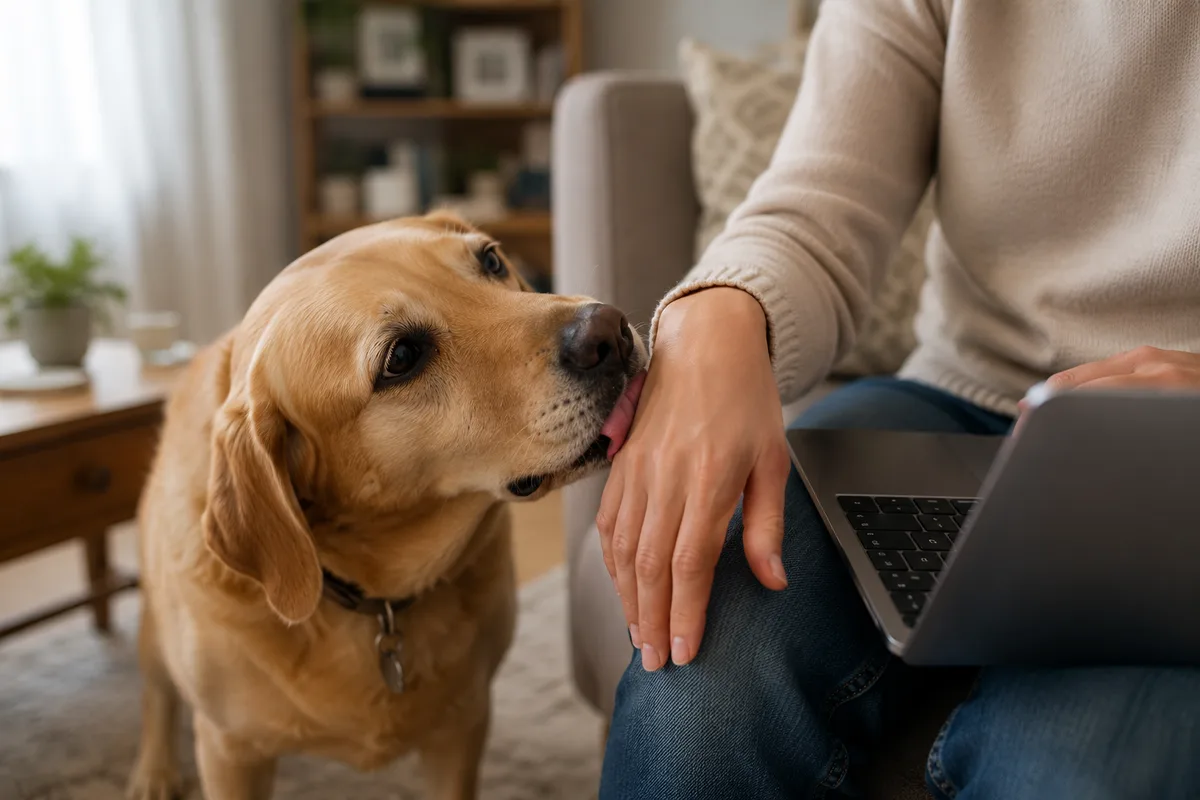
Let’s start with the explanation most dog owners hope is true.
Your dog may lick you because they genuinely enjoy being close to you.
Licking appears very early in canine life. Mother dogs lick their puppies, and puppies use licking during social interactions. As dogs grow, licking can remain part of their social behavior.
That makes the classic welcome-home scene easy to understand.
You open the door.
Your dog rushes toward you.
The tail is wagging. The body is loose and excited. Then your hands—or perhaps your entire face—get covered in enthusiastic licks.
In that context, licking may simply be part of a happy greeting.
But affection is not the only possible explanation.
Sometimes you are simply interesting to taste.
Your Skin May Taste Surprisingly Good to Your Dog
Humans probably do not think of themselves as particularly flavorful.
Dogs may disagree.
Sweat leaves salt on the skin, and dogs explore their environment heavily through scent and taste.
That can make exposed skin particularly interesting after you have been exercising, gardening, walking outside on a hot day, or doing anything else that leaves you sweaty.
It may also explain why some dogs seem fascinated by hands and feet.
So when your dog starts licking your leg after a summer walk, the message may not necessarily be:
“You are my favorite person in the entire universe.”
It could simply be:
“Interesting. Salty.”
The two explanations are not mutually exclusive.
Your dog can like you and think you taste interesting.
Your Dog May Have Learned That Licking Works
This is where an occasional lick can turn into a persistent habit.
Imagine that your dog approaches while you are watching television.
They lick your hand.
You immediately look down.
“Hey, buddy.”
Then you scratch behind their ears.
From your perspective, you simply responded naturally to your dog.
From your dog’s perspective, something important happened:
Licking you produced attention.
Dogs are very good at repeating behaviors that lead to useful outcomes.
If licking regularly results in petting, talking, playing, eye contact, or another desirable response, your dog has a reason to do it again.
Tomorrow, the tongue returns.
Even Telling Your Dog to Stop Can Be Rewarding
This is one of the easiest patterns to miss.
Suppose you do not actually enjoy being licked.
Your dog starts licking your arm.
You turn toward them and say:
“No, stop licking me.”
Then you touch them while moving their head away.
You intended to discourage the behavior.
But your dog still received several things:
Your voice.
Your eye contact.
Your touch.
Your attention.
If attention was the goal, licking still worked.
This is why repeatedly saying “stop” does not necessarily make attention-seeking licking disappear.
Sometimes the response itself is helping maintain the habit.
Sometimes Your Dog Is Asking for Something
Dogs become extremely good at operating the humans they live with.
One dog paws.
Another barks.
Another stares.
Another licks.
Some use every available method until the human finally understands.
Look at when your dog starts licking you.
Does it happen shortly before dinner?
When you stop petting them?
When they need to go outside?
When you normally take your evening walk?
When their favorite toy has rolled somewhere they cannot reach?
The behavior surrounding the lick can reveal the message.
A dog that licks your hand and then repeatedly looks toward the back door may not be delivering kisses.
They may be requesting bathroom access.
Look at What Your Dog Does Next
Individual dog behaviors rarely exist in isolation.
Your dog may lick your hand.
Then stare at you.
Then look toward the leash.
Then stare at you again.
At that point, the mystery is disappearing quickly.
We see the same principle with prolonged eye contact. As explained in our guide to why dogs stare at their owners, context often tells you much more than one isolated gesture.
Licking is similar.
Instead of asking only what the tongue means, watch the entire sequence.
Your dog may already be giving you the rest of the sentence.
Why Does My Dog Lick My Hands?
Hands are perfect targets.
They are easy to reach.
They constantly interact with your dog.
And they collect scents throughout the day.
Think about everything your hands do from your dog’s perspective.
They prepare food.
Hold treats.
Throw toys.
Attach the leash.
Open doors.
Scratch ears.
Touch other people, objects, and animals.
That makes your hands an interesting source of scent and taste information.
If your dog gently licks your hands during relaxed interaction, it may simply be normal social behavior.
If the licking suddenly begins five minutes after you prepared a sandwich, however, the explanation may be considerably less mysterious.
Your dog’s nose is better than your hand-washing confidence.
Why Does My Dog Lick My Face?
Face licking often gets interpreted as the purest version of a “dog kiss.”
It certainly can occur during friendly greetings and affectionate interactions.
But again, there is no universal dog-to-English dictionary in which:
Face lick = I love you.
Your dog may be excited.
They may be seeking attention.
They may enjoy the social interaction.
They may be responding to your scent or taste.
Several motivations can exist at the same time.
There is another important point here:
You are allowed to have boundaries.
A behavior can be normal for a dog without being something you personally enjoy.
You do not need to allow your dog to lick your mouth or face simply because the interaction appears friendly.
Affection does not require unlimited access to your nose.
Why Does My Dog Lick My Feet?
For humans, feet are ordinary.
For a dog’s nose, they are information centers.
Feet sweat and carry strong individual scents. They can therefore be particularly interesting to dogs.
There is also another powerful factor:
Your reaction.
A dog licks your foot.
It tickles.
You laugh, move your leg, talk to the dog, or playfully push them away.
Suddenly, foot licking has created an interactive game.
If this happens repeatedly, the behavior can become self-reinforcing through your response.
Your dog may have discovered one extremely effective button.
Unfortunately, that button is attached to your foot.
Why Does My Dog Lick Me After I Shower?
This seems backwards.
You were sweaty before the shower.
Now you are clean.
And now your dog wants to investigate you?
Remember that showering does not make you scentless.
It changes your scent.
Soap, shampoo, conditioner, lotion, water, and other products can make you smell noticeably different to a dog.
Your dog may lick or sniff simply because something has changed.
However, do not deliberately allow a dog to ingest soaps, creams, topical medications, essential oils, or other products from your skin.
If you have applied medication or another product that should not be ingested, prevent your dog from licking the area and follow the relevant safety instructions.
Curiosity does not make a substance safe to swallow.
Licking Can Be Part of Your Dog’s Greeting Ritual
Think about what your dog does when you come home.
Some dogs grab a toy.
Some spin in circles.
Some jump.
Some vocalize.
Some lick everything they can reach.
And plenty do several of those things simultaneously.
A greeting lick can combine excitement, social contact, learned behavior, and affection.
That is an important theme in dog behavior:
There does not always have to be one explanation.
Your dog may lick because they are excited to see you and because licking reliably gets your attention.
Both can be true.
Some Dogs Simply Want More Contact With Their People
Certain dogs seem to organize their entire day around knowing exactly where their favorite human is.
They watch you.
Follow you.
Sit beside you.
Sleep near you.
And, whenever possible, lick you.
In these dogs, licking may be one part of a broader pattern of social closeness.
If your dog rarely allows you to walk into another room alone, our guide to why dogs follow their owners everywhere explains the behavior often associated with so-called “Velcro dogs.”
Importantly, enjoying constant proximity does not automatically mean a dog has separation anxiety.
The same caution applies to licking.
Frequent licking alone is not enough to diagnose an emotional or behavioral disorder.
Can Licking Be Related to Stress or Anxiety?
Yes—but this explanation needs context.
Licking is normal canine behavior.
A dog licking your hand during a relaxed evening does not need an anxiety diagnosis.
The picture changes when licking becomes unusually frequent, repetitive, difficult to interrupt, or appears alongside other signs of distress.
Pay attention if your dog also:
paces frequently;
struggles to settle;
pants when they are not hot;
appears unusually restless;
becomes distressed when left alone;
repeatedly performs the same behavior;
or shows other noticeable changes.
In those situations, licking may be one piece of a larger behavioral pattern.
One behavior rarely tells the entire story.
Boredom Can Turn You Into an Activity
Imagine your dog’s options.
Sleep.
Look out the window.
Inspect the same toy.
Or lick the human and immediately cause something to happen.
If licking reliably creates interaction, an under-stimulated dog may find it especially rewarding.
That does not mean every persistent licker is bored.
But when a repetitive attention-seeking behavior develops, it is worth looking at the dog’s entire day.
Do they have appropriate opportunities for:
- walking and physical activity;
- sniffing and exploration;
- play;
- training;
- mental enrichment;
- social interaction;
- and sufficient rest?
The right amount varies enormously depending on age, health, temperament, and individual needs.
The objective is not to exhaust your dog.
It is to provide a balanced life in which licking you is not the most exciting activity available.
Licking May Also Feel Good to the Dog
Some repetitive behaviors are rewarding in themselves.
Licking may have a soothing component for some dogs, which can help explain why the behavior occasionally persists beyond its original trigger.
Perhaps licking initially started because your dog wanted attention.
Then the behavior became familiar.
The familiar behavior became rewarding.
Eventually, it turned into a habit.
This is why looking only for one emotional explanation can be misleading.
Behavior develops through experience.
When Does Licking Become “Too Much”?
There is no useful universal number.
A dog does not become an “excessive licker” after lick number 47.
Instead, look at how the behavior affects daily life.
Ask:
Can your dog stop?
Can they settle comfortably without licking?
Can they be redirected?
Does licking occupy large portions of their day?
Has it increased dramatically?
Is the dog damaging their own skin?
Does the behavior interfere with eating, sleeping, playing, or normal activities?
A brief affectionate greeting is very different from repetitive behavior that seems difficult for the dog to control.
The pattern matters more than the raw number of licks.
Licking You and Constantly Licking Themselves Are Different Questions
There is an especially important distinction between:
“My dog loves licking my hands.”
and:
“My dog will not stop licking the same spot on their paw.”
Persistent self-licking can sometimes indicate physical discomfort.
Possible causes vary widely and may include skin irritation, allergies, parasites, infection, injury, or pain.
Watch for signs such as:
- redness;
- swelling;
- hair loss;
- broken or irritated skin;
- unusual odor;
- discharge;
- limping;
- tenderness;
- or repeated attention to exactly the same area.
Do not automatically assume persistent self-licking is purely behavioral.
Physical causes may need to be ruled out first.
A Sudden Change Deserves More Attention
Your dog has enthusiastically licked people since puppyhood.
That is one pattern.
Your normally non-licky dog suddenly begins licking you, themselves, furniture, and floors throughout the day.
That is another.
Changes from an individual dog’s normal behavior can be more informative than the behavior itself.
If licking suddenly increases, think about what else has changed.
Appetite?
Energy?
Skin?
Mobility?
Digestive symptoms?
Medication?
Routine?
Household environment?
Stress?
You do not need to diagnose the cause yourself.
But unexplained behavioral changes—particularly when accompanied by physical symptoms—are worth discussing with your veterinarian.
How Can You Reduce Attention-Seeking Licking?
First, decide whether the behavior actually needs changing.
A few friendly licks that do not bother anyone may require no intervention at all.
But if you would prefer not to be covered in saliva every evening, you can establish boundaries without treating normal dog behavior as misconduct.
Stop Making Every Lick Successful
If licking consistently earns immediate attention, consider whether your responses are maintaining the behavior.
Be consistent.
Reward an Alternative
Instead of focusing entirely on what you do not want, teach your dog what works better.
Perhaps your dog can:
sit calmly;
lie on a mat;
bring a toy;
or perform another familiar behavior to request interaction.
Then reward that behavior.
Redirect Before the Licking Escalates
If you recognize when licking usually begins, offer an appropriate alternative activity before the behavior turns into a marathon.
Make Sure Everyone Is Consistent
One family member discouraging licking while another enthusiastically rewards ten minutes of face kisses every night creates a very confusing system.
Dogs learn from consequences.
Make those consequences predictable.
Don’t Punish Your Dog for Normal Communication
Your dog is not being rude.
They are being a dog.
If licking is unwanted, harsh punishment is unnecessary and can create additional problems.
Instead, teach an alternative behavior and reinforce it.
Want your dog to sit rather than lick during greetings?
Reward sitting.
Want them to relax on a bed while you eat?
Teach and reward that behavior.
Want them to bring a toy when excited?
Make bringing the toy worthwhile.
Training becomes much clearer when the dog learns:
“Do this instead.”
rather than simply:
“Stop doing that.”
When Should You Talk to a Veterinarian?
Normal social licking usually does not require medical attention.
Consider speaking with your veterinarian when licking:
- suddenly increases without an obvious reason;
- becomes repetitive or difficult to interrupt;
- occupies substantial amounts of the dog’s day;
- causes skin damage or hair loss;
- repeatedly targets one body area;
- occurs alongside itching, swelling, or skin changes;
- appears connected with pain or discomfort;
- accompanies major behavioral changes;
- or interferes with normal daily activities.
If physical causes are ruled out but the behavior remains excessive or appears compulsive, your veterinarian may recommend further behavioral evaluation.
The key distinction is between a dog that likes to lick and a dog that appears unable to stop licking.
So, Are Dog Licks Really Kisses?
Sometimes “kiss” is a perfectly reasonable human nickname for what is happening.
Your dog may be delighted to see you.
They may enjoy being close to you.
Licking may be part of a familiar social ritual between you.
But not every lick should automatically be translated as:
“I love you.”
Sometimes the message is closer to:
“Pay attention to me.”
Sometimes:
“You taste salty.”
Sometimes:
“Is dinner happening soon?”
And sometimes your dog may simply have learned that licking humans is one of the most reliable ways to make those humans respond.
Several motivations can exist at once.
That is what makes behavior interesting.
The Bottom Line
Your dog’s tongue does not come with a one-word translation.
Licking can be affectionate.
It can be social.
It can be exploratory.
It can be a request for attention.
It can become a learned habit because people repeatedly respond to it.
And when licking becomes excessive, suddenly changes, appears difficult to interrupt, or focuses intensely on the dog’s own body, there may be a reason to investigate further.
So the next time your dog starts enthusiastically licking your hand, look beyond the tongue.
What happened immediately before?
What does your dog do next?
What does licking usually earn?
And can your dog comfortably stop?
Those questions reveal much more than simply deciding whether every lick means love.
Although when your dog greets you at the door with a wagging tail and several enthusiastic licks, you are still allowed to call them kisses.








Join the discussion