Why Do Cats Knead Blankets? What This Strange Behavior Really Means
Cats begin kneading as nursing kittens, but many keep “making biscuits” long into adulthood. The reason involves comfort, texture, scent — and a little scientific uncertainty.
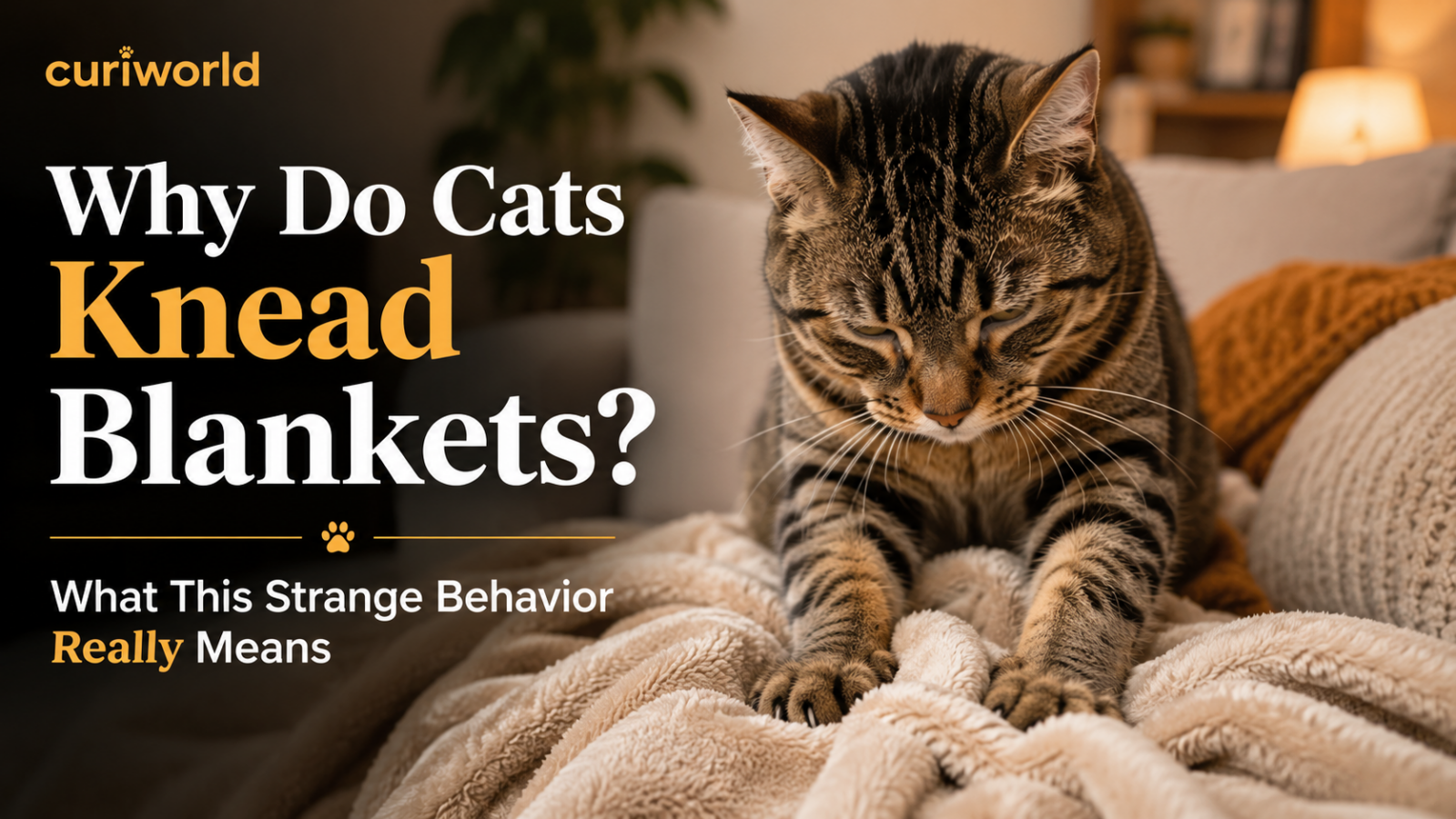
A soft blanket goes down on the couch, your cat climbs onto it, and suddenly the baking begins.
Left paw. Right paw. Left paw. Right paw.
Sometimes there is purring. Sometimes the claws appear. Some cats even close their eyes or start suckling the fabric while they rhythmically press their paws into it.
This behavior is called kneading, although “making biscuits” may be the more familiar name. The movement begins very early in a cat’s life: nursing kittens knead around their mother’s mammary glands, helping stimulate milk flow.
That part is well understood.
Why some cats continue kneading blankets, beds, people, and other soft surfaces long after kittenhood is more complicated. Comfort is probably part of the answer, but scientists do not have one proven explanation that accounts for every adult cat.
Kneading Starts With a Very Practical Kitten Behavior
For a newborn kitten, kneading is not a quirky habit.
It helps with feeding.
While nursing, kittens alternately press their front paws against their mother. The repeated movement helps stimulate milk flow, making kneading closely associated from the beginning of life with warmth, food, physical contact, and the security of being near their mother.
Most adult cats obviously do not need to stimulate milk production.
Yet many retain the same movement.
That makes kneading an interesting example of a juvenile behavior that can continue into adulthood even after its original practical function is no longer necessary.
So Why Do Adult Cats Keep Doing It?
This is where certainty ends.
It is tempting to say that cats knead because they are happy, because they love you, or because they are remembering their mother. Those explanations may contain some truth, but adult kneading has not been reduced to one scientifically established cause.
Cats Protection notes that the reason some cats carry the behavior into adulthood is still not definitively known.
Several explanations are considered plausible, and more than one may be operating at the same time.
Kneading May Be Connected to Comfort
The strongest clue is context.
Cats commonly knead when they are settling down in a comfortable location: a bed, a couch, a warm lap, or a soft blanket.
They may purr, half-close their eyes, relax their body, and eventually curl up to sleep.
Because kneading originally occurs during nursing, the movement may remain associated with a safe and rewarding state. A soft surface beneath the paws could also help trigger a familiar motor pattern that began in kittenhood.
That does not necessarily mean your adult cat is consciously remembering being a kitten.
A simpler explanation is that an old behavior and a familiar sensation remain linked.
Why Are Blankets Such a Popular Target?
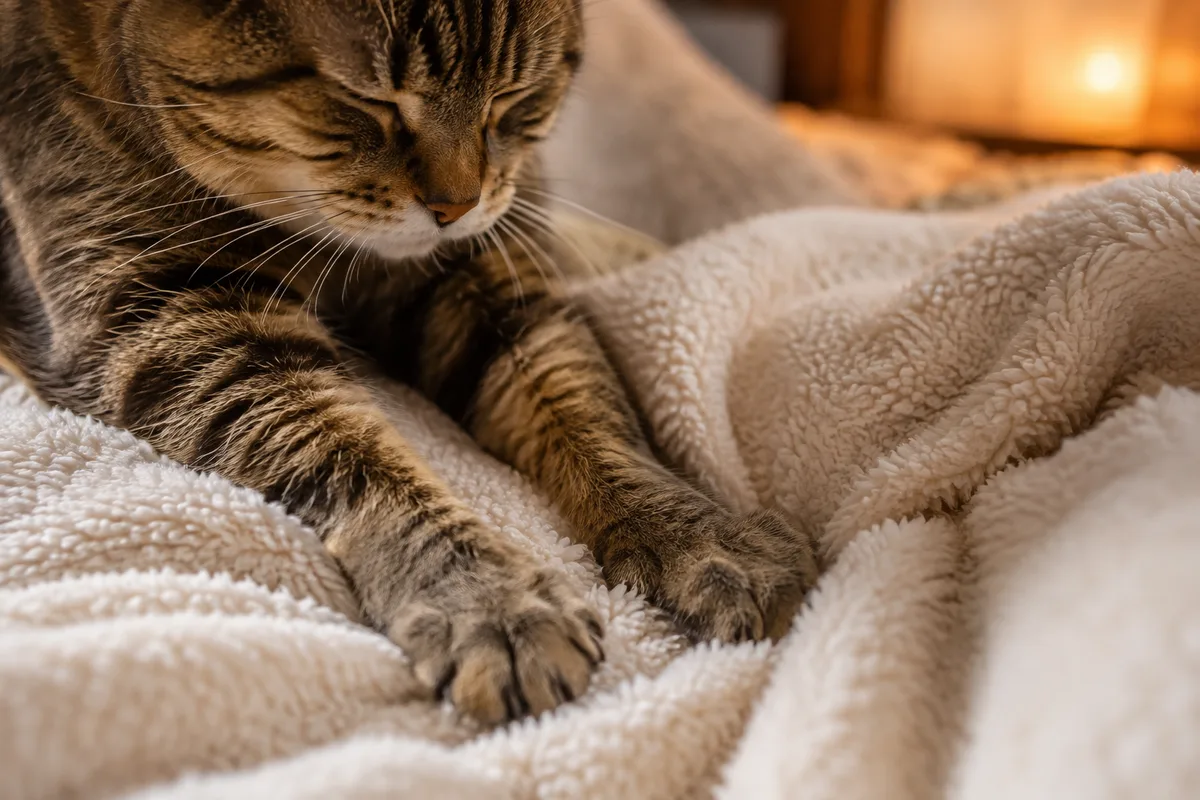
Texture seems to matter.
Many cats choose fleece blankets, comforters, pillows, beds, soft clothing, and human laps rather than hard floors or smooth tables.
A plush blanket compresses beneath the paws in a way that may resemble the soft surface kittens encounter while nursing.
It also happens to be exactly the kind of place where a cat is likely to feel warm enough to rest.
This creates a useful combination:
soft texture + comfortable location + relaxation = ideal kneading conditions.
That may explain why your cat can ignore the blanket all afternoon and then begin kneading it intensely just before falling asleep.
The blanket itself may not be special.
The situation is.
Is Your Cat “Making a Bed”?
You may have heard another popular explanation: cats knead blankets because their wild ancestors flattened grass and vegetation before sleeping.
It is an appealing idea, and kneading could potentially help manipulate a resting surface.
But this explanation should not be presented as settled fact.
Cats Protection points out that the “flattening grass” theory has limited support, particularly because African wildcats — the ancestors most closely associated with domestic cats — often prefer elevated resting places rather than simply bedding down in long grass.
So your cat may rearrange a blanket before sleeping, but saying that every kneading session is an ancient nest-building ritual goes beyond what the evidence can establish.
Your Cat May Also Be Leaving Its Scent Behind
Cats experience a blanket differently from humans.
We notice softness.
A cat also encounters a surface through scent.
Cats have scent-producing structures associated with their paws, and kneading may help deposit chemical signals onto surfaces they frequently use.
That means a favorite blanket can become part of a familiar scent environment.
This does not necessarily mean your cat is aggressively declaring:
“This blanket is mine.”
Feline scent communication is more subtle than that.
Leaving familiar scent in a resting area may simply contribute to making the environment smell recognizable and safe.
Why Does My Cat Knead Me?
Being turned into a human mattress can feel surprisingly personal.
If your cat climbs into your lap, begins purring, and kneads your legs before falling asleep, the behavior is usually occurring in a relaxed social setting.
That makes comfort and security reasonable interpretations.
Still, kneading should not be translated too literally into human emotions. It is safer to say that your cat appears comfortable enough to perform a deeply familiar behavior around you than to claim that kneading is a feline version of saying “I love you.”
You may simply have become the warmest, softest and safest blanket in the house.
Cats have plenty of other behaviors that look bizarre until their context becomes clearer. Curiworld has also explored why cats suddenly race around the house during the “zoomies” — another good example of normal feline behavior that can seem inexplicable from a human perspective.
Why Do Some Cats Use Their Claws While Kneading?
The paws are not always gentle.
Some cats keep their claws mostly retracted. Others extend them with every push, turning an affectionate-looking kneading session into something considerably less relaxing for the human underneath.
This does not automatically mean the cat is being aggressive.
Claw extension can simply be part of the kneading movement.
If your cat’s kneading hurts, placing a thick blanket between your lap and the cat is usually more practical than trying to stop the behavior itself. Keeping the cat’s nails appropriately trimmed can help too.
Punishing a cat for kneading is unnecessary. It is a normal behavior, and punishment may transform a previously comfortable situation into a stressful one.
Why Do Some Cats Suckle Blankets While Kneading?
Kneading occasionally comes with another kitten-like behavior: suckling.
A cat may knead a fleece blanket while holding part of the fabric in its mouth, purring, drooling, or appearing almost sleepy.
The combination makes sense because both kneading and suckling are closely connected with nursing during early life.
In many cats, occasional blanket suckling alongside relaxed kneading may simply be a comfort behavior.
What deserves more attention is fabric ingestion.
Suckling a blanket and actually chewing off and swallowing pieces of fabric are not the same thing. Repeatedly eating non-food materials can create health risks and deserves veterinary attention.
Does Kneading Mean a Cat Was Weaned Too Early?
This is another common assumption that is too confident.
A cat that kneads frequently was not necessarily separated from its mother too soon.
Kneading begins in normal kittenhood and persists in many perfectly ordinary adult cats. The behavior by itself cannot tell you the cat’s complete early-life history.
The same applies to kneading intensity.
One cat may make biscuits every evening.
Another may knead only occasionally.
A third may barely knead at all.
Normal feline behavior allows plenty of individual variation.
When Should Kneading Get Your Attention?
Ordinary kneading usually needs no treatment.
What matters more is a change from your cat’s normal pattern.
Consider speaking with a veterinarian if kneading suddenly becomes much more frequent or appears alongside other changes such as:
- obvious discomfort or sensitivity;
- persistent restlessness;
- unusual hiding or withdrawal;
- changes in appetite or activity;
- repeated chewing or swallowing of fabric;
- excessive grooming or other repetitive behaviors;
- a sudden major change in normal behavior.
Kneading alone does not diagnose pain, anxiety, or any medical condition.
The change in context is what matters.
A cat that has happily kneaded the same blanket every night for five years is giving you very different information from a cat that suddenly begins performing a new repetitive behavior while also acting uncomfortable.
The Blanket May Be Simple — the Behavior Is Not
A kneading cat is displaying a behavior that begins almost at the start of feline life.
We know why kittens do it: kneading helps during nursing.
What happens later is less certain.
For an adult cat, kneading may combine an old motor pattern with relaxation, soft textures, familiar scent, preparation for rest, and the security of a comfortable environment. Different cats may even knead for slightly different reasons.
So when your cat spends several minutes carefully “making biscuits” on a blanket before curling up to sleep, there probably is not one secret message to decode.
The more interesting answer is that a behavior once connected to milk and motherhood has survived into adulthood — and your softest blanket happens to be the perfect place for it to reappear.
Sources
PetMD — Hannah Hart, DVM; reviewed by Jennifer Coates, DVM — “Why Do Cats Knead?”
PetMD source
Cats Protection — “Why do cats knead?”
Cats Protection source








Join the discussion