Your Mouth Isn’t Actually on Fire — So Why Does Spicy Food Feel Hot?
Chili peppers can make your mouth feel intensely hot without actually raising its temperature enough to burn you. The secret is capsaicin and a heat-sensitive receptor called TRPV1.
Take a bite of a hot pepper and your body reacts almost immediately.
Your mouth burns.
Your face feels warm.
Your eyes may water.
Your nose starts running.
With enough spice, you may even begin sweating.
Everything about the experience tells your brain the same thing:
Heat.
Except there is something strange happening.
The chili pepper may be sitting at room temperature.
It is not physically hot enough to burn your mouth.
So why does spicy food feel hot when it isn’t actually hot?
The answer is a clever piece of sensory chemistry.
Chili peppers contain compounds called capsaicinoids, the best known of which is capsaicin.
Capsaicin interacts with a receptor in sensory nerve cells called TRPV1.
And TRPV1 has another important job.
It responds to potentially harmful heat.
Capsaicin essentially activates part of the same sensory alarm system that real heat can activate.
Your mouth is not imagining the burn.
The sensation is real.
The temperature causing it isn’t.
Spicy Is Not Actually One of the Basic Tastes
We casually talk about “tasting” spicy food.
Biologically, that description is not quite accurate.
Your taste system is responsible for familiar taste qualities such as:
sweet;
sour;
salty;
bitter;
and umami.
The burning sensation from chili peppers works differently.
Capsaicin stimulates sensory nerve endings involved in detecting potentially harmful stimuli.
This belongs more closely to a process called chemesthesis—the detection of chemical irritants through sensory systems associated with touch, temperature and pain.
That is why spicy food does not behave like sweetness.
Sugar activates taste receptors associated with sweetness.
Capsaicin activates a system that can warn you about danger.
Your brain receives something much closer to:
“This burns.”
Taste and flavor are shaped by more than the food itself. A striking example is why food tastes different on an airplane, where pressure, dry air and noise can change perception.
Meet Capsaicin
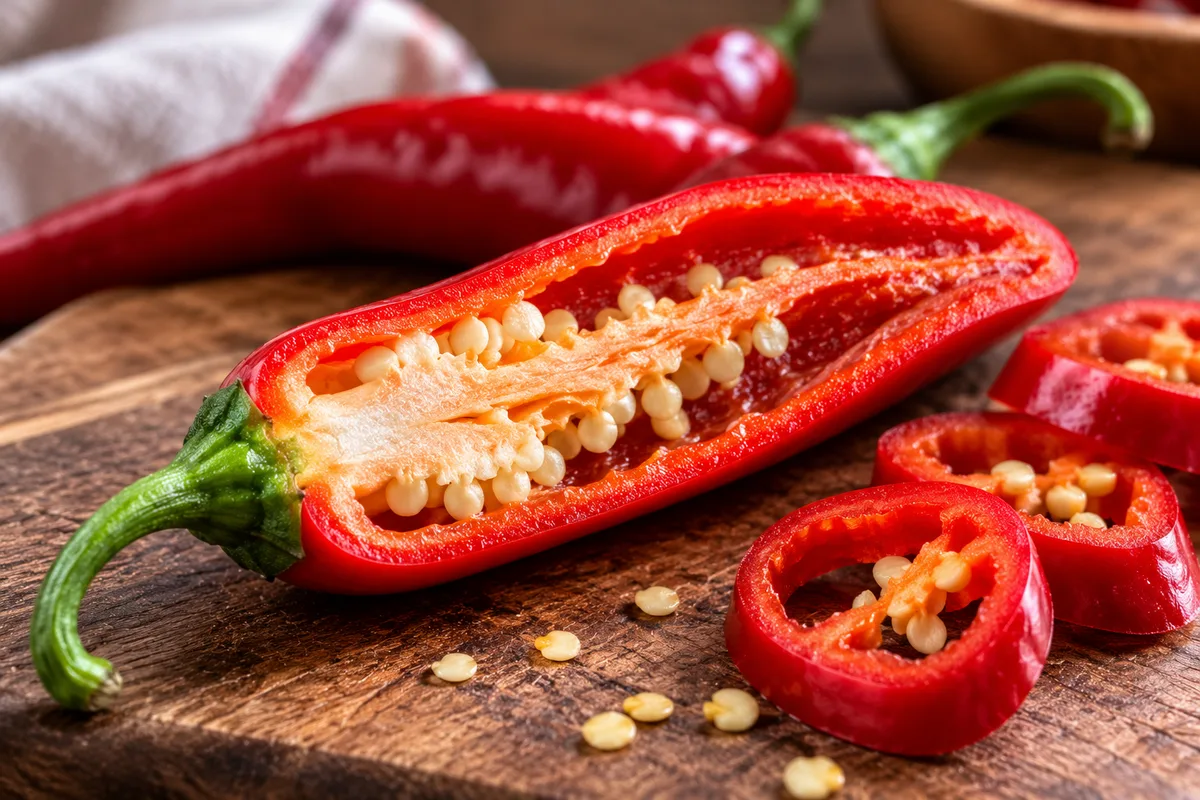
Capsaicin is the chemical celebrity of the chili-pepper world.
It belongs to a group of related molecules called capsaicinoids, which give many Capsicum peppers their characteristic pungency.
Different peppers contain different quantities and combinations of these compounds.
A bell pepper contains essentially no capsaicin and therefore has no chili-style burn.
A jalapeño contains considerably more.
Extremely hot chili varieties contain much higher concentrations.
But capsaicin itself is not physically heating your mouth.
Instead, it binds to a molecular sensor.
And that sensor explains almost everything.
The Sensor Is Called TRPV1
The full name is:
Transient Receptor Potential Vanilloid 1.
Fortunately, everyone calls it TRPV1.
TRPV1 is an ion channel found in sensory neurons involved in detecting potentially harmful stimuli.
It can respond to several different signals.
One of them is noxious heat.
Research on TRPV1 has shown that temperatures around the low-to-mid 40s Celsius can strongly activate this heat-sensitive system.
But temperature is not the only way to activate it.
Capsaicin can do it chemically.
That overlap creates the illusion.
Capsaicin Presses the Same Alarm Button as Heat
Imagine a smoke detector.
Normally, smoke activates it.
But suppose you discovered another chemical that could trigger the detector even when there was no fire.
The alarm would still sound.
The detector does not need an actual burning building if something else activates the same signaling mechanism.
Capsaicin does something conceptually similar with TRPV1.
It binds to the channel and helps stabilize its open state.
Once activated, ions—including sodium and calcium—can flow into the sensory neuron.
That changes the electrical state of the cell.
The neuron fires.
Signals travel toward the central nervous system.
And your brain receives information associated with burning irritation.
The chili itself does not need to be physically hot.
It has found another way to activate the alarm.
That Is Why the Burn Feels So Convincing
Your nervous system is not producing a weak imitation of heat.
Capsaicin and actual high temperature converge on overlapping sensory machinery.
That is why the experience can feel remarkably physical.
You may know intellectually that your salsa is cold.
Your sensory neurons do not care about that argument.
TRPV1 has been activated.
The signal is already moving.
The result is the familiar perception:
HOT.
This also explains why calling spicy food “hot” is more scientifically appropriate than it might first appear.
Spice and heat are different stimuli.
But parts of the nervous system treat them similarly.
Your Mouth Temperature Does Not Need to Rise
This is the crucial distinction.
When you drink genuinely hot coffee, thermal energy raises the temperature of tissues in your mouth.
With a room-temperature chili pepper, capsaicin can activate heat-sensitive pathways without the same physical temperature increase.
The sensation of burning is therefore real.
But the source of that sensation is chemical activation rather than thermal energy.
That distinction is similar to another familiar sensory illusion.
Mint feels cold.
But mint does not necessarily make your mouth dramatically colder.
Mint Pulls the Opposite Trick
Menthol—the compound strongly associated with mint—interacts with another temperature-sensitive ion channel called TRPM8.
TRPM8 participates in sensing cool temperatures.
Menthol can activate that pathway chemically.
So:
Capsaicin → activates a heat-associated sensory pathway → feels hot.
Menthol → activates a cool-associated sensory pathway → feels cool.
Neither compound needs to change the actual temperature enough to explain the intensity of the sensation.
They manipulate your temperature-sensing machinery.
Your nervous system is interpreting signals.
Not reading a thermometer.
Why Does Spicy Food Hurt?
Because the system capsaicin activates is not merely about pleasant warmth.
TRPV1 is strongly associated with nociception—the sensory detection of potentially damaging stimuli.
Very high temperatures can damage tissue.
Your nervous system therefore has good reason to respond strongly when heat reaches dangerous levels.
Capsaicin taps into that protective system.
As the dose increases, the sensation can move from:
warm;
to tingling;
to burning;
to genuinely painful.
Nothing needs to be literally on fire.
Your pain pathways have been activated chemically.
Why Does Your Face Start Sweating?
Now the illusion becomes even stranger.
Your body can respond to capsaicin as though heat is actually present.
Sweating is one example.
After a sufficiently spicy meal, you may notice perspiration around your:
forehead;
scalp;
upper lip;
nose;
or face.
Your nervous system has received powerful heat-related signals.
The body responds with mechanisms normally associated with managing heat.
This is sometimes called gustatory sweating.
The chili pepper has effectively convinced part of your sensory system that a thermal event is happening.
Why Does Your Nose Run?
Spicy food does not limit its effects to your tongue.
Capsaicin can stimulate sensory nerves in the mouth and nasal passages.
That irritation can trigger increased secretions.
The result is familiar:
watery eyes;
runny nose;
salivation.
These responses help protect and clear sensitive surfaces exposed to irritating substances.
Your body is essentially trying to deal with a chemical intruder.
Which, from the nervous system’s perspective, is exactly what capsaicin is.
Why Do Your Eyes Water?
The same general defensive logic applies.
Strong chemical irritation can activate sensory pathways that promote tearing.
Tears help flush irritants from the eye’s surface.
This makes spicy-food tears conceptually similar to another everyday chemistry phenomenon: chopping onions.
For the chemistry behind that comparison, see why chopping onions makes your eyes water.
The molecules and mechanisms are different, but both demonstrate how chemical compounds can activate protective sensory responses without conventional injury.
Your eyes do not need an emotional reason to cry.
Sometimes chemistry is enough.
Why Does Water Barely Help?
You eat something painfully spicy.
Your first instinct is obvious.
Water.
You take a huge drink.
For a moment, maybe it feels better.
Then the burn returns.
The problem is that capsaicin is strongly hydrophobic and does not dissolve well in water.
Drinking plain water therefore does not efficiently remove it from the surfaces in your mouth.
Worse, water can move capsaicin-containing material around.
So although cool water can provide temporary temperature relief, it is often disappointing at actually removing the chemical responsible for the burn.
Why Milk Usually Works Better
Milk has several advantages.
First, it contains fat, which can interact with hydrophobic capsaicin better than plain water.
More importantly, milk contains proteins called caseins.
Casein can help associate with and remove capsaicin from oral surfaces.
This is why dairy products are commonly more effective than water after eating something excessively spicy.
Full-fat milk, yogurt or similar dairy foods can be particularly useful.
The point is not that milk somehow “turns off” TRPV1 instantly.
It helps deal with the capsaicin that keeps activating it.
Why Bread and Rice Can Still Feel Helpful
Starchy foods such as:
bread;
rice;
tortillas;
potatoes
may provide some practical relief by physically absorbing or removing spicy oils and reducing the amount spread around the mouth.
They are not a molecular antidote to capsaicin.
But they can be more useful than repeatedly washing the irritant around with water.
This is one reason spicy cuisines often pair intense sauces with relatively neutral starches.
Besides tasting good together, the combination can make the experience easier to manage.
Does Sugar Help?
Sweet foods or sugar solutions can sometimes make the sensation feel less intense.
The effect is not the same as removing capsaicin with an ideal solvent, and results vary depending on concentration and context.
But sweetness can compete with the overall sensory experience and may provide some relief.
Still, if you accidentally eat a pepper far beyond your tolerance, dairy is usually a more logical first choice than a spoonful of sugar.
Why Does Spice Tolerance Increase?
Someone who rarely eats chili may find a jalapeño overwhelming.
Someone who eats spicy food every day may barely react.
Part of that difference can come from repeated exposure.
TRPV1-containing sensory neurons can become less responsive after repeated or prolonged capsaicin stimulation—a phenomenon generally described as desensitization.
The American Chemical Society notes that regular exposure to capsaicin can reduce sensitivity to its heat over time.
That does not mean experienced chili eaters lack TRPV1 receptors.
Their sensory response can simply become less intense.
In other words:
You can train your relationship with the burn.
But People Really Do Experience Spice Differently
Tolerance is not only about bravery.
People can experience the same spicy food differently for multiple reasons.
Repeated exposure matters.
Individual sensory sensitivity matters.
Cultural eating habits matter.
Expectations and learned preferences matter.
Even the food surrounding the capsaicin can affect how strongly the experience unfolds.
So when one person says:
“This isn’t spicy at all.”
while another person is sweating into a napkin—
both may be accurately describing their own sensory experience.
Why Are Chili Seeds Supposed to Be the Hottest Part?
This is one of the most persistent pepper myths.
The seeds themselves are not where most capsaicin is produced.
Much of the capsaicin is concentrated in the pale internal tissue—often called the placenta—to which the seeds are attached.
Seeds can become coated with capsaicinoids through contact with this tissue, which helps explain their reputation.
Removing the inner membranes and associated tissue can therefore reduce the heat of some peppers more effectively than simply obsessing over every seed.
The American Chemical Society similarly notes that the inner membrane contains much of a pepper’s capsaicin.
What Does the Scoville Scale Actually Measure?
Spicy peppers are commonly described using Scoville Heat Units, or SHU.
The scale originated with pharmacist Wilbur Scoville in the early 20th century.
Historically, heat was evaluated using human tasters and dilution.
Modern measurement can instead use analytical chemistry to quantify capsaicinoids and relate those concentrations to Scoville values.
The important point is simple:
Higher Scoville values generally indicate more capsaicinoid-related pungency.
A bell pepper sits effectively at zero.
Jalapeños occupy the thousands.
Some of the hottest chili cultivars reach into the millions.
But Scoville units do not tell you the literal temperature of the pepper.
They describe pungency.
A million-SHU pepper can still be sitting on a room-temperature plate.
Why Would a Plant Produce Capsaicin?
From the pepper plant’s perspective, capsaicin was not invented to make hot sauce interesting.
It appears to serve ecological functions.
One fascinating feature is that mammals and birds respond differently to capsaicin.
Many mammals find capsaicin irritating.
Birds are much less sensitive to it because their TRPV1 receptors respond differently.
That can benefit wild chili plants.
Birds can eat the fruit and disperse seeds over distances, while some mammalian consumers may be discouraged by the chemical burn.
What humans did was unusual.
Instead of taking the warning—
we turned it into cuisine.
Humans Learned to Enjoy a Pain Signal
This may be the most entertaining part of the story.
Capsaicin activates sensory pathways associated with potentially harmful heat and irritation.
The logical response would seem to be:
Avoid it.
And yet spicy food is loved across the world.
People deliberately seek:
hot sauce;
chili peppers;
curries;
salsas;
spicy noodles;
and dishes powerful enough to produce visible sweating.
Humans can learn to associate the sensation with flavor, excitement, culture and pleasure.
We know the meal is not actually burning us in the same way as a dangerously hot object.
So the nervous system’s warning becomes part of the experience rather than a command to escape.
Is Spicy Food Actually Burning Your Mouth?
Under ordinary culinary exposure, the burning sensation from capsaicin is primarily a sensory effect, not evidence that your mouth has literally been thermally burned.
That distinction matters.
Capsaicin activates nociceptive pathways and can produce genuine pain.
But pain does not automatically mean tissue has suffered the same kind of damage caused by touching something extremely hot.
However, very high concentrations can cause intense irritation, and individual medical conditions may make spicy foods problematic.
“Not literally hot” should therefore not be interpreted as:
Impossible to irritate you.
It absolutely can.
The Burn Is Real. The Heat Is an Illusion.
That sentence captures the whole phenomenon.
Capsaicin does not need to heat your mouth to create a convincing experience of heat.
It activates TRPV1, a sensory ion channel that also responds to potentially harmful temperatures and other irritating stimuli. When TRPV1 opens, sensory neurons send signals that your brain interprets as burning irritation.
That is why a room-temperature chili can make you:
feel hot;
sweat;
tear up;
salivate;
and desperately search for milk.
The chemistry activates machinery your nervous system normally uses to protect you from danger.
The Takeaway
Spicy food feels physically hot because capsaicin hijacks part of your body’s heat-detection system.
The key player is TRPV1.
Real noxious heat can activate TRPV1.
Capsaicin can activate it too.
Your sensory neurons respond, electrical signals travel toward the brain, and you experience the familiar burning sensation even though the chili itself may be nowhere near a temperature capable of causing a thermal burn.
That also explains several other spicy-food mysteries.
Water is often disappointing because capsaicin does not dissolve well in it.
Milk works better because its fat and proteins can help deal with capsaicin.
Repeated exposure can reduce sensitivity.
And mint can create almost the opposite illusion by activating cool-sensitive pathways.
So the next time someone takes one bite of hot sauce and announces:
“My mouth is on fire!”
They are technically wrong.
But their nervous system has a very good reason for disagreeing.
Sources
American Chemical Society — The Science of Hot Sauce: What Makes It Spicy?








Join the discussion