The Moment You Cut an Onion, a Tiny Chemical Chain Reaction Begins
Cutting an onion triggers a surprisingly complex chemical reaction that releases a volatile eye irritant. Here’s the science behind onion tears—and why some popular tricks work better than others.
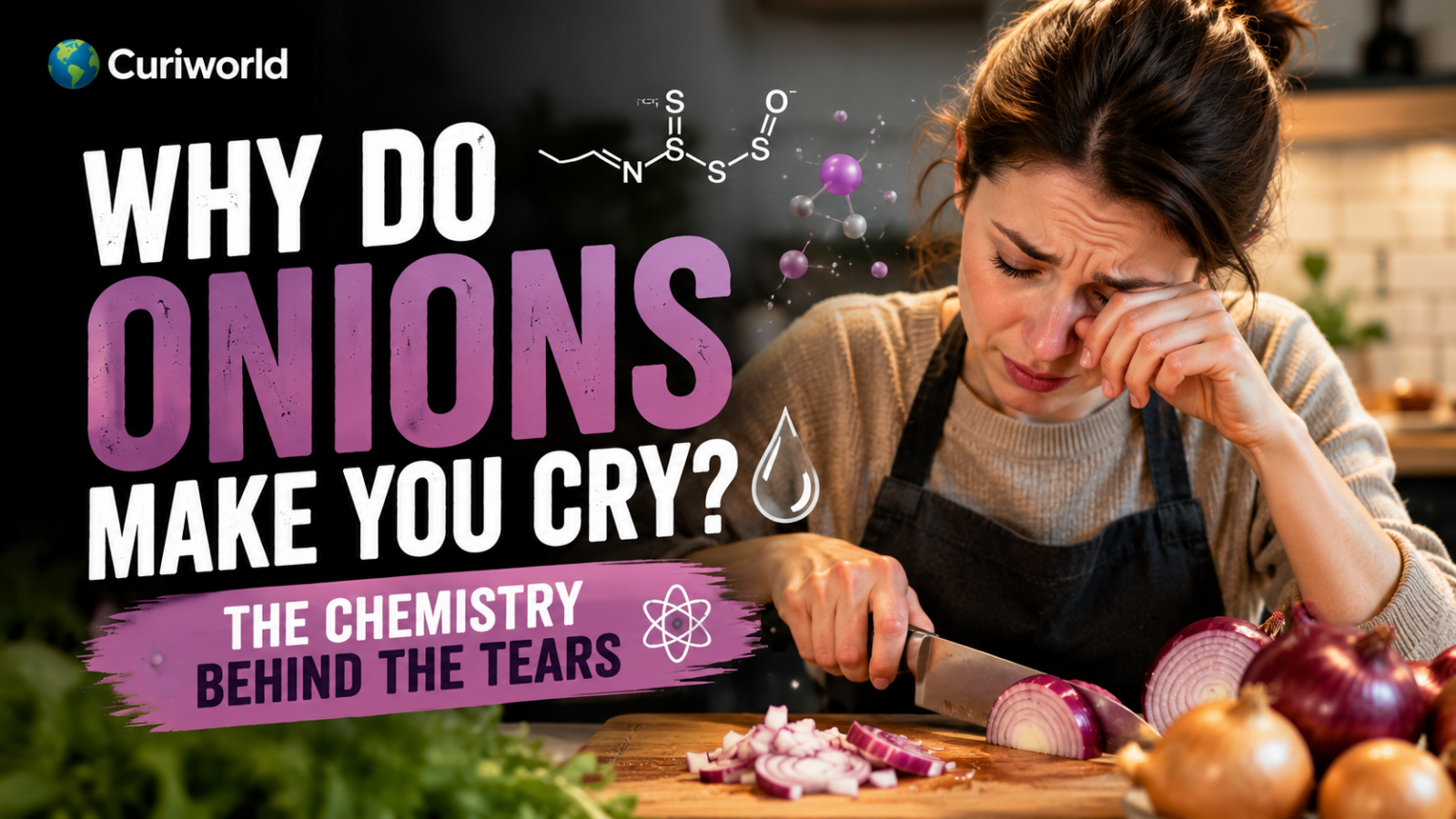
You are making dinner.
The cutting board is ready.
The knife is sharp.
You slice into an onion.
Nothing happens.
Another cut.
Still fine.
Then your eyes begin to sting.
A few seconds later, they are watering so badly that anyone walking into the kitchen might assume you have just received terrible news.
The onion, meanwhile, remains completely unapologetic.
So why do onions make you cry?
The answer is not simply that onions have a “strong smell.”
When you cut an onion, you physically break open thousands of plant cells. Chemicals and enzymes that were safely separated inside those cells suddenly meet.
That starts a rapid chain of chemical reactions.
One of the products is a small, volatile sulfur-containing compound called syn-propanethial-S-oxide.
It escapes from the damaged onion.
Travels through the air.
Reaches your eyes.
And your eyes respond exactly as they are supposed to:
They try to wash the irritant away.
The tears are not the strange part.
They are your defense system working properly.
The Onion Is Fine Until You Cut It
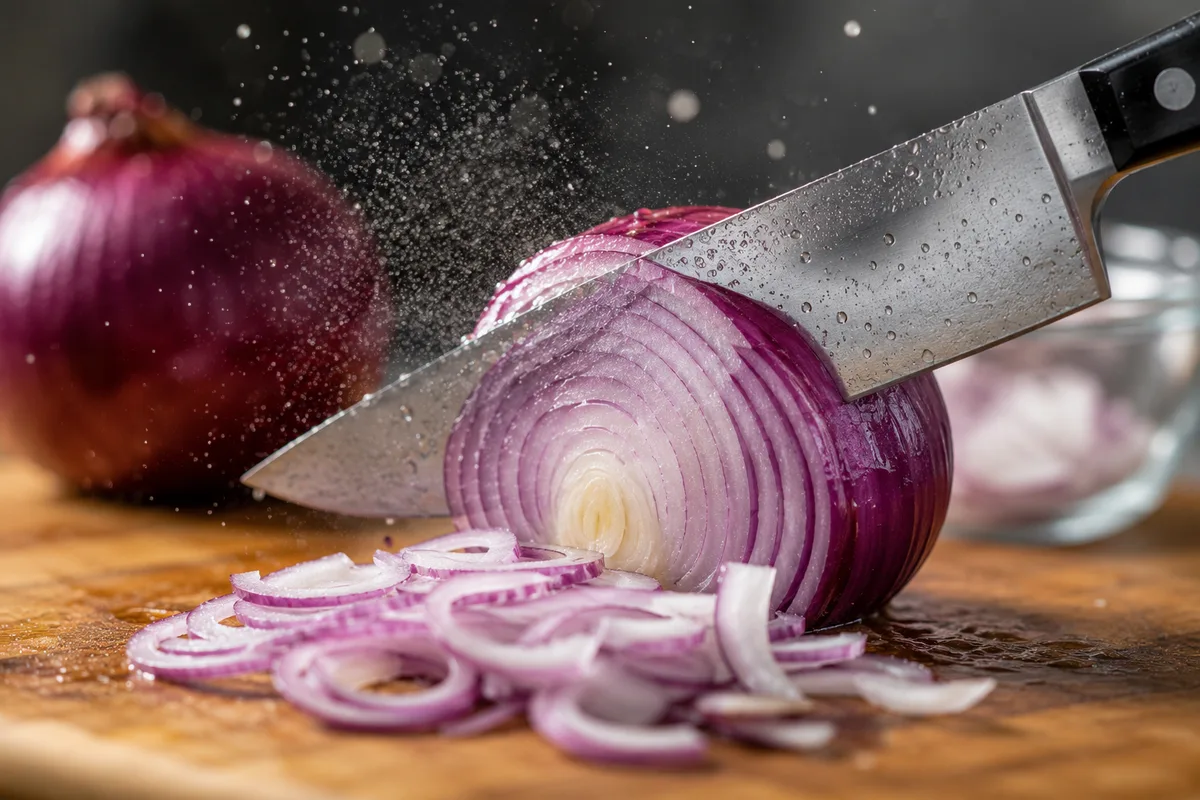
An intact onion is surprisingly well organized.
Different chemicals are stored within its cells in ways that prevent them from freely reacting with one another.
Then your knife arrives.
Slice.
Cells rupture.
Their contents mix.
And the chemistry changes almost immediately.
This is why a whole onion sitting on your kitchen counter does not normally make you cry from across the room.
The tear-producing chemistry becomes important after the onion tissue is damaged.
Cutting.
Chopping.
Crushing.
These actions break the cellular barriers that were keeping key ingredients apart.
In a sense, the onion contains the ingredients for its own chemical reaction.
Your knife simply presses the start button.
The Chemistry Begins With Sulfur
Onions belong to the genus Allium, along with familiar relatives such as garlic.
Part of their distinctive chemistry comes from sulfur-containing compounds.
While the onion is intact, precursor molecules and enzymes remain separated within the tissue.
Cutting the onion changes that.
An enzyme called alliinase gains access to sulfur-containing precursor compounds.
This leads to the formation of highly reactive compounds known as sulfenic acids.
And that is where the story gets particularly interesting.
For years, explanations of onion tears often stopped around this point.
But the pathway contains another important enzyme.
Another food chemical can trigger a very different sensory response; see why spicy food feels hot even though your mouth is not actually burning.
Meet Lachrymatory Factor Synthase
Its name sounds as though it was invented specifically to ruin dinner preparation:
lachrymatory factor synthase, usually abbreviated LFS.
“Lachrymatory” refers to something that causes tears.
The name is therefore remarkably literal.
Research has shown that LFS catalyzes the formation of the onion’s characteristic lachrymatory factor from a sulfenic-acid precursor.
That lachrymatory factor is:
(Z)-propanethial S-oxide, commonly called syn-propanethial-S-oxide.
This is the molecule responsible for the familiar eye irritation associated with chopping onions.
So the simplified chain looks something like this:
Cut onion → cells break → enzymes meet sulfur-containing precursors → sulfenic acids form → LFS helps produce syn-propanethial-S-oxide → volatile irritant reaches your eyes → tears
Your dinner preparation has quietly become a chemistry experiment.
Why Does the Chemical Reach Your Eyes?
Because syn-propanethial-S-oxide is volatile.
That means it can readily enter the air.
Once produced in the damaged onion tissue, some of it escapes and disperses around the cutting area.
Your eyes happen to be conveniently positioned above the cutting board.
The compound reaches the surface of the eyes and produces irritation.
Your sensory system notices.
The response is automatic.
Make tears.
Your Tears Are Trying to Protect You
Crying while cutting onions is not an emotional response.
Your eyes are defending themselves.
The tear-producing structures are called the lacrimal glands.
When the onion’s volatile irritant reaches your eyes, the irritation triggers tearing.
Those tears help dilute and remove the irritating substance from the eye’s surface.
That means the watery eyes, blinking, and instinctive desire to move away from the cutting board all make biological sense.
Your body is not overreacting.
It is performing maintenance.
Why Does It Burn Before You Start Crying?
The sequence can feel strangely predictable.
First:
sting.
Then:
burning.
Then:
tears everywhere.
That happens because the irritant reaches sensitive tissues around the eye and stimulates sensory pathways before and while the tear response ramps up.
A different food chemical can trigger a related protective response: capsaicin can make the eyes water and the nose run even without actual heat. See why spicy food feels hot when it is not actually hot.
Tears then begin washing across the surface.
Unfortunately, producing tears does not instantly eliminate the source.
If you are still standing over a freshly chopped onion, more volatile irritant can continue reaching your eyes.
So you wipe your face.
Return to chopping.
And immediately regret your optimism.
Is Onion “Gas” Actually Toxic?
People often describe the tear-producing substance as “onion gas.”
That is understandable, although volatile irritant is a more useful description.
The amount encountered during ordinary food preparation usually causes temporary irritation rather than lasting injury.
Once you move away from the source and the irritant dissipates, the symptoms generally subside.
If significant or persistent eye symptoms occur beyond normal onion exposure, however, do not assume an onion is automatically responsible.
Eye pain and persistent irritation can have many causes.
Why Are Some Onions Worse Than Others?
Anyone who cooks regularly eventually notices this:
One onion produces barely a tear.
Another turns dinner preparation into an emotional event.
Several factors can influence onion chemistry, including cultivar and growing conditions.
The sulfur available to the plant can influence sulfur-containing compounds in the onion.
Storage and handling may also affect what happens when the onion is cut.
So your experience is not necessarily imagination.
Different onions can produce noticeably different reactions.
Does a Stronger Onion Always Mean More Tears?
Not perfectly.
Pungency, flavor chemistry, and lachrymatory chemistry are related through the onion’s sulfur pathways, but they should not be treated as identical measurements.
An onion’s flavor involves numerous compounds and reactions.
The specific molecule primarily associated with tears is syn-propanethial-S-oxide.
That distinction matters because researchers have even developed onions with reduced lachrymatory-factor production.
Changing one branch of the chemistry can affect what happens elsewhere.
An onion is more chemically complicated than its humble appearance suggests.
Why Doesn’t Garlic Make You Cry the Same Way?
This is an especially interesting question because onions and garlic are relatives.
Both belong to the Allium group.
Both contain sulfur chemistry.
Both undergo dramatic chemical changes when their cells are damaged.
Yet chopping garlic does not normally produce the classic onion-tear experience.
One major difference lies in what happens to the reactive sulfur intermediates after the tissue is disrupted.
Onions use lachrymatory factor synthase to channel part of that chemistry toward their tear-producing lachrymatory factor.
Garlic chemistry instead famously produces other sulfur compounds, including those associated with its characteristic aroma and flavor.
Similar chemical toolbox.
Different products.
Is the Onion Doing This to Defend Itself?
There is a fascinating evolutionary angle here.
Plants cannot run away when something starts eating them.
They need other strategies.
Chemical defenses are one of them.
The biochemical pathway responsible for onion flavor and the lachrymatory factor is associated with the plant’s chemical defenses against organisms that damage it.
From the onion’s perspective, tissue damage is exactly the situation in which chemical defense becomes useful.
Something bites into the plant.
Cells rupture.
Reactive compounds form.
The attacker encounters unpleasant chemistry.
Your kitchen knife triggers the same basic tissue-damage response.
Of course, the onion’s strategy has one significant weakness against humans:
We decided the flavor was delicious.
Can You Actually Cut an Onion Without Crying?
You can often reduce the reaction.
The key is understanding the mechanism.
If tears begin because volatile irritant reaches your eyes, useful strategies generally aim to do one of three things:
Produce less irritant.
Release it less aggressively.
Prevent it from reaching your eyes.
This gives us a much better way to evaluate the endless collection of onion-cutting hacks on the internet.
A Sharp Knife Can Help
This is one of the most sensible strategies.
Remember what starts the entire process:
cell damage.
A dull knife tends to crush and rupture onion tissue more aggressively.
A sharp knife makes cleaner cuts.
That does not stop the chemistry completely—you are still cutting cells—but reducing unnecessary crushing can help limit how aggressively onion material and droplets are released.
It also makes chopping easier and safer when proper knife technique is used.
So before trying elaborate internet tricks, start with the obvious:
Use an appropriately sharp kitchen knife.
Chilling the Onion May Reduce the Reaction
Cooling an onion before cutting is another commonly recommended strategy.
Chemical and enzymatic processes are temperature-dependent.
Lower temperatures can slow some of the reactions involved in producing and releasing the tear-inducing compounds.
The American Chemical Society has recommended refrigerating onions before chopping as a way to slow the conversion and release of the compounds responsible for irritation.
The practical version is simple:
Put the onion in the refrigerator before preparing it.
You do not need to freeze it solid.
And remember that chilling changes handling characteristics, so use normal knife safety.
Ventilation Can Make a Difference
The irritant needs to travel from the onion to your eyes.
Air movement can interfere with that journey.
A kitchen exhaust hood or appropriately positioned fan may help move volatile compounds away from your face.
The direction matters.
A fan blowing onion vapors directly upward into your eyes would be a spectacular failure of engineering.
You want airflow that carries the irritant away from you.
This strategy attacks the problem after the chemical has formed but before much of it reaches your eyes.
Distance Helps Too
Notice what happens when you lean directly over the cutting board.
Your eyes are positioned almost perfectly above the source.
Try maintaining a comfortable, safe posture rather than hovering with your face inches above the onion.
You still need to see what you are cutting clearly.
But there is rarely a benefit to putting your eyes closer to the source of a volatile irritant.
Your knife technique may improve too.
Do Goggles Work?
In principle, yes.
If the irritating compound cannot easily reach the surface of your eyes, the tear response should be reduced.
Properly fitting protective eyewear creates a physical barrier.
Ordinary eyeglasses are much less effective because air can easily move around them.
Dedicated kitchen onion goggles may look absurd.
But chemistry does not care about dignity.
A physical barrier is one of the most direct solutions to an airborne eye irritant.
What About Cutting an Onion Under Water?
You may have heard that cutting onions underwater prevents tears.
There is chemical logic behind using water because the volatile compounds can interact with or be trapped by water before reaching your eyes.
But there is a practical problem:
Knife safety.
Trying to slice an onion submerged in a bowl can make the onion, knife, and your hands harder to control.
A tear-free onion is not worth a cut finger.
For ordinary home cooking, safer approaches such as chilling, ventilation, and using a sharp knife are generally more practical.
Does Leaving the Root End Intact Work?
This is one of the most repeated pieces of onion advice.
The claim usually goes something like:
“All the tear chemicals are in the root, so never cut it.”
That explanation is too simplistic.
The onion’s sulfur chemistry is not confined to one tiny section that can simply be avoided.
Leaving the root end attached can still be useful from a culinary standpoint because it helps hold the onion together while making certain cuts.
But do not expect the root to function like an on/off switch for tears.
You are still damaging onion cells elsewhere.
The chemistry still happens.
Does Holding Bread in Your Mouth Work?
Welcome to the strange part of onion folklore.
Other popular tricks include:
holding bread in your mouth;
chewing gum;
lighting a candle;
breathing only through your mouth;
putting a spoon in your mouth;
and performing various kitchen rituals that look increasingly unrelated to chemistry.
Some may change airflow or how you position your face, which could indirectly affect exposure.
But many have much weaker mechanistic support than simply:
reduce tissue damage, cool the onion, move the vapors away, or protect the eyes.
A good kitchen hack should survive the question:
How would this interfere with the actual chemical pathway?
If there is no convincing answer, skepticism is reasonable.
Why Does Rubbing Your Eyes Make Everything Worse?
Your eyes start watering.
Naturally, you reach up and rub them.
Unfortunately, your hands have just been handling a freshly cut onion.
That can transfer onion residue directly toward your eyes.
Not ideal.
Instead, avoid touching your eyes while chopping.
Wash your hands thoroughly after handling onions.
If your eyes are watering from ordinary onion exposure, moving away from the cutting area and allowing clean tears to flush the surface is usually preferable to rubbing.
The burning is annoying.
Adding onion-coated fingers is unlikely to improve it.
Why Do Contact Lenses Sometimes Seem to Help?
Some contact-lens wearers report less irritation while cutting onions.
A lens covers part of the eye’s surface and may reduce direct exposure in that area.
But contacts are not protective goggles, and they should never be treated as safety equipment.
Onion vapors can still reach exposed eye tissue.
So if you happen to cry less while wearing contacts, enjoy the accidental benefit.
Do not rely on them as chemical protection.
Can You Become Immune to Onion Tears?
Frequent cooking can make people feel as though they have become less sensitive.
But there is no simple rule that repeated onion chopping permanently switches off the tear response.
Exposure varies enormously depending on:
the onion;
how it is cut;
temperature;
ventilation;
distance from the face;
and individual sensitivity.
An experienced cook may also unconsciously use better technique.
Faster cutting.
Sharper knife.
Less crushing.
Better posture.
Better ventilation.
Sometimes what looks like biological immunity is simply improved onion management.
Tearless Onions Really Exist
This sounds like marketing fiction, but the chemistry makes it possible.
Because the lachrymatory factor depends on a specific biochemical pathway, changing that pathway can reduce production of the irritating compound.
Researchers have studied onions in which lachrymatory factor synthase activity is suppressed, producing dramatically less of the tear-inducing factor.
This research is especially interesting because redirecting sulfur chemistry can also alter the other sulfur compounds the onion produces.
So “tearless onion” is not magic.
It is biochemistry.
The Same Chemistry Helps Make Onions Interesting
There is a nice irony here.
The chemistry that makes onions irritating is closely connected to the chemistry that makes Allium plants so distinctive.
Cutting an onion does not merely release a pre-existing bottle of “onion smell.”
Damage triggers reactions.
New compounds form.
Aromas develop.
Flavors change.
The onion you taste after cutting is chemically different from the intact onion you picked up from the counter.
That is one reason cooking is full of chemistry even when no one in the kitchen is thinking about molecules.
Heat.
Acids.
Proteins.
Sugars.
Water.
Enzymes.
Every meal is chemistry happening at human scale.
The Bottom Line
Onions make you cry because cutting them starts a rapid chemical chain reaction.
Your knife ruptures onion cells.
Previously separated enzymes and sulfur-containing compounds come into contact.
Alliinase helps generate reactive sulfenic acids.
Then lachrymatory factor synthase helps produce the volatile tear-inducing compound syn-propanethial-S-oxide.
That compound escapes into the air.
It reaches your eyes.
Your eyes detect an irritant.
And your lacrimal glands respond with tears to help wash it away.
So the onion is not literally making you sad.
Your eyes are defending themselves from chemistry.
If you want fewer tears, focus on strategies that actually interact with that process:
Use a sharp knife.
Try chilling the onion.
Use ventilation that moves vapors away from your face.
Avoid leaning unnecessarily close to the cutting board.
And if you are truly determined—
wear goggles.
You may look ridiculous.
But at least you will understand exactly why they work.
Sources
American Chemical Society — syn-Propanethial S-oxide
Library of Congress — Why Does Chopping an Onion Make You Cry?








Join the discussion