Why Does Food Taste Different on an Airplane?
Cabin pressure, dry air and even engine noise can change how food tastes. Here’s the science behind why meals feel different in the sky.

A meal that tastes perfectly normal on the ground can seem strangely muted once you are thousands of feet in the air. Desserts may seem less sweet, subtle aromas can disappear, and strongly savory foods may suddenly taste more satisfying.
The food itself is only part of the story. Lower cabin pressure, very dry air, constant background noise, and the close relationship between smell and taste all influence how we experience food on an airplane.
That means your in-flight meal is being judged in one of the strangest dining environments imaginable.
Airplane Cabins Are Pressurized — but Not Like Your Kitchen
Commercial aircraft may cruise above 30,000 feet, but cabins are pressurized so passengers can breathe comfortably.
Even so, cabin pressure is generally equivalent to being several thousand feet above sea level rather than standing at sea level.
The same pressure difference that changes the cabin environment also has to be managed by the aircraft’s window system. See why airplane windows have tiny breather holes.
That difference changes the sensory environment in which you eat.
Research on simulated aircraft conditions has found that some tastes and aromas become harder to perceive under lower-pressure conditions. Sweetness and saltiness can feel weaker, while certain stronger flavors remain easier to notice.
This is one reason a meal carefully seasoned in a catering kitchen may seem surprisingly restrained once it reaches cruising altitude.
Your taste buds have not stopped working. The conditions around them have changed.
Dry Cabin Air Can Make Food Seem Blunter
Airplane cabins are extremely dry compared with most homes, restaurants, and offices.
Typical cabin humidity can fall to around 10–20 percent.
Anyone who has spent several hours on a flight has probably noticed the effects: dry lips, a dry mouth, or a nose that feels less comfortable than usual.
That matters because what we casually call “taste” is actually a combination of several senses.
Your tongue can detect basic tastes such as:
- Sweet
- Salty
- Sour
- Bitter
- Umami
But the detailed flavor of coffee, strawberries, curry, chocolate, or roasted meat depends heavily on smell.
As you chew, aroma molecules travel from the mouth toward receptors in the nasal cavity. If those aromas are harder to detect, food loses part of its identity.
That is why eating with a blocked nose can make even familiar foods seem surprisingly bland.
The same basic principle helps explain why food can seem different in a dry aircraft cabin.
One drink has become an especially interesting example of this effect: why tomato juice can taste better on an airplane.
The Noise Around You May Be Changing Flavor Too
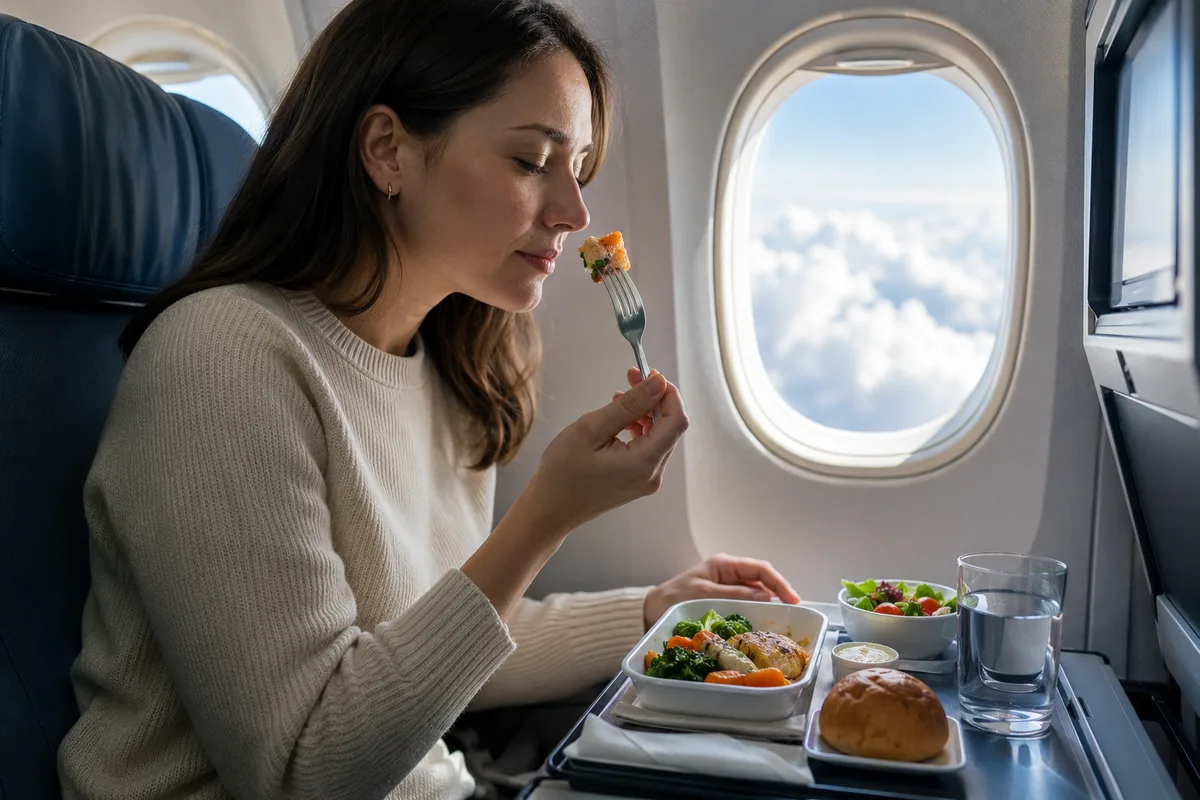
One of the most surprising factors has nothing to do with altitude or humidity.
It is sound.
Aircraft cabins are filled with a continuous mixture of engine noise, airflow, ventilation systems, and conversation. Researchers have investigated whether that background sound can actually influence taste perception.
A Cornell University study exposed participants to noise similar to the acoustic environment inside an airplane while they sampled solutions representing different basic tastes.
The results were striking: loud background noise reduced perceived sweetness while increasing perceived umami intensity.
Salty, sour, and bitter tastes did not change in the same way.
So cabin noise does not necessarily make everything taste weaker. It may change the balance between different taste sensations.
That distinction helps explain why some foods perform surprisingly well in the air while others lose much of their appeal.
Why Tomato Juice Can Taste So Good on a Plane
Tomato juice has become one of the classic examples of airplane flavor.
Some travelers who rarely order it on the ground suddenly find it appealing during a flight.
There may be a sensory reason.
Tomatoes are naturally associated with umami, the savory taste linked closely with glutamate. Because research suggests that aircraft-like background noise can enhance perceived umami, tomato-based foods and drinks may hold their character unusually well in the cabin.
At the same time, delicate sweetness can become less noticeable.
That creates an interesting advantage for foods built around strong savory flavors.
It does not mean flying automatically turns everyone into a tomato-juice fan. Personal preference remains important.
But the cabin environment may give savory flavors an edge.
Why Airlines Can’t Simply Add More Salt and Sugar
If sweetness and saltiness can seem weaker in the air, there is an obvious question:
Why not just add more sugar and salt?
Because good airline food is more complicated than turning up two ingredients.
An excessively salty dish prepared on the ground may still be poorly balanced, and increasing sugar is not always enough to restore the aromas and complexity lost in the cabin.
Instead, foods that work well in flight often rely on stronger sensory characteristics.
Ingredients such as tomatoes, mushrooms, aged cheeses, herbs, spices, rich sauces, and roasted flavors can provide depth without depending entirely on salt.
Umami-rich foods are particularly useful because their savory character may remain satisfying despite the unusual cabin environment.
Airline menu development therefore involves more than choosing dishes that look good on a tray.
The food has to work in the place where passengers will actually eat it.
Reheating Changes the Meal Before You Even Taste It
There is another problem that has nothing to do with human biology.
Your meal was not freshly cooked beside your seat.
Airline food usually has to be prepared in catering facilities, cooled, transported, stored safely, loaded onto the aircraft, and reheated before serving.
That process favors some foods more than others.
A delicate piece of meat that depends on an exact temperature can be difficult to reproduce consistently for hundreds of passengers.
Sauces, curries, braised dishes, pasta, rice dishes, and other moisture-rich preparations are often more forgiving.
Food can also lose moisture during reheating, which makes dry cabin air feel even more noticeable.
So when an airplane meal disappoints, there may be two separate forces at work:
The environment changes how you perceive the food, while the catering process can change the food itself.
Some Foods Are Better Suited to the Sky
The best airplane meal may not be the dish that tastes most refined in a restaurant.
Instead, it needs enough character to survive a difficult sensory environment.
Strong savory flavors often perform well. Sauces can protect moisture. Herbs and spices add complexity. Foods with clear textures can remain satisfying even when subtle aromas are less noticeable.
Desserts face a different challenge.
If sweetness seems reduced in a noisy cabin, a delicately sweet dessert may feel flatter than expected.
Drinks can change too. Beverages that depend heavily on subtle aroma may seem less expressive than they do on the ground.
This is why certain foods repeatedly appear on airline menus while others are far less common.
It is not only about logistics.
It is also about sensory survival.
Does That Mean Airplane Food Isn’t Actually Bad?
Sometimes airplane food really is disappointing.
Poor preparation, excessive reheating, dry ingredients, or an uninspired recipe cannot be blamed entirely on altitude.
But the reputation of airline food is also affected by something passengers rarely think about:
We experience the same food differently in the air.
Imagine eating an identical meal twice.
The first time, you are sitting in a quiet room at comfortable humidity and normal atmospheric pressure.
The second time, you are inside a dry, pressurized cabin surrounded by continuous engine and airflow noise.
Those are not equivalent eating experiences.
Flavor is created by the brain using information from taste, smell, texture, temperature, sound, and context.
Change several of those signals at once, and the food itself can seem to change.
Your Taste Buds Aren’t the Only Thing at Work
Food tastes different on an airplane because flying changes the environment in which flavor is perceived.
Lower cabin pressure can reduce the intensity of some tastes and aromas. Dry air can interfere with the smell component that gives food much of its character. Background noise may reduce sweetness while making savory umami flavors more noticeable.
Then the realities of airline catering — chilling, storing, transporting, and reheating meals — add another layer.
That is why a dessert can seem strangely flat while tomato juice suddenly tastes surprisingly good.
Your taste buds have not forgotten how food works.
For a few hours, they are simply operating inside a very unusual dining room.
Sources
Centers for Disease Control and Prevention — Air Travel — Yellow Book
https://www.cdc.gov/yellow-book/hcp/travel-air-sea/air-travel.html
Yan, K. S. & Dando, R. — A Crossmodal Role for Audition in Taste Perception — Journal of Experimental Psychology: Human Perception and Performance
https://pubmed.ncbi.nlm.nih.gov/25775175/








Join the discussion