Your Dog Keeps Staring at You — Here’s How to Read the Look
Your dog may stare at you for food, attention, information, affection, or a training cue. Learn how context and body language reveal what those long looks may actually mean.
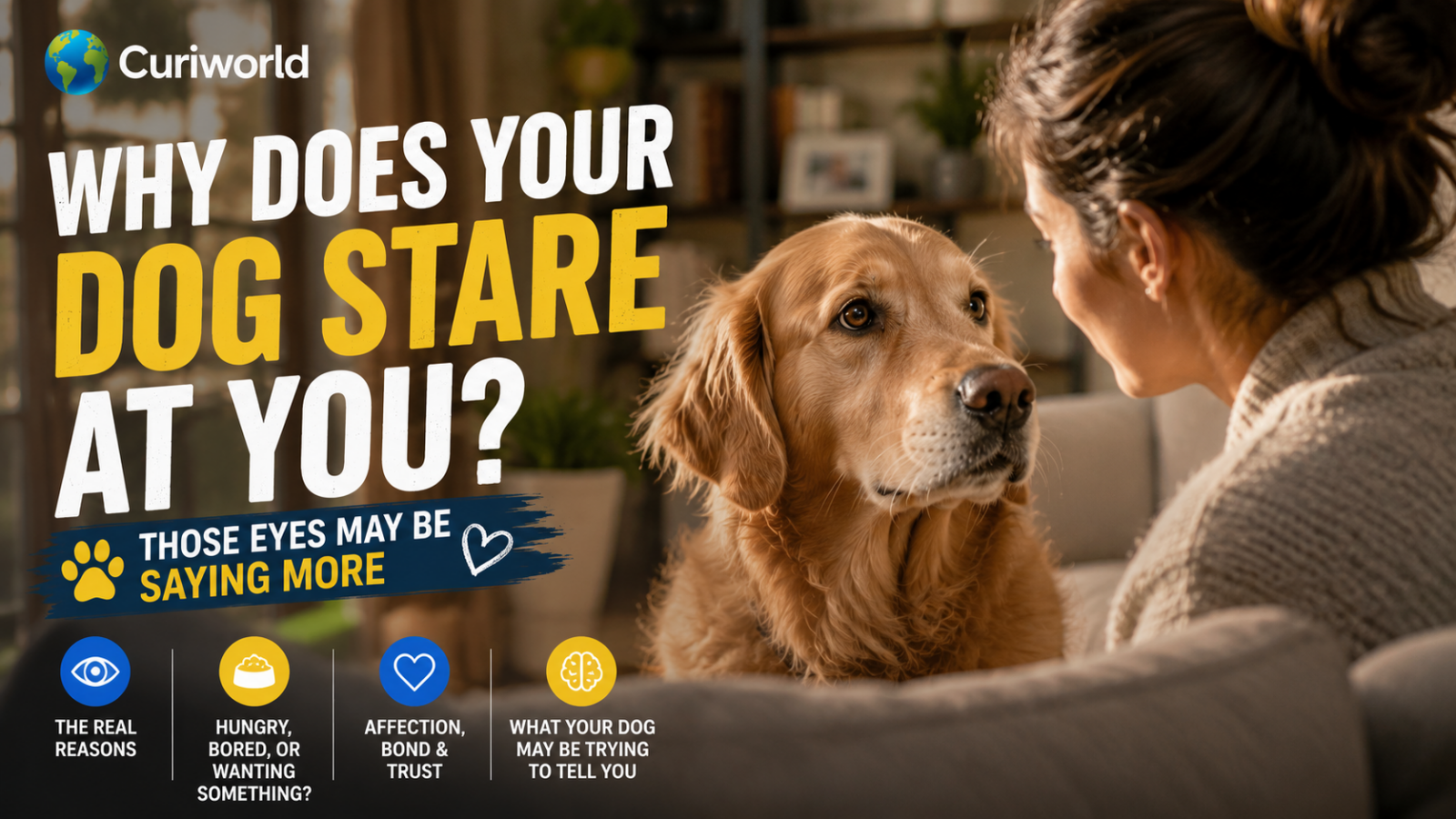
You are sitting on the couch when you notice it.
Your dog is staring at you.
Not glancing.
Not casually checking where you are.
Staring.
You look away, check your phone, look back—and those eyes are still locked on you.
It can feel as though your dog is trying very hard to say something without making a sound.
And sometimes, that is surprisingly close to the truth.
Dogs watch humans for many reasons. They may be waiting for dinner, anticipating a walk, asking for attention, reading your body language, or simply enjoying being close to you.
But not every stare means the same thing.
A relaxed dog gazing at you with soft eyes is very different from a dog standing rigidly over a bone and giving you a hard, unblinking stare.
So instead of asking only “Why is my dog staring at me?”, look at the entire scene.
What happened immediately before the stare? What does your dog usually get afterward? And what is the rest of their body telling you?
Those clues can turn a mysterious look into surprisingly understandable communication.
Your Dog May Be Watching You for Information
Dogs live in a human-controlled world.
We decide when doors open.
We control meals.
We pick up the leash.
We start games.
We get into the car.
We decide when everyone goes to bed.
From your dog’s perspective, watching you closely can therefore be extremely useful.
The American Kennel Club notes that dogs observe humans to gather information about what may happen next. They learn routines and recognize signals associated with activities they care about.
Think about what happens before your normal walk.
Maybe you put on particular shoes.
Pick up your keys.
Reach toward the leash.
Your dog may learn the sequence long before you realize you have one.
Eventually, they do not need to wait for the leash.
They watch you.
Sometimes the Stare Means “I Want Something”
Your dog cannot say:
“Excuse me, my water bowl is empty.”
They need another strategy.
Staring can be one of them.
Your dog may look intensely at you because they want:
- food;
- water;
- a bathroom break;
- a walk;
- play;
- attention;
- access to another room;
- or something they cannot reach.
The surroundings usually provide clues.
If your dog stares at you and then looks toward the back door, the message may be relatively easy to decode.
If they stare at you while you eat a chicken sandwich, you probably do not need a canine behavior expert to solve the mystery.
The interesting part is what happens next.
You May Have Accidentally Trained the Stare
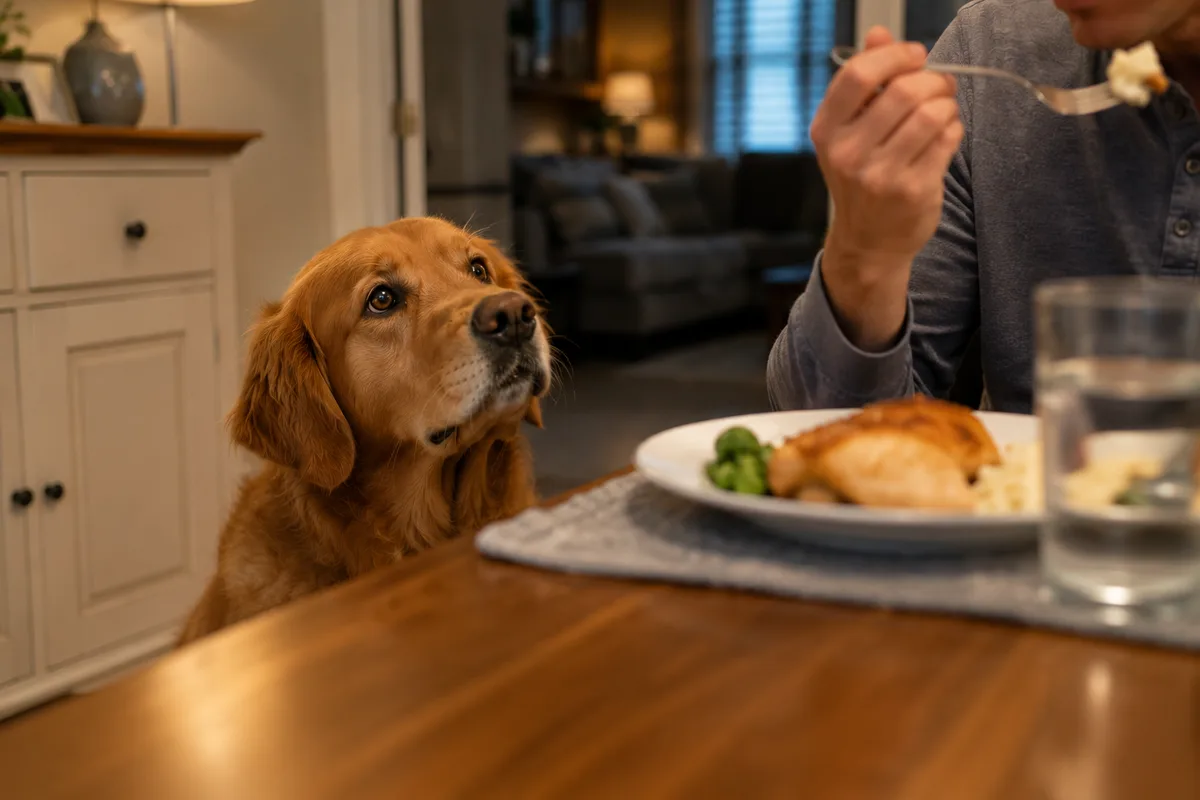
Picture dinner.
Your dog sits beside the table and watches you.
You resist.
They continue watching.
Those enormous eyes become increasingly difficult to ignore.
Eventually, you give them a tiny piece of food.
What did your dog learn?
Staring works.
Behavior that produces a desirable result tends to be repeated.
The same pattern can happen with attention.
Your dog stares.
You laugh and pet them.
Tomorrow, they stare again.
This does not mean your dog is plotting against you.
They have simply discovered a reliable way to make something happen.
If you do not want staring to become the default request for everything, think carefully about what you reward.
Better yet, teach a clearer alternative behavior for common needs.
Your Dog May Be Waiting for a Cue
Training changes the meaning of eye contact.
Dogs trained with positive reinforcement often learn that paying attention to their handler is valuable.
Looking at you might lead to:
“Sit.”
“Down.”
“Stay.”
“Come.”
Or perhaps a treat, toy, praise, or game.
A dog that has learned this pattern may stare because they are waiting for the next piece of information.
That attention can actually be useful.
AKC recommends teaching a “watch me” or similar cue because getting a dog’s visual attention can make training and navigating distractions easier.
In that situation, staring is not a mysterious emotional message.
Your dog may simply be saying:
“I’m listening. What’s next?”
Sometimes It Really Is Affection
Not every explanation needs to involve food.
Relaxed mutual gaze can be part of the social bond between dogs and their people.
Research discussed by the AKC has linked positive mutual gaze between dogs and their owners with oxytocin, a hormone associated with social bonding.
But context still matters.
Affectionate eye contact usually comes with a relaxed dog.
Look for the whole picture:
- soft eyes;
- relaxed facial muscles;
- comfortable posture;
- loose body movement;
- and a dog who appears content rather than tense.
A calm dog resting beside you and occasionally gazing into your eyes is giving you a very different signal from a dog frozen over a valued object.
The eyes matter.
The body around the eyes matters more.
Soft Eyes and a Hard Stare Are Not the Same Thing
This is one of the most important distinctions in the entire article.
A dog’s stare should never be interpreted in isolation.
A relaxed gaze may look like:
Soft eyes.
Loose facial muscles.
A relaxed mouth.
Normal blinking.
A comfortable body.
No obvious tension.
A hard stare can look very different:
Fixed, intense eyes.
Little blinking.
A closed or tense mouth.
Stiff posture.
Freezing.
Body weight positioned protectively over something valuable.
Growling or other warning signals may also occur.
AKC specifically warns that a hard, unblinking stare combined with stiff body language can signal discomfort or threat.
Do not respond by staring back to “show who’s boss.”
Give the dog space.
Be Especially Careful Around Food, Toys, and Chews
Suppose your dog has a favorite chew.
You walk toward them.
They stop chewing.
Their body becomes still.
They lower their head slightly over the item and stare directly at you.
That is not the moment to decide the dog looks adorable and reach for the chew.
A hard stare around food, toys, sleeping areas, or other valued resources can be associated with resource guarding.
Watch for additional signs such as:
- freezing;
- stiffening;
- hovering over the object;
- moving the item away;
- showing teeth;
- growling;
- or snapping.
Do not deliberately provoke these behaviors to “test” your dog.
And do not punish a warning signal like growling.
If resource guarding is a concern, seek guidance from an appropriately qualified professional.
Don’t Stare Down an Unfamiliar Dog
Humans often associate eye contact with confidence, honesty, and connection.
Dogs do not necessarily interpret prolonged direct staring the same way.
AKC advises against staring down unfamiliar dogs because direct, prolonged eye contact may be perceived as threatening, particularly by dogs that are fearful, reactive, or uncomfortable around people.
If an unfamiliar dog is staring at you with a stiff body and hard expression, do not turn it into a contest.
Avoid prolonged eye contact.
Remain calm.
Give the dog space.
Your own dog’s relaxed gaze during a quiet evening at home should not be used as a model for how every dog interprets direct eye contact.
Why Does My Dog Stare at Me While I Eat?
This one is usually less mysterious.
Food is valuable.
You have food.
Your dog knows it.
If staring has ever resulted in food being shared, the behavior can become particularly persistent.
The dog may even move to the person at the table most likely to give in.
If you do not want begging at meals, consistency matters.
One person secretly handing over food can keep the behavior alive even when everyone else ignores it.
Instead, consider giving your dog an appropriate alternative activity during human meals, such as relaxing on their bed with a suitable enrichment item.
The objective is not to punish staring.
It is to make another behavior more worthwhile.
Why Does My Dog Stare at Me Before a Walk?
Because your dog may know your schedule better than you think.
Dogs learn sequences.
At roughly the same time each day:
You close the laptop.
Stand up.
Change shoes.
Reach for a jacket.
Walk toward the door.
Your dog does not need a clock on the wall.
Your behavior becomes the clock.
Staring lets them monitor the countdown.
This is also why your dog may begin watching you intensely shortly before dinner, bedtime, or another predictable activity.
Try changing one part of your normal routine and see whether your dog’s reaction changes.
You may discover just how closely they have been studying you.
Why Does My Dog Stare at Me From Across the Room?
Distance does not necessarily change the basic explanation.
A dog across the room may simply be keeping track of you.
Perhaps they are comfortable where they are but still interested in what you are doing.
This is particularly unsurprising in dogs that are strongly people-oriented.
Some dogs take that attachment a step further and follow their person from room to room. If yours rarely lets you out of sight, our guide to why some dogs follow their owners everywhere explains “Velcro dog” behavior and how it differs from separation anxiety.
That relationship gives us our first strong Animals content cluster on Curiworld.
Why Does My Dog Stare at Me When I Cry?
Dogs are attentive to human behavior and emotional cues.
Your posture changes.
Your facial expression changes.
Your voice may sound different.
Your breathing may change.
A dog who notices these differences may watch you more closely, approach you, or change their own behavior.
It is tempting to translate that immediately into a very specific human thought such as:
“My dog knows exactly why I’m sad and wants to comfort me.”
Be careful with that leap.
We can observe that dogs respond to human cues without claiming to know the exact thought occurring in the dog’s mind.
Your dog may be concerned, curious, seeking information, responding to unusual behavior, or engaging in familiar social contact.
Sometimes the most accurate answer is also the simplest:
Your dog noticed that something about you changed.
What If My Dog Stares and Whines?
Now you have two pieces of information instead of one.
Staring plus whining can indicate that your dog is actively trying to get your attention.
Check practical needs first.
Do they need to go outside?
Is it close to their normal meal?
Is their water available?
Are they waiting for a normal routine?
Are they showing signs of discomfort?
Again, context matters.
A dog staring and whining beside the back door at their usual bathroom time presents a fairly straightforward puzzle.
Persistent unexplained whining, particularly when accompanied by physical or behavioral changes, deserves more attention.
What If My Dog Suddenly Starts Staring at Me Much More?
Changes in behavior are often more informative than the behavior itself.
If your dog has always watched you closely, that may simply be normal for them.
But if a previously independent dog suddenly begins staring at you constantly, look for other changes.
Consider:
- appetite;
- drinking;
- sleep;
- mobility;
- bathroom habits;
- energy;
- vocalization;
- confusion;
- apparent pain;
- and other unusual behavior.
Dogs can alter their behavior when something in their environment or physical condition changes.
A new behavior does not automatically mean something is medically wrong.
But a significant unexplained change is worth mentioning to your veterinarian, particularly when other symptoms appear at the same time.
Staring at You Is Different From Staring at Nothing
There is another distinction worth making.
This article is about a dog deliberately watching you.
A dog repeatedly staring at a wall, into space, or at an apparently empty area is a different question.
Dogs can sometimes hear or detect things humans miss.
However, persistent unusual staring—particularly in an older dog or when accompanied by confusion, repetitive behavior, altered responsiveness, or other neurological signs—should not automatically be dismissed as a quirky habit.
If the behavior is new or concerning, record a video if possible and show it to your veterinarian.
A short recording can provide information that is difficult to recreate during an appointment.
Can Eye Contact Help With Training?
Yes—when the dog is comfortable with it.
A reliable attention cue can be extremely useful.
Imagine walking with your dog when something distracting appears ahead.
Instead of having your dog’s entire attention locked onto the distraction, a practiced cue can help redirect their focus toward you.
AKC describes “watch me” as a useful foundation behavior for training and managing distractions.
Keep training positive.
Do not physically force your dog’s head toward you or demand prolonged eye contact from a dog showing discomfort.
The goal is voluntary attention.
A simple starting idea
In a quiet environment, reward your dog when they voluntarily look toward your face.
Once they begin offering that behavior consistently, you can pair it with a cue such as:
“Watch.”
or
“Look.”
Gradually practice around mild distractions while keeping the exercise easy enough for the dog to succeed.
Training should feel like communication, not a staring competition.
Learn to Read the Entire Dog
Eyes are powerful.
But they are only one part of canine body language.
When your dog stares, also notice:
Ears: relaxed, forward, or pinned back?
Mouth: loose and open, or tightly closed?
Body: soft and wiggly, or stiff and frozen?
Tail: relaxed, tucked, high and rigid?
Movement: approaching comfortably, avoiding, retreating, or guarding something?
Situation: dinner, walk time, training, play, unfamiliar visitor, valued object?
The same pair of eyes can mean something very different depending on everything happening around them.
That is why interpreting dog behavior from a single photograph or isolated gesture is unreliable.
Context turns a stare into a message.
Eye contact is only one part of canine communication. Dogs also use touch and social behaviors in ways that can be easy to misread, including why a dog may lick you so much.
When Should Staring Concern You?
Ordinary staring does not usually require intervention.
But pay closer attention when staring occurs with:
- stiff or frozen body posture;
- growling;
- snarling;
- resource guarding;
- snapping;
- obvious fear;
- sudden behavioral change;
- confusion or disorientation;
- repetitive staring into space;
- unusual movements;
- apparent pain;
- or other physical symptoms.
If aggressive or guarding behavior is involved, avoid deliberately triggering it.
If the staring is new and accompanied by medical or neurological changes, speak with your veterinarian.
If the concern is behavioral, an appropriately qualified behavior professional can help evaluate what is happening in context.
The Bottom Line
Your dog’s stare probably does not have one universal translation.
Sometimes it means:
“Dinner?”
Sometimes:
“Walk?”
Sometimes:
“Pay attention to me.”
Sometimes your dog is watching for the next cue.
And sometimes a relaxed gaze may simply be part of the bond you share.
The useful information comes from everything surrounding those eyes.
Look at your dog’s posture.
Notice what happened immediately before the stare.
Pay attention to what usually happens afterward.
And distinguish a soft, relaxed gaze from a hard stare accompanied by tension.
Your dog may not speak your language.
But that does not mean they have stopped trying to communicate with you.
Sometimes they are doing it from across the room without making a single sound.
Sources
American Kennel Club — Why Does My Dog Stare at Me?
American Kennel Club — Why It’s Smart to Avoid Staring at Dogs





Join the discussion