Your Dog Follows You From Room to Room — Here’s What It Really Means
Some dogs follow their owners from room to room all day. Learn what creates “Velcro dog” behavior, why following is often normal, and which signs may point to separation anxiety.

You get up from the couch.
Your dog gets up too.
You walk into the kitchen. They are right behind you.
You head upstairs, turn around, and there they are again.
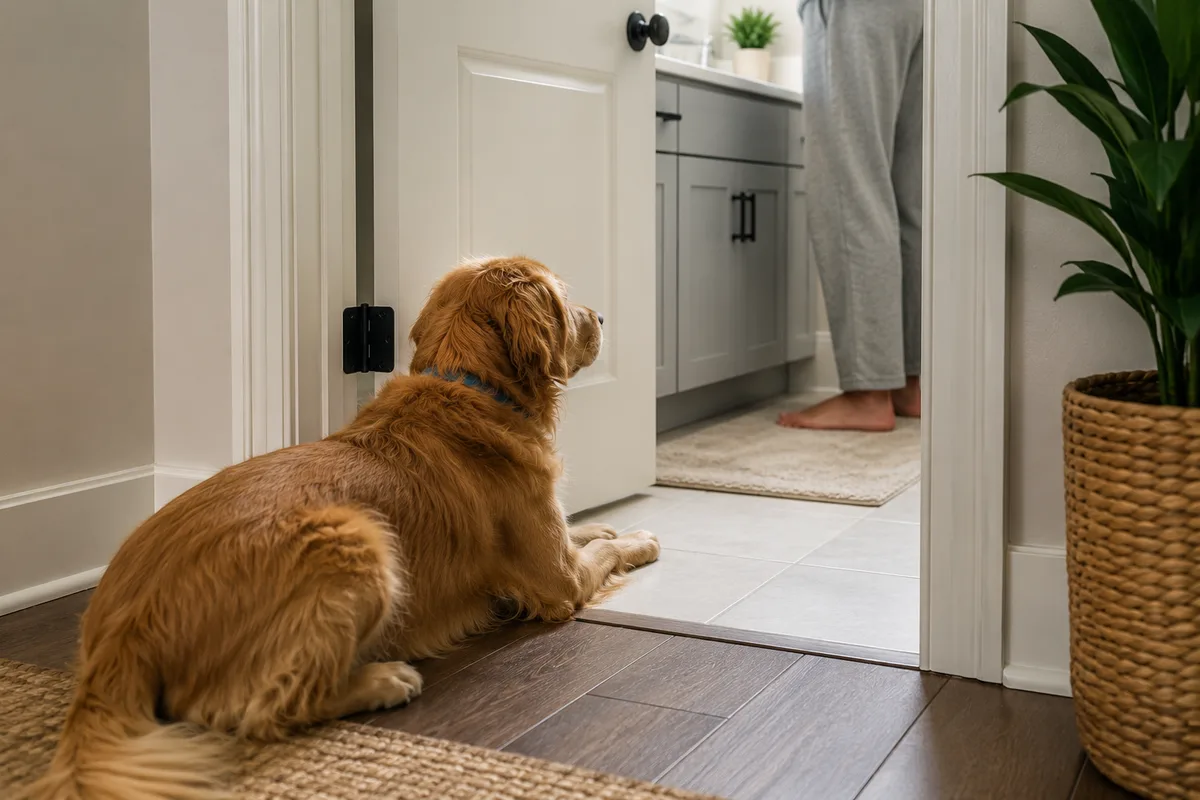
Then you make the least exciting trip imaginable—to the bathroom—and somehow you still have company.
Dogs that seem permanently attached to their humans are sometimes affectionately called “Velcro dogs.” And if yours follows you from room to room all day, it is natural to wonder what is behind the behavior.
Is your dog simply attached to you?
Are they bored?
Do they expect something?
Or is following you everywhere a sign of separation anxiety?
The answer depends less on how often your dog follows you and more on what happens when they cannot.
For many dogs, following a favorite person is perfectly ordinary social behavior. But when staying close turns into an inability to relax independently—or genuine distress when you leave—the behavior deserves a closer look.
Your Dog Has Learned That You Are Where Things Happen
Look at an ordinary day from your dog’s perspective.
Who opens the food container?
Who grabs the leash?
Who throws the ball?
Who opens the backyard door?
Who produces treats seemingly out of nowhere?
You do.
Following you can therefore be an extremely successful strategy.
When you stand up, something interesting might happen.
Maybe dinner is coming.
Maybe you are going outside.
Maybe you will sit somewhere else and provide the world’s most convenient head-scratching service.
Dogs are remarkably good at learning patterns, and everyday routines can teach them that staying close to you gives them access to things they enjoy.
Sometimes the explanation for your tiny four-legged shadow is simply:
Following you keeps paying off.
Attention Can Reinforce the Habit Without You Realizing It
Imagine this happens every afternoon.
Your dog follows you into the kitchen.
You look down.
“Hi, buddy.”
You pet them.
Maybe you hand over a tiny piece of something dog-safe.
From your perspective, you just had a sweet ten-second interaction.
From your dog’s perspective, following you into the kitchen produced attention and perhaps a reward.
That matters.
The American Kennel Club notes that positive reinforcement can contribute to following behavior: if being near you repeatedly leads to affection, treats, or other enjoyable outcomes, your dog has a reason to keep doing it.
This does not mean you should stop loving your dog.
It means behavior has consequences.
If following consistently produces something valuable, following can become a very strong habit.
Some Dogs Simply Want to Be Near Their People
Not every behavior needs a complicated explanation.
Dogs are social animals, and many genuinely enjoy being near familiar people.
Your dog may choose the floor beside your desk instead of an empty bedroom for much the same practical reason that social animals tend to spend time near individuals who matter to them.
You provide familiarity.
Predictability.
Interaction.
Safety.
And, yes, probably food.
Some dogs are naturally more independent. Others seem happiest when they know exactly where their person is.
Individual temperament matters.
So can breed history.
The AKC notes that some dogs from working and herding backgrounds were selectively bred to work closely alongside humans. That history can contribute to a strong tendency to watch, accompany, and respond to a handler.
It does not mean every dog from a particular breed will behave identically.
It simply means personality is not the only ingredient.
Your Daily Routine May Have Created a Professional Shadow
Dogs notice routines that humans barely think about.
Picking up a certain pair of shoes may predict a walk.
Opening one cupboard may mean food.
Turning off your computer may signal that the workday is over.
Walking toward the bedroom at night may predict bedtime.
If your dog has learned these sequences, following you becomes useful information gathering.
Where are you going?
What happens next?
Is this the part where we go outside?
That is why some dogs suddenly become extremely interested in your movements at particular times of day.
Watch your dog’s behavior tomorrow.
You may discover that they do not actually follow you equally all day.
Perhaps the shadowing becomes intense around dinner.
Or shortly before the usual walk.
Or when you begin your morning routine.
The timing can reveal what your dog thinks is about to happen.
Puppies Often Follow Their Humans Closely
A young puppy has entered an unfamiliar world filled with unfamiliar sounds, surfaces, people, and routines.
Staying close to a familiar caregiver makes sense.
AKC notes that young puppies can become strongly oriented toward their owners, and following behavior can be common as they adjust to their new home.
That does not mean independence should be ignored.
A puppy can enjoy closeness while gradually learning that being alone for appropriate periods is safe too.
Teaching calm independence early can be valuable.
That might mean relaxing on a bed while you move around the room, spending appropriate periods occupied with a toy, or learning that you can briefly disappear and return without anything dramatic happening.
The goal is not to make a puppy less attached to you.
It is to help them become comfortable both with you and without constant physical proximity to you.
Boredom Can Turn You Into the Most Interesting Thing in the House
Consider the competition.
Your dog can stare at the wall.
Sleep again.
Inspect the same toy.
Or follow the human who constantly moves around and occasionally produces entertainment.
If your dog tends to stop and watch you closely before deciding whether to follow, see why dogs stare at their owners and what the surrounding context can mean.
You probably win.
A dog without enough appropriate physical activity, mental stimulation, sniffing, play, or training may follow you simply because there is nothing better to do.
Look at the whole day rather than the following behavior in isolation.
Does your dog receive opportunities appropriate for their age, health, temperament, and breed characteristics?
Do they get to sniff and explore?
Do they have appropriate toys or enrichment?
Do you sometimes ask them to use their brain rather than only their legs?
A dog that has had satisfying activity may find it much easier to settle independently while you do something boring.
Your Dog May Have Chosen a Favorite Person
In a home with several people, some dogs still seem to select one human as their primary satellite target.
That person is not necessarily the one who loves the dog most.
From the dog’s perspective, the favorite person may simply control access to the most valuable resources and experiences.
Who feeds them?
Who walks them?
Who trains them?
Who plays the best games?
Who spends the most time at home?
Who responds most consistently when they ask for attention?
Those patterns can influence attachment and following.
Your dog may also feel particularly comfortable with one person’s behavior, voice, routine, or interaction style.
So if your dog ignores three family members to follow you into the laundry room, try not to become too smug.
You may simply be the household’s most reliable gateway to interesting things.
A dog that follows a favorite person closely is also gathering information from that person’s face and body. That makes it useful to understand why dogs sometimes keep staring at their owners.
“Velcro Dog” and Separation Anxiety Are Not the Same Thing
This is the distinction that matters most.
A Velcro dog wants to be near you.
A dog experiencing separation anxiety has difficulty coping when separated from you.
Those can overlap, but they are not interchangeable labels.
A dog might follow you around all evening, watch you cook dinner, sleep beside the couch, and escort you to the bathroom—then curl up peacefully when you leave for work.
That dog likes proximity.
Now consider a different situation.
You pick up your keys.
Your dog begins pacing.
You leave.
They bark or howl persistently, scratch at exits, destroy objects, soil the house despite being house-trained, refuse food, drool excessively, or make frantic attempts to escape.
That picture is much more concerning.
VCA describes separation anxiety as extreme anxiety associated with separation and notes possible signs including vocalization, destructive behavior, house soiling, restlessness, shaking, salivation, and withdrawal.
Following you at home is therefore not enough to diagnose separation anxiety.
What happens when you leave is much more informative.
Your Phone Camera Can Tell You Something You Cannot See
There is an obvious problem with judging your dog’s behavior when you are away:
You are away.
If you are unsure how your dog behaves after you leave, video can be extremely useful.
Set up a safe camera where you can observe the area your dog normally occupies.
Then look at what happens around departure.
Does your dog watch the door for a minute and then go to sleep?
Do they play with a toy?
Do they settle comfortably?
Or do they begin pacing, vocalizing, panting, scratching, or showing other signs of distress?
Both AKC and VCA recommend video or audio observation as a useful way of understanding what a dog actually does when left alone.
This gives you evidence rather than assumptions.
And that is particularly important before labeling ordinary clinginess as an anxiety disorder.
Following You Suddenly Is Different From Always Following You
Suppose your dog has followed you around since puppyhood.
That is one pattern.
Now suppose your normally independent eight-year-old dog suddenly refuses to leave your side.
That deserves more attention.
A sudden behavioral change can sometimes accompany discomfort, illness, sensory changes, or increased insecurity.
Older dogs may become more dependent as vision or hearing changes. Pain or other health problems can also alter behavior.
AKC specifically recommends veterinary evaluation when a dog suddenly becomes unusually clingy.
The key word is suddenly.
You know your dog’s baseline better than anyone.
A behavior that has always been part of their personality is different from a major change appearing over a few days or weeks.
Senior Dogs May Seek More Reassurance
Aging changes how a dog experiences the world.
Vision may become less reliable.
Hearing can decline.
Movement may become more difficult.
Some older dogs can also develop cognitive changes.
A dog that once confidently wandered between rooms may begin using you as a point of reference.
Your presence is familiar and predictable when other parts of the environment become harder to interpret.
Do not simply assume that increased clinginess is “just old age,” however.
A meaningful change in an older dog’s behavior is worth discussing with a veterinarian, especially if it appears alongside:
- changes in appetite;
- altered sleep;
- confusion;
- house-soiling;
- difficulty moving;
- increased vocalization;
- apparent pain;
- changes in vision or hearing;
- or other new behavior.
Behavior is information.
Sometimes it is social information.
Sometimes it is medical information.
Should You Stop Your Dog From Following You?
Usually, there is no need to turn normal companionship into a problem.
If your dog follows you because they enjoy your company but can also relax alone, sleep independently, and cope comfortably when you leave, the behavior may simply be part of who they are.
The goal is not:
“My dog must stop following me.”
A healthier goal is:
“My dog should be able to relax even when following me is not an option.”
That distinction changes how you approach the behavior.
You are not rejecting closeness.
You are building independence alongside it.
Teach Your Dog That Staying Put Can Pay Too
Remember how following may have become rewarding?
You can use the same principle to reward independence.
Give your dog a comfortable bed or mat.
When they choose to settle there calmly, reinforce that behavior.
You can gradually teach a cue such as “place” or another relaxation behavior appropriate to your training approach.
At first, you might remain nearby.
Later, move around the room.
Eventually, briefly leave and return while your dog remains comfortable.
VCA recommends teaching dogs to relax independently while the owner is still at home before expecting them to cope with longer absences.
Progress gradually.
The exercise should build confidence, not create panic.
Let Other People Become Interesting Too
If your dog is intensely focused on one person in a multi-person household, consider spreading some of the rewarding activities around.
Another family member might:
- serve meals;
- go on walks;
- play favorite games;
- practice training;
- provide enrichment;
- or spend calm one-on-one time with the dog.
This can broaden the dog’s social world.
It also reduces the pattern in which one person becomes the exclusive provider of everything valuable.
Of course, every interaction should be safe and appropriate for the individual dog.
The objective is not to force social contact.
It is to give the dog more than one reliable source of positive experiences.
Avoid Turning Every Departure Into a Major Event
Dogs are excellent observers of pre-departure routines.
Keys.
Shoes.
Coat.
Laptop bag.
Suddenly your dog knows what comes next.
Dogs experiencing separation-related problems can become anxious before the owner has even reached the door.
For dogs that are comfortable alone, calm departures and returns help keep these everyday events ordinary.
For a dog already showing significant separation distress, however, simply ignoring the problem or repeatedly leaving them to “get used to it” is not an appropriate treatment plan.
True separation anxiety can require a structured behavior-modification program and professional guidance.
In more serious cases, veterinary involvement may also be appropriate.
When Following Becomes a Reason to Get Help
Your dog walking behind you from the kitchen to the living room is usually not an emergency.
Look at the bigger picture.
Consider speaking with your veterinarian or a qualified behavior professional when following is accompanied by significant distress or when the behavior changes suddenly.
Warning signs can include:
- panic when you prepare to leave;
- persistent barking or howling after departure;
- destructive behavior associated with being alone;
- frantic scratching or attempts to escape;
- house-soiling linked specifically to absences;
- excessive drooling, shaking, or restlessness;
- inability to settle unless physically close to you;
- loss of appetite during separation;
- sudden clinginess in a previously independent dog;
- or other new physical or behavioral symptoms.
Do not punish anxiety-related behavior.
If a dog is destroying something because they are genuinely distressed during your absence, punishment after you return does not address the underlying emotion.
Finding out why the behavior occurs is far more useful.
So, Does Your Dog Follow You Because They Love You?
Probably at least partly.
But “love” alone does not explain the entire behavior.
Your dog may follow you because you are familiar and socially important.
They may also follow because you control food, walks, doors, toys, attention, and entertainment.
The habit may have been reinforced hundreds of times without anyone deliberately training it.
Your routine may predict interesting events.
Your dog may naturally prefer close contact.
Or they may simply have concluded that wherever you go, something worth investigating tends to happen.
Dogs do not need one single reason for a behavior.
Several can be true at once.
The Bottom Line
If your dog follows you everywhere—even to the bathroom—you do not automatically have an anxious dog.
You may simply have a highly social companion who has learned that you are the most interesting thing in the house.
Look beyond the following itself.
Can your dog relax on their own bed while you move around?
Can they spend time with other trusted people?
Can they entertain themselves appropriately?
Most importantly, what happens when you actually leave?
A dog that prefers being beside you but settles peacefully in your absence is very different from a dog that panics when separated.
And if the following behavior appears suddenly, particularly in an older dog or alongside other physical or behavioral changes, have your veterinarian investigate rather than assuming your dog has simply become extra affectionate.
Being your dog’s favorite person is lovely.
Helping them feel secure when you are not in the room is valuable too.
Sources
American Kennel Club — Why Does My Dog Follow Me Everywhere?








Join the discussion