Your Chocolate Turned White — But That Doesn’t Usually Mean It’s Gone Bad
That strange white or gray coating on chocolate usually isn't mold. Learn how fat bloom and sugar bloom form, whether the chocolate is still safe to eat, and how proper storage can help prevent it.
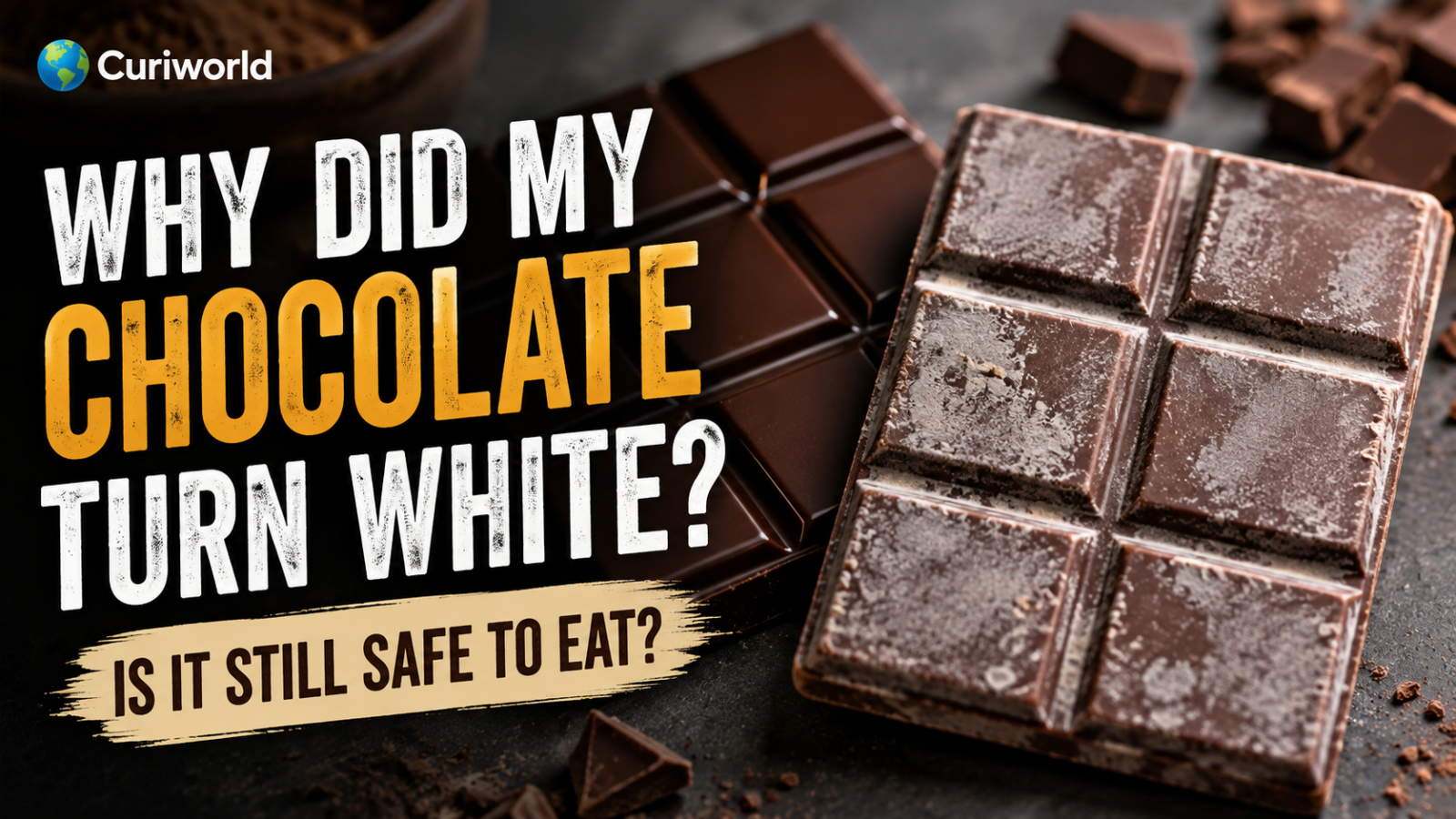
You unwrap a chocolate bar you have been saving.
Something looks wrong.
Instead of the smooth, glossy brown surface you remember, parts of the chocolate are covered in a pale gray or whitish film.
Maybe there are streaks.
Maybe there are dusty-looking patches.
Maybe the entire bar looks as though it has been sitting around for years.
The obvious question is:
Has the chocolate gone bad?
Usually, no.
That strange white coating is commonly known as chocolate bloom.
And despite its unappetizing appearance, bloom is generally a quality problem rather than a sign that the chocolate has become unsafe to eat.
Even more interestingly, there are actually two major kinds of chocolate bloom.
One involves fat.
The other involves sugar.
They can look similar, but they happen for very different reasons.
The White Coating Usually Isn’t Mold
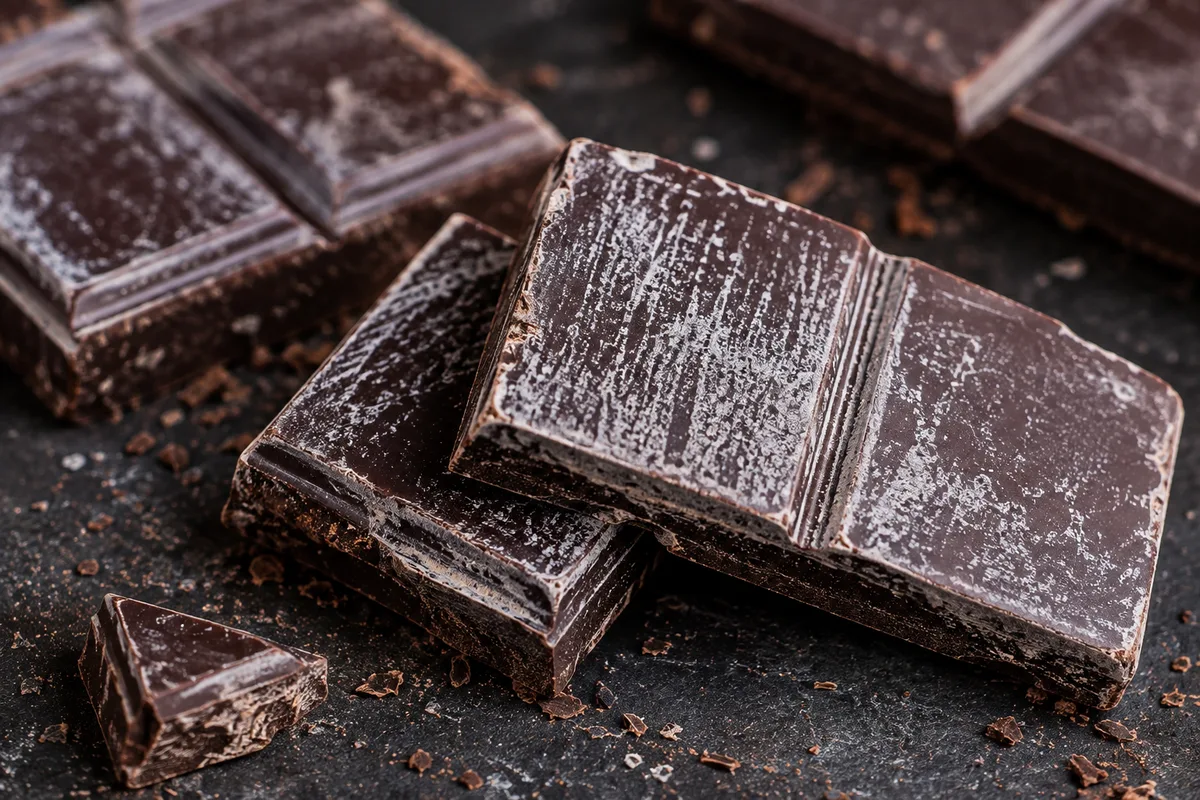
Chocolate does not stay perfectly uniform forever.
It is a carefully structured mixture containing cocoa solids, sugar and cocoa butter, along with other ingredients depending on the type of chocolate.
Temperature and moisture can disturb that structure.
When they do, components that were distributed throughout the chocolate can migrate or recrystallize at the surface.
The result can be a whitish or gray appearance.
This is called bloom.
Hershey explains that chocolate can develop either cocoa butter bloom or sugar bloom and that bloomed chocolate remains safe to use, although its flavor and texture may change.
So if an otherwise normal chocolate bar has developed a pale coating, the chocolate has not necessarily spoiled.
It may simply have lost its ideal structure.
There Are Two Main Types of Chocolate Bloom
This distinction explains almost everything.
The first is:
Fat bloom.
The second is:
Sugar bloom.
Both can make chocolate look old, dusty or strangely pale.
But the chemistry behind them is different.
Fat bloom is primarily about the behavior of fats—especially cocoa butter.
Sugar bloom is about moisture dissolving sugar and leaving crystals behind.
Learning to tell them apart makes that mysterious white chocolate bar much less mysterious.
Honey has its own harmless-looking transformation too; learn why honey crystallizes and whether it is still safe to eat.
Fat Bloom: When Cocoa Butter Moves Around
Chocolate contains cocoa butter, the natural fat found in cocoa beans.
Cocoa butter is unusual because it can solidify into several different crystalline arrangements.
Chocolate makers carefully control those crystals through a process called tempering.
Proper tempering encourages cocoa butter to form a stable crystal structure that gives finished chocolate some of its most desirable qualities:
a glossy surface;
a firm texture;
and that satisfying snap when you break a bar.
But cocoa butter crystals are sensitive to temperature.
If chocolate becomes too warm or experiences repeated temperature changes, part of the cocoa butter can soften or melt.
As conditions change again, fat can migrate toward the surface and recrystallize there.
The result is the pale or grayish coating known as fat bloom.
Why Temperature Swings Are So Bad for Chocolate
Imagine leaving a chocolate bar in a warm car.
It softens.
Later, you take it inside and it becomes solid again.
Then perhaps it warms up once more.
The chocolate may never completely turn into a puddle, but those temperature cycles can still disturb the cocoa butter’s crystalline structure.
Fat becomes more mobile.
It can migrate.
Then it solidifies again in places where it was not originally supposed to be.
Eventually, the surface stops looking smooth and dark.
A whitish haze appears.
This is why chocolate prefers stable storage conditions.
The problem is not only extreme heat.
Repeated warming and cooling can be particularly disruptive.
Tempering Is Really Crystal Engineering
If you have ever watched a chocolatier repeatedly heat and cool melted chocolate, it may have looked unnecessarily complicated.
It isn’t.
They are controlling crystals.
Cocoa butter can form several crystal structures, but they do not all produce equally good chocolate.
Well-tempered chocolate has a stable structure that contributes to:
shine;
snap;
smooth mouthfeel;
and resistance to bloom.
Poorly tempered chocolate can contain less stable cocoa butter crystals.
Those crystals may transform during storage.
When that happens, fat can migrate and the surface can develop bloom even if the chocolate was never obviously melted.
Tempering is not simply a fancy culinary ritual.
It is applied materials science.
Sugar Bloom Happens for a Completely Different Reason
Now imagine taking cold chocolate out of the refrigerator on a humid day.
Tiny droplets of condensation form on the surface.
That water creates another problem.
Sugar dissolves in water.
When moisture reaches chocolate, it can dissolve some of the sugar near the surface.
Later, the water evaporates.
But the sugar does not evaporate with it.
Instead, it recrystallizes.
Those sugar crystals remain on the chocolate and create a rough, pale or grainy coating.
That is sugar bloom.
Humidity, condensation and sudden temperature changes can therefore create a white surface without cocoa butter being the primary cause.
Fat Bloom and Sugar Bloom Can Feel Different
Appearance alone is not always enough for a perfect diagnosis.
But texture can offer a clue.
Sugar bloom often feels rougher or grainier because sugar crystals have formed on the surface.
Fat bloom may look smoother, with a grayish-white haze, streaks or irregular pale patches.
There can be considerable variation, so this is not a flawless home test.
Still, the distinction is useful:
A dry, rough and grainy coating may point toward sugar bloom.
A smoother grayish haze may point toward fat bloom.
Either way, bloom alone is generally more about chocolate quality than food safety.
Why Refrigerating Chocolate Can Be Tricky
Putting chocolate in the refrigerator sounds like an obvious way to protect it from heat.
Sometimes refrigeration is useful, especially in a very warm environment.
But it creates another risk:
condensation.
If cold chocolate is suddenly exposed to warm, humid air, water can condense on its surface.
That moisture can trigger sugar bloom.
This is why stable storage conditions matter so much.
If chocolate has been refrigerated, allowing it to gradually approach room temperature while still wrapped can help reduce direct condensation on its surface.
The goal is not simply:
Keep it cold.
The goal is:
Keep it cool, dry and stable.
So Is White or Gray Chocolate Safe to Eat?
If the coating is ordinary chocolate bloom, generally yes.
Bloom itself does not mean the chocolate has suddenly become unsafe.
Hershey specifically notes that chocolate affected by cocoa butter bloom or sugar bloom remains safe to use, although its flavor or texture may change.
That qualification matters.
Safe does not necessarily mean perfect.
A bloomed chocolate bar may:
feel grainier;
melt differently;
lose some of its snap;
look unattractive;
or taste less fresh.
Those are quality issues.
They are not automatically safety issues.
But Not Every Strange-Looking Chocolate Is Bloom
This is where common sense still matters.
Do not assume that every unusual mark on chocolate is harmless simply because chocolate bloom exists.
Chocolate products can contain much more than chocolate.
Nuts.
Caramel.
Cream fillings.
Fruit.
Wafers.
Nougat.
Those ingredients can have different storage requirements and spoilage risks.
Check the product’s date and storage history.
A printed date is only one part of that decision, because date labels and actual spoilage are not the same thing. See what food expiration and date labels really mean before using the package date as your only safety test.
Pay attention to unusual odors.
Look for obvious mold or other signs of deterioration.
If a chocolate product looks or smells genuinely suspicious rather than simply having the characteristic pale coating of bloom, throwing it away is the safer choice.
Bloom is common.
It is not a universal explanation for every damaged chocolate product.
Does Bloom Change the Taste?
It can.
The most noticeable changes are often textural.
Well-tempered chocolate is engineered to melt in a particular way and feel smooth in the mouth.
Bloom disrupts that structure.
Sugar bloom can leave the surface noticeably gritty.
Fat bloom can alter the chocolate’s snap and mouthfeel.
The chocolate may also lose some of the sensory quality it had when fresh.
A badly bloomed premium chocolate bar therefore may not be particularly enjoyable to eat on its own.
But that does not necessarily mean it belongs in the trash.
Can You Still Bake With Bloomed Chocolate?
Often, yes.
If the chocolate is otherwise properly stored and shows no signs of actual spoilage, blooming alone is generally not a reason to avoid using it in baking.
Once you melt the chocolate, its unattractive surface disappears anyway.
Brownies do not care whether the chocolate bar was perfectly glossy.
Neither does a chocolate cake.
A bloomed bar that has lost its visual appeal can still be useful in:
brownies;
cookies;
cakes;
ganache;
hot chocolate;
or other recipes where the chocolate will be melted.
The bloom may ruin the photograph.
It does not necessarily ruin dessert.
Can Bloomed Chocolate Become Shiny Again?
Sometimes.
If fat bloom is the problem, melting and properly tempering the chocolate can create a new, stable cocoa butter crystal structure.
In other words, you are rebuilding the chocolate’s physical organization.
But simply warming a bloomed bar and letting it harden again is not the same as proper tempering.
Tempering involves controlled heating and cooling designed to encourage desirable cocoa butter crystals.
For ordinary home cooking, using bloomed chocolate in a recipe is often easier than trying to restore a professional glossy finish.
If you are making molded chocolates or dipped candies, however, correct tempering becomes much more important.
Why Can Chocolate Bloom Without Ever Looking Melted?
Chocolate does not need to become visibly liquid for fat bloom to develop.
Fat can migrate within chocolate while the bar still looks completely solid.
Moderate temperature fluctuations can gradually destabilize the fat crystal structure.
Filled chocolates create another possibility.
Fats from nuts, praline or other fillings can migrate into the surrounding chocolate and contribute to bloom.
So a chocolate bar or bonbon can remain solid throughout storage and still develop a pale surface.
The microscopic structure can change even when the overall shape does not.
Is the White Layer Actually Cocoa Butter?
With fat bloom, cocoa butter or other compatible fats have migrated and recrystallized near the surface.
But describing the coating simply as “cocoa butter coming out” misses the interesting part.
The real story is about fat migration and crystal structure.
Chocolate is a carefully organized material.
Its appearance depends partly on how its fats are arranged.
Change that arrangement and the same ingredients can suddenly look completely different.
Nothing new necessarily had to contaminate the chocolate.
Its existing ingredients simply reorganized.
Sugar Bloom Is More Like a Tiny Crystal Landscape
Sugar bloom follows another route.
Moisture reaches the chocolate.
Sugar dissolves into that water.
The water later evaporates.
Sugar recrystallizes on the surface.
The rough coating is essentially evidence of a tiny dissolve-and-recrystallize cycle.
This is why sugar-bloomed chocolate can feel gritty.
You are touching crystals left behind after the moisture disappeared.
What Is the Best Way to Store Chocolate?
Chocolate likes boring environments.
That is good news.
You do not need an elaborate preservation system.
What matters most is avoiding:
excessive heat;
high humidity;
direct sunlight;
strong odors;
and large temperature fluctuations.
Keep chocolate well wrapped or sealed.
Choose a cool, dry location.
Avoid repeatedly moving it between dramatically different temperatures.
If your home is so warm that refrigeration becomes necessary, protect the chocolate carefully from moisture and condensation.
Consistency is your friend.
Chocolate Can Pick Up Unwanted Smells Too
Preventing bloom is not the only reason to store chocolate properly.
Chocolate can absorb odors from its surroundings.
That means placing an unwrapped chocolate bar next to strongly aromatic foods can create an entirely different quality problem.
A beautifully tempered chocolate bar that tastes faintly like garlic is not much of a victory.
Good packaging helps protect:
texture;
appearance;
and flavor.
Chocolate storage is ultimately about maintaining the entire sensory experience.
Chocolate Is More Delicate Than It Looks
A solid chocolate bar seems simple.
But structurally, it is surprisingly sophisticated.
Its gloss depends on crystals.
Its snap depends partly on crystals.
Its melting behavior depends on crystals.
Its smooth texture depends on the careful arrangement of fat, sugar and cocoa particles.
Change the temperature.
Introduce moisture.
Wait long enough.
And that invisible organization can rearrange itself.
The chocolate may contain essentially the same ingredients as before.
Yet its appearance and texture can become dramatically different.
That is what makes chocolate bloom such a good example of everyday science.
You can see materials science happening on a candy bar.
The Takeaway
When chocolate develops a white or gray coating, it usually has not suddenly become moldy.
It has probably bloomed.
There are two main possibilities.
Fat bloom occurs when cocoa butter or other fats migrate and recrystallize near the surface, often because of unstable crystallization, heat or temperature fluctuations.
Sugar bloom occurs when moisture dissolves sugar at the surface and that sugar recrystallizes after the water evaporates.
Both can make chocolate look old or damaged.
Neither automatically means it is unsafe to eat.
If the chocolate otherwise looks and smells normal and the issue is ordinary bloom, it is generally still usable—although its texture, snap and flavor may no longer be at their best.
The easiest prevention strategy is also the least exciting:
Keep chocolate in a cool, dry and stable environment and protect it from moisture and repeated temperature swings.
So the next time you unwrap a chocolate bar and discover a mysterious pale coating, you do not necessarily need to throw it away.
You may simply be looking at cocoa butter or sugar crystals that ended up somewhere they were never supposed to be.
And that ugly chocolate bar?
It can probably still make excellent brownies.







Join the discussion