Crystallized Honey: Is It Bad, and Can You Still Eat It?
That grainy or solid jar of honey probably isn’t spoiled. Crystallization is a natural sugar process—and the honey can usually still be eaten.
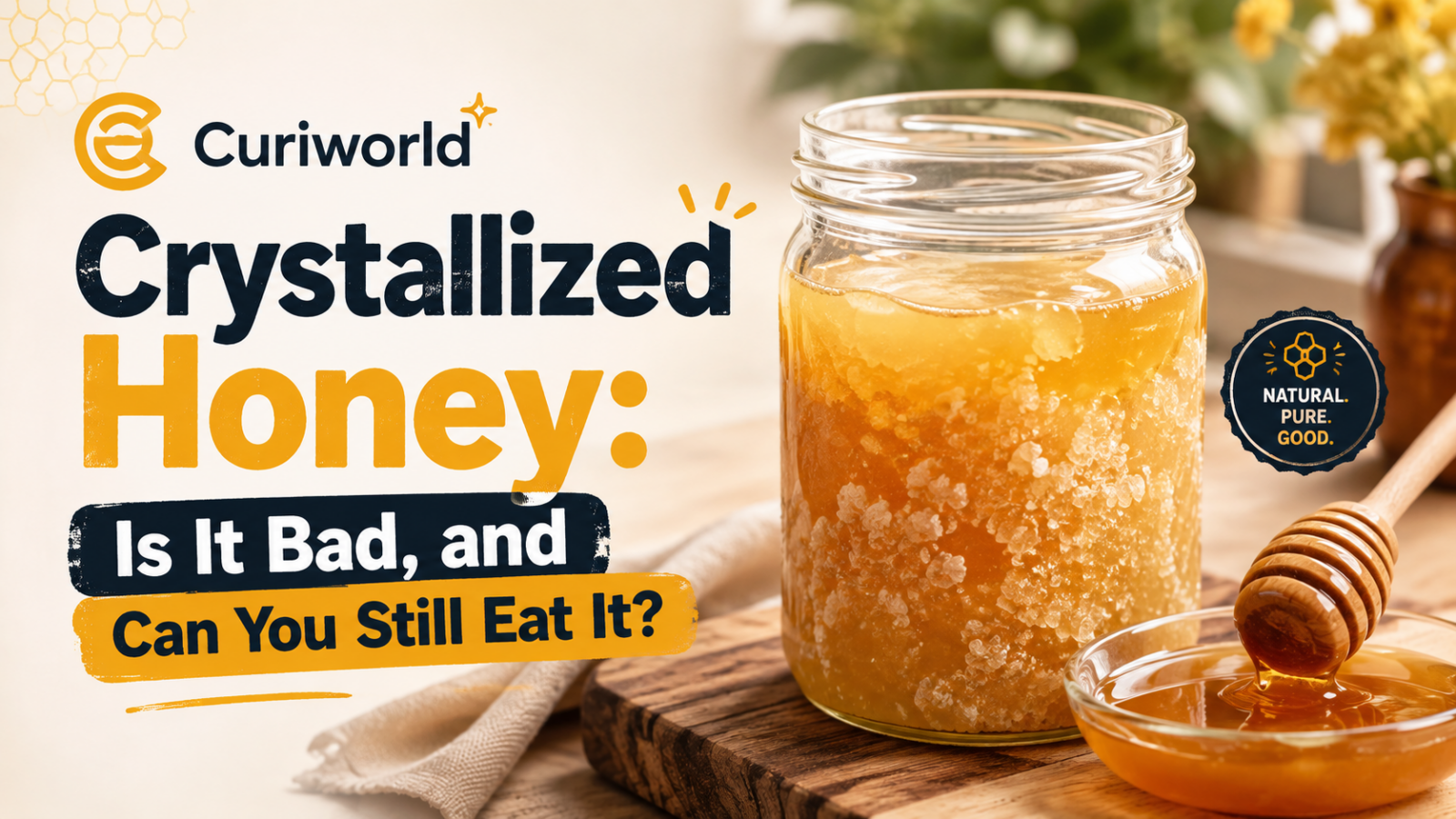
You open a jar of honey expecting a smooth golden liquid and find something completely different.
The honey is cloudy. It feels thick or grainy. Maybe the bottom of the jar has turned almost solid.
It is easy to assume that the honey has gone bad.
Usually, it has not.
Crystallization is a natural change in honey’s texture, not automatically a sign of spoilage. Crystallized honey is generally still perfectly edible, and you can eat it exactly as it is or gently warm it if you prefer it liquid.
The interesting part is why honey does this at all.
What Does It Mean When Honey Crystallizes?
Honey contains a great deal of sugar but relatively little water.
Two of its major sugars are glucose and fructose. They do not behave exactly the same way inside the jar.
Honey holds so much dissolved sugar that it is considered a supersaturated solution. Over time, some of the glucose can separate from the liquid portion and form tiny crystals.
Once enough crystals develop, the texture changes.
The honey may become:
- cloudy;
- grainy;
- creamy;
- thick;
- partially solid;
- or almost completely crystallized.
None of those changes automatically means the honey is spoiled.
The U.S. Department of Agriculture describes granulation as a natural property of honey and specifically notes that it is not an indication of adulteration.
So that solid-looking jar may actually be behaving exactly as real honey can behave.
Chocolate can create the same kind of false alarm: a white coating on chocolate usually does not mean it has spoiled.
Can You Eat Crystallized Honey?
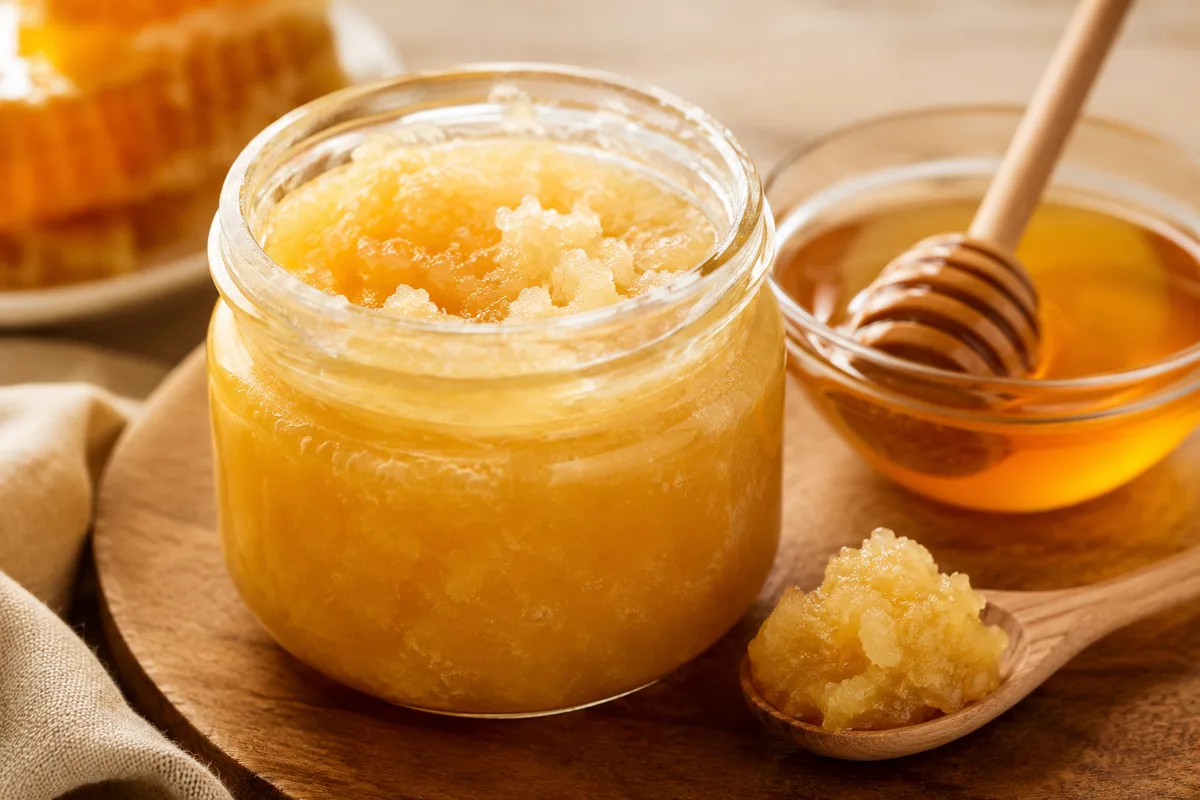
Yes.
Crystallized honey can be eaten without turning it back into a liquid first.
In fact, some people prefer it.
The thicker texture makes crystallized honey easier to spread on toast, biscuits, pancakes, or other foods without dripping everywhere.
Its sweetness does not suddenly disappear when crystals form.
What has changed most noticeably is the physical arrangement of some of the sugars.
Think of crystallization as a texture transformation rather than honey becoming unusable.
Commercial products such as creamed or whipped honey even use controlled crystallization intentionally to create a smooth, spreadable consistency.
Does Crystallization Mean the Honey Is Old?
Not necessarily.
Older honey has had more time to crystallize, so time can certainly play a role.
But a recently purchased jar can crystallize too.
The speed depends heavily on the honey itself.
Different honeys contain different proportions of glucose and fructose depending partly on the floral sources visited by the bees.
Honey with conditions that favor glucose crystallization may become cloudy or solid relatively quickly.
Other varieties can remain liquid much longer.
That means two jars stored next to each other can behave very differently even when both are perfectly good honey.
Some Honey Crystallizes Faster Than Other Honey
This is one reason crystallization cannot be used as a simple quality test.
Honey is not a chemically identical product every time bees make it.
Its properties vary with botanical source, moisture level, sugar composition, processing, and storage conditions.
The USDA notes that the rate of granulation is influenced by factors including the honey’s fructose-to-glucose relationship, particles within the honey, and storage temperature.
Those differences explain why one jar might form fine crystals while another develops larger, rougher grains.
A third jar may remain liquid for a surprisingly long time.
All three can still be genuine honey.
Crystals Do Not Prove That Honey Is Fake
A persistent internet myth says that real honey should never crystallize.
The opposite claim also circulates: if honey crystallizes, it must be pure.
Neither shortcut is reliable.
The National Honey Board specifically identifies “pure honey will not crystallize” as a myth.
Crystallization is a natural process caused largely by glucose leaving the liquid solution and forming crystals.
But that does not mean crystallization can authenticate a jar of honey at home.
The way honey behaves depends on too many variables for a simple kitchen test to reliably determine purity.
So if your jar crystallizes, the useful conclusion is:
The honey crystallized.
It is not proof by itself of either fraud or exceptional purity.
Why Does Honey Sometimes Crystallize From the Bottom?
Crystallization does not necessarily happen evenly.
You might see a thick pale layer at the bottom while the top remains liquid.
Or the entire jar may gradually become opaque.
Crystal formation can begin around tiny particles that provide places for glucose crystals to develop.
Once crystallization starts, those crystals can encourage further crystal growth around them.
The result may slowly spread through the jar rather than appearing everywhere at once.
This is why honey can look almost layered during the process.
Does Putting Honey in the Refrigerator Help?
Not if your goal is to keep it liquid.
Honey generally does not need refrigeration, and cooler temperatures can actually encourage crystallization.
The National Honey Board recommends storing honey in a sealed container at room temperature, roughly 64–75°F (18–24°C).
Its reference guidance notes that cooler storage between approximately 35–60°F (2–16°C) can accelerate the natural crystallization process.
So putting a jar in the refrigerator may turn smooth honey grainy faster rather than preserve its liquid texture.
A closed cupboard or pantry at a moderate room temperature is usually a better place for ordinary honey storage.
Can You Turn Crystallized Honey Back Into Liquid?
Usually, yes.
Crystallization is reversible.
The simplest approach is gentle warming.
Place the closed or appropriately heat-safe honey container in warm water and allow the honey to heat gradually. Stirring can help the crystals dissolve as the honey becomes more fluid.
The National Honey Board recommends warming crystallized honey gently and cautions against boiling or scorching it.
There is no need to aggressively cook the honey.
The goal is simply to warm it enough for the glucose crystals to dissolve back into the liquid portion.
Why Gentle Heat Is Better Than Very High Heat
If a little warmth works, it may seem logical that a lot of heat would work faster.
It probably will—but faster is not always better.
Prolonged high temperatures can alter honey’s color and flavor.
Honey is valued partly for its aroma and subtle flavor compounds, which can differ considerably from one floral source to another.
Aggressive heating can sacrifice some of those qualities simply to save a few minutes.
A warm-water bath gives you more control.
If the container is plastic and you are unsure whether it is suitable for warming, transferring the honey to an appropriate heat-safe container first is a sensible option.
Will the Honey Crystallize Again?
It can.
Turning crystallized honey back into liquid does not permanently change its natural chemistry.
Once it cools and sits for long enough, glucose may begin forming crystals again.
Some honeys may remain liquid for quite a while after warming.
Others may crystallize again fairly quickly.
This does not mean you did anything wrong.
If you regularly use the honey, you may find it easier to warm only the amount you need rather than repeatedly heating the entire jar.
Is Crystallized Honey the Same as Creamed Honey?
They are related, but the texture is usually managed differently.
Ordinary honey may crystallize unpredictably, producing crystals of different sizes and a texture ranging from fine and creamy to noticeably grainy.
Creamed honey is intentionally crystallized under controlled conditions so that very small crystals create a smooth, spreadable texture.
The basic phenomenon—glucose crystallization—is related.
The experience of eating the finished product can be quite different.
That is another useful reminder that crystals in honey are not inherently undesirable.
Sometimes crystallization is exactly the texture a producer wants.
Can Crystallized Honey Still Be Used in Recipes?
Absolutely.
You do not necessarily have to liquefy it first.
Crystallized honey can work particularly well where it will eventually be mixed or heated anyway.
You can use it in:
- oatmeal;
- warm drinks;
- sauces;
- marinades;
- baked goods;
- yogurt;
- toast;
- or other recipes that call for honey.
If a recipe requires an exact liquid measurement or you need the honey to blend smoothly into a cold mixture, gently liquefying it first may make preparation easier.
Otherwise, the crystals rarely make the honey unusable.
What Crystallization Does Not Tell You
A changed texture can look dramatic, which makes it tempting to diagnose everything from appearance alone.
But crystallization by itself does not tell you that:
- the honey has spoiled;
- sugar was secretly added;
- the honey is fake;
- the honey is old;
- or the jar must be thrown away.
It mainly tells you that glucose has begun forming crystals.
That distinction can save a perfectly usable jar of honey from the trash.
Your Grainy Honey Is Probably Doing Something Normal
Honey seems like a simple food, but the jar contains a concentrated mixture of sugars, water, acids, aroma compounds, and other naturally occurring substances.
That chemistry does not remain visually identical forever.
Glucose can leave the liquid solution and organize into crystals, turning transparent honey cloudy, grainy, or nearly solid.
The transformation may look suspicious if you have never seen it before.
But crystallized honey is generally not ruined honey.
Eat it in its thicker form if you like the texture. If you want the familiar golden drizzle back, warm it gently until the crystals dissolve.
Either way, those crystals are usually not a reason to throw the jar away.
Sources
U.S. Department of Agriculture — Commercial Item Description: Honey
https://www.ams.usda.gov/sites/default/files/media/AA20380_Honey.pdf
National Honey Board — Honey: A Reference Guide to Nature’s Sweetener
https://honey.com/images/files/refguide.pdf






Join the discussion