Bread Doesn’t Go Stale Simply Because It Dries Out — Here’s What Really Happens
Bread staling is not simply moisture loss. Changes in starch structure, water movement and crumb texture can make bread feel firm and stale even when it has not completely dried out.
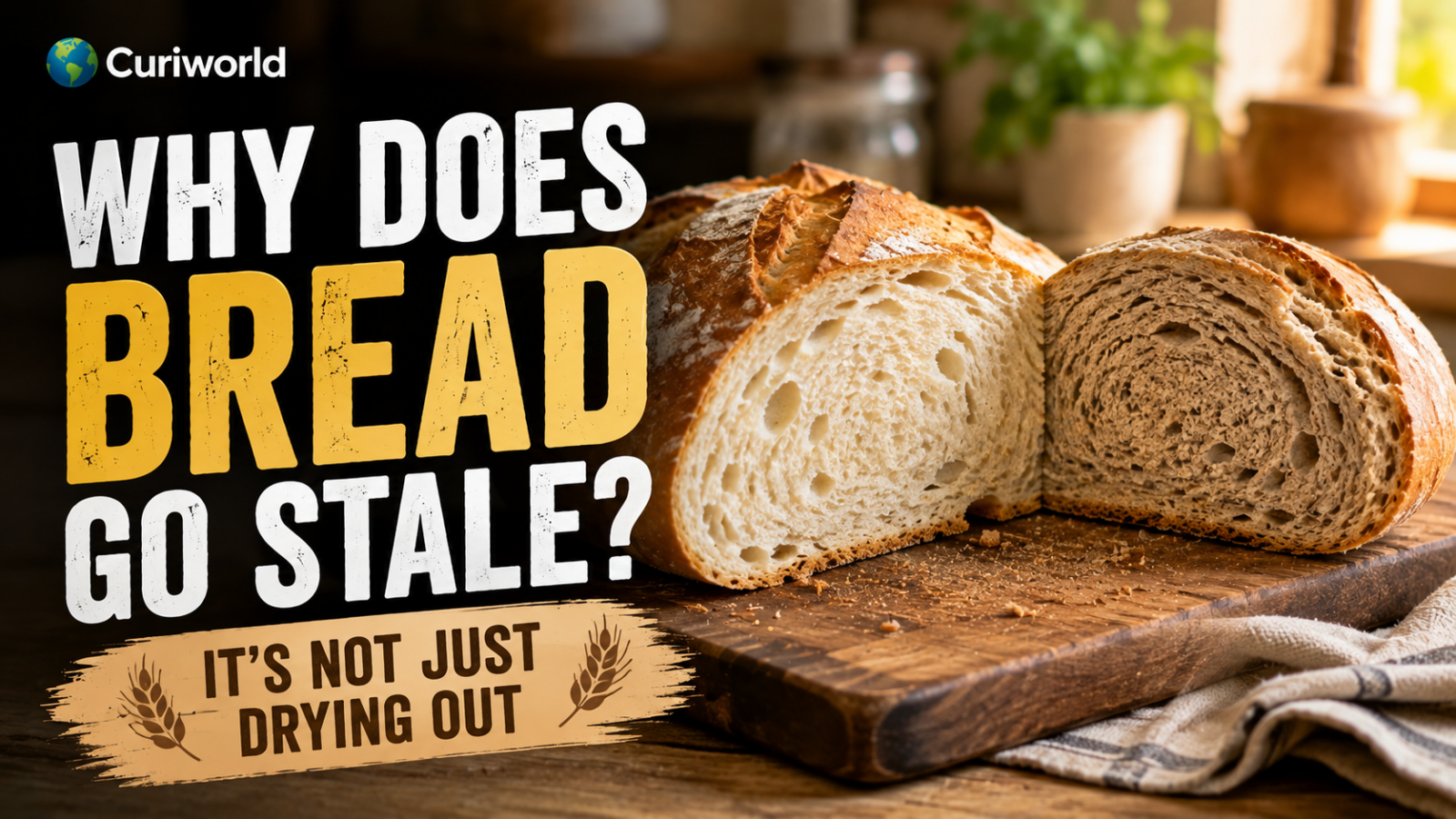
Fresh bread has a very short honeymoon period.
One day, the crust crackles when you tear into it. The inside is soft, springy and almost impossibly tender.
Then you come back the next morning.
The loaf is still there.
It may even be wrapped.
But something has changed.
The crumb feels firmer. The crust has lost its crispness. The aroma seems flatter. A sandwich made with it somehow tastes less fresh even though nothing is obviously “wrong” with the bread.
Most of us explain this with one sentence:
The bread dried out.
That sounds reasonable.
It is also incomplete.
Bread can certainly lose moisture as it sits, but staling is not simply dehydration. Some of the most important changes happen inside the starch structure of the bread itself.
As bread cools and ages, starch molecules that were disrupted during baking begin reorganizing into more ordered structures. Water also moves through the loaf—from crumb to crust and eventually into the surrounding air.
Together, these changes gradually transform fresh bread into stale bread.
And they explain one of the strangest facts about bread storage:
Putting bread in the refrigerator can actually make it go stale faster.
Fresh Bread Starts With a Transformation in the Oven
To understand stale bread, we first need to understand what baking does to flour.
Wheat flour contains large amounts of starch.
Two major components of that starch are:
amylose and amylopectin.
Before baking, starch granules have an organized structure.
But dough contains water, and once that dough becomes hot enough in the oven, starch granules absorb water, swell and lose much of their original order.
This process is known as starch gelatinization.
At the same time, proteins, water, gas bubbles and starch interact to create the structure of the finished bread.
The loaf that comes out of the oven is therefore very different from the dough that went in.
But that newly formed structure is not frozen in time.
As soon as the bread begins cooling, another process starts.
The Starch Starts Reorganizing
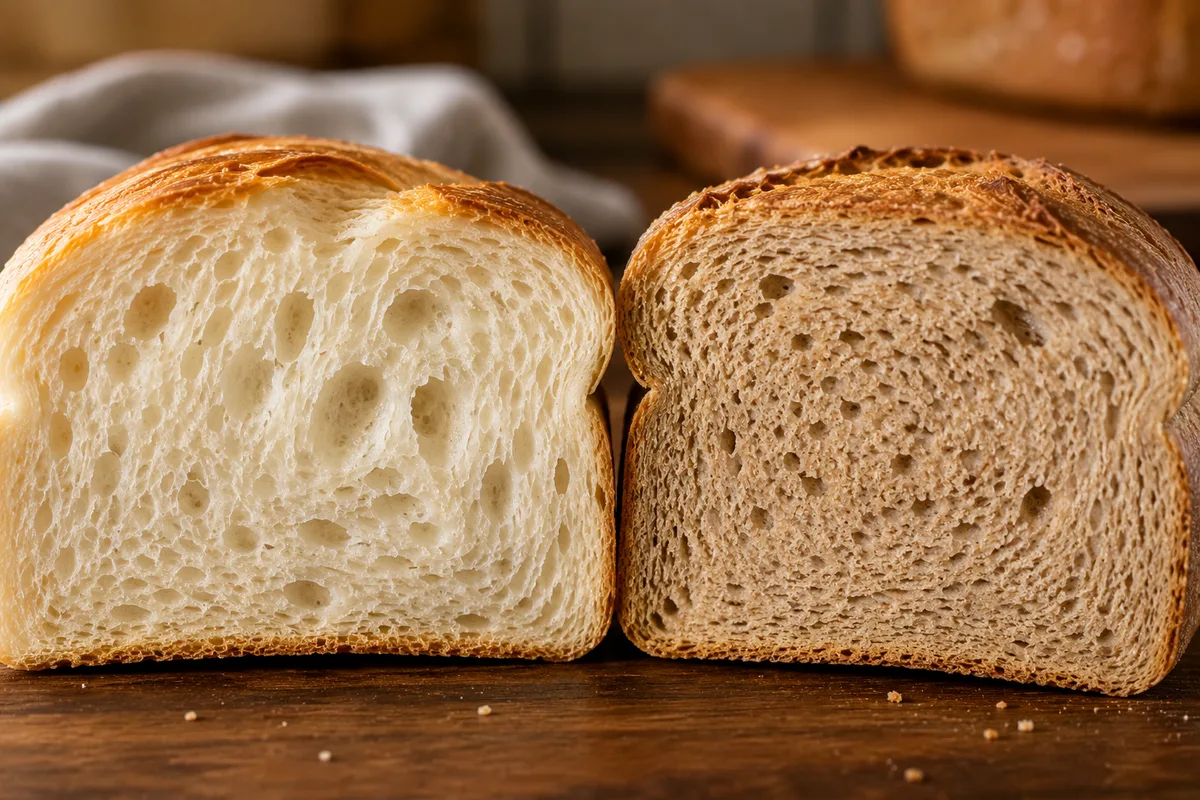
After baking, starch molecules gradually begin moving back toward more ordered arrangements.
This process is called starch retrogradation.
The name sounds complicated.
The basic idea is easier:
During baking, heat and water disrupt the starch’s original structure.
During cooling and storage, parts of that starch begin associating with one another again.
Amylose can reorganize relatively quickly during and shortly after cooling.
Over longer storage, amylopectin recrystallization becomes particularly important in bread staling.
As this happens, the crumb becomes progressively firmer.
That is why a loaf can become stale even when it has been stored in packaging that prevents it from simply drying into a rock.
The bread is changing internally.
Stale Bread Isn’t Just Dry Bread
This distinction is the heart of the story.
Imagine two pieces of bread.
One has genuinely lost a large amount of water.
The other has retained much of its moisture but has undergone significant starch retrogradation.
Both can feel firm.
But they did not arrive there through exactly the same process.
Food-science research has long shown that bread staling involves more than moisture loss. Changes in starch structure—especially amylopectin recrystallization—play a major role in crumb firming.
Water matters too.
But the important question is not simply:
“How much water is left?”
It is also:
“Where is that water, and how is it interacting with the bread’s structure?”
Water Moves Around Inside the Loaf
A fresh loaf does not contain moisture uniformly.
The soft interior, or crumb, contains considerably more water than the dry, crisp crust.
After baking, that imbalance begins changing.
Water migrates from the moist crumb toward the drier crust.
Some moisture eventually escapes into the surrounding air.
Some remains within the loaf but changes location.
Research published in the Journal of Food Engineering found that during bread staling, part of the water lost from the crumb is absorbed by the crust while another portion escapes into the atmosphere.
That produces an unfortunate exchange.
The crumb becomes firmer and drier.
The crust absorbs moisture and becomes less crisp.
In other words, the loaf manages to make both parts worse at the same time.
Why Does the Crust Go Soft While the Inside Gets Hard?
This seems contradictory until you follow the water.
Fresh bread has a relatively dry crust surrounding a much wetter crumb.
That dry crust is one reason it feels crisp.
But water naturally moves in response to differences in moisture conditions.
As the loaf sits, moisture migrates outward from the crumb.
The crust absorbs some of it.
The result:
Crumb → loses moisture and becomes firmer.
Crust → gains moisture and loses crispness.
Eventually, moisture also moves through the crust and into the surrounding air.
This is why keeping bread in a sealed bag helps prevent severe moisture loss but does not completely stop staling.
You can slow one part of the problem without stopping all of the underlying structural changes.
Why Does Stale Bread Feel Hard?
Several processes contribute, but starch retrogradation is central.
As amylopectin chains reorganize and develop more ordered structures, the mechanical properties of the crumb change.
The bread becomes less soft and more resistant to compression.
Water redistribution also affects texture.
The result is what your fingers immediately recognize as stale bread:
less springy;
more crumbly;
firmer;
less pleasant to chew.
Interestingly, the amount of water alone cannot completely explain this change.
Bread texture depends on the physical organization of starch, proteins and water—not simply the percentage of moisture in the loaf.
Here’s the Strange Part: Heat Can Temporarily Reverse Some Staling
Take a piece of stale bread and warm it.
Something interesting happens.
It can become softer again.
That would be difficult to explain if staling were merely the irreversible loss of water.
Heating can disrupt some of the ordered starch structures that developed during storage.
The crumb temporarily softens.
This is why reheating yesterday’s bread can make it seem surprisingly fresh again.
An oven can restore some crispness to the crust as well by driving moisture from its surface.
For a brief period, the bread seems revived.
Unfortunately, the effect does not last forever.
Reheated Bread Usually Stales Again Quickly
Heating does not return an old loaf to the exact molecular state it had when it first left the oven.
Once reheated bread cools again, starch can reorganize once more.
And because the bread may lose additional moisture during reheating, it can subsequently become firm again quite rapidly.
So reheating is useful when you plan to eat the bread immediately.
It is not a permanent reset button.
Think of it as a temporary restoration of texture.
The Refrigerator Is Surprisingly Bad for Bread
This is where normal food-storage intuition gets us into trouble.
For many foods:
cold = longer freshness.
So putting bread in the refrigerator sounds sensible.
But ordinary refrigeration temperatures can encourage starch retrogradation.
Research on bread staling has shown that amylopectin recrystallization can proceed rapidly at cool, above-freezing temperatures.
That means the refrigerator can protect bread from some forms of microbial spoilage while simultaneously making its texture stale faster.
Your loaf may be microbiologically safer for longer.
But it can become disappointingly firm.
Refrigeration and Freezing Are Not the Same Thing
This leads to an important practical distinction.
Refrigerating bread and freezing bread do not produce the same result.
For bread you want to keep for more than a short period, freezing is generally much better for preserving eating quality than ordinary refrigerator storage.
At sufficiently low freezer temperatures, molecular mobility is greatly reduced and the changes responsible for staling slow dramatically.
The easiest approach is often to freeze bread in portions.
Slice the loaf first.
Freeze the slices.
Then remove only what you need.
A toaster can take many bread slices directly from frozen.
That is much more useful than keeping an entire loaf in the refrigerator and slowly converting it into sandwich-shaped building material.
What Is the Best Way to Store Bread for a Day or Two?
There is no perfect storage method because bread has competing needs.
You want the crumb to retain moisture.
But you also want the crust to stay crisp.
Unfortunately, the conditions that protect one can hurt the other.
A tightly sealed plastic bag is good at limiting moisture loss.
But trapped moisture can soften a crisp crust.
A paper bag allows more moisture to escape.
That can preserve crust texture temporarily but may allow the loaf to dry faster.
For soft sandwich bread, moisture retention is usually more important.
For a crusty artisan loaf, maintaining the crust matters more.
Storage should match the type of bread and how quickly you plan to eat it.
Why Bakery Bread Seems to Stale So Fast
A crusty baguette can go from spectacular to disappointing remarkably quickly.
That does not necessarily mean it is poorly made.
The qualities that make certain breads wonderful when fresh can also make their decline very noticeable.
A baguette has a large crust-to-crumb ratio.
Moisture can redistribute and escape relatively quickly.
The crisp crust softens.
The tender crumb firms.
Within hours, the contrast that made the bread special has weakened.
Commercial sandwich breads often stay soft longer because their recipes and packaging are specifically designed to delay these changes.
Ingredients such as fats, emulsifiers and certain enzymes can influence starch behavior, moisture retention and texture over time.
Staling Is Not the Same as Spoilage
This distinction is important.
Stale bread is not automatically unsafe bread.
Staling is primarily a physical and chemical quality change.
Mold growth is microbial spoilage.
They are different processes.
A loaf can be stale without being moldy.
And a loaf can develop mold before it has become extremely stale.
Do not use reheating as a way to “rescue” moldy bread.
If bread shows visible mold, the issue is no longer simply starch retrogradation or moisture migration.
It is spoilage.
The date printed on a package does not by itself tell you whether a food has spoiled. Our guide to what food expiration dates and date labels actually mean explains why storage history and the type of food matter too.
Staleness is mainly a quality change, while food-safety timing is a different question. For cooked foods left at room temperature, see how long cooked food can safely sit out.
Why Does Toasting Stale Bread Work So Well?
Toast is one of stale bread’s greatest career changes.
Heating changes texture and drives off moisture from the surface.
The exterior becomes crisp.
Flavor changes through browning reactions.
And some of the firm texture associated with staling can temporarily soften during heating.
Suddenly, bread that seemed disappointing at room temperature becomes excellent toast.
This is also why slightly stale bread works well for foods such as:
French toast;
croutons;
bread pudding;
stuffing;
breadcrumbs.
Staling changes bread.
It does not necessarily make it useless.
Can You Prevent Bread From Going Stale Completely?
Not indefinitely.
Bread begins changing after baking.
Starch retrogradation, water redistribution and other changes continue during storage.
But you can slow the loss of quality.
For bread you will eat soon, use storage suited to the style of loaf.
For longer storage, freeze it.
Avoid ordinary refrigeration when your main goal is maintaining soft, fresh texture.
And if bread has already become slightly stale but is otherwise safe to eat, reheating or toasting can temporarily improve it.
The key is understanding what you are actually fighting.
Not just dryness.
Structure.
The Same Loaf Is Constantly Rearranging Itself
Bread seems simple once it reaches the table.
Flour.
Water.
Yeast.
Salt.
Heat.
Done.
But at the microscopic level, bread is a complicated material.
Baking disrupts starch structures.
Cooling allows molecules to reorganize.
Water shifts between starch, proteins, crumb and crust.
Some water escapes.
Some changes location.
Amylopectin gradually recrystallizes.
Texture changes.
Fresh-bread aroma fades.
The loaf that sits on your counter is not chemically frozen at the moment it leaves the oven.
It continues evolving.
That evolution is what we experience as staling.
The Takeaway
Bread does not go stale simply because it dries out.
Moisture loss contributes, but one of the central processes is starch retrogradation.
During baking, heat and water disrupt the organized structure of starch.
After baking, starch molecules begin reorganizing.
Over time, amylopectin forms increasingly ordered structures, helping make the crumb firmer.
At the same time, water migrates through the loaf.
Moisture moves from the soft crumb toward the crust and eventually into the surrounding environment.
That helps explain why the inside gets firmer while a once-crisp crust can become soft.
It also explains a seemingly bizarre kitchen rule:
The refrigerator is often one of the worst places to keep bread if texture is your priority.
For longer storage, freezing is usually the better option.
And when yesterday’s loaf has already lost some of its magic?
Heat can temporarily make stale bread softer and more enjoyable again.
So the next time someone says stale bread is simply “dried-out bread,” you can give them the more interesting answer.
The water matters.
But the starch has been quietly rearranging itself too.
Sources
Food Chemistry — Staling of White Wheat Bread Crumb and the Role of Starch Retrogradation






Join the discussion