Food Left on the Counter: When Does It Become Too Long?
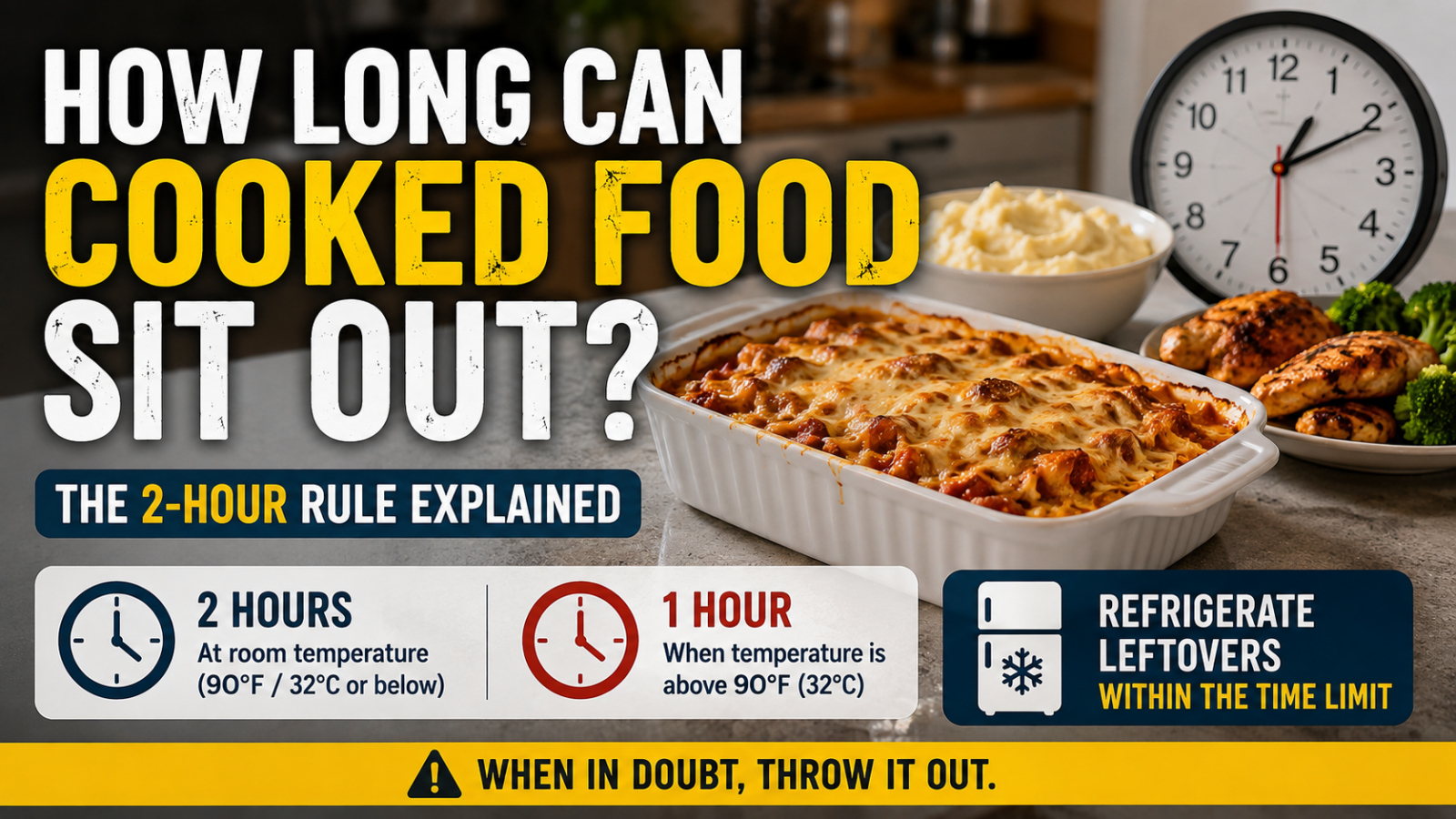
Most perishable cooked food should be refrigerated within two hours—or within one hour in temperatures above 90°F (32°C). Here's how the 2-hour rule actually works.
Dinner is over, but the food isn’t put away.
Maybe you’re talking with friends. Maybe you’re watching a movie. Maybe the takeout containers are still sitting on the coffee table because nobody feels like cleaning up yet.
An hour passes.
Then two.
At what point does cooked food sitting at room temperature become something you should stop saving?
For most perishable cooked foods, the basic rule is straightforward:
Refrigerate or freeze them within 2 hours.
If the food is exposed to temperatures above 90°F (32°C), that window drops to 1 hour.
This is commonly called the 2-hour rule, and it applies to far more than meat. Leftovers, cooked rice, dairy-containing dishes, seafood, eggs and many other perishable foods shouldn’t spend an entire afternoon—or night—sitting at room temperature.
Here’s how the rule works in real life.
What Is the 2-Hour Rule for Food?
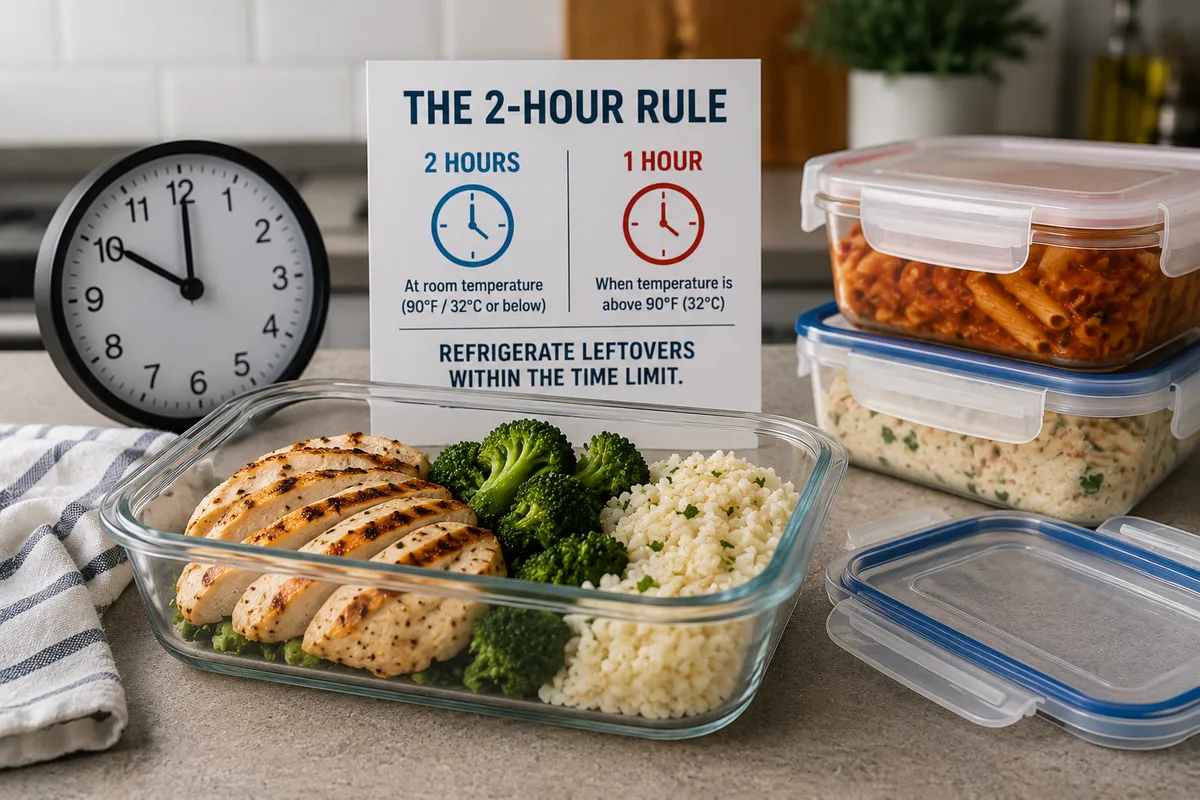
The 2-hour rule is a practical food-safety guideline for perishable foods that aren’t being kept properly hot or cold.
FDA guidance says meat, poultry, eggs, seafood and other perishables should generally be refrigerated or frozen within 2 hours of cooking or purchasing.
That includes leftovers.
The clock becomes even shorter in hot conditions:
Normal conditions → 2 hours
Above 90°F (32°C) → 1 hour
The important word here is perishable.
A loaf of bread sitting on the counter isn’t the same food-safety situation as a chicken casserole, cooked rice or a container of restaurant leftovers.
The rule is intended for foods that normally require temperature control.
Why Two Hours?
Cooked food doesn’t instantly become unsafe the moment it reaches room temperature.
The concern is what happens while perishable food remains in temperatures where bacteria can multiply.
FDA commonly describes 40°F to 140°F (4°C to 60°C) as the food-safety “danger zone.”
Your refrigerator keeps perishable food at the cold end of that range or below.
Proper hot holding keeps food above it.
The kitchen counter does neither.
The longer perishable food remains in that temperature range, the more opportunity certain bacteria have to multiply.
The 2-hour rule gives home cooks a simple boundary rather than expecting everyone to calculate bacterial growth at the dinner table.
Does the Clock Start When Food Becomes Cold?
No.
This is an important misunderstanding.
You don’t wait until the food feels cool and then start counting two hours.
The time begins when the perishable food is no longer being maintained at a safe hot or cold temperature.
Imagine dinner is served at 7 p.m.
Everyone finishes eating around 7:45, but the serving dishes remain on the table while people talk.
You don’t get an extra two hours once the food finally feels like room temperature.
That time on the table already counts.
Can You Eat Cooked Food Left Out for 3 Hours?
For perishable cooked food held at room temperature, three hours is beyond the FDA’s 2-hour recommendation.
This is where the sniff test often appears.
“It smells completely normal.”
That doesn’t reset the clock.
Foodborne pathogens don’t necessarily produce obvious changes in smell, taste or appearance.
If you know a perishable dish has remained at room temperature beyond the recommended limit, sensory inspection isn’t a reliable way to grant it additional time.
This is especially important with foods such as meat, poultry, seafood, eggs, dairy-based dishes and cooked leftovers.
What If Food Was Left Out Overnight?
Discard it.
Food left on the kitchen counter from dinner until breakfast has spent far longer at room temperature than the recommended two hours.
Putting it into the refrigerator the next morning doesn’t undo those hours.
Neither does reheating it aggressively.
This applies to many foods people are tempted to save the next day, including leftover pizza.
Pizza that was refrigerated promptly can generally be stored for several days.
Pizza that sat on the coffee table all night has a completely different storage history.
The same principle applies to casseroles, cooked meat, takeout meals and other perishable leftovers.
Does Reheating Make Food Left Out Too Long Safe Again?
Don’t use reheating as a rescue strategy for food that has already spent too long at room temperature.
Heating can kill many bacteria when food reaches the appropriate temperature.
But that doesn’t mean every consequence of improper storage can always be reversed by making the food hot again.
Some microorganisms can produce toxins, and certain toxins can remain a concern even after reheating.
FDA recommends reheating properly stored leftovers to 165°F (74°C).
Think of that as the final step in a safe sequence:
Cook → serve → refrigerate promptly → store safely → reheat properly.
Not:
Cook → leave out overnight → reheat → hope for the best.
What About Cooked Chicken?
The same 2-hour rule applies.
After cooking, cooked chicken should be refrigerated promptly rather than spending several hours on the counter.
This matters at barbecues and parties in particular.
A platter of chicken may be cooked perfectly to begin with, but safe cooking doesn’t give it unlimited time at room temperature afterward.
And if the outdoor temperature is above 90°F (32°C), remember that the recommended window shrinks to 1 hour.
Once properly refrigerated, cooked chicken has its own refrigerator storage timeline.
The room-temperature rule and refrigerator-storage rule answer two different questions.
Why Does the Rule Drop to 1 Hour in Hot Weather?
Because temperature changes the situation.
When the surrounding temperature rises above 90°F (32°C), perishable foods can warm more quickly.
That’s why FDA guidance reduces the normal 2-hour limit to 1 hour under hotter conditions.
Think about:
summer picnics;
barbecues;
tailgate parties;
food left inside a hot car;
outdoor birthday parties;
and beach lunches.
A dish sitting outside on a 95°F afternoon isn’t experiencing the same conditions as a dish sitting inside an air-conditioned home.
The hotter environment gets the shorter window.
What About Parties and Buffets?
A party can quietly turn the 2-hour rule into a problem because food often stays on the table for much longer than it would during a normal meal.
But “two hours” doesn’t mean every buffet has to disappear after exactly 120 minutes.
The key is temperature control.
FDA guidance recommends keeping hot foods at 140°F (60°C) or warmer and cold foods at 40°F (4°C) or colder.
Hot foods can be maintained with equipment such as slow cookers, warming trays or chafing dishes.
Cold foods can be kept refrigerated until needed or served over ice when appropriate.
If perishable food is simply sitting at room temperature without hot or cold holding, however, the clock matters.
A useful party strategy is to serve smaller quantities and replenish them rather than putting everything out at once.
Does Takeout Food Follow the Same Rule?
Yes.
Takeout doesn’t get a special exemption because someone else cooked it.
If you bring home a restaurant meal and want to save half for tomorrow, refrigerate the leftovers promptly.
The same applies to a restaurant doggie bag.
The trip home counts.
If dinner ends and you then spend an hour shopping before driving another hour home with the leftovers sitting in the car, you need to consider the entire unrefrigerated period—not just the time after you walked through your front door.
This is also why a cooler can be useful when transporting perishable food for longer periods.
Can Hot Food Go Straight Into the Refrigerator?
Yes.
You don’t need to leave cooked food on the counter for hours waiting for it to reach room temperature.
FDA recommends dividing large amounts of leftovers into shallow containers so they can cool more quickly in the refrigerator.
This is particularly useful for:
large pots of soup;
chili;
stew;
large batches of cooked meat;
and meal-prep dishes.
A huge deep container can cool slowly in the center.
Several smaller, shallow containers allow heat to escape more efficiently.
Once those leftovers are properly chilled, their refrigerator storage timeline begins to matter. Our guide to how long leftovers are good in the fridge covers that part separately.
What Foods Does the 2-Hour Rule Apply To?
Think primarily about perishable foods.
Common examples include:
cooked meat and poultry;
seafood;
egg dishes;
dairy-containing foods;
casseroles;
cooked rice;
many cooked vegetables;
cut fruit that requires refrigeration;
and prepared leftovers.
Not every item sitting on a kitchen counter needs to be discarded after two hours.
Shelf-stable foods are a different category.
The important question is whether the food normally requires refrigeration or hot holding for safety.
Is Two Hours a Guaranteed Moment When Food Becomes Dangerous?
No—and that’s not what the rule is trying to claim.
Food safety doesn’t work like a countdown timer where a meal is perfectly safe at 1 hour and 59 minutes and suddenly toxic one minute later.
Microbial growth depends on multiple factors, including the food itself, temperature and handling conditions.
The 2-hour rule is a practical safety boundary.
That’s why trying to negotiate with it—“it was only three hours and the room wasn’t very warm”—isn’t particularly useful.
The guideline exists so you don’t have to guess about invisible microbial growth every time dinner gets forgotten on the counter.
The Refrigerator Doesn’t Reset the Clock
This may be the single most useful idea in the entire article.
Suppose a casserole sits on the table for four hours.
You eventually remember it and put it in the refrigerator.
The next morning, it has been refrigerated for only 10 hours.
But that doesn’t mean its storage history is now fine.
Refrigeration slows what happens next. It doesn’t erase what happened before.
This is also why knowing only “how many days has this been in the fridge?” sometimes isn’t enough.
Safe leftovers depend on both:
how quickly the food was refrigerated
and
how long it has been refrigerated afterward.
A Simple Decision Guide
If you’re standing in the kitchen wondering whether to save food, use this:
Less than 2 hours at normal room temperature?
Refrigerate it promptly.
More than 2 hours at room temperature?
Discard perishable food.
Outside above 90°F (32°C)?
Use a 1-hour limit instead.
Left out overnight?
Discard it.
Kept continuously hot at 140°F (60°C) or above or cold at 40°F (4°C) or below?
That’s a different situation because proper temperature control has been maintained.
Not sure how long it was sitting out?
Don’t rely on smell or taste to reconstruct the missing timeline.
The Numbers Worth Remembering
You really only need four numbers for this rule:
2 hours — maximum general room-temperature window for perishable food.
1 hour — when temperatures are above 90°F (32°C).
40°F (4°C) — keep cold foods at or below this temperature.
140°F (60°C) — keep hot foods at or above this temperature when holding them for service.
And for properly stored leftovers that you’re reheating:
165°F (74°C).
These numbers cover a surprising number of kitchen situations.
The Bottom Line
Most perishable cooked foods shouldn’t sit at room temperature for more than 2 hours.
When the temperature is above 90°F (32°C), the recommended limit drops to 1 hour.
That means food left out for three hours has exceeded the normal guideline, and perishable food forgotten on the counter overnight should be discarded rather than refrigerated the next morning.
Don’t wait for food to become completely cold before putting it away.
Don’t assume reheating resets unsafe storage.
And don’t rely on smell to tell you how much time has passed.
The easiest habit is also the safest:
When the meal is over, watch the clock—and get the leftovers cold.






Join the discussion