A Banana’s Color Is a Chemical Clock — Here’s What Changes as It Ripens
Bananas change from green to yellow to brown because ripening alters pigments, starches, sugars, aromas and the structure of the fruit. Those brown spots are part of an active chemical process.
A bunch of bananas can seem to change personality in a matter of days.
They arrive home green and firm. Then the peel turns bright yellow, the fruit becomes sweeter, and small brown freckles begin appearing. Leave them a little longer and those freckles spread until the banana looks dramatically older than the one you bought a few days earlier.
That color change is not simply decay.
A banana continues carrying out an active ripening program after harvest. Plant hormones signal the fruit to change its pigments, convert stored starch into sugars, soften its tissues and produce the aroma we associate with a ripe banana.
Brown spots appear later in that process as the chemistry of the peel changes further.
So when a banana goes from green to yellow to brown, you are watching biochemistry become visible.
Bananas Keep Ripening After They Leave the Plant
Bananas belong to a group known as climacteric fruits.
Unlike fruits that must reach most of their eating quality before harvest, climacteric fruits can continue ripening after they have been picked.
Bananas are therefore commonly harvested while mature but still green.
The fruit is alive after harvest. It continues respiring, producing hormones and carrying out metabolic reactions.
One molecule is especially important:
ethylene.
Ethylene is a gaseous plant hormone that helps coordinate the ripening process.
As a banana responds to ethylene, several familiar changes begin happening together: the peel loses its green color, the pulp becomes softer, starch is broken down, sugars increase and aroma develops.
The banana on your counter may look inactive.
Chemically, it is busy.
Ethylene Helps Push Ripening Forward
Ethylene is unusual because it is both a plant hormone and a gas.
Bananas naturally produce it during ripening, and exposure to additional ethylene can accelerate the process.
Commercial banana handling takes advantage of this biology. Mature-green bananas can be exposed to controlled ethylene concentrations so they ripen more uniformly before reaching stores.
At home, the same basic chemistry helps explain why bananas can ripen faster when kept near other ripening fruit.
Apples, bananas and several other fruits release ethylene.
Place them together in a relatively enclosed space and the ethylene concentration around the fruit can rise.
That is also the science behind the familiar paper-bag trick.
The bag does not “heat” the banana into ripening.
It helps keep some of the fruit’s own ethylene nearby.
Bread has another counterintuitive bit of food chemistry: it does not go stale simply because it dries out.
The Green Peel Is Losing Chlorophyll
A young or unripe banana peel contains plenty of chlorophyll, the green pigment also familiar from leaves.
During ripening, that chlorophyll is broken down.
As the strong green pigment disappears, the yellow appearance becomes dominant.
So the banana does not simply have yellow paint switched on underneath its peel.
The visible color changes because pigment composition is changing.
This is one of the first obvious signals that the ripening program is well underway.
Green fades.
Yellow takes over.
Then a second transformation becomes obvious when you take a bite.
Why Ripe Bananas Taste So Much Sweeter
An underripe banana can be firm, starchy and only mildly sweet.
A spotted ripe banana can taste almost dessert-like.
That difference comes largely from what happens to stored carbohydrate inside the fruit.
Bananas accumulate substantial quantities of starch while developing.
As ripening progresses, enzymes break much of that starch down and the fruit accumulates soluble sugars.
Scientific reviews of banana metabolism identify this starch-to-sugar conversion as a central part of ripening.
That is why waiting changes the flavor so dramatically.
The banana is not absorbing sugar from somewhere outside itself.
It is converting carbohydrate that was already stored inside the fruit.
Softening Happens at the Same Time
Sweetness is not the only difference between a green banana and a ripe one.
Their textures can feel like different foods.
Green bananas are firm.
Ripe bananas become creamy.
Very ripe bananas can become almost mashable without effort.
This happens partly because structural components of the fruit’s cells are modified during ripening.
Cell walls contain materials that help keep tissues firm. As ripening enzymes alter those structures, the pulp becomes softer.
Starch loss also contributes to the dramatic texture change.
The processes overlap, which is why color, sweetness, aroma and softness often seem to advance together.
Ripening is not one reaction.
It is a coordinated collection of them.
Then the Brown Freckles Arrive
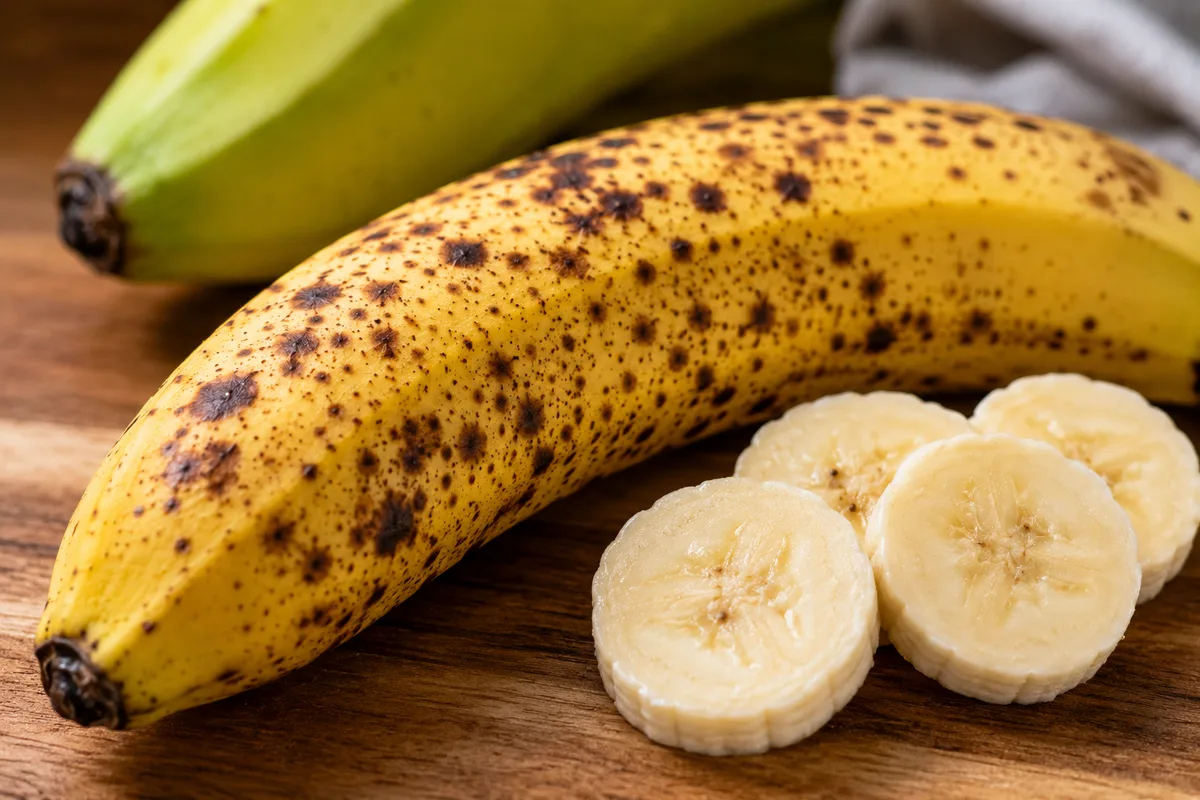
The appearance of small brown or black spots on a yellow banana signals another visible stage.
These dark areas are sometimes called sugar spots, although the name can be slightly misleading because the spots are not simply sugar appearing on the peel.
A study published in the Journal of Agricultural and Food Chemistry in 2026 examined the spatial changes of polyphenolic compounds in banana peel during ripening and dark-spot formation.
The researchers found changes involving compounds such as L-DOPA and dopamine and linked the dark spots with reactions leading toward melanin-derived pigmentation.
That gives us a much more accurate picture than saying the peel simply “gets old.”
The dark color is the visible product of changing plant chemistry.
Browning Also Involves Polyphenol Oxidase
One enzyme strongly associated with browning in bananas is polyphenol oxidase, usually shortened to PPO.
PPO participates in oxidation reactions involving phenolic compounds.
Those reactions can eventually produce darker pigments.
The effect becomes especially obvious when plant cells are physically damaged.
Cut a banana and leave the slices exposed to air.
The pale surface gradually turns brown.
Bruise a banana by dropping it.
A dark patch often develops around the damaged area.
Both situations make sense when you think at the cellular level.
Damage breaks apart the organization inside plant tissue.
Compounds that were previously separated can interact more readily, and oxygen from the air becomes involved.
Browning accelerates.
A Brown Peel Does Not Always Mean the Banana Is Spoiled
This distinction saves perfectly usable bananas from the trash.
A banana can have a heavily spotted or partly brown peel while the fruit inside is still suitable to eat.
In fact, many people deliberately use very ripe bananas for baking because they are softer, sweeter and more aromatic.
Banana bread is almost an unofficial rescue system for overripe fruit.
Color alone therefore does not tell you whether a banana has spoiled.
Look at the whole fruit.
Obvious mold, leakage, severe decay or an abnormal fermented or rotten odor are much more meaningful warning signs than ordinary brown freckles.
Ripe and spoiled are not the same thing.
The same distinction is useful when judging packaged foods too: a date label is not automatically a universal safety deadline. See what food expiration dates really mean for the broader rule.
Bruising Can Make One Area Brown Much Faster
You have probably seen a banana that looks fine except for one dark patch.
Often, that patch corresponds to an impact.
The banana was dropped.
Pressed against another object.
Or squeezed during transport.
Mechanical damage breaks cells.
That makes the chemistry involved in browning easier to trigger locally.
The result can be a dark bruise surrounded by otherwise healthy yellow peel.
This also explains why handling matters if you want bananas to look good for longer.
Keeping them from being crushed or repeatedly knocked against hard surfaces will not stop ripening, but it can reduce localized damage.
Why Bananas Can Seem to Change Overnight
Banana ripening is not visually uniform.
A green banana may appear to change slowly for a while.
Then it reaches a stage where several visible effects accumulate at once.
The peel is already losing chlorophyll.
Ethylene-driven ripening is active.
Starch conversion is progressing.
Tissues are softening.
Oxidative changes are becoming more noticeable.
Suddenly, brown spots appear across the peel.
The fruit did not literally transform in one hour.
You are seeing multiple processes cross a visible threshold at roughly the same time.
Temperature Has a Major Effect
Temperature strongly influences banana metabolism.
Within suitable ranges, warmer conditions generally make ripening proceed faster.
Cooler conditions can slow it.
But bananas come from tropical and subtropical environments, so they also have a vulnerability:
chilling injury.
UC Davis postharvest guidance warns that sufficiently low temperatures can damage banana peel and interfere with normal ripening.
Symptoms can include peel discoloration, brown tissue and abnormal ripening.
This matters because a dark banana from the refrigerator is not always dark for the same reason as a naturally overripe banana on the counter.
The appearance can look similar.
The underlying process can be different.
Should Ripe Bananas Go in the Refrigerator?
Once a banana has reached the stage you like, refrigeration can help slow some further ripening processes.
But there is a cosmetic trade-off.
The peel may become dark much faster in the refrigerator.
The pulp inside can still remain usable even while the exterior looks dramatically worse.
This is why refrigerated ripe bananas can produce one of the strangest kitchen contrasts:
Outside: almost black.
Inside: still normal.
For green bananas that still need to ripen properly, very cold storage is less useful because chilling can interfere with the normal process.
Can You Slow Browning on a Cut Banana?
Once a banana is sliced, oxygen has direct access to damaged tissue.
Enzymatic browning then becomes much easier.
Acidic fruit juices can slow that process.
Lemon juice is commonly used because its acidity and antioxidant chemistry interfere with the reactions responsible for browning.
It does not preserve a banana forever.
It slows the visible change.
Cold storage can also reduce reaction rates, although sliced bananas will still deteriorate with time.
The most effective strategy is usually straightforward:
Cut them close to when you plan to use them.
Why Ripe Bananas Work So Well in Baking
A banana that is almost too soft to eat neatly can be perfect for a cake or loaf.
Several ripening changes become advantages in baking.
The fruit is easier to mash.
More starch has been converted into sugar.
The banana aroma is stronger.
The soft pulp mixes easily into batter.
That is why recipes often call for “very ripe bananas” rather than pristine yellow ones.
The brown freckles are not merely tolerated.
They can indicate the stage the recipe wants.
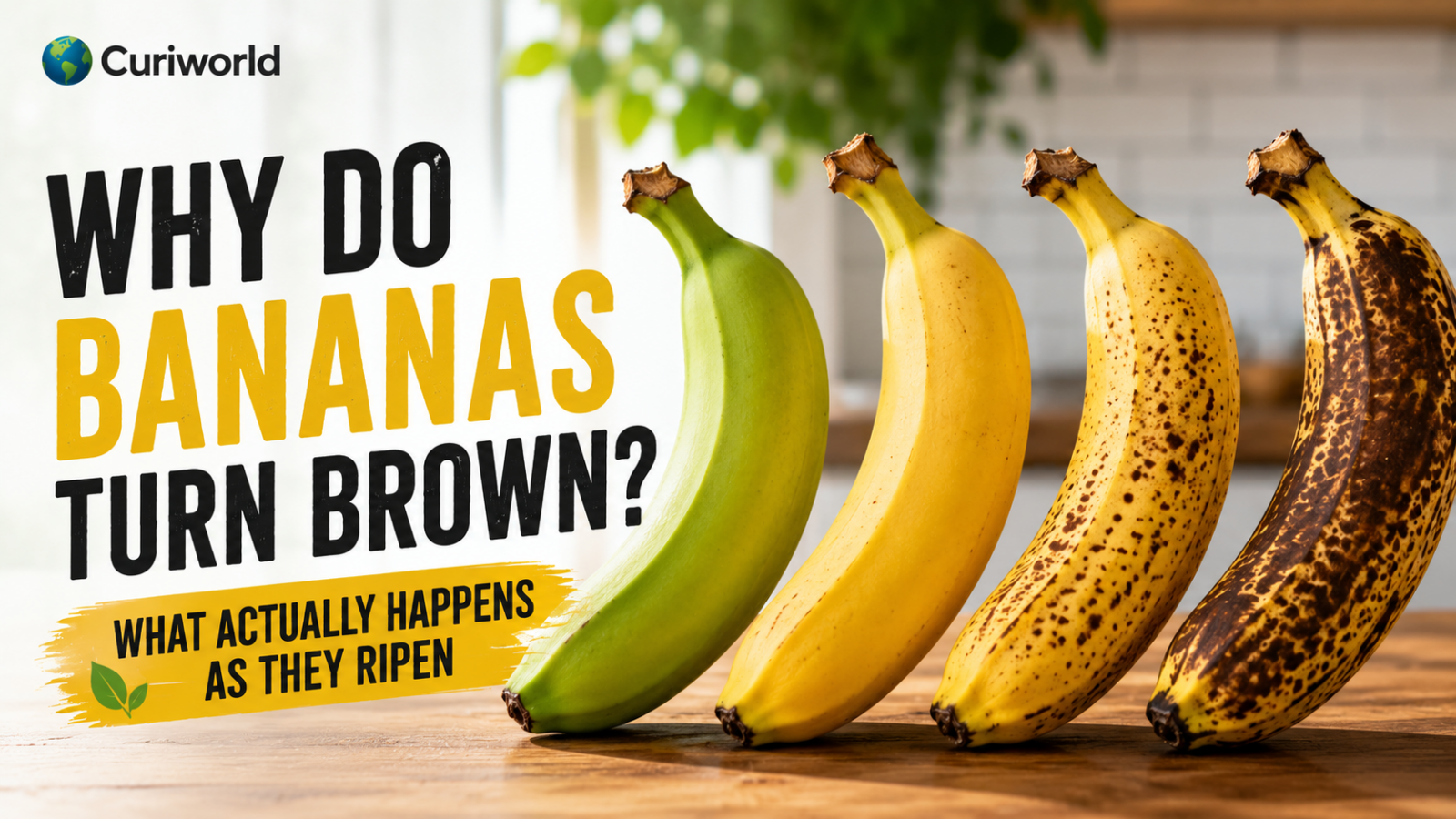
Green, Yellow and Brown Are Three Snapshots of One Process
The easiest way to understand a banana is to treat its appearance as a rough chemical clock.
Green: Chlorophyll is still prominent, starch levels are relatively high and the pulp is firm.
Yellow: Chlorophyll has declined, ripening is active, starch conversion has progressed and the fruit is sweeter and softer.
Spotted: Ripening is advanced and dark peel pigments are beginning to appear.
Very brown: The fruit is moving beyond peak eating ripeness toward senescence and eventual spoilage.
These stages are not exact laboratory categories.
Cultivar, temperature, handling and storage conditions can alter the timing.
But the progression reveals something fascinating:
A banana displays much of its internal biology on its surface.
The Takeaway
Bananas turn brown because ripening changes the fruit from the inside out.
Ethylene helps coordinate the process. Green chlorophyll disappears. Stored starch is converted toward sugars. Cell structures soften. Aroma develops. Later, oxidation and polyphenol-related chemistry create the familiar brown and black spots on the peel.
Physical damage can make browning happen faster in one area, while refrigeration can darken the peel through cold injury even when the pulp remains usable.
That is why “brown banana” does not have one universal meaning.
Sometimes it means ripe.
Sometimes bruised.
Sometimes cold-damaged.
And eventually, yes, it can mean spoiled.
The useful skill is knowing the difference.
A few brown freckles on a sweet, soft banana are rarely a tragedy.
They may simply be chemistry telling you it is time to make banana bread.






Join the discussion