Can Concrete Heal Itself? The Technology Repairing Cracks from Within
Concrete can now be engineered to seal some of its own cracks using bacteria, microscopic capsules and reactive minerals. Here’s what self-healing concrete can really do — and where its limits remain.
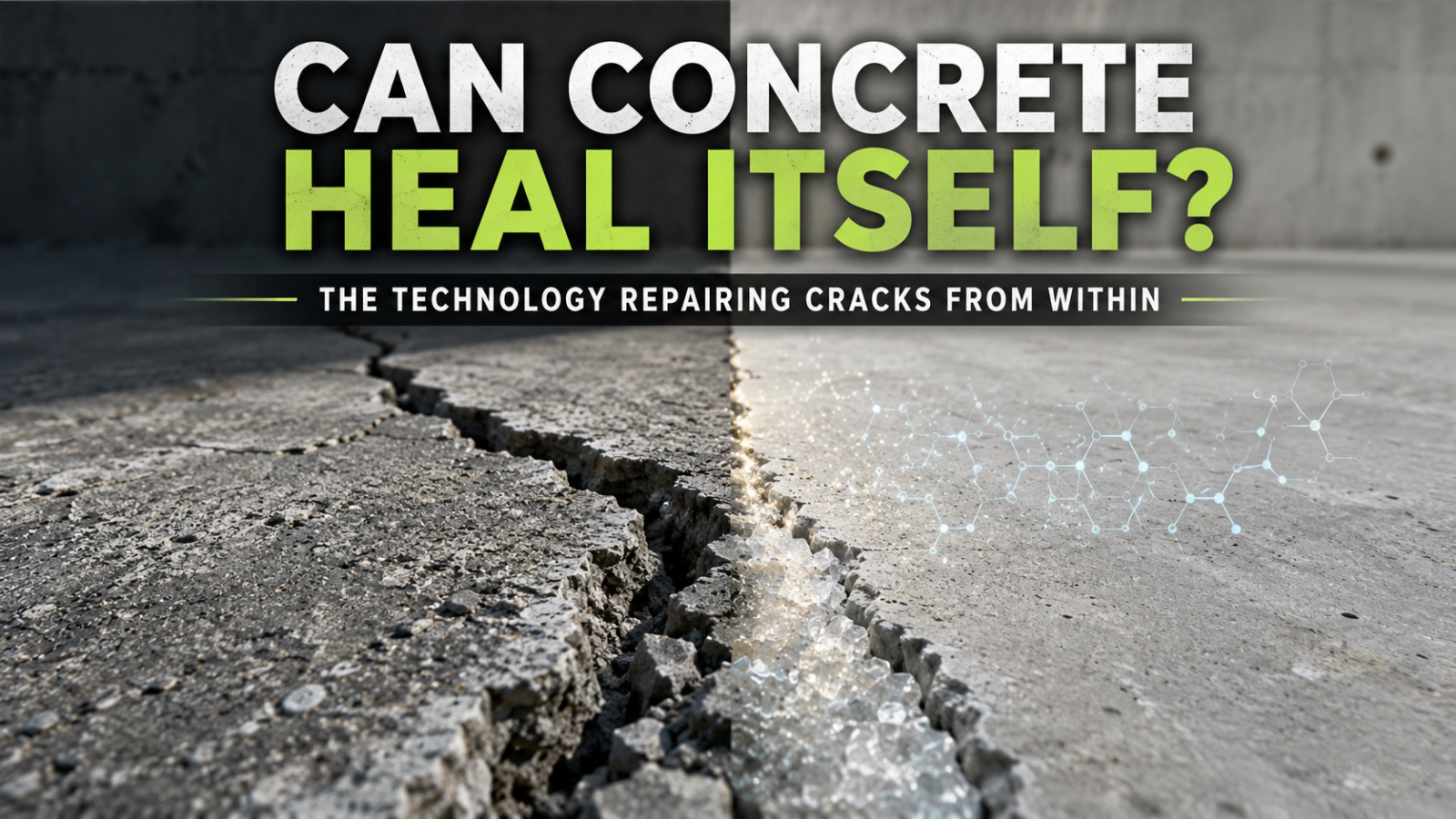
A crack appears in a concrete wall.
Normally, that means someone eventually has to inspect it, seal it, inject it, patch it, or replace part of the structure.
But what if the concrete could react to the damage itself?
That idea is no longer science fiction. Researchers have developed several forms of self-healing concrete designed to close small cracks after they appear, sometimes using dormant bacteria, microscopic capsules, reactive minerals, or internal networks carrying repair materials.
The technology is real.
What it can do, however, is more specific than the phrase “self-healing” might suggest. Today’s systems are generally best at sealing relatively small cracks, limiting water and harmful chemicals from entering the material, and potentially extending the useful life of concrete structures.
They do not turn severely damaged concrete back into something brand new.
Understanding that difference explains both why self-healing concrete is exciting — and why ordinary concrete is not disappearing anytime soon.
Concrete Already Has a Small Ability to Heal Itself
Engineered self-healing concrete did not begin from nothing.
Ordinary cement-based concrete can sometimes partially close very small cracks naturally when moisture is available. This process is known as autogenous healing.
Some cement particles inside hardened concrete may remain unhydrated. When water later enters a small crack, those particles can continue reacting. Calcium-containing compounds can also react with carbon dioxide and form calcium carbonate crystals.
Over time, these products may accumulate inside a narrow crack and partially seal it.
The effect is useful, but limited.
Natural healing tends to work best on very small cracks and under favorable moisture conditions. It cannot be relied upon to repair significant structural damage.
Researchers therefore began asking a different question:
Could the same basic idea be deliberately engineered into concrete?
The answer has produced several very different technologies.
There Is More Than One Kind of Self-Healing Concrete
“Self-healing concrete” sounds like a single material.
It is actually a broad family of approaches.
Some systems enhance reactions that concrete already performs naturally. Others place special healing agents inside the material and keep them inactive until a crack forms.
The main approaches under development include:
- bacteria-based healing;
- microcapsules containing repair agents;
- crystalline or reactive admixtures;
- vascular networks that deliver healing material;
- superabsorbent polymers;
- and other smart-material systems.
They all attempt to solve the same problem in different ways: detect or respond to a crack before that crack becomes a much larger durability problem.
The materials used across cities matter in other ways too; they are one reason some neighborhoods become noticeably hotter than others.
Bacteria Can Turn a Crack Into a Mineral-Filled Gap
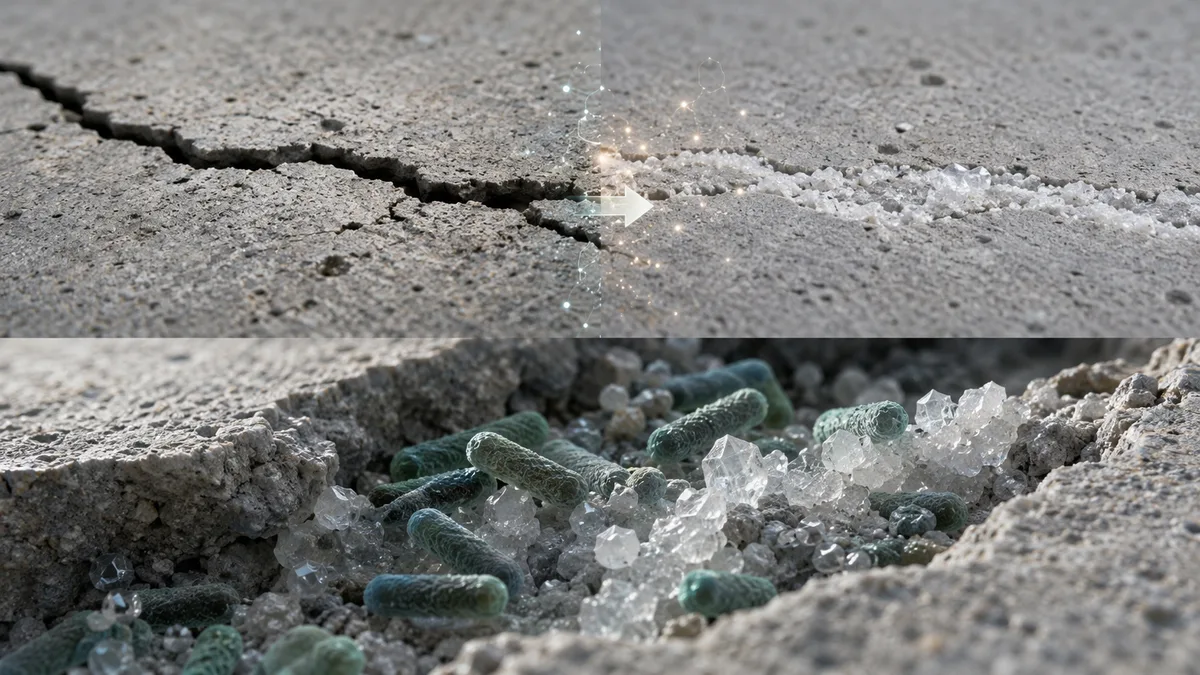
One of the most fascinating approaches uses living organisms.
Certain bacteria can survive inside specially designed concrete systems in a dormant state. Rather than remaining continuously active, they wait until conditions become suitable.
A crack provides an opportunity.
Water enters.
Dormant bacterial spores can become active, provided the surrounding chemistry and environmental conditions allow it.
The bacteria then participate in reactions that result in the precipitation of calcium carbonate, a mineral closely related to limestone.
The newly formed mineral accumulates inside the crack.
Instead of a worker arriving with repair material from outside, part of the repair process happens from within the concrete itself.
Researchers at Delft University of Technology have been among the groups developing bacteria-based self-healing concrete, including systems in which bacterial spores and nutrients are protected within carrier materials.
The protection matters because fresh and hardened concrete can be an extremely harsh environment for microorganisms. High alkalinity, limited nutrients, mechanical pressure, and long periods without water create conditions very different from a normal biological habitat.
The bacteria therefore need to survive for potentially long periods before a crack gives them a chance to work.
The Bacteria Are Not Eating the Concrete
The phrase “bacterial concrete” can create a misleading mental image.
The concrete is not full of colonies continuously growing through a building.
The microorganisms used for self-healing applications are selected and incorporated specifically for their ability to remain dormant and participate in mineral-forming processes when suitable conditions appear.
In bacteria-based systems, their role is essentially to help create solid mineral material inside the damaged area.
That mineral precipitation can reduce the open path through which water and aggressive substances travel.
This distinction matters because the greatest practical benefit of self-healing concrete may not be making a crack visually disappear.
It may be making that crack less permeable.
Why Water Getting Into a Crack Matters So Much
A tiny crack can look harmless from the outside.
For reinforced concrete, however, cracks can become routes into the structure.
Water can penetrate through them.
So can chlorides, particularly in coastal environments or where deicing salts are used.
Over time, these substances can reach the reinforcing steel embedded inside the concrete. When the protection around that steel is compromised, corrosion becomes possible.
Corroding reinforcement expands.
That expansion can create additional internal pressure, more cracking, surface spalling, and increasingly serious deterioration.
Self-healing technology therefore does not need to magically rebuild an entire structural element to be valuable.
If it closes a small crack early enough to reduce the movement of water and aggressive chemicals, it may help slow one of the processes that causes concrete infrastructure to deteriorate.
Microcapsules Use a Completely Different Trick
Bacteria are only one option.
Another strategy hides tiny capsules inside the concrete.
These microcapsules contain a healing substance rather than living microorganisms.
When concrete cracks, the crack can rupture capsules in its path.
The material stored inside is released.
Depending on the system, it can then react, harden, bond with the surrounding concrete, or otherwise help seal the damaged area.
The concept is somewhat similar to having microscopic repair kits distributed throughout the material before damage ever occurs.
There is one obvious limitation.
A capsule that has already broken and released its contents cannot simply refill itself.
That means capsule-based systems can have a limited capacity for repeated healing in exactly the same location.
Researchers are therefore studying capsule design, shell materials, healing agents, distribution, compatibility with concrete, and combinations of different healing technologies.
Some Concrete Can Grow Crystals Into Its Own Cracks
Another approach uses reactive or crystalline additives.
When water enters a crack, components within the material can react and create insoluble products that grow into pores and openings.
This can reduce water penetration and help seal narrow cracks.
These systems are different from bacterial concrete even though the end result may look similar from the outside.
That is why claims that a particular “self-healing concrete” can repair a certain crack width should be treated carefully.
Performance depends on what type of system is being used, how wide the crack is, the concrete mixture, temperature, moisture, curing conditions, age, and how researchers define successful healing.
There is no single universal number that describes what all self-healing concrete can repair.
Vascular Concrete Is Closer to an Internal Repair Network
A more ambitious concept borrows inspiration from biological circulation systems.
Researchers can create small channels or vascular networks inside a cement-based material.
If cracking occurs, those channels may deliver healing agents to the damaged region.
Unlike a single-use capsule, a network potentially allows material to travel toward damage from another location.
That creates the possibility of repeated or more extensive repair.
It also makes the system considerably more complicated.
Channels must survive construction.
They must not weaken the structure excessively.
Healing material must remain usable.
Blockages must be avoided.
The network must also reach cracks in a useful way.
The elegance of the concept therefore comes with significant engineering challenges.
A Closed Crack Is Not Necessarily a Fully Repaired Structure
This is one of the most important distinctions in the entire subject.
Photos of self-healing concrete often show a crack before treatment and the same crack later filled with new material.
It is easy to interpret that as complete recovery.
But researchers can measure healing in several different ways.
One is crack closure: how much of the visible opening has disappeared?
Another is water tightness or permeability: how effectively does the healed area stop water from passing through?
Another is the recovery of mechanical properties such as stiffness or strength.
Those outcomes are not identical.
A crack may become substantially sealed against water without the concrete recovering every mechanical property it possessed before cracking.
That does not make the healing useless.
For many infrastructure applications, restoring resistance to fluid penetration could substantially improve durability.
But “the crack closed” and “the structure completely restored itself” should not be treated as interchangeable claims.
How Large a Crack Can Self-Healing Concrete Repair?
There is no honest answer that applies to every system.
Laboratory studies have reported impressive closure of sub-millimeter cracks, with some experimental bacterial and capsule-based systems approaching roughly the millimeter scale under favorable conditions.
But maximum crack width is only part of the story.
A system that heals a crack in a controlled laboratory environment may behave differently in a bridge, tunnel, retaining wall, marine structure, or parking garage exposed to changing temperatures and moisture.
Environmental conditions can be especially important for biological systems.
Bacterial activity may depend on factors such as:
- moisture;
- temperature;
- oxygen availability;
- alkalinity;
- nutrient availability;
- crack width;
- and the way bacteria were protected inside the concrete.
This is one reason laboratory success does not automatically translate into universal real-world performance.
Why Engineers Care About Tiny Cracks
A sub-millimeter crack may sound insignificant compared with a broken beam or damaged bridge deck.
But self-healing technology is largely about preventing small damage from becoming more consequential.
Concrete structures can spend decades exposed to rain, groundwater, seawater, salts, temperature cycles, and other environmental stresses.
Repairing difficult-to-access infrastructure can also be expensive.
Think about:
- tunnels;
- underground structures;
- dams;
- marine infrastructure;
- bridge components;
- retaining structures;
- water tanks;
- and other concrete that must remain relatively watertight.
If a material can autonomously reduce crack permeability before significant deterioration develops, maintenance interventions may become less frequent or less extensive.
That is where the technology becomes economically interesting.
Could Self-Healing Concrete Make Construction More Sustainable?
Potentially — but the answer needs a qualification.
Concrete has an enormous environmental footprint partly because societies use so much of it.
A technology that extends the service life of structures could reduce the need for some repairs, replacement materials, transportation, and maintenance activities.
Longer-lasting infrastructure can therefore create environmental benefits.
But adding a healing system also requires materials, manufacturing, and sometimes more complex processing.
It is not enough to label concrete “self-healing” and assume that it automatically has a smaller environmental footprint.
The relevant question is whether the additional materials and cost at construction are outweighed by improvements in service life and reductions in future maintenance.
That answer can differ between technologies and applications.
A difficult-to-access marine structure may benefit far more from autonomous crack sealing than a small concrete element that can be repaired easily.
Why Isn’t Every New Building Made From It?
If self-healing concrete works, its limited use may seem surprising.
The obstacle is not a single technical failure.
It is the distance between a promising material and a construction material engineers can specify routinely.
Researchers still have to address issues including:
- cost;
- long-term reliability;
- repeatability;
- manufacturing at large scale;
- compatibility with conventional concrete;
- performance under real weather and loading;
- standardized testing;
- design methods;
- building codes and engineering standards.
Recent research has specifically examined how the effects of self-healing could eventually be incorporated into reinforced-concrete design practice.
That step is crucial.
An engineer designing a bridge cannot simply assume that future cracks will heal because a laboratory experiment showed that a material has healing potential.
Designers need predictable performance, accepted testing procedures, safety factors, and rules that can be applied consistently.
Until those pieces mature, self-healing concrete is likely to grow selectively rather than replace conventional concrete everywhere.
Does Self-Healing Concrete Mean Cracked Buildings Could Repair Themselves?
Not in the science-fiction sense.
Self-healing concrete is mainly designed to respond to relatively small cracks and durability problems.
A major structural crack can indicate overloading, foundation movement, reinforcement problems, impact damage, design issues, or other serious conditions.
Adding bacteria or capsules to concrete does not eliminate structural engineering.
It does not mean dangerous damage can be ignored while the building quietly fixes itself.
The realistic promise is more subtle and arguably more useful.
Concrete could become better at dealing with the earliest stages of damage before those small defects develop into pathways for long-term deterioration.
The Future May Combine Several Healing Methods
The most effective future systems may not rely on a single mechanism.
Researchers are studying combinations of microbial healing, capsules, mineral admixtures, polymers, and other smart materials.
Different mechanisms could potentially compensate for one another’s weaknesses.
One system might react quickly.
Another might remain available for later damage.
One might primarily restore water tightness.
Another might improve mechanical recovery.
Future concrete could therefore resemble less of a single “self-healing material” and more of an engineered damage-management system built directly into the structure.
That is a much more realistic way to think about the technology.
So, Can Concrete Really Heal Itself?
Yes — within limits.
Ordinary concrete already has a modest natural ability to seal very small cracks under the right conditions. Engineered self-healing systems can push that ability much further by using bacteria, capsules, reactive minerals, internal networks, and other technologies.
The strongest evidence today is not that damaged concrete can magically regenerate.
It is that specially designed concrete can autonomously close certain cracks and, importantly, restore some of the protection against water and aggressive substances that those cracks compromised.
That could make bridges, tunnels, marine structures, water-retaining structures, and other infrastructure more durable and less demanding to maintain.
The remaining challenge is turning impressive laboratory results into predictable performance over decades in real structures.
Concrete that completely repairs itself is still a futuristic idea.
Concrete that helps stop a tiny crack from becoming a much bigger problem is already much closer to reality.
Sources
Structures — A Comprehensive Review: Self-Healing Methods and Cementitious Composites
Read the scientific review
Delft University of Technology — Perspectives on the Incorporation of Self-Healing in the Design Practice of Reinforced Concrete Structures
Read the TU Delft research paper








Join the discussion