Why Does the Moon Look So Much Bigger Near the Horizon?
Why does the Moon look so much bigger near the horizon? The Moon illusion comes from how our brain interprets distance, size, and surrounding visual cues—not because the Moon suddenly grows.
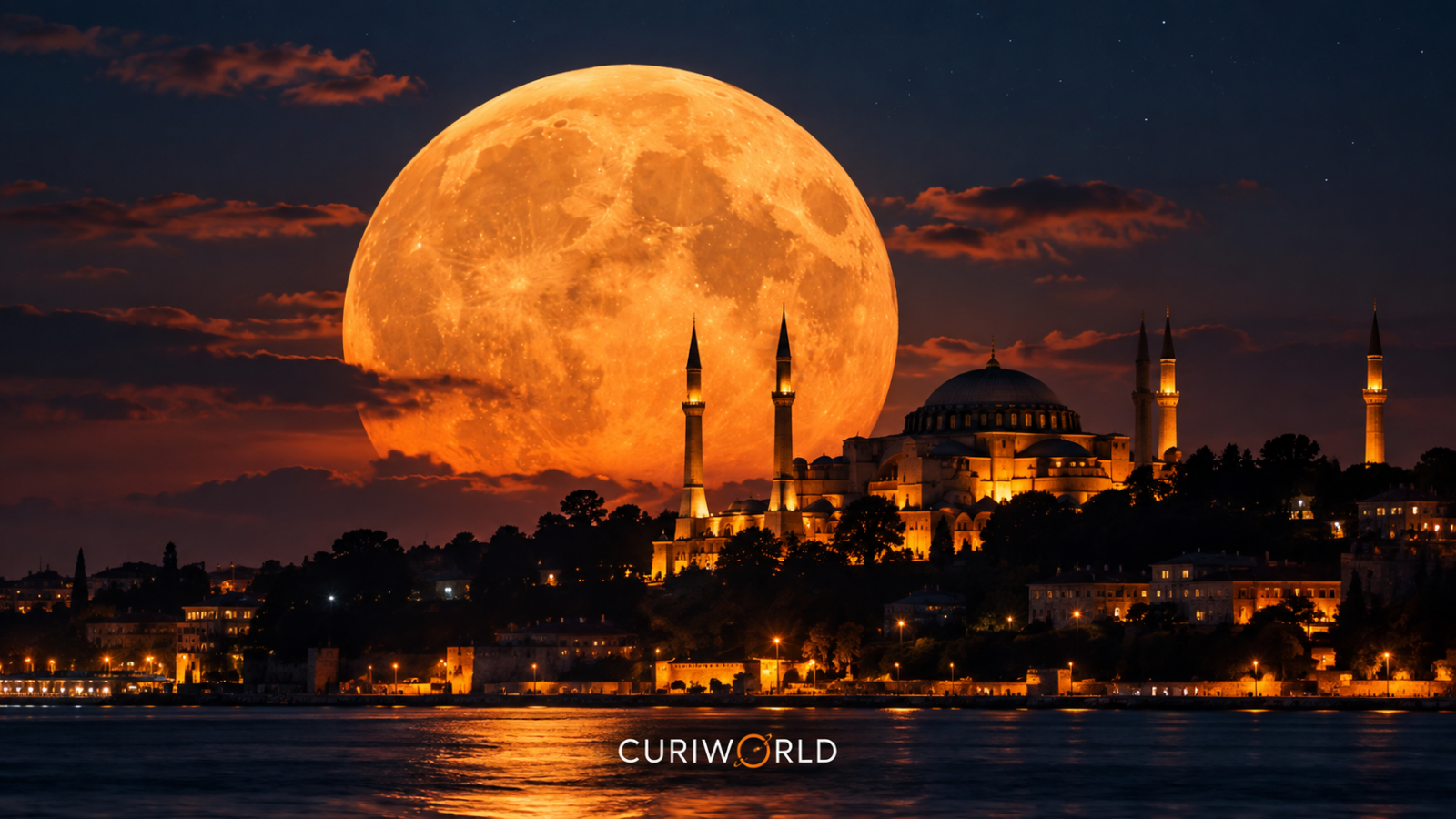
A full Moon rising behind buildings or trees can look enormous. A few hours later, the same Moon high in the sky somehow seems much smaller.
The Moon has not dramatically changed size or moved closer.
What you are seeing is the Moon illusion: a remarkably persistent trick of visual perception in which the Moon appears larger near the horizon than it does overhead.
And despite centuries of attempts to explain it, scientists still do not have one universally accepted explanation for exactly why the illusion is so convincing.
The Moon Isn’t Actually Bigger at the Horizon
The easiest assumption is that the Moon really does appear larger because of something happening in Earth’s atmosphere.
Measurements say otherwise.
NASA notes that photographs taken with the same camera settings show the Moon to be essentially the same width near the horizon as it is higher in the sky.
In fact, when the Moon is on the horizon, it can actually be slightly farther from an observer than when it is directly overhead.
So the effect is not caused by the Moon suddenly moving closer.
It happens in perception.
Your eyes receive an image of roughly the same angular size, but your brain interprets that image differently depending on where the Moon appears in the sky.
Why Does Your Brain Make the Moon Look Bigger?
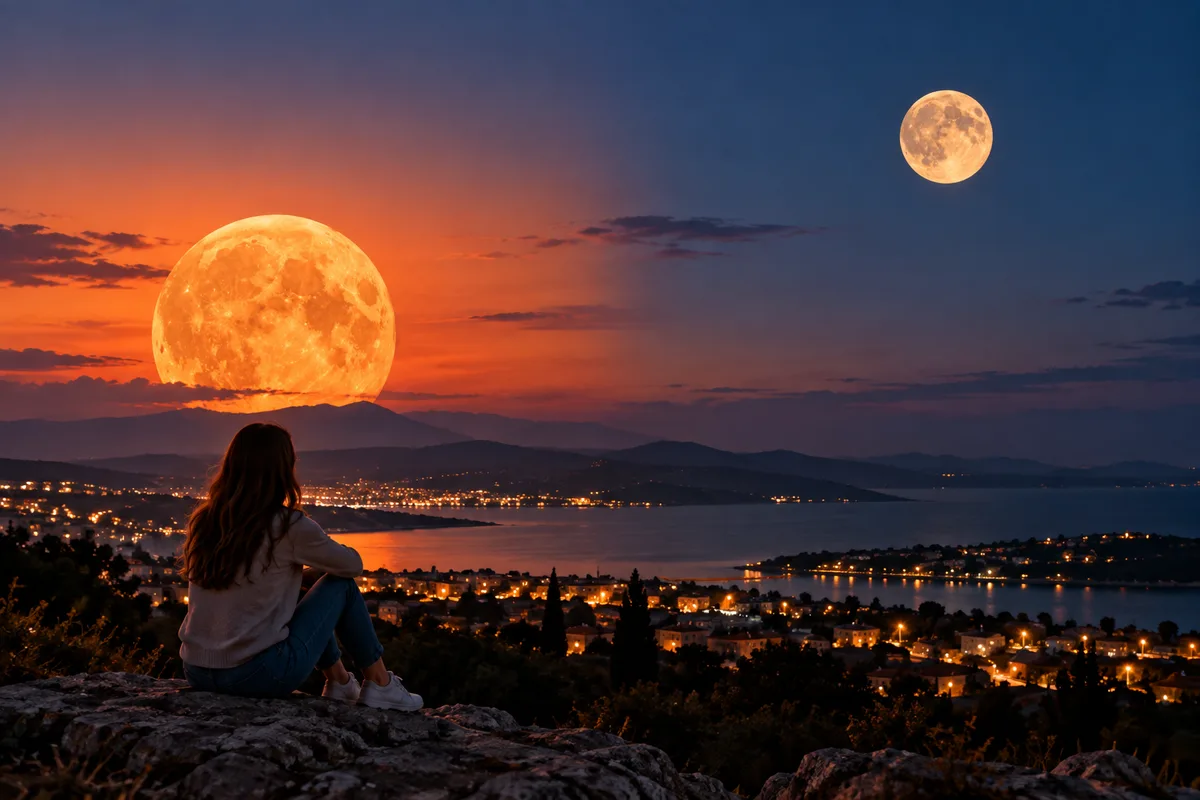
This is where the explanation becomes more interesting—and less certain.
One leading idea involves the way the brain interprets distance and size.
When you look toward the horizon, you see a world filled with distance cues: buildings, trees, mountains, roads, clouds, and other objects receding away from you.
Your brain is extremely good at using those cues to judge how far away things are.
The Moon, however, does something unusual.
It keeps roughly the same angular size even though your visual system may interpret the horizon as being much farther away than the open sky directly above you.
One possible result is that the brain treats the horizon Moon as a large object located very far away.
A similar principle appears in the Ponzo illusion, where two objects of equal size can appear different because surrounding perspective cues make one seem farther away.
Experiments on the Moon illusion have supported the idea that perceived distance plays an important role. Research published in Proceedings of the National Academy of Sciences, for example, found evidence that observers perceive the horizon Moon as being at a greater perceptual distance.
But that still does not settle the entire mystery.
Trees and Buildings Help — But They Aren’t the Whole Explanation
It certainly feels as though foreground objects are responsible.
A full Moon rising behind a distant building looks enormous partly because you suddenly have familiar objects around it.
Remove the buildings and trees, and you remove some of those visual comparisons.
But foreground objects cannot completely explain the Moon illusion.
NASA points out that astronauts have reported the effect even when they did not have ordinary terrestrial foreground objects providing the same distance cues.
Research has also suggested that several factors may contribute to the illusion rather than one simple mechanism.
That is why the most accurate answer is not:
“Your brain compares the Moon with buildings.”
It is:
The illusion appears to involve the way our visual system interprets size, distance, and the surrounding visual scene, but there is still no single explanation accepted as complete.
The Atmosphere Does Change the Moon — Just Not in the Way You Think
Earth’s atmosphere is often blamed for magnifying the Moon near the horizon.
It does not.
Atmospheric refraction can actually make a low Moon look slightly flattened, because light from the lower part of the Moon is bent differently from light coming from the upper part.
The atmosphere also changes its color.
When the Moon is low, its light travels through more of Earth’s atmosphere before reaching you. Shorter blue wavelengths are scattered more strongly along that long path, allowing warmer yellow, orange, and reddish tones to become more noticeable.
That is why a rising Moon may genuinely look orange while still not being physically enlarged.
The same atmosphere also produces other surprising effects in the night sky. Curiworld’s explanation of why stars twinkle while planets usually don’t shows how turbulent air can alter the light reaching our eyes without the distant object itself changing.
You Can Prove the Moon Illusion Yourself
There is a simple experiment.
Photograph the Moon shortly after it rises.
Later that night, photograph it again when it is much higher in the sky.
Use the same camera, focal length, and zoom setting both times.
Compare the Moon’s horizontal diameter in the two images.
It should be essentially the same.
NASA uses this photographic comparison as a straightforward demonstration that the dramatic increase we perceive near the horizon is an illusion.
You can also hold a small object—such as your fingernail—at arm’s length and compare it with the Moon at different heights.
The Moon may feel much larger at moonrise.
Its measured apparent width tells a different story.
Then Why Do Some Moon Photos Look Absolutely Huge?
Photography can create a different effect.
Those spectacular images showing an enormous Moon towering behind a skyscraper, mountain, or person are often taken from a long distance using a telephoto lens.
A long lens narrows the field of view and allows a photographer to frame distant foreground objects and the Moon together at large scale.
The Moon itself has not suddenly become gigantic.
The photographic composition has.
This is one reason the enormous Moon in a carefully planned photograph can look even more dramatic than the Moon illusion you experience with your eyes.
Is the Moon Illusion the Same as a Supermoon?
No.
A supermoon involves a real difference in distance.
The Moon follows an elliptical orbit around Earth, so its distance changes throughout the month. When a full Moon occurs near the closest part of that orbit, it can appear somewhat larger than a full Moon occurring farther away.
The Moon illusion is different.
It happens when the Moon appears unusually large simply because it is near the horizon.
A supermoon involves orbital distance.
The Moon illusion involves perception.
The two effects can happen at the same time, which can make a moonrise especially impressive.
The Moon’s distance from Earth also changes over much longer timescales. It is currently moving outward by roughly 3.8 centimeters per year—a completely different phenomenon explained in Curiworld’s look at why the Moon is slowly moving away from Earth.
Why Does the Illusion Still Work Even When You Know About It?
Knowing the explanation usually does not make the effect disappear.
You can understand perfectly well that the Moon has not doubled in size and still watch a moonrise that looks enormous.
That is because perception is not simply a conscious calculation.
Your visual system is constantly interpreting distance, perspective, size, and context before you consciously think about what you are seeing.
Optical illusions exploit those automatic processes.
The Moon illusion is especially striking because it happens not on a screen or in a psychology experiment, but across hundreds of thousands of miles of space.
The Moon stays roughly the same apparent size.
The sky around it changes.
And your brain turns that difference in context into one of the oldest visual illusions humans have ever noticed.
Sources
NASA Science — The Moon Illusion: Why Does the Moon Look So Big Sometimes?
NASA — Why Does the Moon Look Larger at the Horizon?
Kaufman & Kaufman — Explaining the Moon Illusion, PNAS
Plug & Ross — The Natural Moon Illusion: A Multifactor Angular Account






Join the discussion