Why Does Hair Turn Gray? And Can Stress Really Speed It Up?
Why does hair turn gray, and can stress speed it up? Here’s what science says about melanin, aging, genetics, stress and whether gray hair can ever regain color.
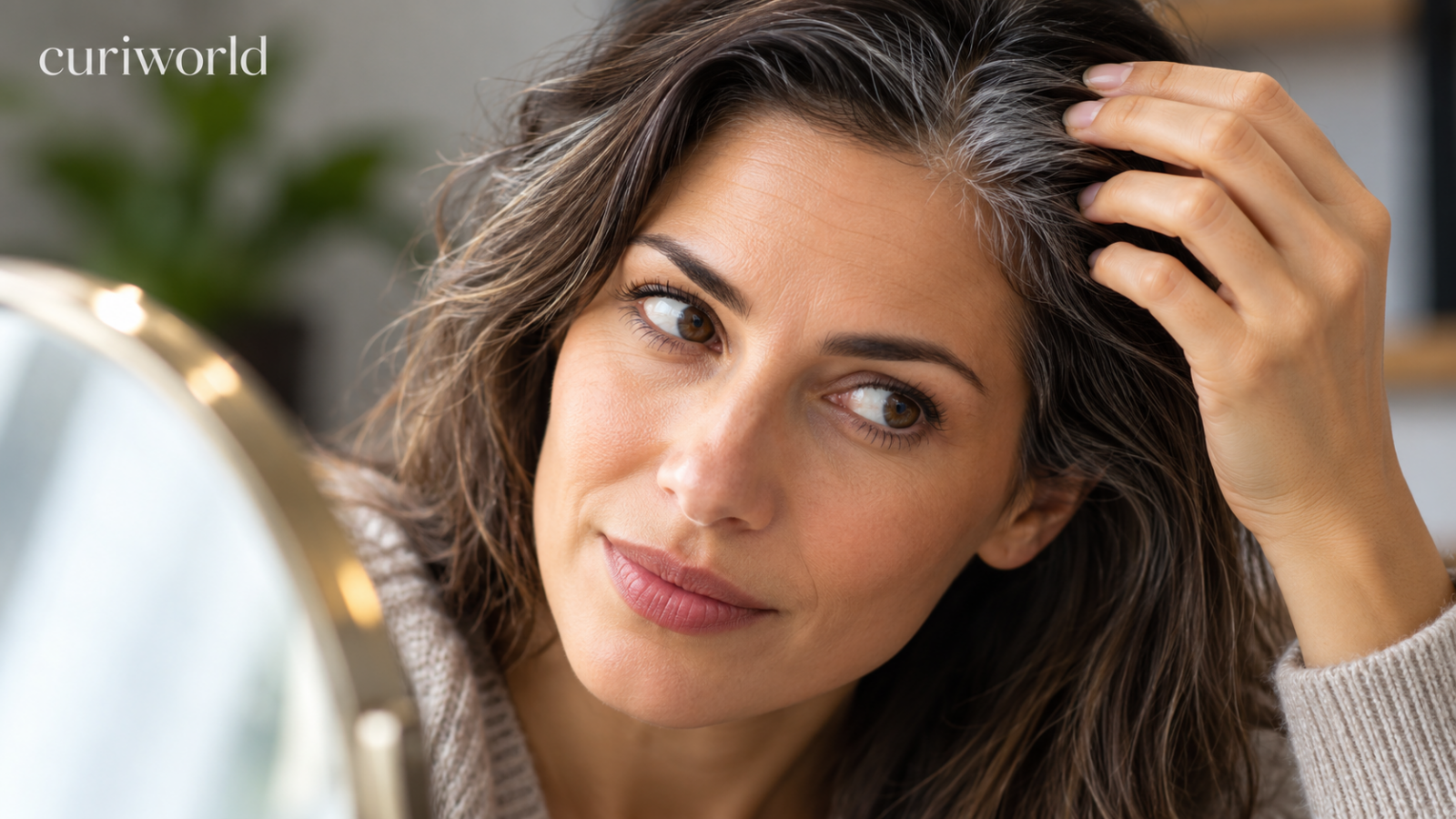
The first gray hair can feel surprisingly sudden. One day your hair looks unchanged; the next, a silver strand seems to have appeared out of nowhere.
But hair does not simply “lose its color” after it leaves your scalp.
Gray hair begins inside the follicle, where pigment-producing cells normally add melanin to each new strand as it grows. With age, that pigment system becomes less reliable. Eventually, some follicles produce hair with much less melanin—or none at all.
And stress? The familiar idea that an intensely stressful period can make someone go gray is not entirely a myth. The science is real, but it is more nuanced than the popular story suggests.
Hair Gets Its Color Before You See It
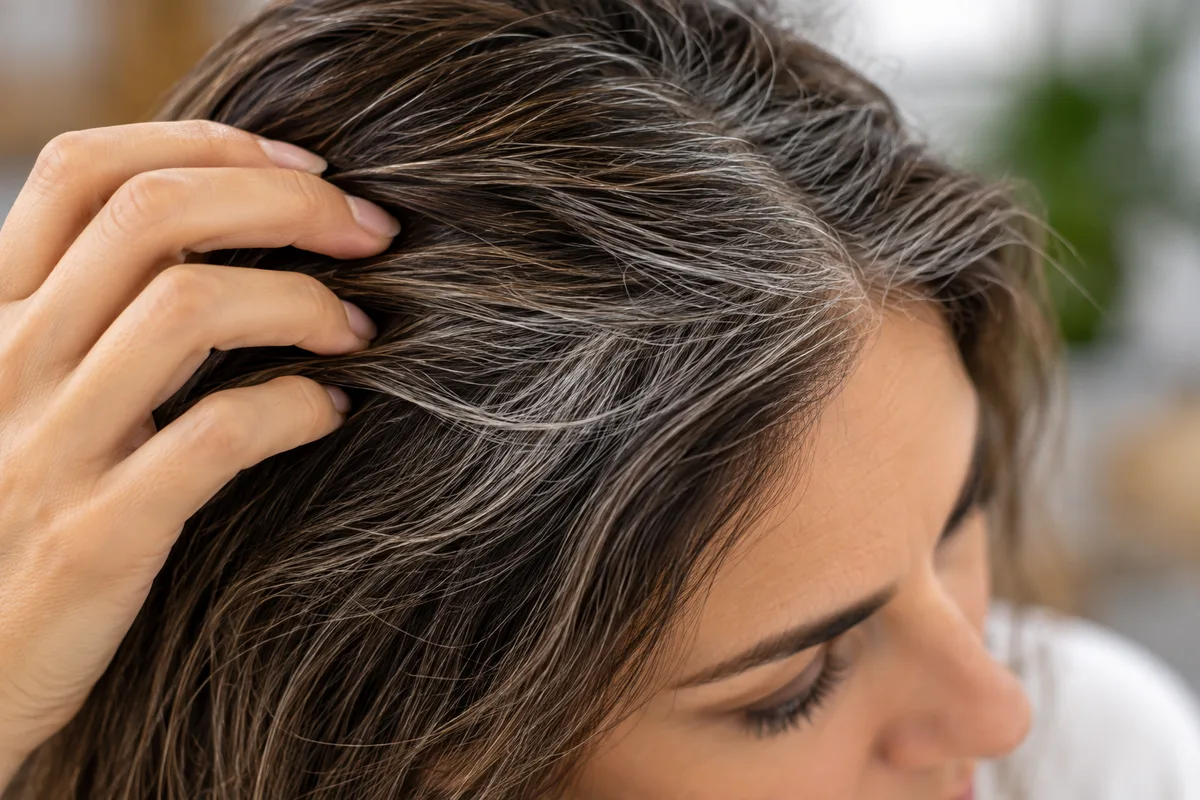
Natural hair color comes largely from melanin, the same broad family of pigments involved in skin and eye color.
Inside a growing hair follicle, specialized cells called melanocytes produce pigment and transfer it into the developing hair shaft. Darker hair generally contains more or differently distributed melanin than lighter hair.
Once that section of hair grows out of the scalp, however, its pigmentation is essentially already set.
That distinction matters.
A visible brown hair does not normally sit on your head and suddenly drain itself of pigment. If a follicle stops supplying enough melanin, the change becomes visible in the new hair growing from that follicle.
The biology therefore happens underneath the skin before you notice it in the mirror.
It is similar to another everyday hair question Curiworld has explored: why hair gets greasy so quickly. What we see on the strand often begins with processes happening in the scalp and hair follicle.
So What Actually Changes as Hair Turns Gray?
Hair follicles contain a population of melanocyte stem cells that help replenish the pigment-producing cells needed during new cycles of hair growth.
Those cells do not function indefinitely.
Research supported by the U.S. National Institutes of Health has shown that aging melanocyte stem cells can become increasingly dysfunctional. Some become trapped in parts of the follicle where they can no longer mature and perform their normal pigment-producing role.
As fewer functioning pigment cells remain available, new hairs receive less melanin.
The progression may look roughly like this:
A fully pigmented follicle produces a strand in your normal hair color. A follicle with declining pigment activity may produce a lighter or gray-looking strand. A follicle producing essentially no pigment may generate a white strand.
What we call a “gray head of hair” is often actually a mixture of pigmented and unpigmented strands rather than thousands of hairs that are literally the same shade of gray.
NIH — Aging Melanocyte Stem Cells and Gray Hair
Why Do Some People Go Gray Earlier Than Others?
There is no universal age at which hair is supposed to turn gray.
The American Academy of Dermatology notes that many people begin noticing gray hair in their 30s or 40s, while others see it considerably earlier.
Genetics plays a major role.
If your parents or close relatives developed gray hair relatively early, your own chances of doing so earlier may also be higher. Researchers have identified genetic variants associated with hair graying, while the aging of pigment-producing cells and oxidative processes inside the follicle also appear to contribute.
That means two healthy people of the same age can have dramatically different amounts of gray hair without either person doing anything “wrong.”
Gray hair is primarily a biological aging process—not evidence that someone has failed to eat the right food, use the right shampoo or manage life perfectly.
Can Stress Really Make Hair Turn Gray Faster?
This is where the science becomes especially interesting.
There is strong experimental evidence that stress can affect the biological machinery responsible for hair pigmentation.
A landmark study published in Nature examined the process in mice. Researchers found that acute stress activated the sympathetic nervous system, part of the body’s fight-or-flight response.
That activation triggered the release of norepinephrine around hair follicles.
The result was dramatic: melanocyte stem cells became excessively activated, left their normal reserve state and were depleted from the follicle. Once that stem-cell supply was exhausted in the mice, the affected hairs could no longer maintain normal pigmentation.
Nature — Hyperactivation of Sympathetic Nerves Drives Depletion of Melanocyte Stem Cells
But there is an important limitation.
That mechanistic experiment was performed in mice.
Human biology does not always behave exactly like a mouse model, so it would be too simplistic to claim that every stressful month permanently destroys human hair pigment cells in precisely the same way.
Human evidence is more limited—but still intriguing.
Human Hair May Record Periods of Stress
A 2021 study published in eLife examined pigmentation patterns along individual human hairs.
Because scalp hair grows gradually, different sections of the same hair can effectively represent different periods of time. Researchers were therefore able to compare changes in pigmentation with participants’ reported life stress.
In some individual hairs, changes toward graying occurred around periods of greater psychological stress. In other cases, hairs regained pigmentation around periods when stress decreased.
That does not prove that stress alone determines whether a person’s hair turns gray.
The study involved a relatively small number of people and unusual individual hairs, so its findings should not be interpreted as evidence that taking a vacation will restore an entire head of gray hair.
What it does show is more interesting: human hair pigmentation may be more biologically responsive than scientists once assumed.
eLife — Quantitative Mapping of Human Hair Greying and Reversal in Relation to Life Stress
Can Your Hair Really Turn White Overnight?
Not in the way the phrase usually suggests.
A hair shaft that has already emerged from your scalp cannot normally switch from dark brown to white overnight because the pigment in that section was deposited while the hair was forming.
New growth can emerge with less pigment after changes inside the follicle, but hair grows gradually.
That means extreme stress today is not expected to transform every visible strand into white hair tomorrow morning.
Stories about people apparently “going gray overnight” are therefore misleading if interpreted literally.
A dramatic change can sometimes appear much faster than normal graying if pigmented hairs are preferentially lost while existing white hairs remain, but that is a different process from an individual hair suddenly losing all of its pigment.
Can Gray Hair Ever Turn Dark Again?
Surprisingly, sometimes an individual hair can.
The eLife researchers documented rare hairs that changed from pigmented to gray and later regained pigmentation.
This challenges the older assumption that every instance of graying is absolutely irreversible from the moment it begins.
But there is a major difference between biological possibility and a practical treatment.
Repigmentation observed in research involved isolated hairs and appears uncommon. There is currently no proven therapy that reliably restores the original color of ordinary age-related gray hair across the scalp.
Once the pigment-producing system within a follicle has been substantially depleted or permanently altered, reducing stress does not guarantee that color will return.
So the useful conclusion is not:
“Reduce stress and your gray hair will disappear.”
It is:
Some early pigment changes may be more reversible than once believed, but normal age-related graying is still usually persistent.
What About Vitamins, Supplements and Anti-Gray Products?
This is an area where marketing often gets ahead of evidence.
Gray hair has been associated in some studies with nutritional deficiencies and certain medical conditions, particularly when graying occurs unusually early. But an association does not mean that everyone with gray hair has a deficiency.
Taking large amounts of biotin, vitamin B12 or other supplements without evidence of a deficiency is not a proven way to restore ordinary age-related hair color.
The American Academy of Dermatology states that there is currently no effective medical treatment that reliably adds natural color back to typical gray hair.
If an underlying condition or nutritional deficiency is actually present, treating that condition is a different situation.
American Academy of Dermatology — What Causes Gray Hair, and Can I Stop It?
When Is Gray Hair Worth Asking a Doctor About?
For most adults, gradually developing gray hair is simply part of aging.
It may be worth discussing with a dermatologist or primary care professional when graying appears unusually early, progresses unexpectedly, develops alongside significant hair loss or skin pigment changes, or occurs together with other unexplained symptoms.
The goal is not to assume that gray hair signals disease.
Usually, it does not.
The point is that unusually early or atypical changes can occasionally occur alongside nutritional, autoimmune, thyroid or other medical issues that deserve evaluation based on the person’s broader health picture.
Gray Hair Is Really a Story About the Follicle
Hair does not turn gray because color simply “wears out.”
The change begins deep inside the follicle.
Melanocytes normally provide pigment. Melanocyte stem cells help maintain that system. As those cells age, malfunction or disappear, new hair grows with progressively less melanin.
Genetics strongly influences when that process becomes noticeable.
Stress may also accelerate pigmentation changes under some circumstances. Animal experiments have uncovered a direct biological pathway, while human research suggests that stress-related graying—and even occasional reversal—can happen in individual hairs.
But neither finding means that stress is the sole cause of gray hair.
For most people, the simplest explanation remains the strongest one:
Your hair follicles are aging, and their pigment-producing system is gradually changing with them.
Sources
National Institutes of Health — Aging Melanocyte Stem Cells and Gray Hair
Nature — Hyperactivation of Sympathetic Nerves Drives Depletion of Melanocyte Stem Cells
eLife — Quantitative Mapping of Human Hair Greying and Reversal in Relation to Life Stress
American Academy of Dermatology — What Causes Gray Hair, and Can I Stop It?






Join the discussion