Why Are Some Beaches Made of Black Sand?
Why are some beaches covered in black sand? Discover how volcanic rock, lava, erosion, and heavy minerals create some of the world’s most dramatic shorelines.
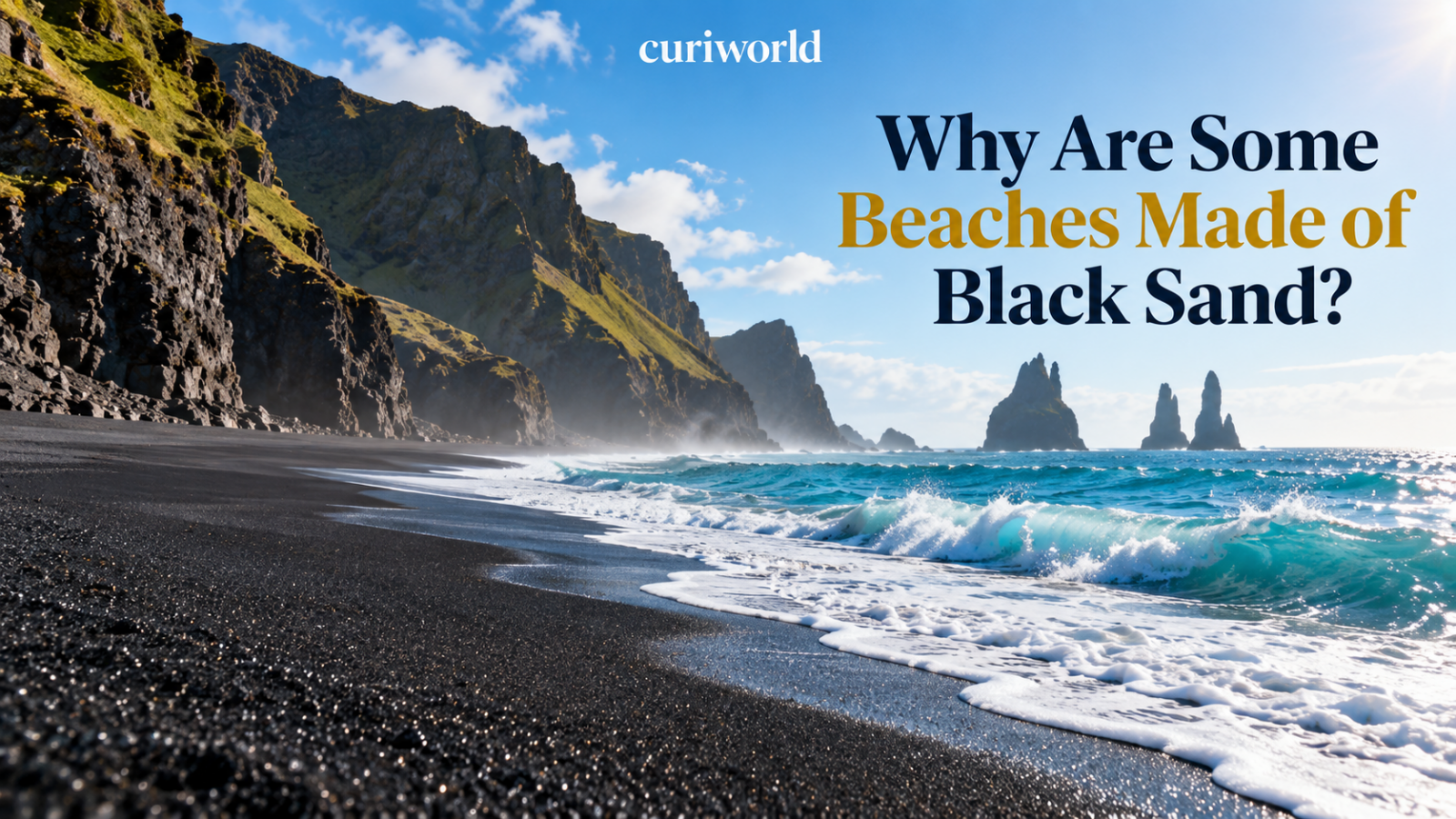
You step onto a beach expecting pale golden sand—then find the entire shoreline covered in deep charcoal grains instead.
Black sand beaches look dramatic, almost unreal. They are especially famous in places like Hawaii, Iceland, the Canary Islands, and parts of New Zealand, where the contrast between dark sand, blue water, and surrounding cliffs can feel almost cinematic.
But the explanation is wonderfully geological:
Most black sand beaches are made from dark volcanic material, especially basalt, that has been broken down into tiny grains by cooling, erosion, and wave action.
In other words, the beach is black because the rocks that supplied the sand were black.
Sand Is Not Just “Sand”
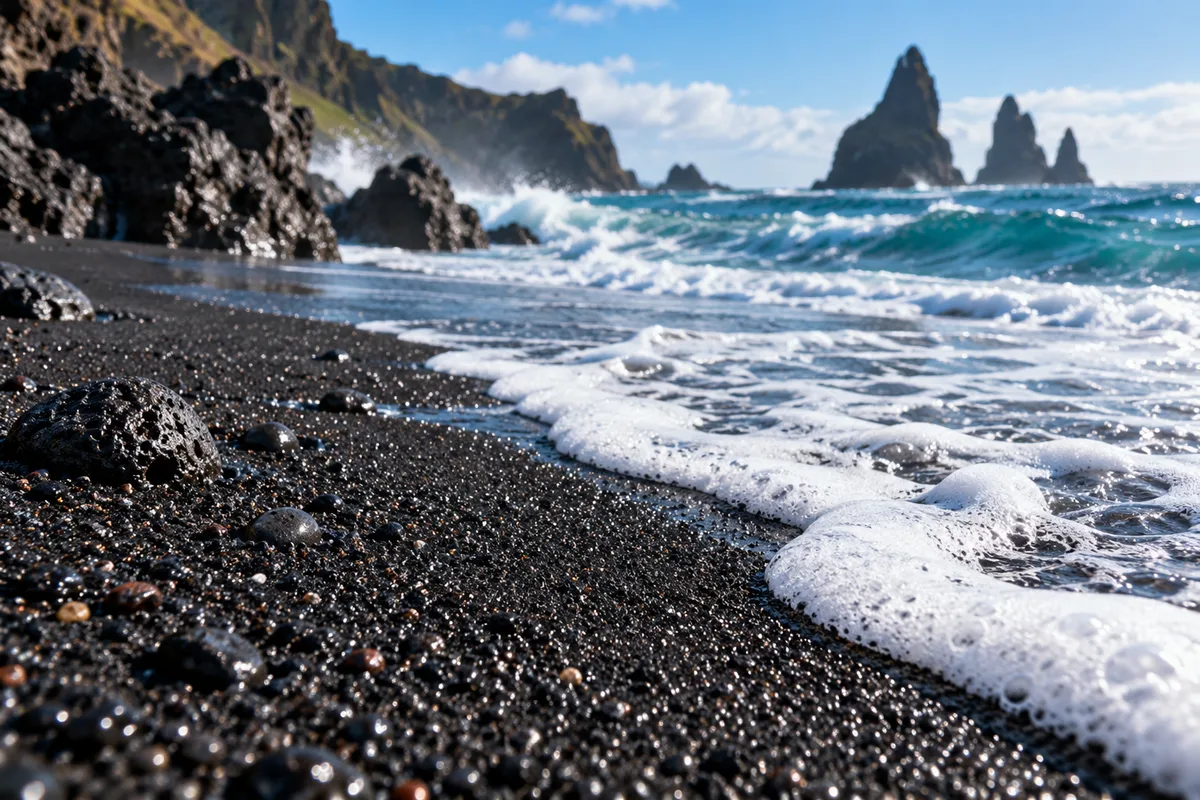
It is easy to think of sand as one universal material.
It is not.
Sand is simply a name for grains of a certain size. Those grains can come from many different sources: quartz, coral, shells, limestone, volcanic rock, glassy lava fragments, or heavy minerals such as magnetite.
That is why beaches come in so many colors.
A white beach may be rich in coral and shell fragments. A golden beach may contain lots of quartz and feldspar. A green beach may owe its color to olivine. And a black beach usually gets its dark color from volcanic material or dark heavy minerals.
So when people ask why some beaches are black, the real question is:
What kind of material is being broken down and deposited there?
The Most Common Reason: Volcanic Rock
The classic black sand beach forms in volcanic regions.
Basalt, one of the most common volcanic rocks on Earth, is dark gray to black. When lava flows reach the coast or when older basaltic lava cliffs are exposed to weathering, the rock begins to break apart.
That breakdown can happen in more than one way.
Sometimes lava enters the ocean and cools extremely quickly. The sudden cooling causes it to fracture and shatter into fragments. Over time, waves grind those fragments into smaller and smaller pieces until they become sand-sized grains.
Other times, older lava flows or volcanic cliffs are gradually worn down by rain, wind, surf, and erosion, feeding dark particles into nearby beaches.
USGS describes this process clearly at Pohoiki in Hawaiʻi: molten lava entered the ocean, cooled, shattered into fragments, and those fragments were later ground down and redistributed by wave action and longshore currents.
That is the basic recipe behind many of the world’s best-known black sand beaches.
Why the Sand Looks So Dark
Color depends on composition.
Basalt contains dark minerals and volcanic glass, so when it is broken into tiny grains, the resulting sand keeps that dark appearance.
But not every black beach is exactly the same shade.
Some look jet black.
Others appear charcoal gray, dark brown, or peppered with lighter grains.
That variation depends on what else is mixed in. A beach may contain:
- basalt fragments,
- volcanic glass,
- lighter mineral grains,
- shell fragments,
- or sediments carried from nearby rivers or cliffs.
A “black sand beach” is therefore often a mixture rather than a perfectly pure field of black grains.
Still, if dark volcanic material dominates, the overall effect is unmistakable.
Not All Black Sand Beaches Are Purely Volcanic
Volcanic material is the best-known cause—but it is not the only one.
Some dark beaches owe part of their color to heavy minerals, especially iron-rich minerals such as magnetite. Because these grains are denser than many lighter sands, waves can sort and concentrate them.
That means a beach does not always need to be made entirely from fresh volcanic lava to look dark. Coastal processes can separate heavy dark grains from lighter ones and leave behind striking black or dark-gray patches.
This is one reason black sand can sometimes appear in streaks, bands, or concentrated zones rather than as a uniform shoreline from end to end.
So the short version is:
- Volcanic black beaches are usually made from eroded basalt or volcanic glass.
- Mineral-rich black beaches may get their color from concentrated heavy dark minerals.
Both are real. The first is simply the more famous version.
Why Aren’t All Beaches Black?
Because most beaches do not have the same raw materials.
Many of the world’s sandy shorelines are dominated by light-colored quartz, shell fragments, or coral-derived material. If that is the main sediment source, the beach will not turn black.
To form a black sand beach, a coastline usually needs a few specific conditions:
1. A dark source material
There has to be volcanic rock or dark minerals available in the first place.
2. A way to break it down
Weathering, surf, cliff erosion, or lava entering the sea must turn larger rock into smaller grains.
3. Coastal transport
Waves and currents need to move and sort the material along the shore.
4. Limited dilution by lighter sand
If lots of pale quartz or shell material is mixed in, the beach may look gray or mottled instead of deeply black.
That is why black sand beaches are common in some volcanic island systems but rare in many non-volcanic coastal regions.
Why Some Black Sand Beaches Change Over Time
A black sand beach may look ancient and permanent, but some are surprisingly dynamic.
Waves, storms, tides, and longshore currents constantly reshape beaches. Sand is moved upshore, offshore, and sideways along the coast. In some places, black sand beaches may grow, shrink, shift location, or change texture over the years.
USGS notes that Pohoiki’s black sand beach in Hawaiʻi continued evolving after its rapid formation, with currents and seasonal swells redistributing the dark sediment over time.
That helps explain why one black beach may appear wide and smooth while another nearby is coarse, narrow, or patchy.
A beach is not just a place where sand sits.
It is an active system.
If the sediment supply changes—or if storms remove more sand than the coast can replace—the appearance of the beach can change dramatically.
Why Black Sand Beaches Often Feel Hotter
There is a practical reason black sand leaves such a strong impression on visitors:
it heats up fast.
Dark materials absorb more solar energy than pale materials, so black sand exposed to strong sun can become much hotter underfoot than a white or beige beach.
That does not mean every black sand beach is always scorching. Weather, moisture, wind, and time of day all matter.
But on a bright sunny afternoon, the difference can be very noticeable.
For travelers, this is one of the most memorable parts of the experience—after the color itself.
Where Do You Usually Find Black Sand Beaches?
Most famous black sand beaches are found in places with volcanic histories.
That includes:
- Hawaii
- Iceland
- the Canary Islands
- parts of New Zealand
- some beaches in Japan
- and other volcanic islands or coastlines
The exact look of each beach depends on local geology.
A Hawaiian black beach may be tied closely to basaltic lava flows.
An Icelandic one may include volcanic ash and basaltic material shaped by a very different coastal environment.
So while these beaches share a dark appearance, they do not all form in exactly the same way.
Are Black Sand Beaches Rare?
They are unusual on a global scale, but not mysterious.
They stand out because they are visually striking and because the conditions needed to create them are more specific than those for an ordinary quartz-sand beach.
You need the right rocks, the right erosional forces, and the right coastal transport.
When all of that comes together, the result is one of the most distinctive landscapes on Earth.
And if you are curious about how ocean water and coastal systems shape what we see at shorelines, Curiworld’s Why Is the Ocean Salty but Rivers Aren’t? pairs especially well with this topic.
So Why Are Some Beaches Made of Black Sand?
Because the sand reflects the geology around it.
Most black sand beaches form where dark volcanic rocks—especially basalt—are broken down into small grains and then sorted and deposited by waves and currents.
Some dark beaches also owe their color to concentrated heavy minerals such as magnetite.
So the beach is not black by accident.
It is black because the surrounding landscape, the history of lava, and the movement of the sea all combined to make it that way.
That is what makes black sand beaches so memorable: they are not just beautiful coastlines.
They are visible geology under your feet.
Sources
U.S. Geological Survey — Volcano Watch: How to build a beach: Pohoiki growth over the years
University of Hawaiʻi — Beaches and Sand
University of Hawaiʻi Sea Earth Atmosphere Learning — Black Sand Beaches








Join the discussion