Can Roads Charge Electric Cars While They Drive? How Dynamic Charging Works
Dynamic charging roads use embedded coils to transfer electricity wirelessly to compatible EVs while they move. The technology works—but cost, standards and infrastructure remain the bigger challenge.
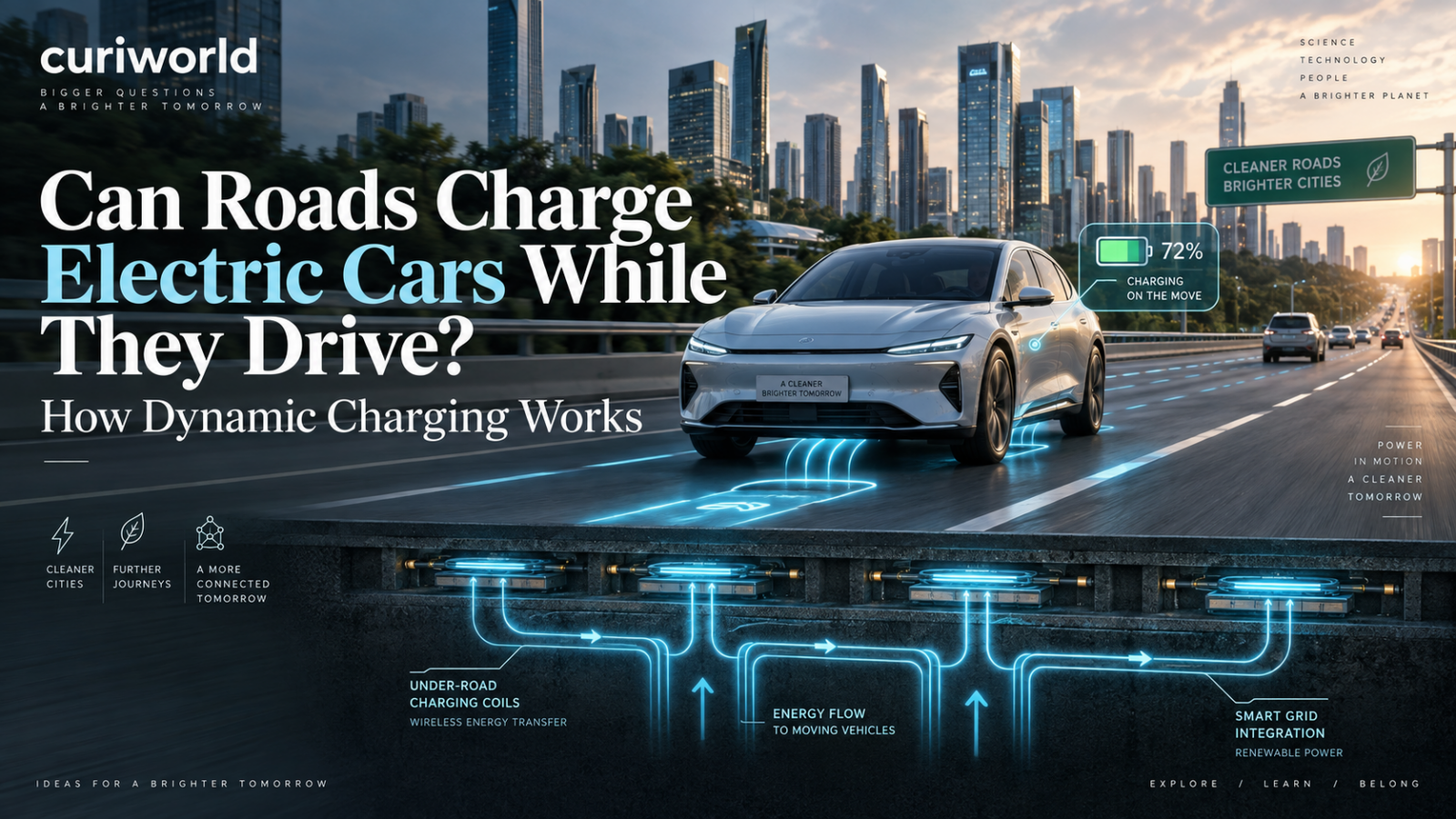
Imagine driving an electric car down a highway and watching the battery percentage fall much more slowly than expected.
No charging stop.
No cable.
No plug.
The road itself is sending energy into the vehicle.
That sounds futuristic, but the basic technology already exists.
Dynamic wireless charging uses electrical coils installed beneath or inside the roadway to transfer power wirelessly to a receiver mounted under a compatible electric vehicle while it is moving.
The idea is real.
The harder question is whether it can become practical enough to use at large scale.
Dynamic Charging Is Basically Wireless Charging for a Moving Vehicle
Most people are familiar with wireless phone charging.
You place a phone on a charging pad.
A coil in the charger creates a changing magnetic field.
A receiving coil inside the phone picks up that energy and converts it back into electricity.
Dynamic EV charging uses a similar basic principle—but on a much larger scale.
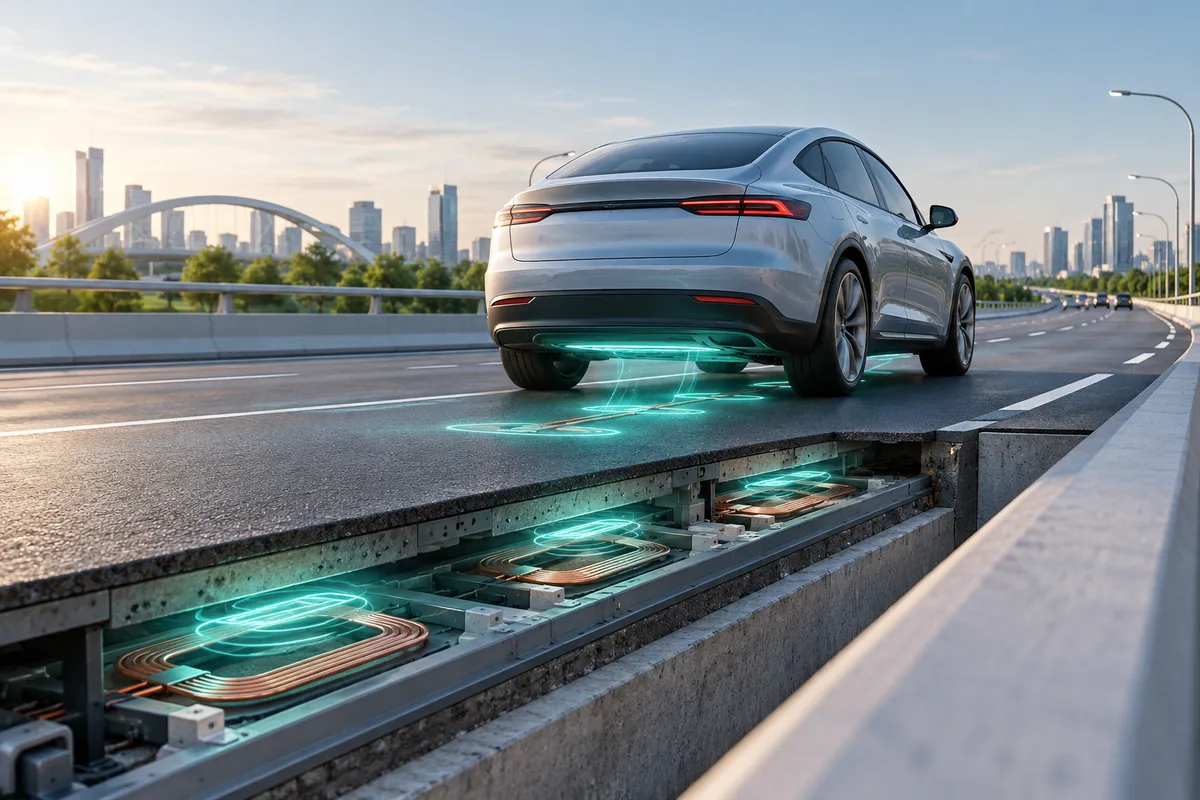
Instead of one charging pad, the road contains a series of embedded charging segments.
Instead of a phone coil, the vehicle has a large receiver underneath.
As the vehicle passes over an active road segment, energy transfers across the air gap between road and vehicle.
The battery can then receive that power while the car continues moving.
The Road Does Not Need to Be Electrified Everywhere at Once
This is an important point.
A dynamic charging road does not necessarily keep every embedded coil continuously powered.
Systems can activate only the segment directly beneath an authorized vehicle.
Michigan DOT describes its wireless charging roadway this way: the system energizes the in-road coil segments when an equipped vehicle is directly above them, and the vehicle-mounted receiver transfers that energy to the battery.
That makes the infrastructure more controlled.
It also reduces the need to energize empty sections of roadway continuously.
What Is Actually Under the Road?
A simplified system usually contains three main parts.
1. Power electronics connected to the grid
Electricity has to come from somewhere.
Roadside equipment converts grid power into the type of high-frequency alternating current needed by the wireless charging system.
2. Embedded transmitting coils
These coils sit beneath or within the road surface.
They create a magnetic field when energized.
3. A receiver mounted under the vehicle
The vehicle needs its own compatible receiving coil and power electronics.
That receiver converts the transferred energy into electricity the vehicle can use.
So the car does not simply “absorb electricity from the asphalt.”
Both road and vehicle need specialized hardware.
How Does Power Cross the Gap Without a Cable?
The key idea is inductive power transfer.
A changing electrical current in one coil creates a changing magnetic field.
A nearby second coil can capture part of that field and generate an electrical current of its own.
Wireless EV charging systems often use resonant techniques to improve the transfer across the gap between road and vehicle.
That gap matters.
The road coil is below the surface.
The vehicle receiver is mounted underneath the chassis.
The two coils therefore need to transfer substantial power across several inches of space while the vehicle is moving.
That is much harder than charging a phone sitting still on a pad.
The Vehicle Has to Stay Reasonably Aligned
Wireless charging works best when the transmitter and receiver are positioned properly relative to one another.
If the vehicle moves too far sideways, coupling between the coils becomes weaker.
That can reduce efficiency and power transfer.
For stationary wireless charging, alignment can be controlled relatively easily by parking over the pad.
Dynamic charging is harder because:
- the vehicle is moving,
- suspension height changes,
- lane position varies,
- and road geometry is not perfectly uniform.
That is one reason lane positioning and system design matter so much.
Future systems may benefit from advanced driver-assistance systems that keep vehicles more precisely centered over charging lanes.
Can the Road Fully Charge the Battery While You Drive?
Possibly—but not necessarily.
It depends on the amount of power transferred and how much energy the vehicle is using at the same time.
Imagine an EV cruising and consuming 20 kW.
If the road supplies 10 kW, the battery may still lose energy—but much more slowly.
If the road supplies approximately the same amount the vehicle is consuming, battery state of charge may stay roughly stable.
If the road delivers more power than the car needs to move, the battery can gain charge.
So “charging while driving” does not automatically mean the battery percentage will climb quickly.
Sometimes the bigger benefit is simply reducing how much battery energy the trip consumes.
Why This Could Matter for Trucks More Than Cars
Heavy trucks are one of the most interesting use cases.
Long-range electric trucks need enormous batteries.
Those batteries are:
- expensive,
- heavy,
- resource-intensive,
- and space-consuming.
If a truck can receive energy while traveling along frequently used freight routes, it may not need to carry as much battery capacity.
That could reduce vehicle weight and battery cost.
This is one reason SAE has separate wireless power work addressing higher-power heavy-duty applications and includes dynamic charging among the areas under development.
Freight corridors also have another advantage:
trucks often follow predictable routes.
That makes infrastructure investment easier to target.
Why Not Electrify Every Highway?
Because installing powered roadway is expensive.
A charging road requires much more than coils.
It may need:
- excavation,
- electrical connections,
- power electronics,
- communications systems,
- road reconstruction,
- monitoring,
- maintenance access,
- drainage protection,
- and integration with the wider electricity grid.
And roads are harsh environments.
They experience:
- water,
- heat,
- freezing,
- salt,
- heavy axle loads,
- vibration,
- resurfacing,
- potholes,
- and repeated repairs.
Embedding electrical infrastructure under a road makes maintenance more complicated.
That does not make the idea impossible.
It simply means the economics matter as much as the physics.
Dynamic Charging Could Reduce Battery Size
This is one of the strongest arguments for the technology.
Today, EV manufacturers increase range largely by adding battery capacity.
But a larger battery adds:
- cost,
- mass,
- material use,
- and manufacturing emissions.
If an electric road can provide energy during a meaningful part of a vehicle’s journey, designers could potentially use a smaller battery while maintaining useful range.
That would fundamentally change the EV design problem.
Instead of carrying enough energy for the entire journey, a vehicle could receive part of its energy from the road.
That is closer to the logic of an electric train—but without a continuous overhead wire.
But Smaller Batteries Only Make Sense if the Road Is Reliable
There is an obvious catch.
Drivers will not accept a small battery if the charging road is unavailable.
Imagine depending on dynamic charging for a long trip and discovering:
- the system is offline,
- construction has closed the charging lane,
- your vehicle cannot authenticate,
- or the next electrified section is hundreds of miles away.
The vehicle still needs enough battery capacity to handle real-world interruptions.
That means dynamic roads are unlikely to eliminate batteries.
They may reduce how large those batteries need to be in specific use cases.
What Happens When a Car That Cannot Charge Drives Over It?
Nothing special.
The road does not automatically transmit usable power to every vehicle.
The vehicle needs compatible receiver hardware and communication with the charging system.
Michigan DOT’s system, for example, energizes charging segments when an authorized equipped vehicle is above them.
A conventional gasoline car or an EV without the required receiver simply drives over the road normally.
Is It Safe to Have Powerful Magnetic Fields Under the Road?
Safety and electromagnetic compatibility are major parts of wireless charging standardization.
SAE J2954 includes requirements related to:
- electromagnetic compatibility,
- electromagnetic fields,
- minimum performance,
- interoperability,
- and safety.
Dynamic systems add more complexity because the vehicle is moving.
This is one reason standards matter so much.
A road system cannot realistically scale if each vehicle manufacturer uses completely incompatible charging geometry and communication rules.
Why Standards Are Such a Big Deal
Imagine if every gas station nozzle worked with only one car brand.
Charging infrastructure would become chaotic.
Dynamic road charging has the same problem.
The road must know:
- that a compatible vehicle is present,
- how to communicate with it,
- how much power to deliver,
- how to authenticate it,
- and how to do all of that safely.
The receiver also has to work with infrastructure built by different road operators.
As of 2026, SAE’s current light-duty J2954 standard is focused on stationary wireless charging, while dynamic light-duty applications are planned under J2954/3.
That tells us something important:
The technology is real, but large-scale interoperability is still being developed.
Is Dynamic Charging Efficient?
Wireless transfer is not perfectly lossless.
Some energy becomes heat and is lost in power electronics and magnetic coupling.
Efficiency depends on factors such as:
- coil design,
- alignment,
- air gap,
- power level,
- vehicle speed,
- and electronics.
Stationary wireless charging systems can achieve high efficiencies under controlled alignment.
Dynamic systems have to maintain good performance while vehicles move across many separate road segments.
That makes consistent efficiency more difficult.
And at highway scale, even a small percentage difference matters.
If millions of kilowatt-hours are transferred, small losses become large amounts of energy.
Could the Charging Road Bill You Automatically?
Technically, yes.
Because the system already needs to identify compatible vehicles and control which road segments activate, it can also support digital authorization and usage tracking.
A future system could charge drivers based on:
- energy received,
- distance traveled on the charging lane,
- subscription,
- fleet account,
- or another billing model.
That creates another layer of infrastructure beyond electricity itself.
The road becomes partly a communications network.
What About Rain and Snow?
Road infrastructure has to work in far worse conditions than a household wireless charger.
The system needs to tolerate:
- rain,
- standing water,
- road salt,
- snow,
- freezing temperatures,
- heat,
- and heavy traffic.
Because the coils are embedded and the power transfer is wireless, there are no exposed charging contacts that a driver has to plug in.
That is an advantage.
But sealing, thermal management, road durability, and maintenance remain engineering challenges.
Could Roads Charge Buses at Stops Instead?
Yes—and that can actually be easier.
Wireless EV charging does not have to be fully dynamic.
There are three broad forms:
| Type | Vehicle movement |
|---|---|
| Static wireless charging | Parked |
| Quasi-dynamic / opportunity charging | Stopped briefly, such as at a bus stop |
| Dynamic charging | Moving |
A city bus that stops repeatedly on the same route can receive short bursts of energy at selected stops.
That requires far less electrified roadway than powering an entire route continuously.
For some transit systems, this may be more economical than full dynamic charging.
Why Dynamic Charging Is Different From an Overhead Electric Road
Not every “electric road” is wireless.
Several concepts exist.
Some systems use:
- overhead wires,
- conductive rails in the road,
- roadside power connections,
- or embedded wireless coils.
Wireless dynamic charging avoids physical contact between the moving vehicle and the electrical infrastructure.
That is attractive because there is no exposed rail or overhead pantograph.
But wireless transfer adds its own cost and efficiency challenges.
So there is no single technology that has already “won.”
Where Is This Actually Being Tested?
One of the clearest U.S. examples is in Detroit.
Michigan DOT describes a quarter-mile electrified roadway on 14th Street equipped with wireless charging infrastructure.
An equipped Ford E-Transit test vehicle has demonstrated charging both while parked and while moving over the system.
Projects like this matter because laboratory efficiency is only one part of the problem.
Engineers also need real-world data on:
- road durability,
- maintenance,
- vehicle alignment,
- energy transfer,
- weather,
- traffic,
- and operational reliability.
Would Every Lane Need Charging Coils?
Probably not.
A more realistic deployment strategy would be selective.
Examples might include:
- freight corridors,
- bus routes,
- taxi lanes,
- airport roads,
- heavily used highways,
- ports,
- logistics hubs,
- or steep road sections where vehicles consume more energy.
Vehicles could use ordinary battery power elsewhere.
This turns dynamic charging into infrastructure that extends effective range rather than something that must exist beneath every road.
Could This Make Charging Stops Disappear?
For some vehicles and routes, perhaps.
For most drivers, probably not completely.
Static charging is still much simpler and cheaper.
Cars already spend long periods parked at:
- homes,
- workplaces,
- parking garages,
- shopping centers,
- and overnight destinations.
Those are natural charging opportunities.
Dynamic charging becomes most valuable when stopping is costly.
That is why long-haul trucks, transit fleets, taxis, and continuously operating commercial vehicles may benefit before the average privately owned car does.
The Biggest Question Is Economic, Not Technical
Can a moving electric car receive useful power from a road?
Yes.
That part has already been demonstrated.
The harder question is:
Is installing and maintaining charging infrastructure inside the road cheaper and more useful than simply building more fast chargers and putting larger batteries in vehicles?
The answer will differ by route.
A lightly traveled rural road may never justify the cost.
A freight corridor carrying thousands of electric trucks every day might.
That is why dynamic charging will probably grow selectively rather than replace conventional charging overnight.
Smart Roads Are Becoming Real Infrastructure
Dynamic charging is part of a broader trend.
Infrastructure that once seemed passive is becoming engineered to do more.
Concrete can now be designed to respond to tiny cracks, a technology Curiworld explores in how self-healing concrete works.
Roads may eventually follow the same direction.
A road may no longer be only a surface that carries vehicles.
It could also:
- supply energy,
- communicate with vehicles,
- monitor traffic,
- and interact with the electrical grid.
That does not mean every highway will soon become a giant wireless charger.
But the boundary between road infrastructure and energy infrastructure is already beginning to blur.
The Bottom Line
Yes, roads can charge electric vehicles while they drive.
Dynamic wireless charging uses coils embedded in the roadway and a compatible receiver under the vehicle to transfer electricity through a magnetic field while the vehicle is moving.
The concept has already moved beyond laboratory experiments into real-world road pilots.
But widespread adoption still faces major questions:
- infrastructure cost,
- durability,
- efficiency,
- vehicle compatibility,
- standardization,
- grid capacity,
- and where the technology actually provides enough value to justify installation.
The most realistic future may not be electrifying every mile.
It may be electrifying the right miles.
Sources
Michigan Department of Transportation — Wireless Charging Roadway
SAE International — J2954 Wireless Power Transfer Standard for Light-Duty EVs
SAE International — J2954/2 Wireless Power Transfer for Heavy-Duty Electric Vehicles








Join the discussion