Could We Ever Build a Space Elevator? The Engineering Behind the Idea
A space elevator sounds like science fiction, but the physics is real. The challenge is building a tether strong, light, and durable enough to reach far beyond geostationary orbit.
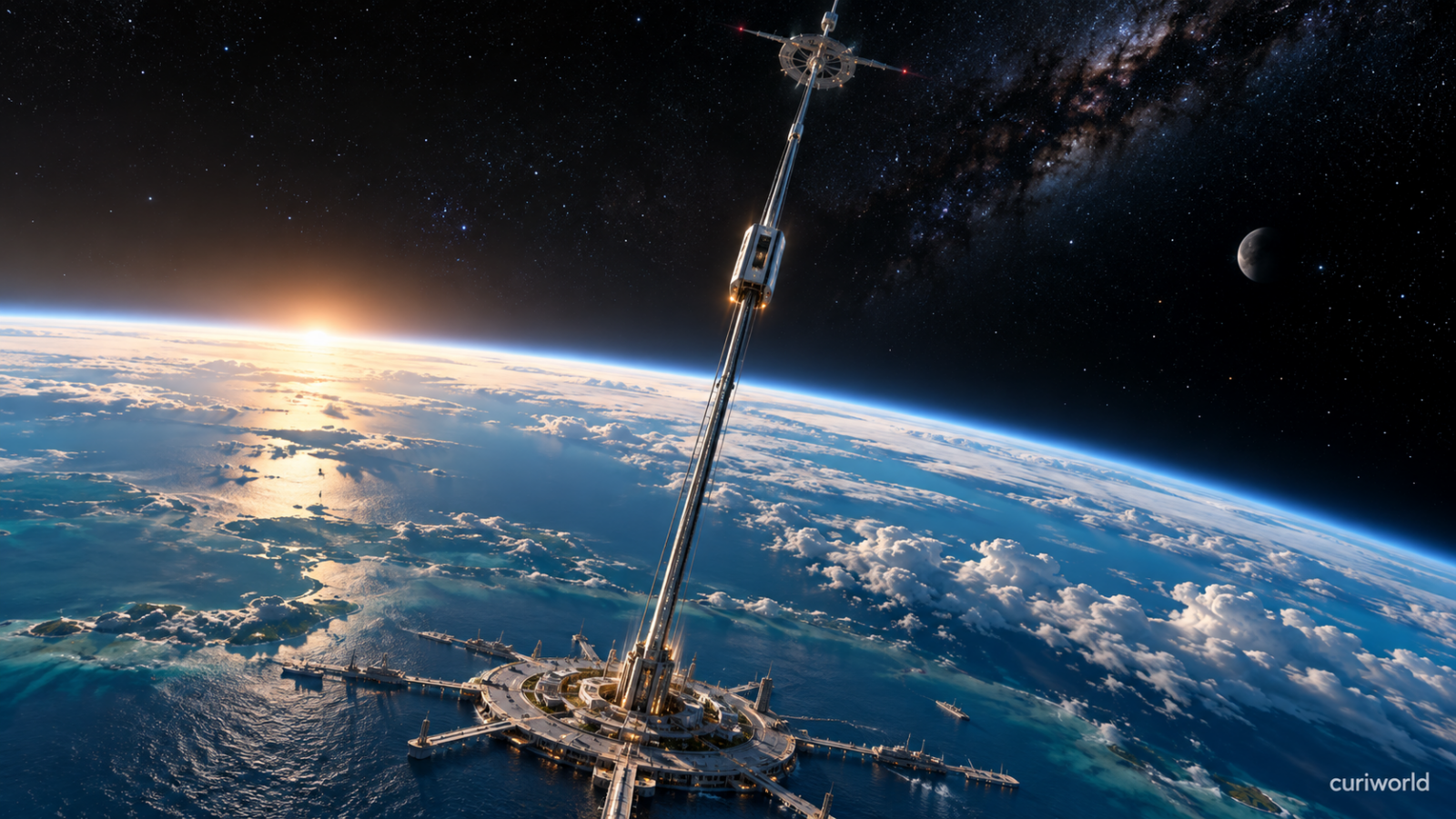
Imagine stepping into a machine at Earth’s equator and climbing straight into space without a rocket.
No explosive launch. No enormous fuel tanks. Just a vehicle traveling up an incredibly long tether stretching tens of thousands of kilometers above Earth.
That is the basic idea behind a space elevator.
It sounds like science fiction, but the physics behind it is real. The problem is not whether engineers understand how a space elevator could work. The problem is whether we can manufacture a material strong, light, durable, and long enough to build one.
Right now, we can’t.
But the idea is no longer as simple as saying “impossible.”
How Would a Space Elevator Actually Work?
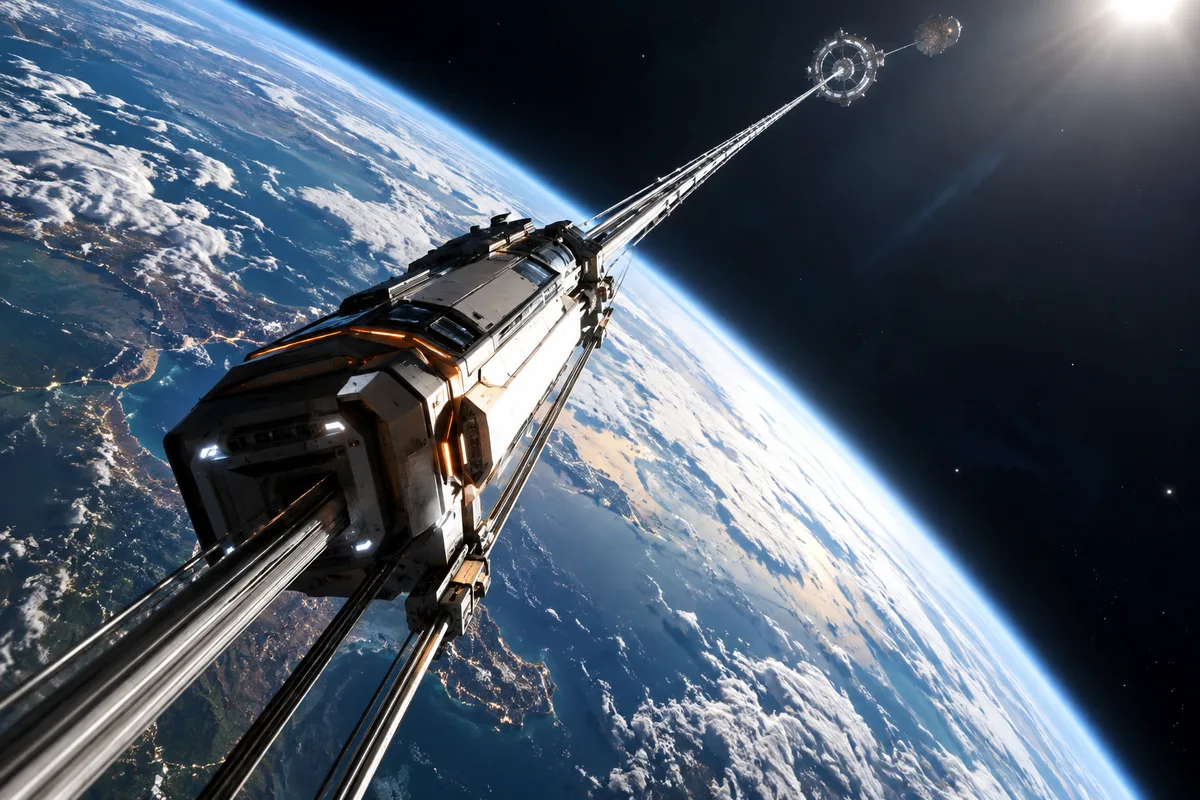
A space elevator would not be a giant tower reaching upward from Earth.
A tower that tall would collapse under its own weight.
Instead, the most widely discussed design uses a tether held in tension.
One end would be anchored near Earth’s equator. The tether would extend upward through geostationary orbit and continue farther into space, where a counterweight or extended section of tether would help keep the entire structure taut.
Electric vehicles usually called climbers would grip the tether and move up and down it carrying cargo—and potentially, one day, people.
The key is Earth’s rotation.
A tether attached at the equator would rotate with the planet. If it extends far enough beyond geostationary orbit, the outward effect associated with that rotating mass helps balance the gravitational pull on the lower portion.
The result is a tether stretched between Earth and space rather than a tower supporting itself from below.
Why Geostationary Orbit Matters
Geostationary orbit, or GEO, sits about 35,786 kilometers (22,236 miles) above Earth’s equator.
A satellite there takes the same amount of time to orbit Earth as Earth takes to rotate. From the ground, it appears to remain above the same location.
That makes GEO crucial to the space elevator concept.
But the tether could not simply stop there.
At geostationary altitude, the orbital motion and Earth’s rotation are matched. To keep the whole structure under tension, the tether would need to continue well beyond GEO.
A counterweight, or simply additional tether mass extending farther outward, would help pull the upper section away from Earth while gravity pulls the lower section inward.
Those competing effects would keep the tether stretched.
This dependence on rotation is also why a classic Earth space elevator would need to be anchored close to the equator.
Earth’s rotation is doing part of the engineering work.
Curiworld’s look at what would happen if Earth stopped spinning shows just how much speed and angular momentum are hidden in the planet’s everyday rotation.
The Biggest Problem Is the Cable
This is where the elegant physics runs into brutal engineering.
A space elevator tether would have to support:
- its own enormous weight,
- climbing vehicles,
- payloads,
- dynamic vibrations,
- atmospheric forces near Earth,
- and stresses changing dramatically with altitude.
Steel is nowhere near good enough.
Even extremely strong conventional materials become impossibly heavy when stretched across tens of thousands of kilometers.
What matters is not simply tensile strength.
Engineers need a material with extremely high specific strength—strength compared with its mass.
A tether that is strong but heavy still has to carry its own weight.
That is why carbon nanotubes and graphene receive so much attention.
Why Carbon Nanotubes Look So Promising
Individual carbon nanotubes can be extraordinarily strong while remaining extremely light.
That combination makes them attractive for a space elevator.
Laboratory research has produced centimeter-scale carbon nanotube bundles with extremely high tensile strength. The problem appears when engineers try to turn microscopic structures into long fibers.
Defects matter.
Misaligned nanotubes matter.
Connections between individual nanotubes matter.
Tiny imperfections that are almost irrelevant in a short laboratory specimen become critical when imagining a structure thousands of kilometers long.
A chain may contain millions of strong links, but one weak link is enough to cause failure.
The same principle becomes terrifying when the “chain” stretches from Earth far beyond geostationary orbit.
What About Graphene?
Graphene presents a similar promise.
An ideal sheet of graphene has exceptional tensile strength and extremely low mass, making it another serious candidate for future tether materials.
Recent space elevator engineering studies often discuss advanced graphene structures, including layered graphene materials, as potential solutions.
But there is a huge difference between demonstrating remarkable strength in a small sample and manufacturing tens of thousands of kilometers of consistently flawless material.
That manufacturing challenge may be the single largest obstacle separating the space elevator from reality.
We know materials with impressive theoretical or microscopic properties.
We do not yet know how to turn them into a full-scale space elevator tether.
The Cable Would Need to Survive Space Too
Even solving the strength problem would not finish the job.
The tether would pass through several radically different environments.
Near the surface, it would encounter:
- wind,
- storms,
- lightning,
- moisture,
- and atmospheric turbulence.
Higher up, conditions change.
The tether would face:
- ultraviolet radiation,
- atomic oxygen in low Earth orbit,
- extreme temperature changes,
- micrometeoroids,
- radiation,
- and orbital debris.
That last problem is especially difficult.
Thousands of active satellites and far more pieces of debris travel around Earth at orbital speeds. Even a small object can carry enormous kinetic energy.
A tether stretching through heavily used orbital regions would create a collision-management problem unlike anything built so far.
Materials themselves could also deteriorate.
Experiments exposing carbon nanotube yarns to the space environment have shown that atomic oxygen can damage their surfaces and significantly reduce tensile strength.
So the tether cannot merely be strong on the day it is manufactured.
It has to stay strong in space.
How Would the Elevator Avoid Satellites and Space Junk?
A space elevator would pass directly through regions occupied by satellites and debris.
That does not automatically make the idea impossible, but it makes orbital traffic management essential.
Some concepts propose locating the Earth anchor on a movable ocean platform, allowing small adjustments in the tether’s position.
Other approaches involve continuously tracking objects and moving the tether enough to avoid predicted collisions.
The tether itself could also be designed with redundancy so damage to individual fibers would not immediately cause total failure.
Still, avoiding a slow-moving tether is very different from maneuvering a satellite.
A satellite can perform an orbital correction.
A structure tens of thousands of kilometers long behaves like an enormous flexible system.
Every movement can produce waves and oscillations that engineers would have to control.
How Would the Climber Get Its Power?
The elevator car presents another challenge.
Running a conventional electrical cable all the way to space is hardly simple, and carrying enough batteries for an extremely long climb adds weight.
Several power concepts have been proposed.
One is power beaming.
A ground-based laser could send energy toward receivers on the climbing vehicle, which would convert the light into electricity.
Microwave power transmission has also been considered.
Solar power could contribute at higher altitudes, while other concepts involve conductive tether systems.
The International Space Elevator Consortium’s 2026 engineering study examined laser, microwave, solar, and tether-delivered electrical power as possible approaches.
None makes the overall problem easy.
A climber carrying tons of payload would require substantial energy and would need to dissipate heat while maintaining traction against the tether.
And the journey would not be quick.
Depending on design and climbing speed, reaching geostationary altitude could take days rather than minutes.
Why Bother When We Already Have Rockets?
Because rockets must carry much of their own propellant.
That creates the famous tyranny of the rocket equation: carrying more fuel requires a larger vehicle, which requires still more fuel.
A functioning space elevator would operate very differently.
After construction, climbers could theoretically move cargo upward using externally supplied electrical energy rather than burning enormous quantities of rocket propellant during every trip.
That could make moving large amounts of material into space far more routine.
Potential uses could include:
- supplying space stations,
- delivering satellite components,
- moving fuel and construction materials,
- building large structures in orbit,
- and supporting missions farther into the Solar System.
Payloads released from sufficiently high points on the tether would already possess substantial rotational velocity.
A mature system might therefore become more than an elevator to orbit. It could act as part of a wider transportation network.
Could It Take People Into Space?
In principle, yes.
In practice, cargo would almost certainly come first.
Human passengers introduce additional requirements:
life support, radiation protection, emergency systems, food, water, temperature control, medical contingencies, and safe evacuation.
A rocket reaches orbit in minutes.
A space elevator climber could take far longer.
That means passengers would spend much more time passing through Earth’s radiation environment and traveling along a structure from which emergency escape could be extremely difficult.
A cargo container can tolerate risks humans cannot.
So even if a space elevator becomes technically possible, a freight elevator to space would probably make sense before a passenger version.
Would the Tether Fall Around Earth If It Broke?
A broken tether would be a serious event, but the result would depend heavily on where it broke.
Different sections have different velocities, gravitational conditions, and trajectories.
The entire structure would not simply fall vertically onto one location like a collapsing skyscraper.
Parts below the break could descend toward Earth, while upper sections could move into different orbital paths or even escape into higher trajectories depending on their position and velocity.
Managing tether failure would therefore be one of the central safety challenges of any real design.
A system of this scale would need redundancy, controlled failure modes, monitoring, and potentially the ability to deliberately separate sections.
Could We Build One on the Moon First?
Possibly—and the Moon changes the engineering dramatically.
The Moon has much weaker gravity than Earth and rotates far more slowly.
That changes the forces acting on a tether and can make the material requirements much less extreme for certain lunar elevator concepts.
A lunar space elevator would not be identical to an Earth elevator, but it could potentially be built with materials closer to those available today.
It is another reminder that “space elevator” does not describe one universal design.
Different worlds produce different engineering problems.
The orbital mechanics are also closely connected to the interaction between Earth and the Moon. Curiworld explains that relationship in why the Moon is slowly moving away from Earth.
So, Could We Actually Build a Space Elevator?
The physics does not obviously forbid it.
That is what makes the idea so fascinating.
We understand the basic orbital mechanics. Engineers can model tapered tethers, climbers, counterweights, power systems, and dynamic behavior. Research continues into materials that could theoretically provide the necessary specific strength.
But that is very different from being ready to build one.
As of 2026, there is no demonstrated tether material that has been manufactured at anything approaching the required combination of strength, consistency, length, durability, and industrial scale.
And even if that material appeared tomorrow, engineers would still have to solve debris avoidance, tether dynamics, climber power, atmospheric hazards, maintenance, deployment, safety, and an enormous construction challenge.
So the most accurate answer is neither “yes” nor “never.”
A space elevator is physically plausible enough to remain a serious engineering concept—but the material that would turn it from an equation into infrastructure does not yet exist at the scale we need.
For now, rockets still own the road to space.
The elevator is waiting on materials science.








Join the discussion