Stars Twinkle, Planets Usually Don’t — Here’s the Science
Stars and planets shine through the same atmosphere, yet one often flickers while the other stays steady. The reason comes down to turbulence and apparent size.
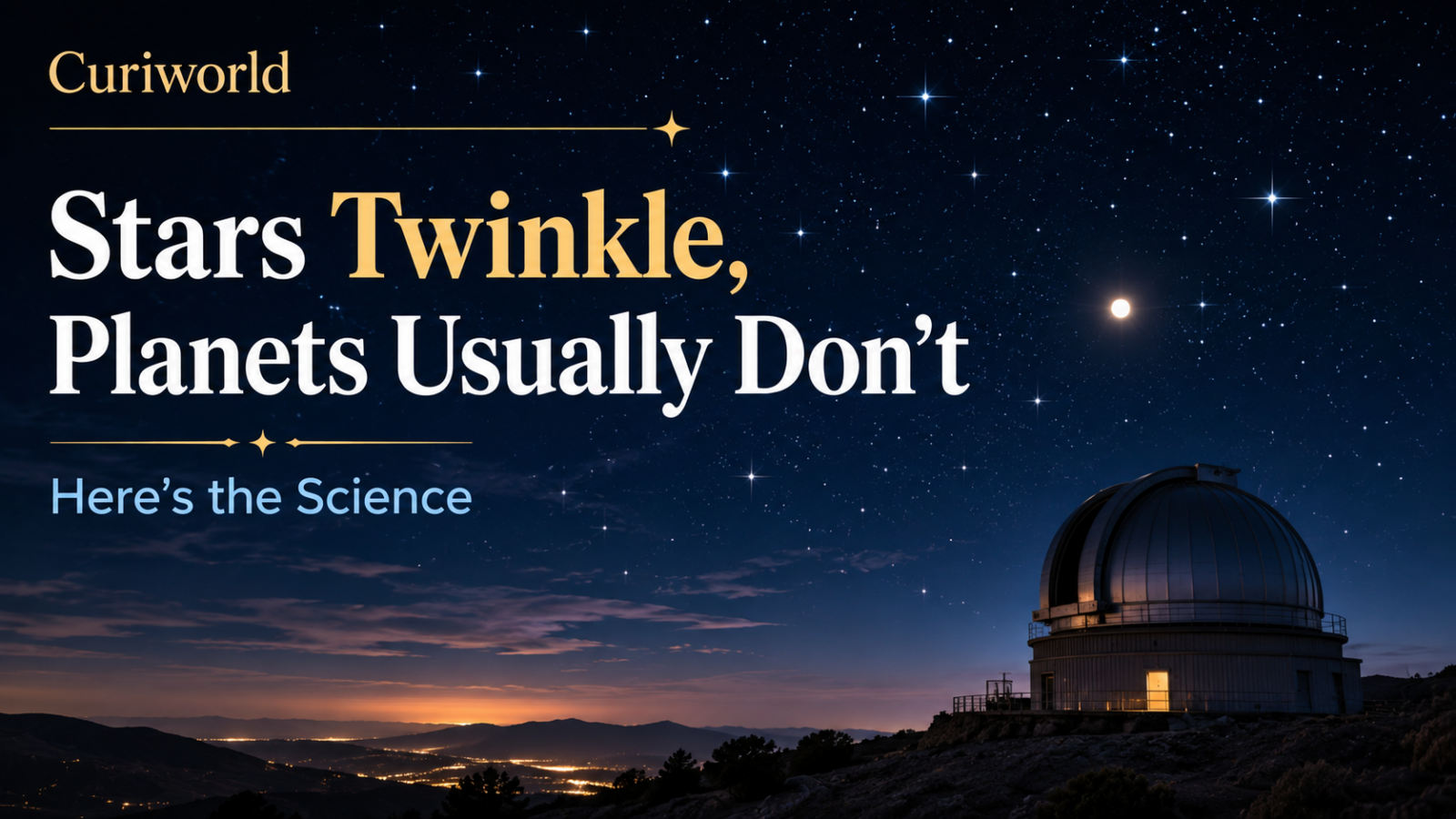
Look at a bright star and then at Jupiter or Venus on the same clear night. The star may flicker, shimmer, or even flash different colors, while the planet often shines with an almost suspicious steadiness.
The difference is not because stars produce their own light while planets reflect sunlight.
The real explanation is much closer to home: Earth’s turbulent atmosphere affects a distant point-like star differently from the tiny visible disk of a nearby planet.
That familiar sparkle even has a scientific name: scintillation.
The Stars Themselves Are Not Usually Twinkling
Most of the rapid twinkling you see with the naked eye is created after the starlight reaches Earth.
Before reaching your eyes, light from a star has to pass through layers of atmosphere containing moving pockets of air with slightly different temperatures and densities.
Those differences change the way light travels.
Instead of following one perfectly stable path through the atmosphere, the incoming starlight is continually bent by small and changing amounts. From the ground, the star can appear to shift position slightly, brighten, dim, or shimmer from moment to moment.
Astronomers describe the broader effect of atmospheric turbulence on astronomical observations as seeing.
The important point is that the star is not rapidly switching itself on and off.
Earth’s atmosphere is distorting the light on its final journey toward you.
Our atmosphere is not responsible for every astronomical change we notice—for example, the Moon is genuinely moving slowly away from Earth.
Why Does Distance Matter So Much?
Stars are enormous objects.
The Sun, for example, is vastly larger than Earth. Many other stars are considerably larger than the Sun.
Yet stars outside our solar system are so extraordinarily distant that, from Earth, they appear essentially as points of light.
That apparent size is what matters.
When turbulent air bends the light arriving from such a tiny apparent source, the changes can affect a substantial fraction of the light reaching your eye at that moment.
The result is noticeable scintillation.
This also explains why simply saying “stars are small” would be wrong.
They are not physically small.
They are angularly tiny because they are so far away.
Why Do Planets Usually Look Steadier?
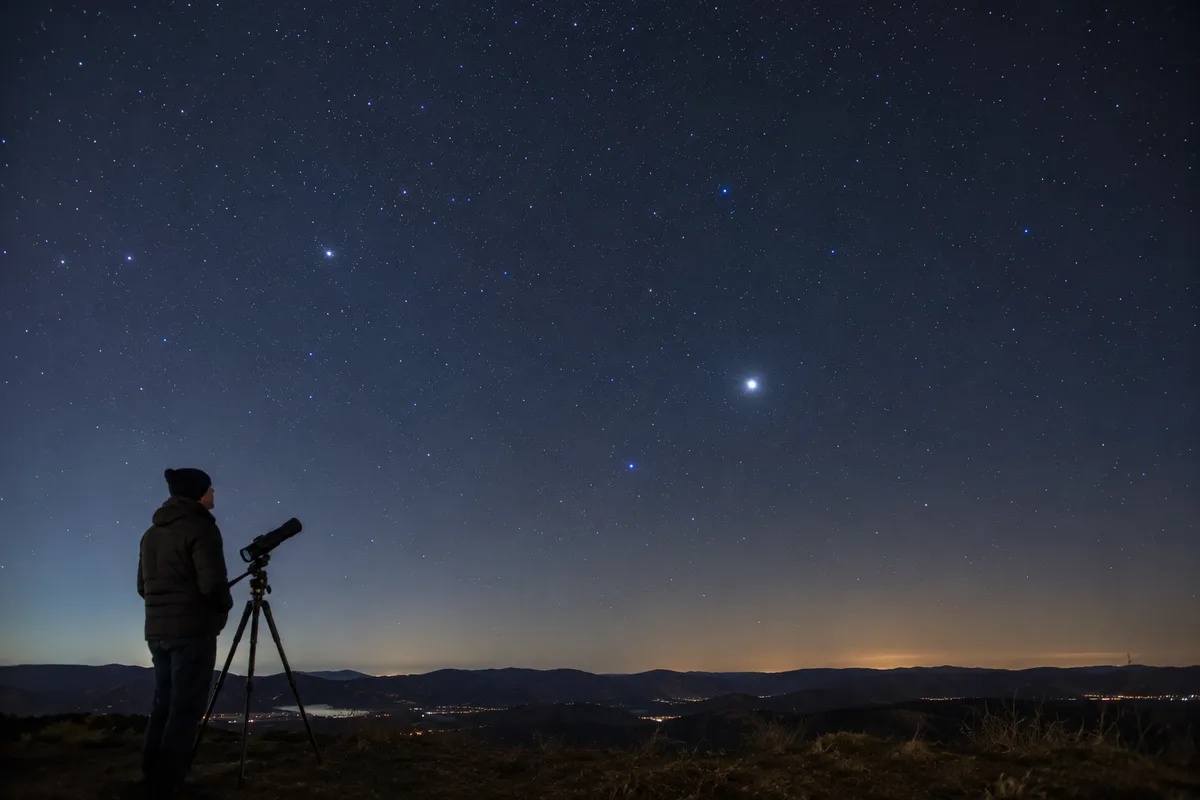
Planets such as Venus, Mars, Jupiter, and Saturn are much closer to us than the stars.
Although they may look like points to the naked eye, they actually have measurable apparent disks in the sky.
That seemingly minor difference changes everything.
Light reaches us from many slightly different parts of a planet’s visible disk. As those rays pass through Earth’s turbulent atmosphere, one part of the planet’s image may be distorted in one direction while another part is distorted differently.
When all that light reaches your eye, much of the atmospheric variation averages out.
The planet therefore tends to look much steadier than a star.
NASA’s explanation of the effect makes essentially this distinction: stars behave like point-like sources, while planets are large enough in apparent size for the effects of different turbulent atmospheric cells to average together.
The important word is “usually.”
Planets have an apparent disk rather than behaving as an almost point-like source. Light from different parts of that disk passes through slightly different parts of the atmosphere, so many small fluctuations tend to average together.
Under poor atmospheric conditions—especially when a planet is low on the horizon—even planets can appear to shimmer.
So Planets Never Twinkle?
They can.
That is why “planets usually don’t twinkle” is more accurate than saying they never do.
Under very turbulent atmospheric conditions, a planet can show some visible scintillation.
It can also happen when a planet is very low in the sky, because its light must travel through considerably more atmosphere before reaching you.
The effect is usually weaker than the dramatic twinkling seen from bright stars, but the familiar rule—
stars twinkle, planets don’t
—is a useful observational shortcut rather than an absolute law.
Why Do Stars Twinkle More Near the Horizon?
Watch the same star at different heights in the sky and you may notice another pattern.
Stars close to the horizon often twinkle much more dramatically.
The reason is geometry.
When a star is almost directly overhead, its light takes a comparatively short path through Earth’s atmosphere before reaching you.
When the star is close to the horizon, you are looking through the atmosphere at a much shallower angle. Its light must travel through a longer stretch of turbulent air.
More atmosphere means more opportunities for changing air temperature and density to distort the incoming light.
That is why astronomers generally prefer observing objects when they are higher in the sky rather than just above the horizon.
Why Can a Twinkling Star Flash Different Colors?
Some bright stars do more than brighten and dim.
They seem to flash red, blue, green, or orange.
Sirius—the brightest star in the night sky—is particularly famous for this effect when it is low above the horizon.
The colors do not mean Sirius is rapidly changing from red to blue.
Different wavelengths of visible light are affected slightly differently as they pass through Earth’s atmosphere. Under the right conditions, atmospheric turbulence and refraction can briefly separate or redirect those colors enough for your eyes to notice.
Combine that with a bright point-like star close to the horizon and the result can look surprisingly dramatic.
People unfamiliar with the effect sometimes mistake a brightly twinkling star for an aircraft, drone, or unusual object because its apparent colors change so rapidly.
Why Doesn’t the Moon Twinkle?
The Moon makes the planet-versus-star explanation easier to understand.
It has a large apparent disk in the sky.
Millions of different points across the visible lunar surface send reflected sunlight toward us. Atmospheric distortion still affects that light, but variations across such a large extended object average together.
So the Moon does not appear to flicker like a distant star.
You can see atmospheric instability in other ways, however.
Through a telescope, especially when the Moon is low in the sky, its edges may appear to ripple or wobble slightly.
That is the same restless atmosphere revealing itself on a much larger target.
Would Stars Twinkle If You Were in Space?
Not because of Earth’s atmosphere.
Move an observer above the atmosphere and the familiar atmospheric scintillation disappears.
This is one reason space telescopes have such an enormous observational advantage.
Ground-based telescopes have to look through constantly moving air. That turbulence blurs and distorts astronomical images even on apparently clear nights.
Space telescopes avoid that particular problem entirely.
Ground observatories can compensate for some atmospheric distortion using adaptive optics, systems capable of adjusting telescope optics rapidly to counteract changing atmospheric effects.
In a sense, astronomers are continuously trying to undo the same process that creates a beautiful twinkling sky for everyone else.
Can Twinkling Help You Identify a Planet?
Sometimes.
Suppose you notice an extremely bright “star” that shines steadily while the surrounding stars visibly flicker.
There is a good chance you are looking at a planet—particularly a bright one such as Venus or Jupiter.
But steadiness alone cannot identify an object with certainty.
Atmospheric conditions change. Stars may twinkle very little on an exceptionally stable night, while planets near the horizon can sometimes scintillate.
A better identification also considers:
- where the object is in the sky
- how bright it is
- whether it changes position relative to nearby stars over successive nights
- the time and date
- which planets are currently visible from your location
Twinkling is a clue, not a celestial ID card.
The Sparkle Is Really a View of Our Own Atmosphere
There is something slightly counterintuitive about a twinkling star.
The star may be light-years away, yet the flicker you see is largely created during the very last part of the light’s journey.
Stars look like tiny point sources, so atmospheric turbulence can noticeably disturb the light reaching your eyes. Nearby planets present small disks, allowing many of those disturbances to average out.
That is why a star can dance beside a planet that appears almost perfectly still.
The two objects are shining through the same sky.
What changes is how their light arrives at Earth—and how much of that distant object our atmosphere has to work with.
Sources
NASA Goddard — Why Stars Twinkle While Planets Usually Don’t






Join the discussion