What Would Happen If the Earth Stopped Spinning for One Second?
If Earth suddenly stopped spinning, the danger would come from inertia: people, oceans and the atmosphere would keep moving. The result changes depending on whether the stop lasts one second, one nanosecond or permanently.
One second sounds almost harmless. Earth stops turning, a clock ticks once, and then the planet starts spinning again.
Physics would make that single second extraordinarily destructive.
At the equator, Earth’s surface is already traveling eastward at roughly 465 meters per second — about 1,670 kilometers per hour — because of the planet’s rotation. We never feel this motion because the ground, oceans, atmosphere, buildings and our bodies are moving together.
If the solid Earth suddenly stopped while everything else retained its momentum, that shared motion would disappear instantly.
The ground would stop.
In the version of this thought experiment where only the solid Earth stops, the immediate danger would be inertia. Near the equator, people, air and ocean water would still be moving eastward at roughly 465 meters per second relative to the suddenly stationary ground.
You would not.
First, What Does “Earth Stops Spinning” Actually Mean?
There is no known natural mechanism that could instantly stop the entire planet and restart it exactly one second later. This is a physics thought experiment, so the result depends on what we assume.
The most interesting version is this:
Earth’s solid surface suddenly stops rotating, but the atmosphere, oceans, people and other objects retain the motion they already had. One second later, the planet resumes its original rotation.
That distinction is crucial.
If some imaginary force stopped every atom on Earth at exactly the same moment — including the atmosphere, oceans and everything on the surface — while somehow preventing the required forces from causing damage, much of the disaster would simply have been removed by the rules of the scenario.
The real problem is inertia.
The Ground Would Stop, but Everything on It Would Keep Moving
Imagine being inside a fast-moving vehicle that stops almost instantly.
Your body wants to keep moving forward.
Now replace the vehicle with Earth.
At the equator, the surface is moving eastward at about 465 meters per second. If the ground suddenly became stationary while an object continued moving at its previous speed, that object could travel roughly 465 meters relative to the surface in just one second.
The rotational speed becomes lower as you move toward the poles because the distance traveled during each rotation becomes smaller.
Approximate surface speeds are:
- Equator: 465 m/s — about 1,670 km/h
- 30° latitude: about 403 m/s
- 45° latitude: about 329 m/s
- 60° latitude: about 233 m/s
- Geographic poles: effectively 0 m/s from Earth’s rotation
Real life would be much messier than those simple numbers suggest.
People would collide with structures. Vehicles, loose objects and debris would continue moving. Buildings would experience enormous stresses as their foundations stopped while the rest of their structures resisted the sudden change in motion.
“One second” would not make the event gentle.
The Atmosphere Would Become One of the Biggest Problems
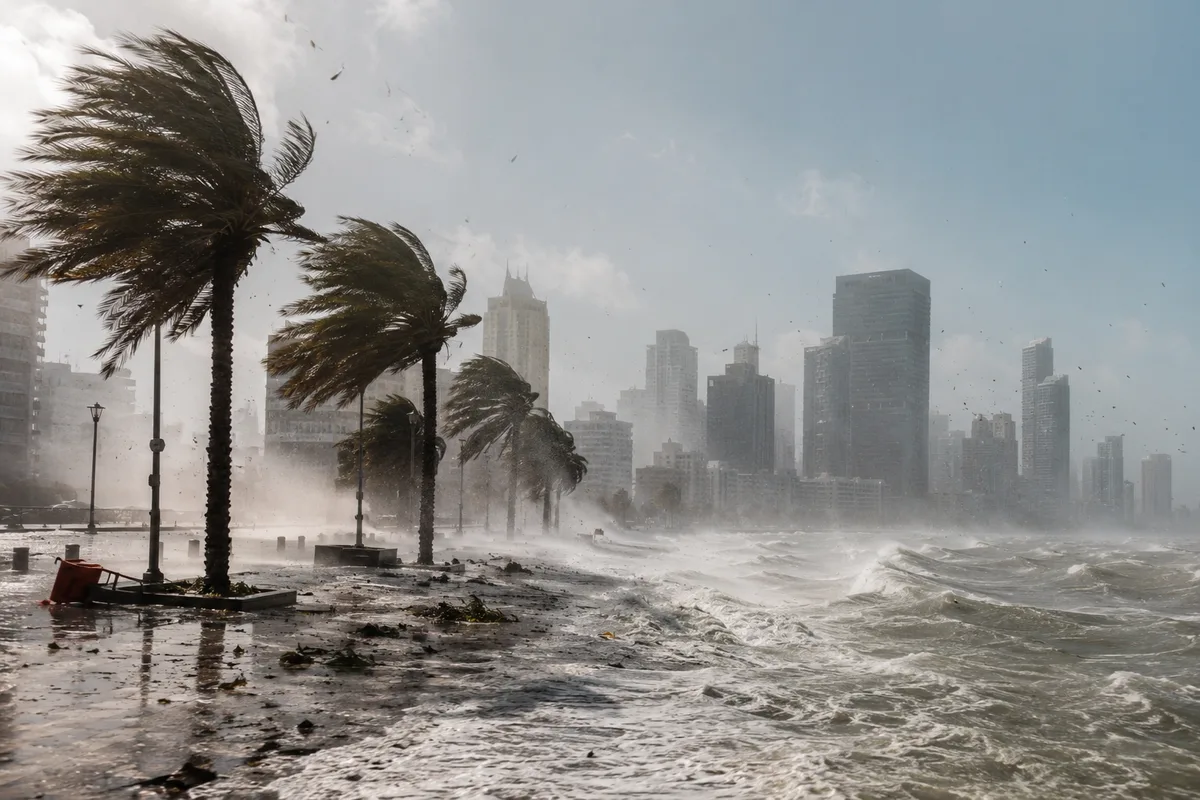
The atmosphere rotates with Earth.
If the surface stopped suddenly, the air would initially continue moving eastward because of inertia.
Near the equator, the difference between the stationary ground and the moving atmosphere could approach 465 meters per second.
That is faster than the speed of sound under typical atmospheric conditions.
Calling the result “strong winds” would barely describe it.
Air moving at such enormous relative speeds would encounter mountains, forests, cities and every other obstacle on the surface. The interaction would create extreme turbulence and destructive pressure changes across large areas.
The atmosphere would not instantly reorganize itself into a new weather system during that single second. Instead, the planet would experience something closer to a massive mechanical shock.
And then Earth would start rotating again.
The Oceans Would Keep Moving Too
Water has inertia just like air.
If the solid Earth stopped while the oceans retained their rotational momentum, vast quantities of seawater would continue moving relative to coastlines and the ocean floor.
Near the equator, that water begins the event with hundreds of meters per second of eastward velocity.
The result would not be one neat global wave.
Continents, islands, coastlines, ocean basins and seafloor topography would interfere with the moving water almost immediately. The flow would become chaotic, producing enormous surges and waves.
Coastal areas would be particularly vulnerable.
Most importantly, the oceans would not return to normal simply because Earth started rotating again one second later. Once waves and currents had been generated, their energy would continue moving through the oceans.
The pause might last one second.
Its consequences would last much longer.
Buildings Would Not Simply Stay Where They Are
A building is attached to the ground, but that does not make it immune to inertia.
If the foundation suddenly stopped while the upper parts of the building attempted to continue moving, enormous forces would pass through the structure.
Bridges, towers, trees, power lines and other infrastructure would face similar stresses.
Loose objects would be even more vulnerable.
Anything not firmly connected to the ground would tend to preserve its existing eastward motion.
The effect would be strongest around the equator and become progressively smaller toward the poles.
This leads to an interesting question: would standing at the North or South Pole save you?
Not necessarily.
The direct rotational speed at the exact poles is extremely small, so the initial sideways-motion problem would be much less severe. But atmospheric disturbances, ocean waves and other effects could still spread into high-latitude regions.
The poles would be physically different from the equator, but they would not necessarily be safe.
Gravity Would Not Disappear
A common misconception is that Earth’s rotation somehow produces gravity.
It does not.
Gravity comes primarily from Earth’s mass. Stopping the planet’s rotation would not cause that mass to disappear.
You would therefore not suddenly float into space.
In fact, at the equator, you would technically become very slightly heavier.
Earth’s rotation creates a small centrifugal effect that partially offsets gravity. Without rotation, that effect would temporarily disappear.
The difference would be tiny compared with the destruction happening around you.
So if Earth suddenly stopped spinning, the problem would not be losing gravity.
The problem would be retaining momentum.
Would Earth Stopping Its Rotation Throw Everyone Into Space?
No.
Earth’s equatorial rotational speed of around 465 meters per second is enormous from a human perspective, but it is far below the speed required to escape Earth’s gravity.
Objects would be thrown eastward relative to the surface, not automatically launched away from the planet.
They would still be gravitationally bound to Earth.
This is an important distinction because dramatic versions of the scenario often portray everything flying directly into space.
The physics points toward catastrophic horizontal motion instead.
What Happens When Earth Starts Spinning Again?
This is where the one-second version becomes especially nasty.
After stopping, Earth suddenly resumes its previous rotational speed.
But the atmosphere, oceans and everything on the surface would already be in chaotic motion.
The ground accelerating beneath them would create another enormous change in relative velocity.
The first event is a sudden stop.
The second is a sudden restart.
Restarting the rotation would not rewind the previous second.
Buildings would not repair themselves. Waves would not disappear. The atmosphere would not instantly return to normal circulation.
The damage produced during that brief interruption would already be underway.
What If Earth Took One Second to Slow Down Instead?
This sounds like a gentler scenario, but it still would not be remotely safe.
Suppose the equator slowed from roughly 465 meters per second to zero over exactly one second.
A simple calculation gives an average deceleration of about:
465 m/s²
That is approximately 47 times standard gravitational acceleration.
So even stopping over the course of one full second would involve extraordinary forces.
The distinction matters because “Earth suddenly stops for one second” and “Earth gradually stops over one second” are not the same physical scenario.
Both are catastrophic.
An instantaneous stop is simply even more extreme.
What If Earth Stopped Spinning for Just One Nanosecond?
A nanosecond is one billionth of a second.
That sounds so brief that it is tempting to assume nothing meaningful could happen.
But the answer depends less on how long Earth stays stopped and more on how abruptly the change occurs.
At the equator, the surface normally moves eastward at about 465 meters per second because of Earth’s rotation. If the solid Earth were brought to an instantaneous stop while people, oceans and the atmosphere retained their previous motion, they would still have that eastward velocity at the moment the ground stopped.
During one nanosecond, an object moving at 465 meters per second would travel only about:
0.000000465 meters — roughly 0.465 micrometers.
That distance is tiny.
But this does not mean the event would be harmless.
The physically extreme part is the instantaneous change in velocity. Bringing the ground from 465 meters per second to zero with essentially no stopping time implies an enormous acceleration, regardless of whether the planet remains stopped for one second or one nanosecond.
So there are really two separate questions:
- How far would things move while Earth was stopped?
- What forces would be required to stop and restart the planet?
For an extremely short pause such as one nanosecond, the displacement caused during the stopped interval would be microscopic.
But an instantaneous stop and restart would still require an impossible and extraordinarily violent change in momentum.
In other words, shortening the pause reduces how far freely moving material could travel during the stopped period.
It does not make the assumed instantaneous stop physically realistic.
Does It Matter How Long Earth Stops?
Yes—but not in the way people usually assume.
| Scenario | Main problem |
|---|---|
| Earth stops instantly for one nanosecond | Extreme acceleration from the sudden stop; almost no time for large displacement |
| Earth stops instantly for one second | Extreme stop plus enough time for moving air, water and objects to travel significant distances |
| Earth slows to a stop over one second | Extremely large deceleration, but different from an instantaneous stop |
| Earth permanently stops rotating | Long-term changes to day length, climate, ocean distribution and planetary shape |
The crucial distinction is between stopping time and how long Earth remains stopped.
An instantaneous stop is physically violent because velocity changes essentially at once.
The length of the pause then determines how much time the still-moving atmosphere, oceans and objects have to continue moving relative to the ground.
Would One Side of Earth Freeze While the Other Burned?
Not if the planet restarted after one second.
This idea belongs to a very different thought experiment: Earth permanently stopping its rotation while continuing to orbit the Sun.
Earth currently rotates once in roughly 24 hours relative to the Sun. If rotation permanently stopped, the normal day-night cycle would disappear and different regions would experience extraordinarily long periods of daylight and darkness as Earth continued its yearly orbit.
That could eventually transform climate patterns.
But a one-second interruption is far too brief for such a new climate state to develop.
The planet would simply be slightly behind where its rotational orientation otherwise would have been.
The immediate disaster would come from motion, not temperature.
Would the Oceans Permanently Move Toward the Poles?
Earth is not a perfect sphere.
Its rotation contributes to a slight bulge around the equator, making the planet wider there than from pole to pole.
If Earth permanently stopped rotating, its long-term equilibrium shape would slowly change, and the distribution of ocean water could eventually change as well.
But geological-scale reshaping does not happen in one second.
During our thought experiment, the planet would not suddenly become perfectly spherical, nor would all the oceans race toward the poles because the rotation briefly disappeared.
The immediate movement of water would instead be dominated by inertia.
That distinction separates the short-stop scenario from the permanent-stop scenario.
Would Earth Still Orbit the Sun?
Yes.
Earth’s rotation and Earth’s orbit are different motions.
Rotation is Earth spinning around its own axis.
Orbit is Earth traveling around the Sun.
Stopping Earth’s rotation would not automatically stop its orbital motion.
The planet would continue traveling around the Sun at roughly the same orbital velocity unless the hypothetical force responsible for stopping the rotation somehow affected its orbit as well.
So the Sun would not suddenly disappear from the sky, and Earth would not immediately fall into it.
The disaster would be happening on a planet that was still continuing its journey around the Sun.
Could Earth Actually Stop Spinning?
Not in anything resembling this scenario.
Earth’s rotational speed does change slightly over time. Interactions involving the Moon, oceans, atmosphere and Earth’s interior can produce tiny changes in the length of a day.
Over extremely long periods, tidal interactions with the Moon are gradually slowing Earth’s rotation.
The same tidal interaction is also connected to the Moon’s gradual recession from Earth. Curiworld explains that relationship in Why Is the Moon Slowly Moving Away from Earth?.
But these changes are tiny compared with an instantaneous stop.
Earth possesses an enormous amount of rotational energy and angular momentum. Bringing the entire planet to a sudden halt would require forces far beyond anything humanity could produce and beyond any ordinary natural process we observe.
And stopping it is only half of our fictional problem.
Restarting Earth at exactly its original speed one second later would require another extraordinary transfer of energy and angular momentum.
This scenario belongs firmly in the world of thought experiments.
Would the Effect Be the Same Everywhere on Earth?
No.
Earth’s rotational speed at the surface depends on latitude.
It is greatest at the equator and falls as you move toward the poles.
At the equator, the surface moves at roughly 465 meters per second.
At higher latitudes, the eastward speed is lower because the circle traveled around Earth’s axis becomes smaller.
At the geographic poles, rotational surface speed is effectively zero.
That means the immediate inertial effect of a sudden stop would be strongest near the equator and weaker toward the poles.
A person near the equator would retain much more eastward velocity relative to the stopped ground than someone standing near a pole.
This does not mean polar regions would necessarily be safe. Atmosphere, oceans, structural stresses and global disturbances would still matter.
But the simple “everything everywhere would move at 1,670 km/h” version is incorrect.
That figure applies approximately to the equator, not the entire planet.
Why One Second Is More Than Enough
The most interesting part of this question is that duration is not the main problem.
Speed is.
At the equator, everything around you is already moving eastward at roughly 465 meters every second.
You feel nothing because you, the atmosphere, the oceans and the ground share that motion.
It is the same reason passengers can comfortably sit inside an airplane traveling hundreds of kilometers per hour when the aircraft is moving smoothly.
Constant motion is not necessarily dramatic.
A sudden change in motion is.
If Earth’s surface abruptly stopped while everything else continued moving, one second would be more than enough to create enormous destruction.
Gravity would remain.
Earth would continue orbiting the Sun.
The planet would not suddenly develop six-month nights.
Its oceans would not have time to settle into a new permanent configuration.
But the atmosphere, oceans, structures and objects on the surface would experience a catastrophic mismatch in momentum.
The unsettling fact is not simply that Earth spins quickly.
It is that we spend every second of our lives moving at extraordinary speed without noticing it.
Sources
NASA Goddard Space Flight Center — The Rotating Earth
https://pwg.gsfc.nasa.gov/stargaze/Srotfram1.htm
NASA — Facts About Earth
https://science.nasa.gov/earth/facts/




Join the discussion