Why Is the Moon Slowly Moving Away from Earth?
The Moon is moving about 3.8 centimeters farther from Earth each year. The reason lies in tides, Earth's rotation, and a slow transfer of angular momentum between two worlds.
The Moon is leaving us—but not fast enough to notice by looking at the night sky.
Measurements show that the Moon’s average distance from Earth is increasing by about 3.8 centimeters, or roughly 1.5 inches, each year. That is only a tiny change compared with the roughly 384,400 kilometers separating the two worlds.
The cause is not that Earth’s gravity is failing or that the Moon is simply drifting loose.
The Moon is moving outward because Earth and the Moon continuously exchange energy and angular momentum through tidal forces. The same interaction that creates ocean tides also slows Earth’s rotation and transfers part of that rotational motion into the Moon’s orbit.
The result is remarkably simple: Earth spins a little more slowly, while the Moon gradually moves into a larger orbit.
The Story Begins With Tides
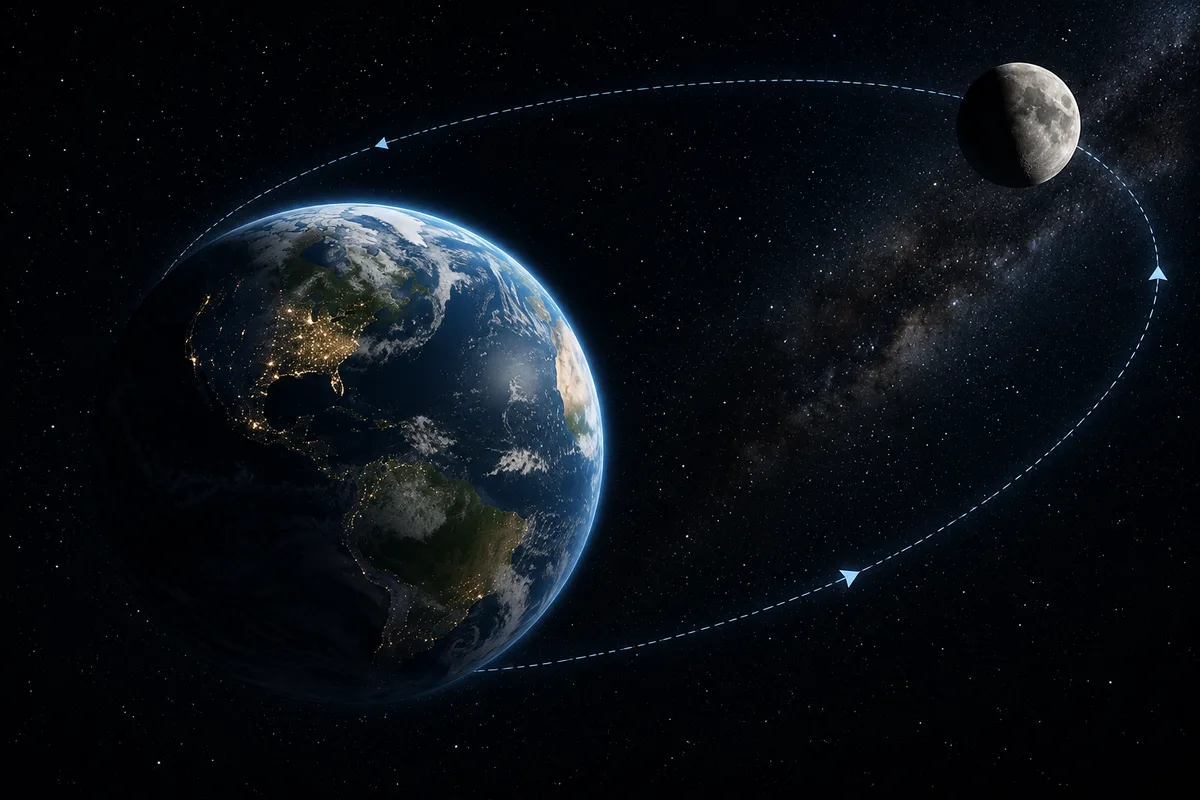
The Moon’s gravity pulls on Earth.
We notice one result of that attraction every day in the oceans.
Water on the side of Earth facing the Moon is pulled slightly more strongly than Earth’s center, while water on the opposite side experiences a different gravitational pull. Together with the motion of the Earth–Moon system, this produces tidal bulges.
If Earth were not rotating, the simplified picture would be relatively straightforward: the tidal bulges would tend to align with the line connecting Earth and the Moon.
But Earth is rotating much faster than the Moon travels around us.
Earth completes one rotation in roughly a day. The Moon takes about a month to complete an orbit.
That difference changes everything.
Earth Pulls the Tidal Bulge Ahead of the Moon
Earth’s rotation carries the tidal bulges slightly ahead of the line pointing directly toward the Moon.
They are not perfectly aligned.
That small offset creates a gravitational interaction between the bulge and the Moon.
The bulge pulls gravitationally on the Moon from slightly ahead in its orbit. In effect, this gives the Moon additional orbital angular momentum.
The Moon, meanwhile, pulls backward on the tidal bulge.
That opposing torque acts against Earth’s rotation.
So two things happen at the same time:
Earth’s rotation gradually slows.
The Moon’s orbit gradually expands.
They are two sides of the same physical process.
But Why Does Giving the Moon Energy Make It Move Farther Away?
This can sound counterintuitive.
If Earth gives the Moon a gravitational push forward, you might imagine the Moon simply moving faster around the same orbit.
Orbital mechanics works differently.
Adding energy and angular momentum to an orbiting object can move it into a larger orbit.
The Moon therefore shifts outward rather than simply remaining at the same distance and continuously speeding up.
There is an interesting twist: an object in a larger stable orbit actually travels more slowly on average than one in a smaller orbit.
So the Moon receives angular momentum from Earth’s rotation, moves outward, and eventually follows a slightly larger, longer-period orbit.
It is not being pushed away in the same way that a person might throw a ball away from Earth.
Its orbit itself is evolving.
Earth Is Paying the Energy Bill
The Moon cannot gain orbital angular momentum from nowhere.
The source is mainly Earth’s rotation.
Tidal friction dissipates some energy as heat while transferring angular momentum through the Earth–Moon system.
As a result, Earth is gradually rotating more slowly.
That means the length of an Earth day changes over very long timescales.
NASA’s eclipse calculations describe this connection directly: tidal friction transfers angular momentum from Earth to the Moon, slowing Earth’s spin while increasing the Moon’s orbital distance and orbital period.
The change is tiny on a human timescale.
Nobody will notice Tuesday becoming meaningfully longer than Monday because of lunar tides.
But over geological time, tiny changes accumulate.
Curiworld has also explored the much more extreme hypothetical question of what would happen if Earth stopped spinning for one second. The real Earth is nowhere close to suddenly stopping, but lunar tides are one of the genuine processes that gradually modify its rotation over enormous spans of time.
How Do Scientists Know the Moon Is Moving Away?
A change of less than four centimeters per year sounds almost impossibly small to measure across hundreds of thousands of kilometers.
The solution involves lasers and equipment placed on the Moon.
Apollo astronauts left special retroreflectors on the lunar surface. Additional lunar reflectors were also deployed during other missions.
Scientists on Earth can fire laser pulses toward these reflectors.
A tiny amount of the light returns.
By measuring how long the laser takes to travel from Earth to the Moon and back, researchers can calculate the Earth–Moon distance with extraordinary precision.
Repeated measurements reveal long-term changes in the lunar orbit.
That technique, known as lunar laser ranging, is how scientists can directly measure the Moon’s gradual recession.
NASA reports a present average increase in distance of about 3.8 centimeters per year.
We are therefore not merely calculating that the Moon should be moving away.
We can measure it happening.
The Moon Was Closer to Earth in the Past
If the Moon is moving outward today, it follows that it was closer to Earth earlier in its history.
The young Earth–Moon system looked very different from the one we see now.
The Moon formed billions of years ago and began its history much nearer to Earth than its present average distance.
That closer Moon would have produced much stronger tidal interactions.
Earth was also rotating more rapidly.
Over vast amounts of time, tidal interactions transferred angular momentum and reshaped the system toward its present configuration.
But there is an important trap here.
You cannot simply take today’s recession rate of 3.8 centimeters per year, multiply it by billions of years, and reconstruct the Moon’s entire history.
The 3.8-Centimeter Rate Has Not Been Constant Forever
The current recession rate describes what is happening now.
It is not a universal speed limit permanently fixed into the Earth–Moon system.
Tidal evolution depends on how efficiently tidal energy is dissipated.
Earth is complicated.
Its oceans have changed dramatically over geological history. Continents move. Ocean basins open and close. Sea depth changes. The arrangement of coastlines changes how tides behave and where energy is dissipated.
The distance between Earth and the Moon also affects the strength of their tidal interaction.
NASA notes that the Moon’s outward drift slows as the system evolves.
This matters because a simple linear extrapolation produces misleading results.
The Moon did not spend billions of years moving outward at exactly today’s 3.8-centimeter annual rate.
Its history has been dynamic.
Is the Moon Escaping Earth’s Gravity?
No—not in the everyday sense of an object escaping into space.
The Moon remains gravitationally bound to Earth.
Its orbit is simply growing very slowly because of tidal evolution.
The difference is enormous.
An escaping object gains enough energy to leave a gravitational system entirely.
The Moon is instead transitioning between slightly different bound orbits over very long timescales.
NASA describes a theoretical far-future state in which, if the Earth–Moon system could survive unchanged for tens of billions of years, Earth itself could eventually become tidally locked to the Moon.
At that point, Earth’s rotation and the Moon’s orbital period would become synchronized.
But that hypothetical timescale is far longer than the future evolution of the Sun allows the present Earth–Moon system to continue undisturbed.
So the Moon is not packing its bags and leaving the Solar System.
The Moon Has Already Been Tidally Locked to Earth
There is another fascinating result of the same family of tidal processes.
The Moon rotates.
It simply rotates at almost exactly the same rate that it orbits Earth.
That synchronization is why we continually see roughly the same lunar hemisphere.
This is called tidal locking.
Early in the Moon’s history, Earth’s gravity created distortions in the Moon. Internal friction dissipated rotational energy until the Moon’s spin synchronized with its orbit.
The system therefore carries evidence of tidal evolution in more than one way.
One process helped lock the Moon’s rotation.
Another ongoing interaction continues to transfer angular momentum from Earth and expand the Moon’s orbit.
The Earth–Moon relationship is not static.
It has been evolving for billions of years.
Will the Moon’s Movement Change Solar Eclipses?
Yes, eventually.
A total solar eclipse is possible because the Moon can appear just large enough in our sky to completely cover the Sun.
The match is not perfect, and the Moon’s apparent size already varies because its orbit is elliptical.
As the Moon’s average distance increases over extremely long timescales, however, it will appear slightly smaller in Earth’s sky.
NASA notes that eventually the Moon will become too distant to completely cover the Sun during an eclipse.
Total solar eclipses will therefore not remain a feature of Earth’s sky forever.
Annular eclipses—where a bright ring of sunlight remains visible around the Moon—can still occur when the Moon appears too small to cover the Sun completely.
For people alive today, none of this represents a practical change.
The recession is far too slow.
But it reveals something easy to forget when looking at the night sky:
the arrangement we see is temporary on astronomical timescales.
Does the Moon Look Smaller Every Year?
Technically, an increase in distance makes an object appear slightly smaller.
Practically, the annual difference is far too tiny for a person to notice.
The Moon’s distance from Earth naturally changes by tens of thousands of kilometers during each orbit because the orbit is not perfectly circular.
That normal monthly variation is enormously larger than the few centimeters added to the average distance each year.
So you will not be able to compare photographs taken a decade apart and watch the Moon visibly shrink because of lunar recession.
The effect becomes meaningful only when measured precisely or considered across extremely long timescales.
A Tiny Movement That Reveals a Planetary Exchange
The Moon’s slow retreat is a beautiful example of how apparently separate phenomena can be connected.
Ocean tides seem like something that happens here on Earth’s beaches.
Earth’s rotation seems like another issue entirely.
The Moon’s orbit appears to belong to space.
Yet they are parts of the same gravitational system.
The Moon raises tides on Earth. Earth’s rotation carries those tidal bulges ahead. Their gravity transfers angular momentum to the Moon. Earth loses a tiny amount of rotational momentum, while the Moon moves into a wider orbit.
About 3.8 centimeters per year is almost nothing.
Over millions and billions of years, almost nothing becomes enough to reshape the relationship between two worlds.
Sources
NASA Science — Tidal Locking
NASA Science — Tidal Locking
NASA Goddard Space Flight Center — Eclipse Predictions and Earth’s Rotation
NASA — Eclipse Predictions and Earth’s Rotation








Join the discussion