Why Do Pine Cones Open and Close With the Weather?
Pine cones open in dry air and close when humidity rises. The movement comes from moisture-sensitive tissues in their scales—and it can continue even after the cone is no longer alive.

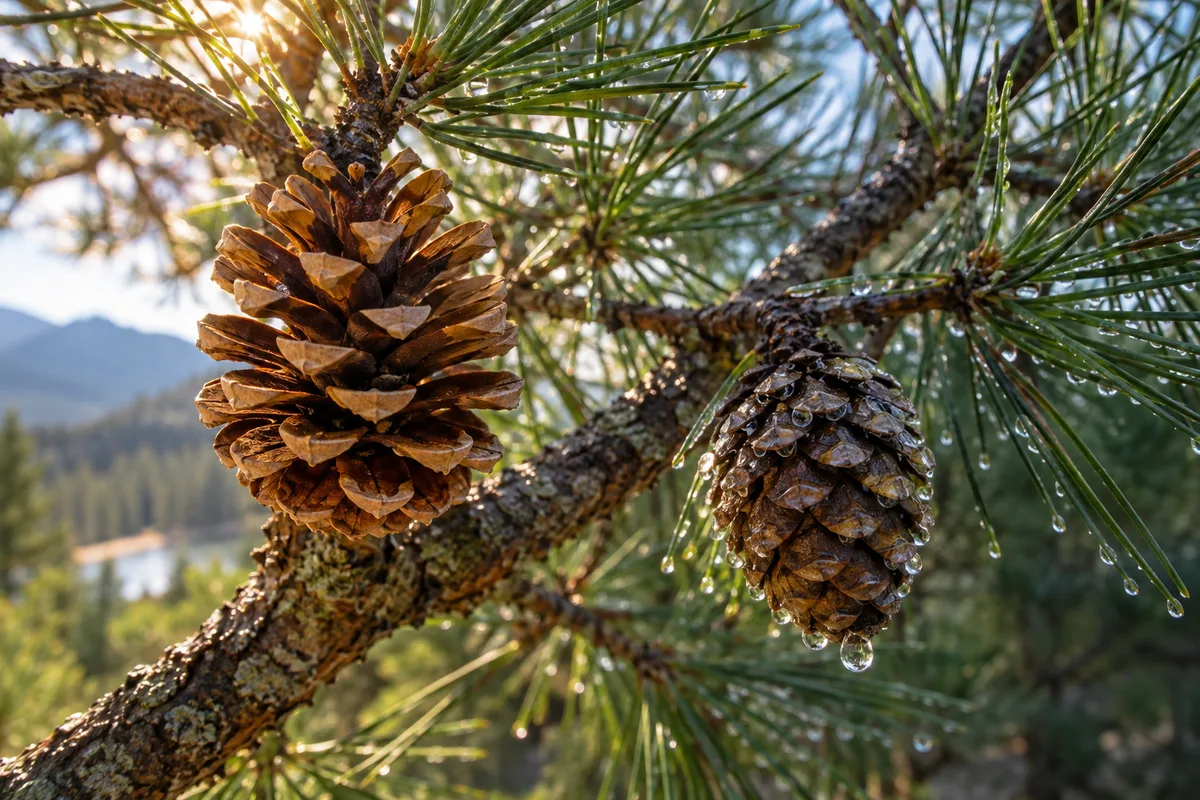
Pick up a dry pine cone and its scales are usually spread open.
Leave that same cone somewhere damp, and something strange happens.
The scales slowly pull inward.
Let it dry again and they reopen.
It looks almost as if the cone can sense the weather.
In a way, it can—but not because it is actively “watching” the sky.
Pine cones open and close because their scales respond physically to moisture in the air. When conditions are dry, the scales bend outward and the cone opens. When humidity rises and the cone absorbs moisture, the scales bend inward and close.
The remarkable part is that a mature cone can do this even after it has fallen from the tree and its cells are no longer alive.
The movement is built into the material itself.
Pine Cones Are Responding to Humidity, Not Predicting Rain
It is tempting to say pine cones “predict the weather.”
A closed cone often appears before or during wet weather, while a dry cone tends to open.
But the cone is not detecting future rain.
It is reacting to moisture that is already present in its environment.
Relative humidity rises.
The cone tissues take up water.
The scales change shape.
When the surrounding air becomes drier, water leaves the tissue and the process reverses.
So the cone is better described as a natural humidity-responsive structure than as a weather forecaster.
The Scales Are Built From Layers That Behave Differently
The secret is inside each individual scale.
A pine cone scale is not a uniform slab of wood.
Its tissues differ in structure and in how strongly they expand when they absorb moisture.
Research on pine cones has shown that one region of the scale changes dimensions more strongly with humidity than another.
When both layers are attached to one another, they cannot simply expand independently.
Instead, the mismatch forces the scale to bend.
The basic idea is similar to a bimetallic strip in a thermostat.
A bimetallic strip contains two metals that expand differently with temperature.
Because they are bonded together, a temperature change makes the strip curve.
A pine cone scale performs a comparable trick with moisture rather than heat.
Wet Tissue Swells, and the Scale Bends Closed
When humidity rises, moisture enters the cell walls of the cone.
Certain tissues absorb more water and expand more strongly than neighboring tissues.
Because the scale layers are mechanically connected, that unequal expansion creates curvature.
The scale bends toward the cone.
Dozens of scales doing the same thing gradually transform an open cone into a tightly closed one.
When the cone dries, the more responsive tissue shrinks again.
The curvature reverses.
The scales swing outward.
The cone opens.
This process is known as hygroscopic movement—movement caused by the uptake and loss of moisture.
The Cone Does Not Need Living Cells to Do This
This is probably the most surprising part.
Many plant movements depend on living cells.
Leaves turn toward light.
Stomata open and close.
Some flowers follow the sun.
A Venus flytrap snaps shut.
Those processes depend on active biology.
A mature pine cone is different.
The tissues responsible for the opening and closing movement are largely dead.
Nature researchers demonstrated decades ago that the movement is passive: the structure of the scale and its cell walls is enough to respond to changing relative humidity.
No nerves are involved.
No muscles are involved.
The cone is not spending energy to pull itself open.
Water moving into and out of its material does the work.
A Fallen Cone Can Open and Close Again and Again
You can observe this without sophisticated equipment.
Take a mature open pine cone.
Place it somewhere damp or briefly expose it to water.
Over time, the scales begin to close.
Allow it to dry thoroughly.
They open again.
Experiments have repeated this cycle many times.
That durability is one reason pine cones have become such an interesting model for engineers studying smart materials—structures that change shape automatically when the environment changes.
The cone does not need electronics or a motor.
Its geometry and material properties already contain the response.
Why Would a Pine Tree Want Its Cone to Behave This Way?
The movement is closely connected to seed dispersal.
For many pine species, dry weather is a better time to release winged seeds.
Dry seeds are lighter.
Air movement can carry them away from the parent tree.
Wet conditions are less favorable.
A seed released during rain may become heavy, stick to wet surfaces, or fall close to the cone rather than being carried farther by wind.
Opening during dry conditions therefore helps expose and release seeds when dispersal conditions are more favorable.
Closing when the air is damp protects seeds from being released at a poor time.
The 2024 research literature describes this as weather-adaptive seed-scale movement that helps facilitate seed dispersal under favorable environmental conditions.
Opening the Cone Does Not Automatically Mean Every Seed Falls Out
A cone opening is only part of the dispersal process.
The seed still has to detach.
Wind matters.
Vibration matters.
The cone’s orientation matters.
And different pine species have different reproductive strategies.
Some cones release seeds relatively easily once mature and dry.
Others remain closed much longer.
Certain fire-adapted species have serotinous cones, which can remain sealed with resin until intense heat helps open them.
So “pine cones open when dry” is a useful general explanation, but it does not describe every conifer cone in exactly the same way.
Humidity Matters More Than Temperature
Because pine cones change with the weather, people sometimes assume temperature directly controls the movement.
The main trigger is moisture.
Temperature can affect drying rate and relative humidity, so it can influence the process indirectly.
A warm, dry day may help a cone dry and open faster.
A cool, humid day may encourage it to remain closed.
But the scale’s actual mechanical response is driven primarily by water uptake and loss.
That distinction explains why a cone can close indoors without any rain at all if the environment becomes humid enough.
Why Does the Movement Take So Long?
Pine cones do not snap open like a trap.
Their movement can take minutes or hours because water has to move through the material.
Moisture diffuses into or evaporates from the cone tissue.
The scale gradually changes dimensions.
The larger and thicker the scale, the longer that process can take.
Research comparing cones of different sizes found that opening and closing time is linked to the thickness of the moisture-responsive tissue.
More recent work has also emphasized that pine cone movement is unusually slow compared with many engineered actuators.
That slow response actually makes sense for its purpose.
A pine tree does not need its cone to react within milliseconds.
Weather conditions usually change on a much slower timescale.
Why Do the Scales Move So Far if the Cells Only Change a Little?
This is another clever piece of geometry.
The strongest deformation occurs near the base of each scale.
A relatively small dimensional change there produces bending.
Because the scale extends outward like a long lever, that small bend becomes a much larger movement at the tip.
This is called geometric amplification.
The individual cells do not have to double in size.
A modest microscopic change can produce a dramatic macroscopic motion because of the scale’s shape and length.
That is one reason an entire cone can appear to transform even though each tissue layer changes only slightly.
Cellulose Helps Make the Movement Possible
Plant cell walls contain cellulose microfibrils embedded within a matrix of other materials such as hemicellulose and lignin.
These structures interact with water.
How the microfibrils are arranged influences which direction the tissue can swell.
Pine cone tissues do not expand equally in every direction.
That anisotropy—different behavior depending on direction—is part of what turns moisture absorption into controlled bending rather than random swelling.
The result is not simply:
wet cone gets bigger.
It is:
specific tissue expands in a specific direction → scale bends predictably.
That level of structural control is what makes the mechanism so interesting.
Can You Use a Pine Cone as a Hygrometer?
Very loosely, yes.
A hygrometer measures humidity.
A pine cone also responds to environmental moisture, so an open cone suggests relatively dry conditions and a closing cone suggests increasing moisture.
But it is a poor scientific instrument.
Its response depends on:
- species,
- cone age,
- tissue thickness,
- how wet it was previously,
- airflow,
- temperature,
- and how quickly environmental humidity changes.
It also responds slowly.
So a pine cone can demonstrate the principle of humidity response beautifully.
It should not replace an actual humidity sensor.
Can Pine Cones Really Predict Rain?
Not reliably.
This popular idea has a grain of truth because rising humidity can precede rain.
If moisture in the air increases before a storm, a cone may begin closing before the first raindrops fall.
That can make it appear as if the cone predicted what was coming.
But the cone did not sense tomorrow’s weather.
It responded to today’s humidity.
Meteorological forecasting requires much more information than a pine cone can provide.
Why Do Some Cones Stay Closed Even When They Look Dry?
Not all cones behave identically.
Some may be immature.
Some may be damaged.
Some species naturally hold their seeds longer.
And serotinous cones may be sealed by resin and require unusually high temperatures—often associated with wildfire—to release seeds effectively.
Even within humidity-responsive cones, age and structural deterioration can reduce movement.
So if one cone on the ground refuses to open while another nearby spreads its scales widely, that is not necessarily a contradiction.
Biology rarely gives every specimen identical behavior.
The Same Basic Trick Appears Elsewhere in Nature
Pine cones are not the only organisms that exploit moisture-driven movement.
Plants use hygroscopic structures in:
- seed awns,
- seed pods,
- mosses,
- leaves,
- and other reproductive structures.
Some seeds even use humidity-driven twisting to help bury themselves in soil.
These movements are especially efficient because they do not require continuous metabolic energy.
Once the plant has built the structure, environmental moisture powers the mechanism.
Engineers Are Copying the Pine Cone
The simplicity of the mechanism has made pine cones a popular model for biomimetic materials.
Researchers have built artificial bilayer structures that:
- bend with humidity,
- open and close like flowers,
- change ventilation openings,
- alter shape without motors,
- and respond automatically to environmental moisture.
In one well-known study, researchers created artificial paper-and-polymer structures whose humidity-driven movement followed the same basic physics as a pine cone.
The attraction is obvious.
Traditional responsive systems may require:
- sensors,
- electrical power,
- motors,
- controllers,
- and software.
A pine-cone-inspired structure can potentially respond because the material itself acts as both sensor and actuator.
Pine Cones Are a Good Reminder That Plants Do Not Need to Move Like Animals
We tend to think movement requires muscles.
Plants repeatedly prove otherwise.
They can use:
- growth,
- water pressure,
- evaporation,
- differential swelling,
- elastic instability,
- and carefully arranged tissues
to produce motion.
A pine cone is one of the cleanest examples.
The tree builds the structure.
Then even after the tissues die, physics continues doing the job.
Curiworld has explored another extreme example of how unusual tree biology can be in why some trees live for thousands of years.
The Bottom Line
Pine cones open and close because their scales are hygroscopic: they change shape as they gain and lose moisture.
In dry air, the scales bend outward and expose the seeds.
In humid or wet conditions, the tissues absorb moisture and the scales bend inward.
The movement does not require living cells, nerves, or energy from the tree.
It is built into the microscopic structure of the cone itself.
And there is a practical reason for it.
For many pines, dry weather gives lightweight seeds a better chance of being carried away by wind.
So that ordinary cone lying on the forest floor is doing something surprisingly sophisticated:
using the weather itself to control when its seeds get a chance to leave.
Sources
Nature — How Pine Cones Open
Proceedings of the Royal Society A — Hygromorphs: From Pine Cones to Biomimetic Bilayers
Advanced Science — The Structural and Mechanical Basis for Passive-Hydraulic Pine Cone Actuation








Join the discussion