Why Is Venice Built on Water? How the Floating City Actually Stays Standing
Venice looks like it floats, but its buildings stand on centuries-old timber foundations driven into soft lagoon soil. Here’s how the city was built—and why it still stands.

Venice looks as if it should not exist.
Stone palaces rise directly beside canals, churches stand on ground barely above the lagoon, and boats move through spaces where other cities would have streets. It is easy to assume Venice is literally floating.
It isn’t.
Venice was built across small natural islands in a shallow lagoon. Where the ground was too soft to support heavy buildings, Venetian builders strengthened it with thousands of wooden piles, timber platforms, and masonry foundations.
That centuries-old system is the real reason the city is still standing.
Venice Was Built in a Lagoon, Not in the Open Sea
Venice sits in the Venetian Lagoon in northeastern Italy. UNESCO describes the historic city as being spread across 118 small islands, with settlement in the lagoon dating back to the fifth century.
The location offered an important advantage: protection.
People escaping instability and invasions on the mainland could retreat to lagoon islands surrounded by shallow water that was difficult for large land armies to cross.
But the same landscape created an obvious problem.
The islands were made largely from layers of sand, clay, silt, and other soft sediments. That is not ideal ground for heavy stone buildings.
So Venetians had to make the ground stronger before building on it.
The Real Secret Is Under the Buildings
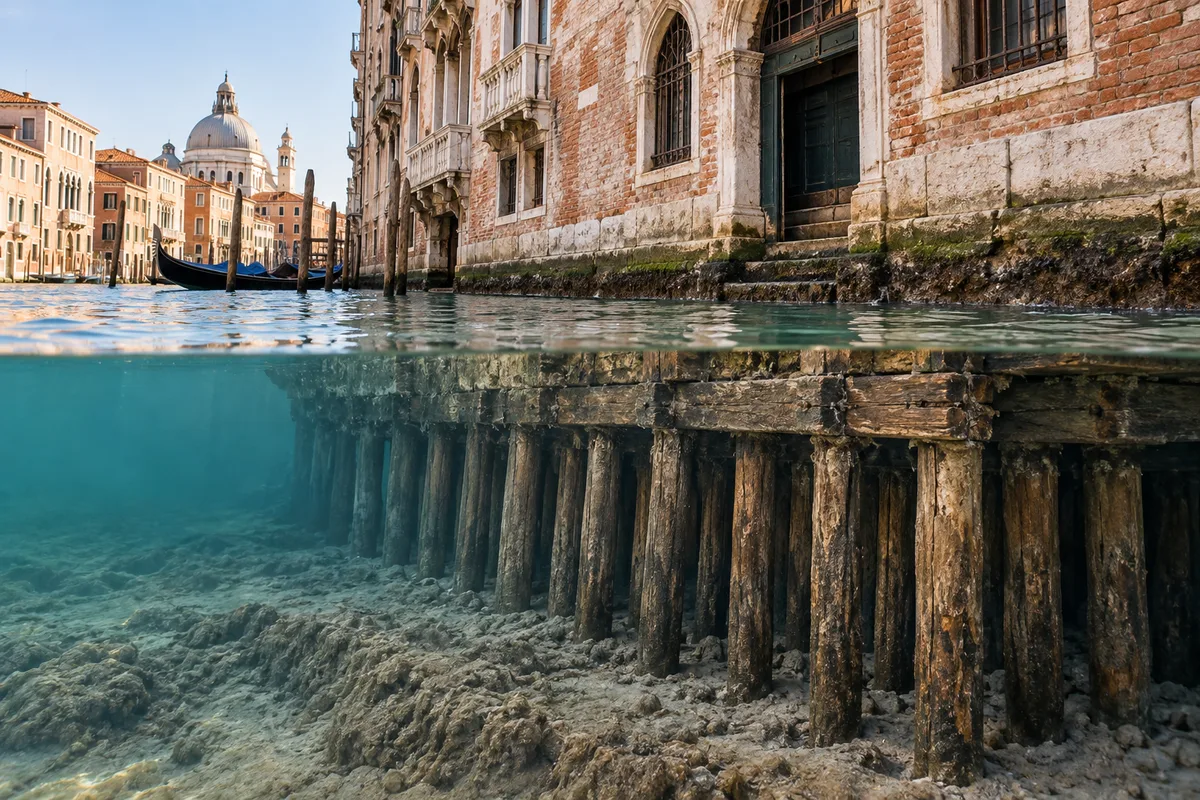
For many major structures, builders drove large numbers of wooden piles into the wet soil.
A common misconception is that these piles were enormous stilts driven all the way down to solid bedrock.
Research on historic Venetian foundations tells a different story.
Many piles were relatively short—often around 1.5 to 3 meters (5 to 10 feet)—and were packed closely together. Their job was not necessarily to reach rock. Instead, driving many piles into the sediment helped compact and reinforce the weak ground.
Above the piles, builders created a horizontal wooden platform known as a zatterone, usually made from several layers of timber planks.
Stone and brick foundations could then be constructed on top.
In simplified form, the system looked like this:
Building → masonry foundation → timber platform → wooden piles → compacted lagoon soil
Venice is therefore not floating on water. Its buildings stand on engineered foundations embedded in the lagoon ground.
Why Haven’t the Wooden Piles Rotted Away?
This is where one of the most popular Venice facts becomes misleading.
You may have heard that the wooden piles survived because there is no oxygen underwater and that the wood eventually “turned to stone.”
There is some truth in the first idea, but the second oversimplifies what happened.
Wood normally decays quickly when fungi and other organisms have the conditions they need to survive. But timber buried in permanently waterlogged, oxygen-poor sediment can decay much more slowly.
That helped Venice’s foundations survive for centuries.
It does not mean the wood became indestructible.
Researchers examining timber from Venetian foundations have identified species including alder, larch, oak, pine, elm, and spruce. Studies have also found varying levels of deterioration depending on factors such as wood species, burial conditions, and depth.
The piles are still wood—not stone.
Minerals can accumulate in waterlogged timber over long periods, but saying Venice’s foundations universally “petrified” gives the wrong impression.
How Can Wooden Piles Support Massive Stone Buildings?
The answer is partly in the numbers.
A Venetian palace does not rest on one or two giant posts. Many closely spaced piles work together, strengthening the soil and spreading the building’s weight over a larger area.
The wooden platform above them helps distribute that load even further.
The Rialto Bridge is a remarkable example.
Research into its historic foundations found densely arranged timber elements beneath the structure. The piles did not function like isolated columns holding the bridge above the water. They formed part of a broader system designed to reinforce the soft ground underneath it.
That distinction is important.
Venetian engineers were not trying to make individual wooden stakes carry enormous buildings. They were changing the behavior of the soil itself.
Does Every Building in Venice Use the Same Foundation?
No.
Another oversimplification is that the entire city rests on one enormous forest of identical wooden stakes.
Venice developed over many centuries, and construction methods varied according to the building, period, location, soil, and weight of the structure.
Research suggests that dense pile-and-platform foundations were particularly important beneath load-bearing walls and major buildings.
Smaller or lighter structures did not necessarily use exactly the same system.
So while wooden piles are fundamental to the story of Venice, there is no single foundation blueprint underneath every building in the city.
Why Build a Major City in Such a Difficult Place?
Because the lagoon eventually became one of Venice’s greatest advantages.
Once settlements were established, the waterways provided direct access to maritime trade. Venice’s position helped it grow into one of Europe’s most important commercial and naval powers.
The city also adapted itself to the environment instead of trying to eliminate it.
Canals became transportation routes. Goods arrived by boat. Buildings faced waterways. Bridges connected separate islands.
Water was not simply an obstacle Venice had to overcome.
It became part of the city’s infrastructure.
Why Doesn’t Venice Collapse as the Ground Settles?
Venice does experience gradual settlement and subsidence.
That is not unusual for a city built on compressible sediments.
The important point is that the pile foundations spread structural loads into strengthened ground rather than concentrating the entire weight of a building in one place.
Some settlement has occurred over centuries, but the system proved remarkably durable.
Modern Venice still faces significant challenges from land subsidence, aging structures, saltwater exposure, and rising relative sea levels.
Those issues, however, should not be confused with the idea that the wooden piles beneath the city are suddenly disappearing.
If you’re interested in how built environments interact with water, Curiworld also explains how cities can become flood traps.
Is Venice Really Sinking?
Yes, but not in the dramatic way the phrase often suggests.
Venice is not simply dropping into the lagoon because its wooden foundations are collapsing.
The city sits extremely close to sea level. That means even small changes in land elevation and water level matter.
Natural subsidence gradually lowers parts of the land, while rising sea levels increase the relative height of the water around Venice. Together, these processes make high-water events more dangerous.
Flooding and foundation failure are therefore two different issues.
Venice can experience worsening flood risk even while centuries-old timber foundations remain structurally functional.
What Is MOSE, and Does It Hold Venice Up?
No. MOSE does not support Venice’s buildings.
It protects the lagoon from exceptionally high tides.
MOSE is a system of movable barriers installed at the lagoon’s inlets. When dangerous water levels are forecast, the gates can be raised to temporarily separate the lagoon from the Adriatic Sea.
The system helps reduce flooding in Venice, but it has nothing to do with the wooden foundations beneath palaces and churches.
Those foundations are centuries old.
MOSE is modern flood protection.
The City Isn’t Floating—It Was Engineered for the Lagoon
Venice becomes much easier to understand once you stop imagining a city balanced precariously above open water.
It began on real lagoon islands.
Where those islands could not safely support heavy construction, builders reinforced the soft sediment with closely packed wooden piles. Timber platforms distributed the load, and stone and masonry structures were built above them.
The piles survived because their permanently waterlogged environment slowed many forms of biological decay—not because they magically became stone.
Venice has lasted because its builders learned to work with the lagoon instead of fighting it.
That may be the most impressive part of the story: the “floating city” does not actually float at all.
Sources
- UNESCO World Heritage Centre — Venice and its Lagoon
- Construction and Building Materials — Assessing Wood in Venetian Pile Foundations
- Construction and Building Materials — An Investigation Into Preservation of Wood From Venice Foundations
- Journal of Cultural Heritage — The Wooden Foundations of Rialto Bridge








Join the discussion