Socotra Island: Why This Place Looks Like Another Planet
Socotra Island looks almost extraterrestrial, thanks to its dragon’s blood trees, endemic plants, rugged limestone landscapes, and millions of years of geographic isolation.
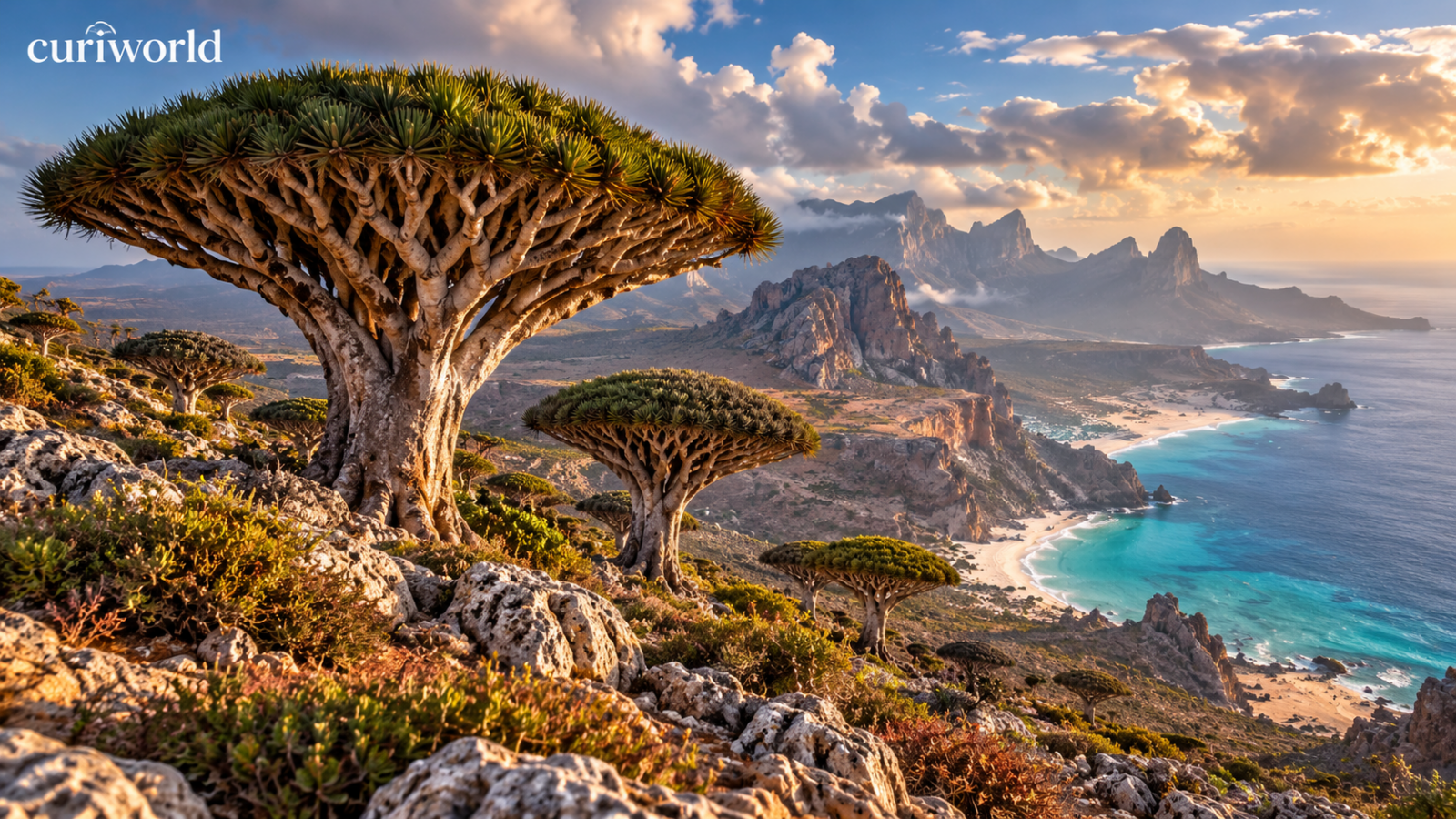
Umbrella-shaped trees rise from bare rock. Thick, swollen trunks seem to grow straight out of a desert. White beaches sit below rugged mountains, while plants with shapes found almost nowhere else cover parts of the landscape.
Socotra looks like the setting of a science-fiction movie, but nothing about it is artificial.
The Yemeni island looks so unusual because geographic isolation, evolution, an arid climate, and ancient geology have been working together for millions of years. The result is one of the most distinctive ecosystems on Earth.
Socotra Is Not Just a Strange-Looking Island
Socotra is the largest island in the Socotra Archipelago, located in the northwest Indian Ocean near the Gulf of Aden.
The archipelago contains four islands and two rocky islets and is internationally recognized for its exceptional biodiversity. According to the UNESCO World Heritage Centre, Socotra has 825 recorded plant species, and 307 of them — about 37% — are found nowhere else.
The numbers become even more striking with animals. UNESCO reports that around 90% of Socotra’s reptile species and 95% of its land snail species are endemic.
That helps explain why the island can feel visually unfamiliar.
Many of the living things in a Socotra photograph genuinely do not naturally occur almost anywhere else.
Curiworld previously included the archipelago among 15 places on Earth that don’t look real — but actually are. Socotra, however, deserves a closer look because its appearance has an unusually deep evolutionary explanation.
Isolation Changed the Course of Evolution
One of the biggest misconceptions about Socotra is that it is simply another remote volcanic island.
It isn’t.
NASA Earth Observatory describes Socotra as a landmass of continental rather than volcanic origin, linked to the geological history of the ancient Gondwana landmass.
Long periods of isolation meant populations on the islands had limited contact with those elsewhere.
Over many generations, species adapted to local conditions independently. Some ancient lineages also survived on Socotra after disappearing or becoming far less common across other regions.
That combination — isolation plus survival in a demanding environment — is central to Socotra’s strange appearance.
The Dragon’s Blood Tree Is Socotra’s Most Famous Alien
The plant most closely associated with the island is the dragon’s blood tree, Dracaena cinnabari.
Its shape is instantly recognizable.
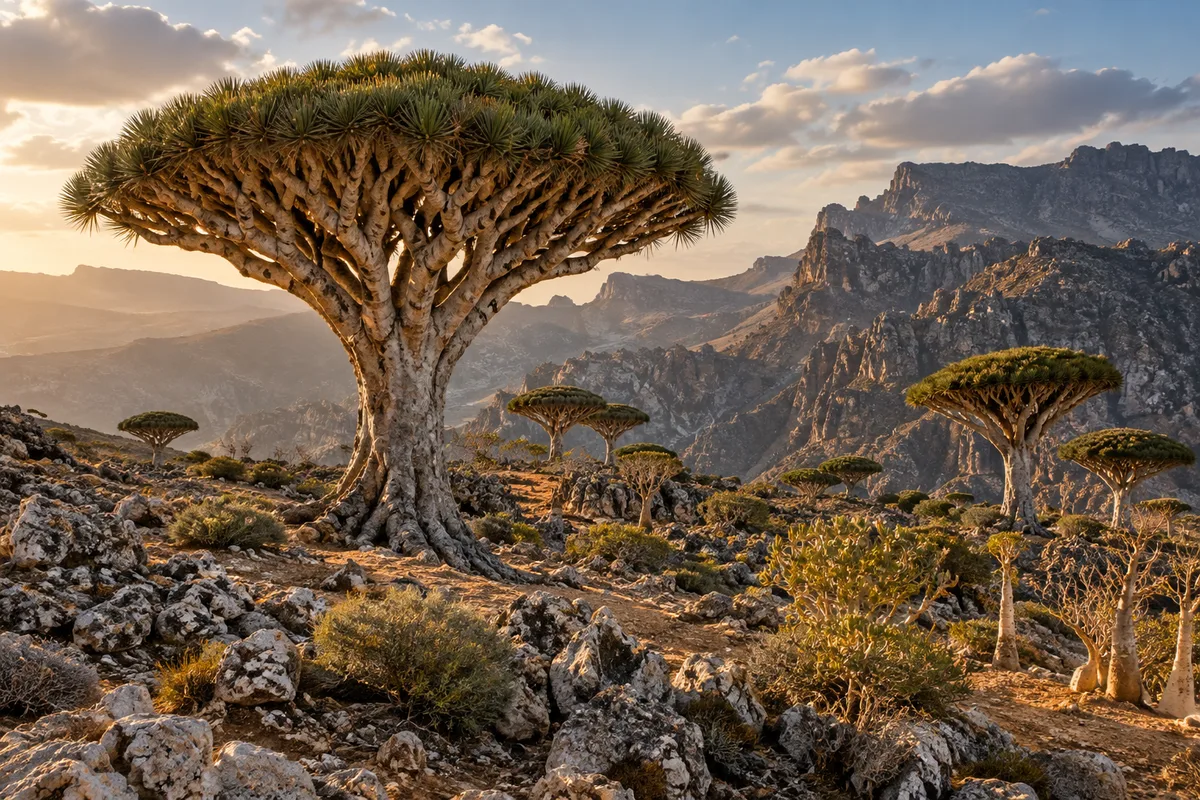
A thick trunk divides into dense branches supporting a broad, flattened crown. From a distance, mature trees can resemble giant umbrellas, mushrooms, or enormous green satellite dishes scattered across rocky hills.
According to Royal Botanic Gardens, Kew, the natural range of Dracaena cinnabari is Socotra, where it grows primarily in desert and dry shrubland environments.
Its dramatic shape is not simply a botanical accident.
A broad, dense crown helps the tree function in a difficult dry environment. Research on Socotra’s dragon’s blood woodlands has also shown that the canopy can influence the conditions beneath it, including shade, temperature, humidity, and moisture availability.
The tree’s famous name comes from the deep red resin it produces.
So although the dragon’s blood tree looks like something invented for another planet, its unusual form makes sense when viewed as an adaptation to life on this one.
Socotra’s Bottle-Shaped Plants Make It Look Even Stranger
Dragon’s blood trees get most of the attention, but they are only part of the visual story.
Socotra is also home to plants with thick, swollen stems and trunks. Some look more like sculptures than conventional trees.
The Socotran desert rose is one of the most striking examples. Its broad, swollen base stores water, allowing it to survive in an environment where moisture can be limited.
The cucumber tree, Dendrosicyos socotranus, creates another unusual silhouette.
This is a recurring pattern in dry environments: plants that must manage scarce water often develop shapes very different from the tall, narrow trees associated with temperate forests.
On Socotra, those adaptations occur alongside one another.
The result can look less like a normal woodland and more like a collection of oversized botanical experiments.
The Landscape Around the Plants Matters Too
Socotra would still look extraordinary without its famous trees.
Satellite imagery from NASA shows an island of strong contrasts: pale coastal terrain, reddish and beige surfaces, green mountain areas, and exceptionally bright sandy beaches.
Much of the island is dry and rocky.
That setting dramatically amplifies the appearance of its unusual plants.
Imagine a dragon’s blood tree surrounded by dense tropical vegetation. It would still look strange.
Now place the same tree alone on an exposed limestone plateau beneath an enormous open sky.
Suddenly, the landscape begins to feel almost extraterrestrial.
Socotra’s visual identity comes from the combination of unusual organisms and the stark terrain surrounding them, not from one species alone.
Why Are So Many Socotra Species Found Nowhere Else?
The scientific term is endemism.
An endemic species has a naturally restricted geographic range. It may occur on one island, one mountain range, one lake, or another relatively limited area.
Islands are especially good places for endemism to develop because populations can remain separated from their relatives elsewhere.
Over enough time, isolation allows evolutionary paths to diverge.
Socotra is an extreme example.
UNESCO considers the archipelago so biologically distinctive that it was added to the World Heritage List in 2008. The organization has also referred to it as the “Galápagos of the Indian Ocean.”
The comparison is useful because both places are famous for isolation and unique species.
But Socotra is not a Middle Eastern version of the Galápagos. Its geology, climate, plants, wildlife, and evolutionary history form their own distinct system.
Socotra Is Not an Untouched Lost World
The “alien island” label can create another misleading impression: that Socotra has remained perfectly preserved and unaffected by modern environmental pressures.
It hasn’t.
In a 2026 World Heritage Committee decision, UNESCO said the archipelago continues to retain the exceptional biodiversity for which it was listed, but warned that important terrestrial and marine ecosystems are deteriorating.
The pressures identified include development, invasive species, pollution, climate change, and unsustainable resource use.
The dragon’s blood tree is itself considered vulnerable.
This makes Socotra more than an unusual landscape worth photographing. It is also a fragile ecosystem whose most recognizable features cannot be assumed to survive unchanged forever.
Can Tourists Visit Socotra?
Socotra often appears on travel wish lists, but its political location cannot be separated from its natural beauty.
The island is part of Yemen.
As of September 2026, the U.S. Department of State’s Yemen Travel Advisory remains Level 4: Do Not Travel.
The advisory specifically says not to travel to Socotra and warns that some companies have misrepresented conditions on the island or offered trips involving unofficial travel documents.
Travel advisories can change, so anyone researching Socotra as a destination should check current government guidance rather than relying on older travel blogs or social media posts.
So Why Does Socotra Look Like Another Planet?
There is no single trick behind Socotra’s appearance.
It is the combination that makes the island extraordinary:
- millions of years of geographic isolation,
- unusually high levels of endemism,
- ancient plant lineages,
- adaptations to a dry climate,
- dragon’s blood trees with huge umbrella-shaped crowns,
- swollen water-storing plants,
- exposed limestone and rocky plateaus,
- bright beaches and rugged mountains.
Nothing on that list is extraterrestrial.
In fact, Socotra is remarkable for exactly the opposite reason.
Every strange tree, swollen trunk, rocky plateau, and isolated species is the product of processes that belong completely to Earth.
Socotra looks like another planet because it reveals a version of our own planet that most people have never seen.
Sources
UNESCO World Heritage Centre — Socotra Archipelago
Biodiversity, endemic species, World Heritage status, and ecological significance:
https://whc.unesco.org/en/list/1263
NASA Earth Observatory — Socotra, Yemen
Geology, continental origin, climate, and landscape:
https://earthobservatory.nasa.gov/IOTD/view.php?eoci=related_image&eocn=related_to&id=9090
Royal Botanic Gardens, Kew — Dracaena cinnabari
Native range, habitat, and conservation information for the dragon’s blood tree:
https://powo.science.kew.org/taxon/urn%3Alsid%3Aipni.org%3Anames%3A534145-1/general-information




Join the discussion