Why Do Hotel Rooms Almost Always Use White Sheets?
Hotels use white sheets because they make cleanliness visible, help reveal stains, simplify linen systems and create the crisp, neutral look guests associate with a freshly prepared room.

Walk into a budget hotel, a business hotel, or a five-star resort and there is a good chance the bed will look familiar:
White sheets.
White pillowcases.
Often a white duvet too.
It may seem like an oddly universal design choice, especially when white fabric shows every stain.
That is partly the point.
Hotels often use white bedding because it creates an immediate visual signal of cleanliness, makes stains easier to notice, works with almost any room design, and creates the crisp, standardized look guests have come to associate with professionally prepared hotel beds.
White is not automatically cleaner than another color.
But it makes cleanliness much easier to communicate.
White Bedding Makes Cleanliness Visible
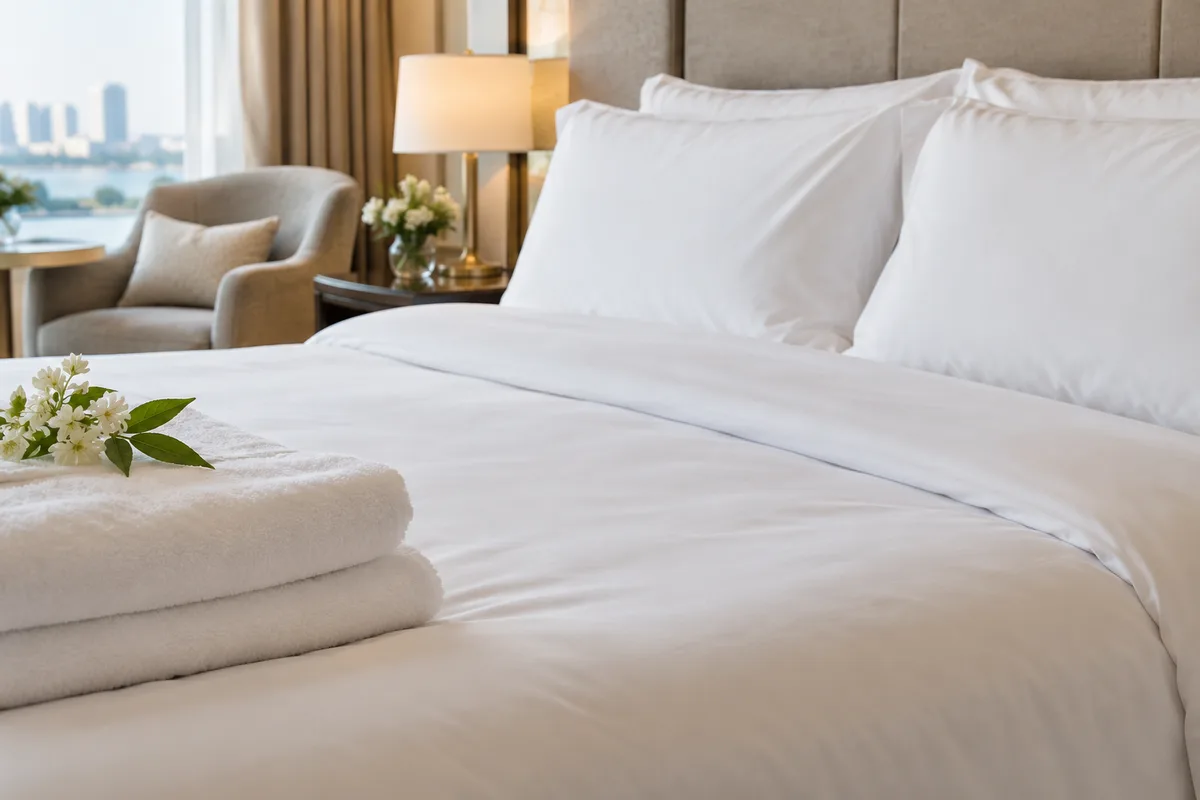
Hotels face a problem that most bedrooms do not.
A guest has to trust a bed they did not see being cleaned.
The room may have been occupied by a complete stranger only a few hours earlier.
That makes visible reassurance important.
Hotel-industry sources have repeatedly noted that guests associate white bedding with cleanliness. Hotel Management, for example, quoted hospitality suppliers saying that both hotels and guests tend to equate white linens with a clean bed.
A dark navy or patterned sheet can look attractive, but it can also hide small marks.
White does the opposite.
Makeup. Food. Blood. Dirt. Body oils.
A stain that might disappear visually into a pattern is much easier to spot against a bright white background.
That is useful to housekeeping before the guest ever enters the room.
White Doesn’t Hide Problems—and Hotels Usually Want That
At home, choosing a darker sheet can be practical because it disguises minor discoloration.
Hotels generally benefit from the opposite approach.
Housekeeping staff need to identify damaged or stained linen before making the bed.
White fabric acts almost like a visual inspection surface.
If something remains after laundering, it is easier to see.
That allows the item to be:
- treated again,
- removed from circulation,
- or replaced.
This is one reason the argument that “white sheets must be impractical because they show stains” misses the hotel perspective.
Showing the stain can be useful.
The guest is not supposed to see it.
Housekeeping is.
White Is Easier to Standardize Across Hundreds of Rooms
Hotels buy and launder linen at a scale very different from a household.
Imagine a property with:
- 200 rooms,
- several beds per room,
- fitted sheets,
- flat sheets,
- pillowcases,
- duvet covers,
- replacement sets,
- and laundry circulating every day.
Using a relatively standardized white linen system simplifies inventory.
A housekeeping department does not need to match a particular patterned pillowcase to a particular room.
A white queen sheet can be replaced with another compatible white queen sheet.
The bed remains visually consistent.
This matters even more across hotel brands that want the guest experience to look familiar from property to property.
Major hospitality companies continue to sell and use white hotel-style sheet sets across multiple brands, including Marriott and Westin, which reflects how strongly white bedding remains associated with the modern hotel aesthetic.
White Gives Laundry More Flexibility
There is a practical laundry advantage too, although it needs an important qualification.
White textiles do not create the same color-transfer concerns as mixed loads of brightly colored bedding, and compatible white linens can often be processed together.
Some white cotton or cotton-blend linens may also tolerate whitening or bleaching products when their care instructions permit it.
That does not mean every hotel pours chlorine bleach onto every sheet.
Fabric composition matters.
Laundry chemistry matters.
Commercial washing systems vary.
And even white fabric can be damaged by the wrong chemical treatment.
The American Cleaning Institute specifically notes that whether bleach is appropriate depends on fiber content and care instructions—not simply on the fact that a textile is white.
So the real advantage is consistency and flexibility, not “white sheets can be bleached endlessly.”
Guests Have Learned to Read White as “Hotel Clean”
There is also a psychological loop at work.
Hotels use white because guests associate it with cleanliness.
Guests associate white with cleanliness partly because hotels have used it for so long.
Over time, the look became a visual language.
Think about the moment you enter a hotel room.
A tightly made bed with bright white sheets creates an immediate impression:
fresh, unused, ordered, ready.
A patterned bedspread can be perfectly clean and still feel less obviously “reset” between guests.
White makes the transition from one guest to the next visually clear.
It is almost like a blank page.
Why Does White Bedding Feel More Luxurious?
Color is only part of it.
Hotels also create the luxury effect through:
- tightly made corners,
- smooth surfaces,
- layered pillows,
- consistent lighting,
- high-quality cotton or cotton blends,
- crisp percale or smooth sateen,
- and careful bed presentation.
White amplifies those details because there is little visual distraction.
Hilton has described crisp white bed linens as a component of a calm, high-quality sleep environment, while Marriott markets white percale and sateen linens around the same “hotel-fresh” experience.
That does not mean white itself is expensive.
It means white provides a neutral background that makes texture, softness, tailoring, and cleanliness more noticeable.
White Works With Almost Any Hotel Room Design
Hotel rooms get renovated. Wall colors change. Headboards change. Artwork changes. Carpets change. Curtains change. White bedding rarely has to.
That makes it a remarkably flexible design choice.
A white bed works with:
- dark wood,
- pale wood,
- minimalist interiors,
- colorful artwork,
- coastal rooms,
- luxury interiors,
- modern business hotels,
- and historic properties.
Hotels can introduce color through cushions, throws, headboards, rugs, or artwork without replacing the entire core bedding inventory.
White therefore acts as a stable design foundation.
Why Not Use Dark Sheets to Hide Stains?
Because hiding stains is usually not the goal.
A hotel wants staff to detect them before the room is released.
There is another issue too.
Dark colors can fade after repeated commercial laundering.
That creates inconsistencies.
One black pillowcase may remain deep black while another becomes charcoal.
A dark sheet can also develop visibly lighter wear around folds and edges.
White can discolor too, but the maintenance problem is different: stains and yellowing are easier to identify and treat as a quality-control issue.
Curiworld has looked at a similar textile problem in why white fabrics can turn yellow over time.
Does White Bedding Mean the Hotel Sheets Are Actually Cleaner?
No. This distinction matters.
Color is not proof of hygiene.
A white sheet can be poorly washed.
A colored sheet can be perfectly clean.
What white does is make certain types of visible contamination and discoloration easier to detect.
Actual cleanliness depends on the hotel’s laundering, handling, storage, housekeeping, and linen-replacement procedures.
So when a guest sees a bright white bed, they are receiving a visual cleanliness signal.
That signal is useful.
It is not laboratory evidence.
Why Do Hotel Pillows Sometimes Still Turn Yellow?
Because white fabric makes long-term textile changes very obvious.
Pillowcases and pillow protectors reduce contact with the pillow underneath, but moisture, skin oils, and other residues can still accumulate through repeated use.
Over time, oxidation can create yellow discoloration.
Curiworld explains that process separately in why pillows can turn yellow even when they are always used with pillowcases.
Hotels therefore do not simply wash bedding indefinitely.
Linens and pillows eventually have to be removed from service when appearance or condition no longer meets the property’s standard.
Why Are Hotel Sheets Usually Plain Instead of Patterned?
Patterns create several complications.
They can:
- date visually more quickly,
- make stains harder to spot,
- complicate matching replacement pieces,
- clash with future room redesigns,
- and create more noticeable differences as colors fade.
Plain white avoids most of those problems.
It also keeps the bed visually calm.
That matters because the bed is usually the largest object in a hotel room.
A bold pattern can dominate the entire space.
White lets the rest of the room do the decorating.
Are All Hotel Sheets White?
No.
Boutique hotels, themed properties, resorts, and luxury brands sometimes use:
- ivory,
- cream,
- pale gray,
- colored borders,
- embroidery,
- decorative top sheets,
- or colored throws.
Some properties also use patterned or colored bedding as part of their identity.
So “hotels always use white sheets” is not literally true.
The more accurate statement is:
White has become the dominant hotel bedding standard because it solves several practical and visual problems at once.
The Real Reason Is Not Just Cleanliness
If hotels used white sheets only because white “looks clean,” the practice would be much less interesting.
White bedding succeeds because several advantages overlap.
It helps staff notice stains.
It gives guests visible reassurance.
It simplifies matching and inventory.
It works with changing room designs.
It supports a crisp luxury aesthetic.
And decades of hotel use have taught travelers to associate a bright white bed with a freshly prepared room.
That is why the color has survived so many interior-design trends.
The furniture changes.
The wallpaper changes.
The technology changes.
The hotel bed is still very often white.
Sources
Hotel Management — Hotel Bedding Trends Promote Wellness and Cleanliness








Join the discussion