Why Are Manhole Covers Round? The Clever Engineering Reason
Why are manhole covers round instead of square? The answer comes down to smart geometry, safety, easier handling, and a design that works no matter how the cover is rotated.
Manhole covers are so ordinary that their shape barely registers. Yet once you notice that so many of them are round, the obvious question appears: why not make them square?
The most important reason is surprisingly clever. A round cover cannot accidentally drop through the smaller circular opening beneath it, no matter how it is rotated. But that is only part of why the design works so well.
A Circle Has No Dangerous “Wrong” Direction
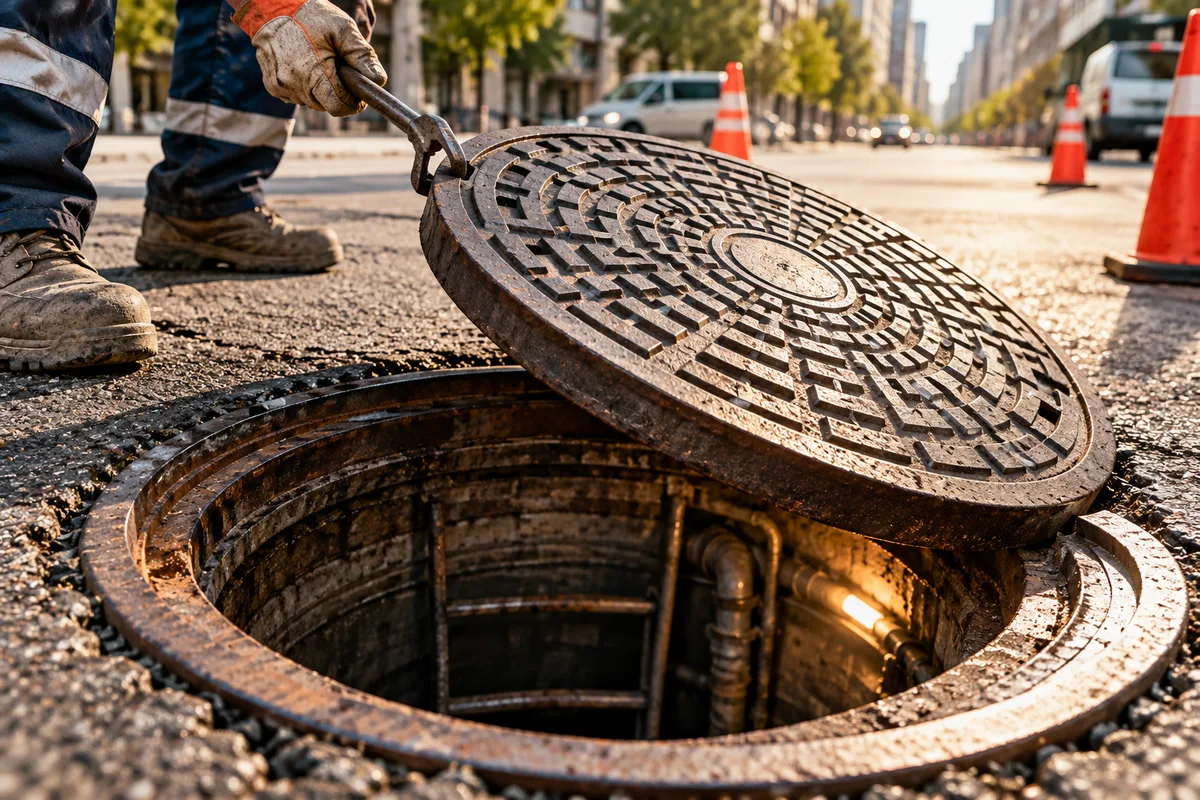
A manhole cover does not simply sit on top of a hole of exactly the same size. It rests on a supporting rim, or seat, so the opening underneath is slightly smaller than the cover.
With a circle, the width is the same in every direction.
Turn the cover 10 degrees, 90 degrees, or 180 degrees and nothing changes. There is no shorter side or corner-to-corner orientation that suddenly allows it to slip through the opening.
A square behaves differently.
The distance across a square from one corner to the opposite corner is longer than the length of one side. That difference creates orientations in which a square cover can potentially be maneuvered through a similarly shaped opening if it is tilted.
The circle avoids that problem.
That matters when the opening may lead to a sewer, utility tunnel, or other underground space where dropping a heavy cover would be dangerous and inconvenient.
The geometry behind this idea is explored in TED-Ed’s lesson on why manhole covers are round.
Round Covers Don’t Need to Be Carefully Aligned
There is another practical advantage that becomes obvious when you imagine replacing the cover.
A square lid has corners.
To put it back into a square frame, those corners need to line up with the frame. Rotate the lid slightly and it may not sit correctly.
A circle has no corners and no preferred orientation.
A worker can rotate a round cover however they want and it still fits the same frame.
For something that may be removed repeatedly for inspections, maintenance, or repairs, eliminating unnecessary alignment makes the design simpler.
It is the same kind of hidden design logic behind other everyday objects. Curiworld has explored how seemingly minor choices can serve practical purposes in why elevators have mirrors.
A Heavy Round Cover Can Be Rolled
Manhole covers are built to survive traffic, weather, and years of use. Many traditional designs use heavy iron or similar durable materials.
A large metal disk is not something most people would want to carry across a street.
A round cover has one useful advantage: it can roll on its edge.
That does not mean workers casually roll every cover wherever they want, and proper lifting equipment and workplace procedures still matter. But from a basic design perspective, a circular object offers an easier way to reposition a heavy lid over a short distance than an equally heavy square plate.
The round shape therefore helps both while the cover is in place and when it needs to be moved.
The Manhole Underneath Is Often Round Too
The cover is only the visible part of a much larger structure.
Many manholes use cylindrical or circular components below street level. Municipal engineering standards include precast manhole risers, cones, frames, and covers that work together as a complete access system.
The Philadelphia Water Department’s sewer standards are a good real-world example: its engineering details separately specify precast manhole structures and gray iron frames and covers.
Once the shaft and frame are circular, a circular lid is the natural match.
This is an important distinction because the cover was not designed in isolation. It is one component of an underground infrastructure system.
Does the Round Shape Help With Traffic Loads?
You will often see claims that manhole covers are round mainly because circles “distribute weight evenly.”
There is some useful intuition behind that idea, but it should not replace the simpler explanation.
A properly designed frame and cover must withstand the loads required for its location regardless of whether it is circular, rectangular, or another approved shape. Material, thickness, reinforcement, frame design, seating, and installation all matter.
So the circle’s most elegant advantage is not simply “circles are stronger.”
It is that the shape combines safe geometry with easy alignment and convenient handling.
That is a much better explanation for why it became so common.
Are All Manhole Covers Round?
No.
Square and rectangular access covers absolutely exist.
They may be used for utility vaults, drainage infrastructure, telecommunications equipment, electrical systems, or locations where the underground structure makes another shape more practical.
Even street infrastructure provides plenty of examples of rectangular grates and access panels.
So “manhole covers are round” is really shorthand for:
Why are circular covers so common for manholes?
The answer is that circles solve several engineering problems at once.
Could Another Shape Work Just as Well?
Mathematically, yes.
A circle is not the only shape with constant width.
A famous example is the Reuleaux triangle, a curved triangular shape whose width remains constant as it rotates. In theory, a properly designed cover using such a shape could share the useful anti-drop property of a circle.
But now another engineering principle enters the picture:
Why make something more complicated when a circle already works?
A circular cover is straightforward to manufacture, fits naturally with round frames, has no orientation problem, and can be rolled.
The exotic geometry is interesting.
The simple geometry wins.
The Best Designs Often Look Obvious Afterward
Manhole covers are a good example of engineering becoming invisible through familiarity.
Nothing about a round metal lid looks particularly sophisticated.
But its shape quietly solves several problems:
- It cannot find a narrower orientation that lets it slip through its circular seat.
- It does not need to be aligned with corners.
- It can be rolled when necessary.
- It works naturally with circular manhole structures.
- It keeps the design simple.
That combination is why the familiar circle has lasted.
Curiworld has looked at a similar phenomenon in why electrical outlets are different around the world: everyday infrastructure often looks arbitrary until you understand the technical decisions and historical systems behind it.
A manhole cover is much the same.
The circle is not there for decoration.
It is a small piece of geometry doing a very practical job.
Sources
TED-Ed — Why Are Manhole Covers Round?
Geometry, constant width, rolling, and alignment:
https://ed.ted.com/lessons/why-are-manhole-covers-round-marc-chamberland
Philadelphia Water Department — Sewer Standard Details and Specifications
Official engineering details for manholes, frames, and covers:
https://water.phila.gov/design/sewer-standard-details/








Join the discussion