Why Do Escalators Have Brushes on the Sides? They’re Not for Cleaning Your Shoes
Those black brushes along escalator steps aren’t for cleaning your shoes. They’re a safety feature designed to help keep feet, clothing, and other objects away from the moving step-to-side gap.
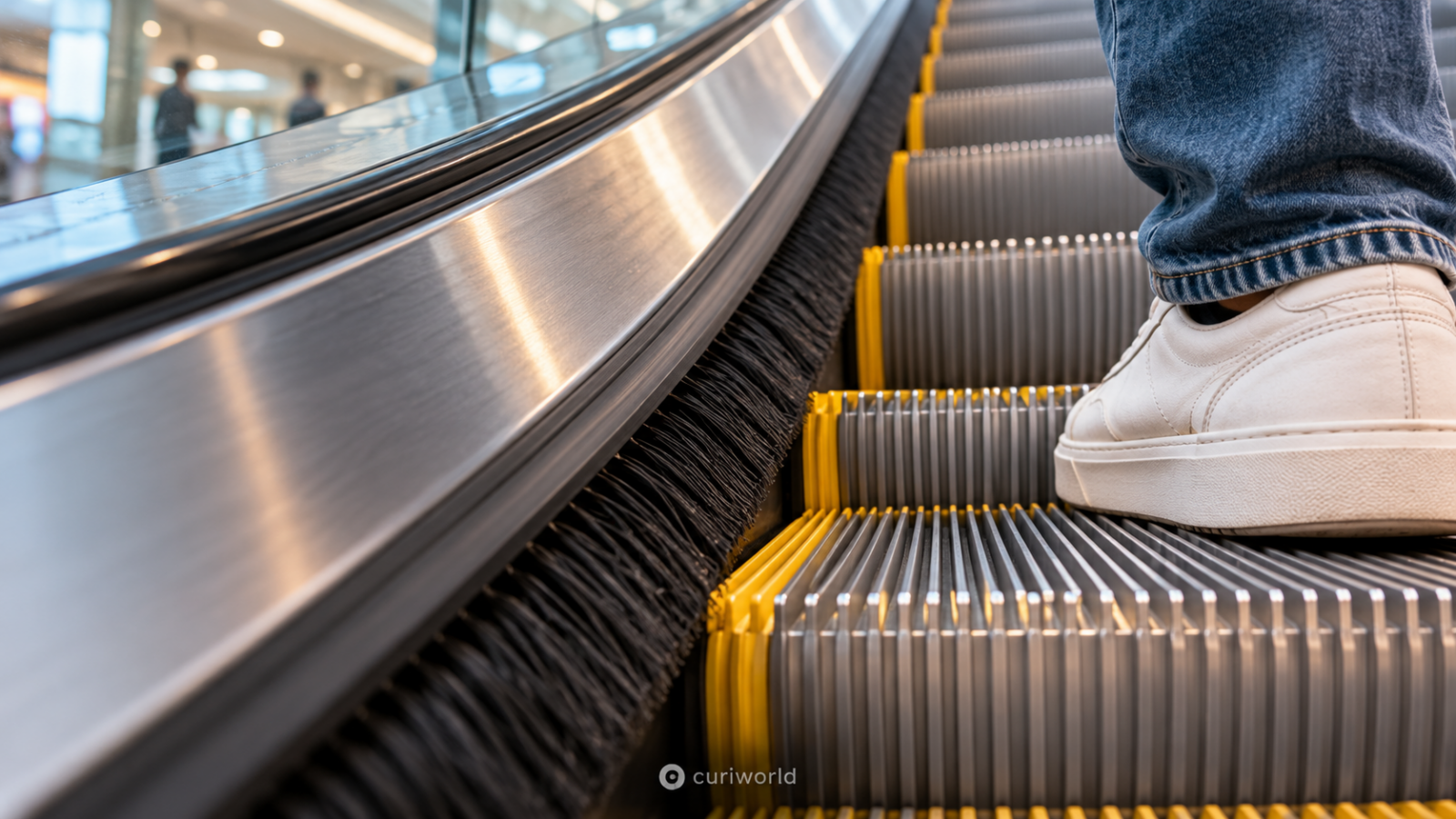
Those stiff black brushes running along the sides of an escalator look perfectly placed for cleaning dust from your shoes.
That is not what they are there for.
They are escalator skirt brushes, also called skirt deflectors, and their real job is safety. The bristles are designed to discourage your feet, shoes, clothing, and other objects from getting too close to the narrow area where the moving steps pass beside the stationary side panel.
In other words, the brush is not inviting your shoe toward the wall.
It is quietly telling you to move away from it.
What Are the Brushes on an Escalator Actually For?
The metal panels beside an escalator’s moving steps are known as skirt panels.
Although the steps move, those panels remain stationary. That creates an interface between two surfaces moving differently relative to each other.
Escalator manufacturers use several design features to reduce the risk of something getting caught in that area. The brushes are one of them.
Schindler describes skirt brushes as deflectors mounted just above the moving steps. Their bristles gently encourage passengers to keep their feet away from the step-to-skirt interface. Otis describes the same basic function: safety brushes guide passengers away from the skirt panels.
So the bristles are not supposed to scrub anything.
They act as a physical and tactile warning.
If the side of your shoe begins touching the brush, you can feel it before your foot gets closer to the panel.
Why Is the Side of an Escalator a Risk Area?
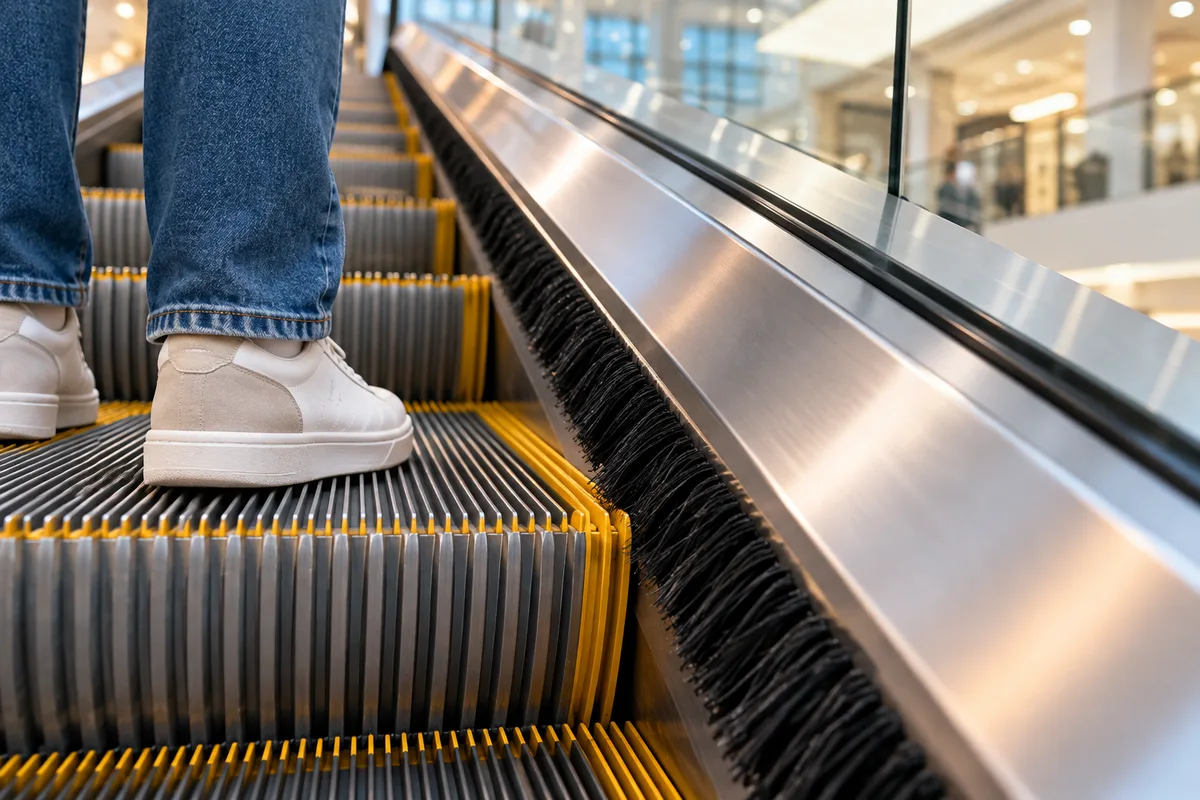
An escalator may look like a staircase, but mechanically it is a continuous moving system.
Each step travels past stationary components, including the skirt panels along the sides.
The gap between these surfaces is designed to be small, but shoes or other objects pushed firmly toward the edge can still create an entrapment risk.
The U.S. Consumer Product Safety Commission has specifically advised riders to avoid the sides of escalator steps. In its escalator safety guidance, the agency notes that hands, feet, and shoes can become trapped and recommends standing near the center of the step.
Soft, flexible footwear can deserve particular attention because it may deform more easily than a rigid shoe.
The skirt brush adds another layer of protection by making the edge less inviting to stand against.
The Brushes Actually Change Where People Stand
There is an interesting piece of research behind the design.
A study summarized by the U.S. Consumer Product Safety Commission examined how people positioned their feet before and after brush-type deflectors were installed on escalators.
Researchers analyzed 6,295 observations.
After the brushes were fitted, passengers consistently positioned the foot nearest the side farther away from the skirt panel. The average increase was roughly 2 centimeters.
That sounds tiny.
On an escalator, however, those extra centimeters are exactly the point.
The brush does not need to push someone dramatically across the step. It only needs to make contact with the edge of a shoe uncomfortable or noticeable enough that the rider naturally shifts inward.
That makes the design a good example of passive safety engineering: instead of requiring a passenger to understand the machinery, the escalator itself encourages safer behavior.
Why Use a Brush Instead of a Solid Barrier?
A rigid wall sticking out beside every escalator step would create problems of its own.
Brushes have a useful combination of properties.
They project far enough from the skirt panel to provide an early tactile cue, but they remain flexible when touched. A rider can feel the bristles without encountering a hard protruding object beside a moving staircase.
The continuous brush also follows the escalator along the incline rather than creating isolated obstacles.
Actual designs vary between manufacturers and installations, but the underlying idea is similar: create a buffer that encourages people to maintain some separation from the side.
This kind of design is easy to overlook because it works without requiring much thought from the passenger.
Curiworld has explored another surprisingly purposeful feature in why elevators have mirrors. Like escalator brushes, something that looks decorative or incidental can have practical reasons behind it.
So Should You Rub Your Shoes Against the Brushes?
No.
They may look like shoe-cleaning brushes, but deliberately pressing your shoes into them defeats their purpose.
The brushes are supposed to encourage your feet away from the side, not provide a surface to lean against.
A better position is toward the center of the step, with your feet clear of the edges.
The CPSC also recommends facing forward, holding the handrail, making sure shoelaces are tied, supervising children closely, and stepping off promptly when you reach the landing.
Treating the brushes like free shoe polish is therefore almost the exact opposite of what their designers intended.
It belongs in the same category as many everyday objects whose real purpose is easy to misread—something Curiworld also explores in 10 everyday things you’re probably using wrong.
Do All Escalators Have Side Brushes?
No.
You can still encounter escalators without them.
The design, age, location, modernization history, and applicable safety requirements can all affect what equipment is installed.
Schindler notes that skirt brushes may be mandatory in some jurisdictions, but requirements are not identical everywhere. Older escalators may also receive brushes as part of a safety modernization.
Other features work alongside them.
Modern escalators can include low-friction skirt panels, sensors, emergency stop systems, yellow step markings, combplate safety devices, and other safeguards.
That is another reason not to think of the brush as a protective shield.
It is one part of a larger safety system.
What Are the Yellow Lines and Grooves on Escalator Steps For?
The brushes are not the only subtle visual cue built into an escalator.
Many escalators use yellow markings to make step edges and boundaries easier to see. At the entrance and exit, comb-shaped components mark the transition between the moving steps and stationary landing.
The grooves in escalator steps also interact with those combs as the steps disappear beneath the landing.
These features serve different purposes, but they share a design philosophy: make important boundaries noticeable before a passenger has to think about the machinery underneath.
The safest escalator is one that does not require riders to understand its engineering just to use it normally.
The Brush Is Supposed to Be Annoying
That slight scratchy feeling against your shoe is not a design flaw.
It is the message.
The bristles create a gentle warning before your foot gets too close to a more hazardous area. You feel the brush, instinctively move inward, and continue riding without giving the mechanism another thought.
That is why such a simple strip of bristles can be surprisingly effective.
So the next time you see those black brushes running along an escalator, resist the temptation to polish your shoes on them.
They are not there to clean your footwear.
They are there to remind your feet where not to be.








Join the discussion