Why Do Elevators Have Mirrors? It’s Not Just for Checking Your Hair
Elevator mirrors are not just for checking your appearance. They can change how a small cabin feels, redirect attention and provide valuable visibility for wheelchair users.
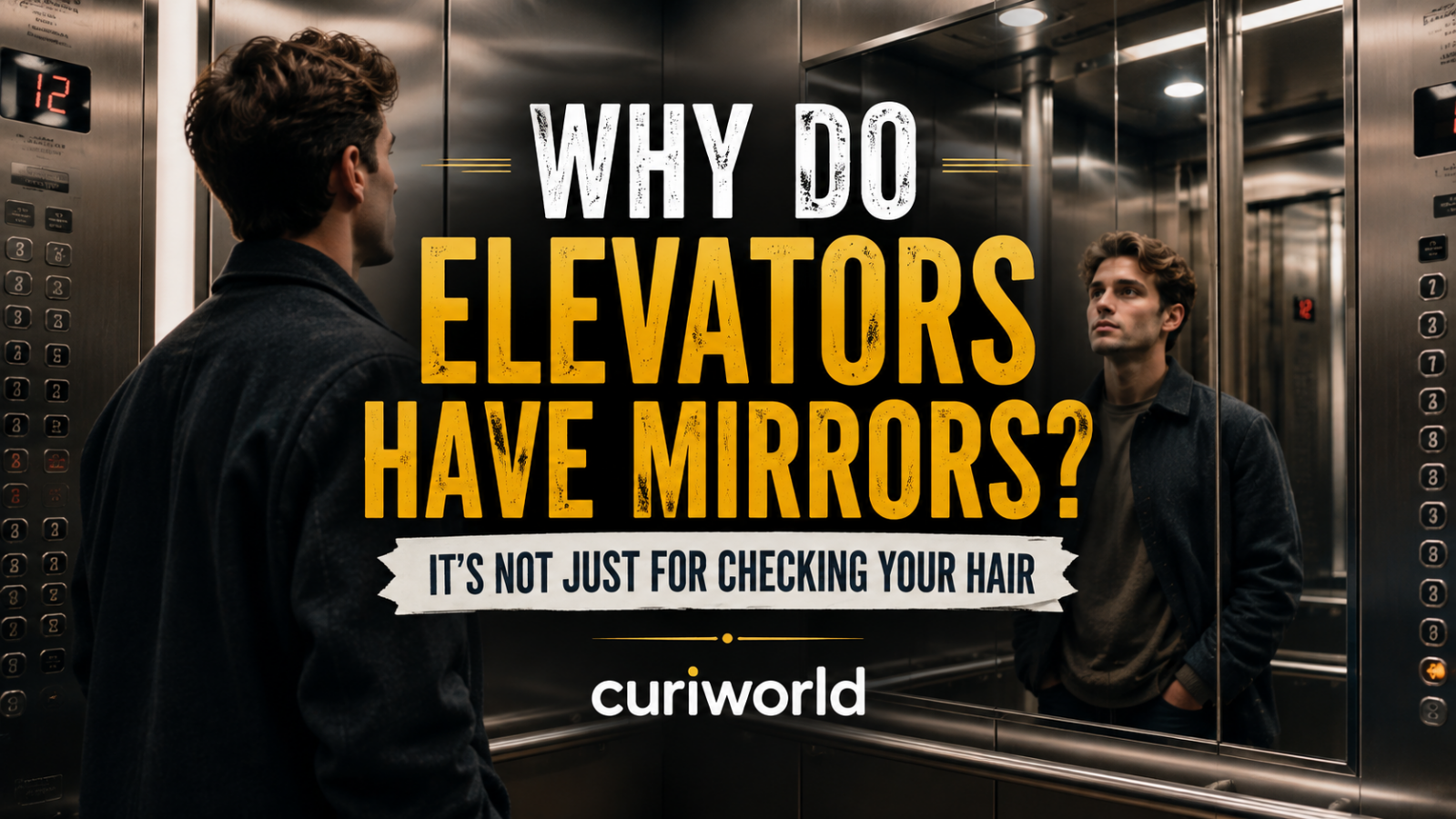
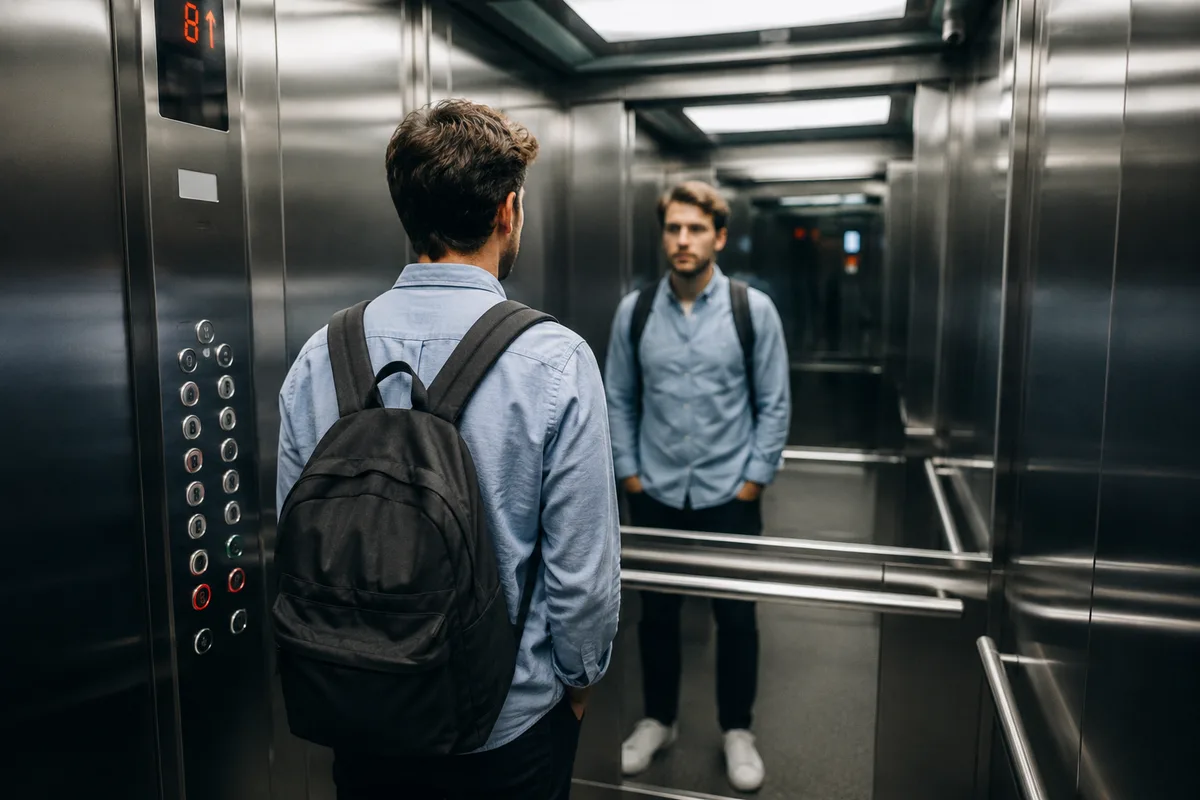
Step into an elevator alone and there is a good chance you will look at the mirror almost immediately.
Maybe you check your hair. Maybe you straighten your jacket. Maybe you avoid making eye contact with the stranger standing two feet away.
It is easy to assume that elevator mirrors are simply there for appearance or decoration.
They are not.
Mirrors can make an elevator ride feel less empty, provide useful visual information inside a confined space, and help some wheelchair users see behind them when backing out of a car that is too small to turn around in comfortably. They may even change how long the ride feels.
That makes the ordinary elevator mirror a surprisingly clever piece of human-centered design.
A Mirror Gives Your Brain Something to Do
Elevator rides are usually short.
Yet a short period of doing absolutely nothing can feel strangely long.
There is an important difference between actual time and perceived time. A clock may measure two identical 30-second periods, but they do not necessarily feel equally long.
Attention matters.
If you are focused entirely on waiting, you notice the waiting.
If your attention is occupied by something else, the same period may feel shorter.
Research into human-elevator interaction has examined this distinction between actual waiting time and the way passengers experience that wait. Mirrors are one example of a design feature that can redirect attention inside the cabin.
The mirror does not make the elevator motor move faster.
It changes what you do while the elevator is moving.
You look at yourself.
You notice the other passengers.
You check whether your shirt is sitting strangely.
You watch the floor indicator in the reflection.
You shift your attention away from the simple fact that you are standing inside a box waiting to arrive somewhere.
That small change can matter.
Curiworld has explored a related question in Why Does Time Feel Faster as We Get Older?, which looks at why our experience of time can change even though clocks themselves do not.
Mirrors Can Make a Tiny Cabin Feel Less Closed In
An elevator car is a peculiar environment.
It is enclosed.
The doors close completely.
There may be no windows.
Several strangers can be standing unusually close together.
And unlike an ordinary small room, the entire space is moving.
A mirror cannot physically increase the dimensions of the cabin, but visually it creates a reflected continuation of the space.
Instead of seeing a solid wall directly in front of you, you see an apparent space extending beyond the surface.
Your brain knows that the reflected elevator is not another real room. Even so, mirrors can make a compact interior appear visually deeper and more open.
This is one reason mirrors are commonly used in small rooms, corridors, stores and other restricted spaces.
The effect should not be exaggerated.
An elevator mirror is not a treatment for claustrophobia, and someone who has a strong fear of elevators may still find the experience uncomfortable.
But replacing a blank wall with a reflection can make the cabin feel less visually closed.
The Accessibility Reason Is More Practical Than Psychological
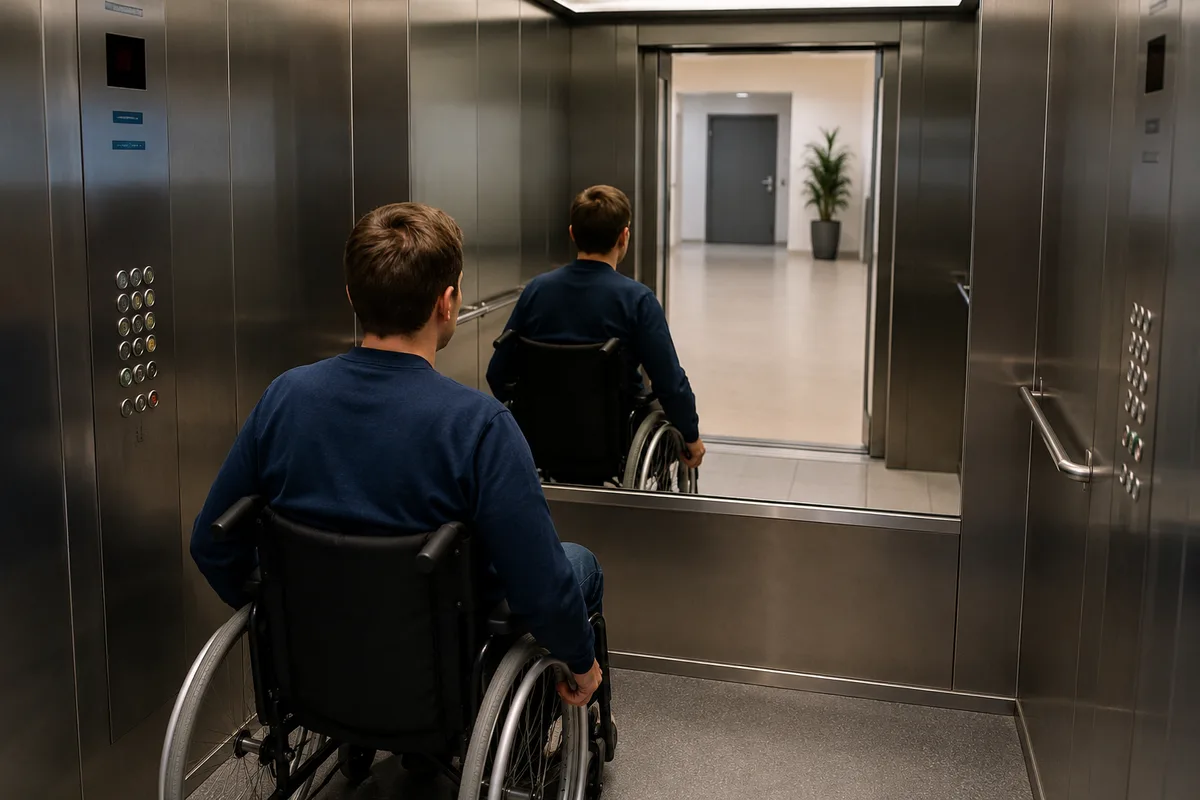
One of the most useful reasons for putting a mirror on the rear wall of an elevator has nothing to do with boredom or appearance.
It is about seeing behind you.
Imagine entering a relatively small elevator in a wheelchair.
You roll into the car facing forward.
The doors close behind you.
When you reach your floor, there may not be enough room to turn the wheelchair completely around.
That can mean reversing toward the open doorway.
Without a mirror, seeing exactly what is behind the chair can be difficult.
A rear-wall mirror changes that.
By looking at the reflection, a wheelchair user may be able to see the doorway, the landing outside the elevator and possible obstacles while reversing.
This is not simply an explanation invented for internet trivia.
Accessibility guidance can specifically recommend mirrors on the back wall of elevator cars to improve visibility for people who may need to reverse out of the cabin.
For example, Accessibility Standards Canada includes guidance concerning mirrors within accessible elevator design.
The exact legal requirements vary between countries, building standards and elevator designs, so it would be misleading to claim that every elevator everywhere must have a mirror.
But the accessibility benefit itself is very real.
In some elevators, the mirror effectively works like a rear-view system.
Mirrors Let You See More Without Turning Around
Elevators create an unusual social situation.
People who would normally stand several feet apart may suddenly be packed into a tiny cabin.
Where do you look?
Direct eye contact with a stranger can feel too intense.
Staring at the floor can feel awkward.
Looking at the doors for ten floors becomes boring.
The mirror provides another option.
It expands your field of visual awareness without requiring you to turn your entire body.
You can see who has entered.
You can notice movement behind you.
You can understand where other passengers are standing.
Other passengers can do the same.
That does not mean mirrors magically make elevators safe or prevent crime. Claims that mirrors were specifically installed to stop theft or harassment should be treated cautiously unless a particular building or design decision is documented.
What mirrors clearly do provide is additional visual information.
Humans are highly sensitive to faces, gaze and movement around them. Curiworld explores that broader social-awareness mechanism in Why Do We Feel Like Someone Is Watching Us?.
Inside an elevator, a mirror makes more of the cabin visible at a glance.
So Were Mirrors Added Because Elevators Were Too Slow?
This is probably the most famous elevator-mirror story online.
It usually goes something like this:
People in a tall building complained that the elevators were painfully slow.
Engineers investigated but found that replacing or significantly speeding up the elevators would be expensive.
Someone suggested installing mirrors instead.
Passengers became occupied with their reflections, perceived the wait differently, and complaints dropped.
It is a brilliant story because it captures an important principle of design:
Sometimes changing how people experience a problem can matter almost as much as changing the problem itself.
But the neat historical origin story deserves caution.
Versions of the story are repeated across business books, design articles and websites, often without a clear primary historical source identifying one specific building where the worldwide practice supposedly began.
The psychological principle is plausible and relevant.
The claim that one famous slow-elevator incident is definitively responsible for mirrors becoming standard worldwide is much harder to establish.
These are two different claims.
Mirrors may help redirect attention during an elevator journey: plausible and supported by research into perceived waiting experiences.
Every elevator mirror exists because one building solved a slow-elevator complaint with mirrors: much less certain.
Interesting design does not always come with a perfectly documented origin story.
Why Not Just Put Screens in Elevators Instead?
Many modern elevators do.
Screens can show:
- Building directories
- Advertisements
- News
- Weather information
- Floor numbers
- Events
- Safety information
These displays can also occupy passengers’ attention.
But mirrors provide something screens cannot.
A mirror requires no software.
It never needs a firmware update.
It does not become technologically obsolete after five years.
It takes almost no additional usable cabin space.
Most importantly, it reflects the actual elevator environment.
A screen can entertain you.
A mirror can show you the person standing behind you, the opening door and the space you are about to reverse into.
That makes mirrors unusually efficient pieces of elevator design.
Why Aren’t All Elevator Walls Mirrors?
Because reflection can become excessive.
A single large mirror can make an elevator feel more open.
Mirrors on every surface can make the space visually confusing.
Multiple reflections may make boundaries harder to interpret, especially in a very small cabin.
Maintenance is another issue.
Elevator mirrors are exposed to:
- Fingerprints
- Scratches
- Cleaning chemicals
- Bags and luggage
- High passenger traffic
- Accidental impacts
Designers therefore have several options.
Some elevators use one large mirror on the rear wall.
Others use partial mirrored panels.
Luxury elevators may use extensive reflective surfaces as part of the interior aesthetic.
Other cabins use polished metal instead.
And some elevators have no mirrors at all.
The goal is not to turn the cabin into a hall of mirrors.
It is to gain the useful effects of reflection without making the space confusing.
And Yes, Checking Your Hair Is Part of It
People really do use elevator mirrors to check their appearance.
That behavior is not irrelevant.
It may actually help explain why mirrors are so effective at occupying attention.
You have a few seconds with nothing urgent to do and a large reflection directly in front of you.
Naturally, you look.
Maybe you adjust your hair.
Straighten your clothes.
Check your face.
Or simply watch yourself standing there.
But underneath that ordinary habit is a much more interesting piece of design.
An elevator mirror can occupy attention.
It can visually expand a small cabin.
It can increase awareness of the people and movement around you.
And in the right elevator layout, it can provide genuinely useful visibility for a wheelchair user reversing toward the door.
So the next time you automatically check your reflection between floors, remember:
The mirror is not only showing you what you look like. It is quietly changing the way you experience — and sometimes navigate — the elevator itself.
Sources
Human-Elevator Interaction Research — Waiting Time and Passenger Experience
View the research on PubMed Central
Accessibility Standards Canada — Accessible Built Environment Standards
View Accessibility Standards Canada








Join the discussion